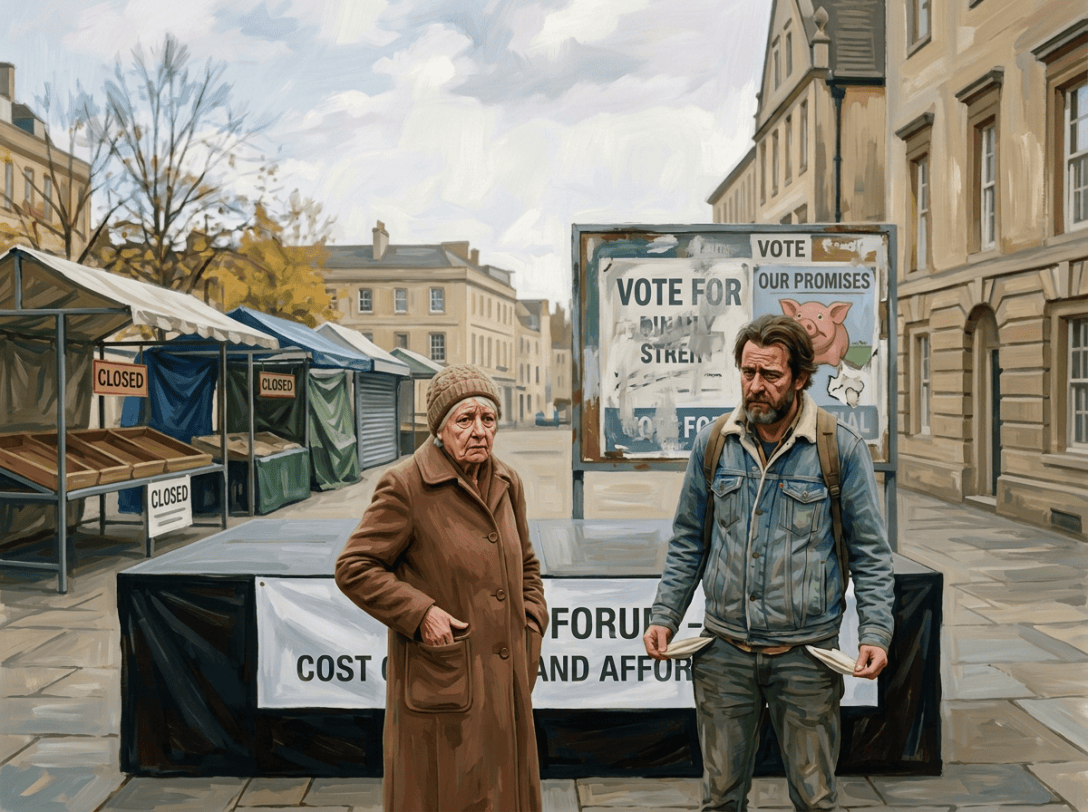
While politicians failing to deliver on their promises isn’t surprising, I cannot remember another cycle when there wasn’t so much as an attempt to propose anything that would actually address voters’ concerns either before or after the election.
After last week’s historic Democrat victory in the midterm elections, affordability is all the rage as survey after survey revealed the public’s frustration with the economy in general and prices in particular. According to NBC, for example, the economy topped all concerns with 74% saying it was either “poor” or “not so good” while only 2% rated it excellent. When asked about prices, a truly incredible 89% said the cost of living was a “crucial or major” factor in their choice, 88% said they were “very or somewhat concerned” about the cost of groceries, 87% about gas and diesel, and 86% about utilities. While the Democrats ran on it and the Republicans lost on it, politicians in both parties are now claiming they heard the public loud and clear, and moving forward they will focus as exclusively as possible on these concerns. The only problem is: Not one of them, either Democrat or Republican, actually has anything resembling a plan or even the slightest inkling of an idea.
For their part, Democrats have been talking about prices since before the election – “What we’re going to do is lower costs,” explained Senator Chuck Schumer, likely to be the new majority leader, and “The cost of living is way too high,” echoed Representative Hakeem Jeffries, likely to be the next Speaker of the House – but they didn’t run on any platform whatsoever to do so and are not currently advancing any legislation that would do so. Instead, the majority of their efforts after obtaining their largest majority in at least two decades have been devoted to targeting key members of the Trump Administration and planning multiple investigations. In this regard, Secretary of War Pete Hegseth appears to be their main target, for now. After ousted Republican Representative Thomas Massie made a last ditch effort to file articles of impeachment against him this week, Senator Schumer himself remarked “The Senate needs to put Pete Hegseth on trial so we can remove him for his catastrophic failure in Iran” and Representative Ro Khanna, largely expected to run for President, posted on X “Impeach Hegseth. End the war.” Representative Jason Crow, appearing on Fox News even went so far as to explain the effort is “not really about impeachment” but forcing a “a course change,” noting that impeachment was just a “tool” and the entire situation could be avoided if President Donald Trump would only fire his Secretary.
Secretary Hegseth, however, is certainly not alone. Representative Robert Garcia of California claimed he will focus on “Trump family corruption,” and according to NBC News at least, that means a wide net, “how Trump’s fortune has grown by billions of dollars since his 2024 campaign, as well as Jeffrey Epstein’s crimes and Trump’s immigration crackdown.” Democrats on the Judiciary Committee claim to have a long list as well, including pardons for “wealthy criminals and MAGA loyalists” and foreign governments “buying influence.” Meanwhile, Senator Elizabeth Warren, the incoming chair of the Senate Banking Committee is targeting the private sector. She issued a letter to top executives on Wall Street and other major corporations including tech companies, demanding they “preserve their documents and prepare to answer tough questions” starting in January, presumably at a series of highly publicized hearings. At the same time, perhaps no one was blunter than Senator Ed Markey, who posted on X, “They are going to need to plant new forests for all of the subpoenas we’ll be printing.” What they are not printing are bills that would improve the cost of living as they promised. In fact, for the most part, they aren’t even talking about it anymore.
For their part, Republicans are convinced they heard voters’ concerns after getting routed. Senator John Thune, selected yesterday as Minority Leader for the next session despite the Republican drubbing, told reporters, “Obviously, the election result was not what we hoped for, but I think it’s important that we take the lessons from that and internalize the message the American people were sending to us and focus on the things that really matter to them, and we intend to do that.” Later that same day, he appeared on Fox News’ Special Report with Brett Baier and reiterated the sentiment, but in neither case has he nor any other Republican explained what that actually means beyond the rhetoric. When asked about the Republican agenda before Democrats take power next year, affordability wasn’t even on the list. Instead, they plan to confirm as many judges as possible and hope to pass a government funding bill that includes defense policy legislation via reconciliation. From what I can tell, the goal next year is not to propose legislation on their own as a counterpoint to Democrat policies, merely to use the filibuster – assuming it still exists – to block any Democrat legislation, or at least Senator Thune noted several times that when Republicans are in the minority, they will be happy they didn’t nuke the 60-vote threshold.
While politicians failing to deliver on their promises, substituting rhetoric for reality, is not surprising in some ways, I cannot remember another cycle when there wasn’t so much as an attempt to propose anything that would actually address voters’ concerns, even something that had either no chance of passing or working in the real world. At the same time, perhaps this shouldn’t be surprising. While no one wants to say it out loud, the reality is that affordability as it’s being bandied about by politicians and the public isn’t a real thing. There is no agreed upon definition, much less a measurable economic metric. It is instead a perception which conflates a combination of real metrics – namely, inflation and income – with an individual’s personal feeling about what things should cost and their financial position. This is not to suggest voters aren’t rightfully concerned with how prices have risen since the pandemic or those concerns aren’t valid, merely that people in general have always believed things cost too much for their tastes and even if inflation were to suddenly stop, plummet to zero overnight, they’d maintain that same belief because prices would remain elevated anyway, that’s how inflation works. Putting this another way, no one has ever thought prices were too low and prices have always risen. Indeed, that’s what prices do and have done since long before any of us was born. When my mom came back from the grocery store in the 1980s, she wasn’t waxing eloquent about how cheap everything was. Instead, she complained that everything was more expensive than it had ever been. When we went to the movies in the 1990s and tickets hit what-seems-quaint $5.50, she noted how it used to be less than $1 for a double feature back in her day.
To a large extent, this is simply human nature – we remember how things were when we were young, we find much of the present worse in comparison, and there’s little, if anything a politician can do about it even if they truly wanted to. While Democrats and their progressive allies might insist that ending the War in Iran and removing the tariffs will reduce prices, it’s far from clear that’s the case. The tariffs are much maligned, and yet they have had only a negligible impact on inflation. After the latest round was enacted in the middle of 2025, inflation hovered between 2.5% and 2.6% hitting a peak of 2.9% in February 2026. Overall, economists at the St. Louis Federal Reserve estimated they increased inflation by about .5% using the full PCE measure and about .6% using the core measure, though even this is somewhat deceiving. For example, they found the highest price impacts in pharmaceutical and medical products, increasing prices some 4.2%, but a study earlier this year found that pharmaceuticals had the largest price decrease since 1968, falling 3.1% between August 2025 and 2026, with .8% in July alone. Elsewhere, the Federal Reserve claimed prices would have declined by about 1% without the tariffs, measurable, but certainly not much considering voter outrage, or at least it seems unlikely to me that saving a penny on every dollar would have made a difference. Even if you assume these figures are accurate and to be certain, I have some doubts, the impact was barely noticeable to most and a wholesale repeal that results in prices declining by 1% is not going to be near the sort of meaningful price reductions voters seem to be demanding.
If anything, the Iran war had a larger, more measurable impact on inflation compared to tariffs by causing a spike in oil prices, sending costs from under $70 per barrel to over $100 and inflation in general to rise from 2.4% in February to 4.0% now. This has created a ripple effect throughout the fossil fuel industry, where home heating oil prices have shot up 128% between January and September, and natural gas prices some 77%. Fertilizer prices have also driven up food prices by about 1.1%. In that sense, “ending” the war might reduce prices across some goods, particularly fossil fuels, enough for consumers to notice, but there are two problems with that. First, oil prices have already dropped substantially since the election, down over 10% in a week, which economists expect will ease inflation as soon as next month, meaning politicians might not have to do a thing whatever they claim. Second, and most importantly, it’s not simply a matter of ending the war. It’s ending the war with the Strait of Hormuz fully open, which it’s not clear Iran has plans to agree to anytime soon. As we all know, President Trump failed to secure not one, but two deals that were said to make that happen specifically because Iran kept firing on ships, even though many claimed the deals made them the victor of the war. When you consider that Iran had previously relied on its proxies to hit ships in the Red Sea and other places for years, it seems unlikely that Democrats in Congress are capable of preventing any and all future attacks, once again whatever they claim. In other words, blaming President Trump is not an unreasonable position, but expecting Democrats to magically unwind the situation is.
Further, traditional Democrat policy prescriptions including higher taxes, increased regulation, and more subsidies are perhaps even less likely to have an impact, or at least an impact that doesn’t move prices in the wrong direction because the first two make the economy less efficient and generally increase prices. While the third sounds appealing in principle, all it does is move the money from one person to another with the government in the middle. Obamacare is a classic example. Democrats promised savings of $2,500 on health insurance premiums per family, but the combination of mandates and massive subsidies has produced the exact opposite for the past sixteen years. Instead of anything resembling this kind of savings or even remaining steady, healthcare costs exploded ever since, rising 60% in the first four years alone, an increase of $2,524 for a an individual between 31 and 40 years of age and a whopping $12,040 for a family headed by someone over 60, far outpacing inflation. In some cases, costs almost doubled between 2010 and today with family coverage rising from $13,871 to nearly $27,000, nor have only those plans listed on the exchanges been impacted. Those with employer provided plans are also paying more with average contributions almost doubling as well, rising from $3,721 in 2010 to $6,850 today. Employees also pay a larger average share than they did before the ACA was passed, meaning it is costing everyone far more than promised. In fact, the situation was so untenable that President Joe Biden was forced to provide massively increased subsidies on a temporary basis, more than doubling the number of people receiving the benefit, and yet costs only continued to go up. This should not be surprising: If you subsidize and regulate something with a limited supply, you will only increase demand, and increased demand combined with more onerous regulations will necessarily increase prices.
Lest you think I am picking on Democrats, the traditional Republican policy approaches – lower taxes, less regulation, and increased energy production – are not likely to lower prices either, save on some commodities. Lower taxes might well put a little more money in your pocket, but seeing as how Republicans did exactly that with the Big Beautiful Bill, voters aren’t likely to accept that as an optimal remedy either. Ultimately, the real irony is that there is no remedy short of an economic catastrophe worse than inflation. While no one seems to want to come out and tell the public the truth – including President Trump himself who promised lower prices during the 2024 campaign, much to his own detriment – falling prices can be much, much worse than rising ones. The problem is that prices do not fall on their own. Though it’s common to see memes on social media about what $180 could buy you at the grocery store in 1980 or something similar, all of them fail to mention that wages have risen over the same period, though for certain items not nearly as fast as inflation. Deflation ushers in the opposite scenario: The cost of goods falls, but so does the cost of labor, meaning you get paid less for your work, creating a spiral that drives prices and wages down even further. In addition, private and corporate debt remains the same, making it far harder to pay off. Perhaps needless to say, the politicians and the experts know this. They are simply pretending otherwise, talking a good game to make it seem as though they’re voters’ concerns when they are incapable of it. The sooner someone comes out and tells the truth, the better it will be for us all.


