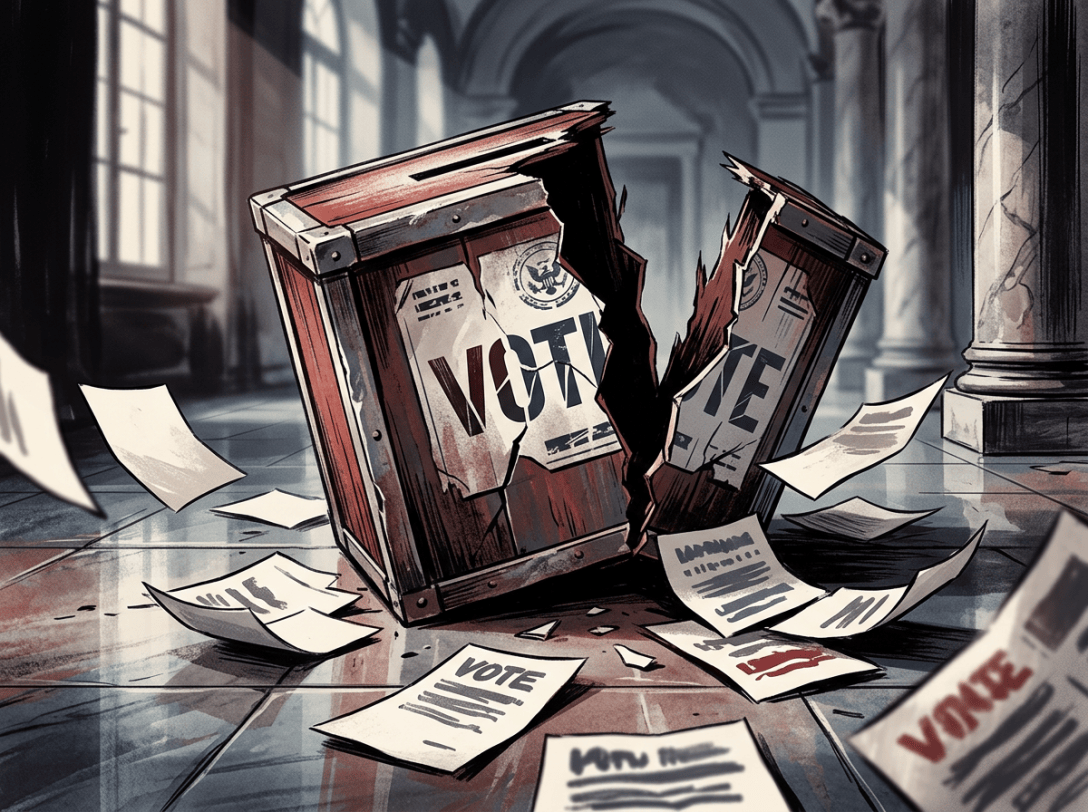
You can vote to punish the President if you want, but be careful you don’t end up punishing yourself as well.
For obvious reasons, Democrats and their enablers in the mainstream media are desperate to frame the midterm elections, just two weeks from today, as a referendum on President Donald Trump’s time in office to date. In this view, voters are essentially providing a thumbs up or a thumbs down on the President, casting their ballot for a Republican or a Democrat respectively to express their opinion. Thus, they frequently use language such as “holding President Trump accountable” or even “punishing” him for his perceived sins and broken campaign promises. Chief among these sins and broken promises is the failure to lower gas and grocery prices, and for beginning what they claim is a new war in Iran. To be certain, there is some truth to this: President Trump did make specific promises about lower costs, including $2 gasoline, and he claimed at various times that costs would come down almost as soon as he was re-inaugurated. While his supporters can point out that the inflation rate is lower than it was at the peak of the Biden era or that gas prices have been variously higher at times under Democratic Presidents – and there would be some truth to that as well – the specific promises were clearly not met. Prices have risen and in many ways, the increase has been a result of the President’s decision to break his other pledge on no new wars. Once again, supporters such as myself can argue that the war in Iran isn’t new and the President is really addressing an old threat, which once dealt with will make the world more peaceful and prosperous, or that he has already taken steps to do so, but at the same time, he and he alone made the decision to turn a slow-simmering conflict into a hot war, and the notion this broke his promise isn’t much of a stretch.
In other words, if you subscribe to this view as the President’s detractors hope you will, the only rational choice is to vote Democrat by default. While there’s admittedly a sort of simplistic appeal to this framing, you do not cast a vote by crossing out a candidate’s name or providing a rating of some kind. Instead, you select the candidate you prefer, meaning you are voting for somebody even more so than against someone else and whoever you choose is necessarily a part of the decision, meaning what that politician will do or not do should they prevail is a relevant question, one which simply cannot be dismissed. Putting this another way, it’s a choice, not a grade. Therefore, any voter who’s concerned about gas prices, the war in Iran, or anything else should not stop simply with their opinion on President Trump. They should also be asking what the Democrat politician in question they are being encouraged to vote for will do to help alleviate their concerns. If they are not pleased with how the President has handled these issues, is the politician they might or might not support to express their displeasure going to do any better or is there a possibility they will actually make things worse? If they aren’t going to make things better, what sense does it make to punish President Trump by ultimately punishing yourself? While we cannot predict the future and answer that question with any certainty, we can consider the Democrats track record on the issue of gas and other prices, as well as the feasibility of they’re being able to somehow end the war in Iran — and revert to the previous status quo on the Strait of Hormuz in the process – to at least make an attempt. We can also consider whether they have put forward any policies, even largely half-baked ideas, that might address these concerns, but by either measure, it’s almost immediately clear why they prefer the referendum framing.
For at least the last generation, Democrats, urged on by their progressive base, have actively sought to increase rather than decrease the price of oil and other fossil fuels. Crucially, this wasn’t merely a matter of global markets or factors beyond their control raising prices higher than they would like. It was instead their stated policy position that prices must rise to combat global warming. The only question was how much, how fast, and via what mechanisms. Indeed, since at least the 2000 election, Democrats have rejected the expansion of the fossil fuel market at almost every turn. They were against drilling in the Arctic, against expanded offshore drilling, and against fracking, nor were these positions taken lightly or abandoned easily. In 2015 and 2016, President Barack Obama reversed his predecessor, President George W. Bush, and halted oil exploration across 98% of the Arctic Circle. He chose to do so despite facing record oil prices during this time in office and in a way that sought to make the ban permanent. When the first Trump Administration attempted to overturn this decision, US District Court Judge Sharon Gleason ruled that it would take an act of Congress, writing “The wording of President Obama’s 2015 and 2016 withdrawals indicates that he intended them to extend indefinitely, and therefore be revocable only by an act of Congress.” During this tenure in the Oval Office, President Joe Biden also faced record oil prices, and yet he too chose to greatly restrict drilling, expanding on the bans put in place by his former boss. Rather than simply restricting drilling in the Arctic, he did so up and down both coasts, and the Gulf of Mexico, using the same semi-permanent tactic. As the BBC described it, “President Joe Biden has announced a ban on new offshore oil and gas drilling along most of America’s coastline, weeks before Donald Trump takes office. The ban covers the entire Atlantic coast and eastern Gulf of Mexico, as well as the Pacific coast off California, Oregon and Washington and a section of the Bering Sea off Alaska. It is the latest in a string of last-minute climate policy actions by the Biden administration ahead of Donald Trump’s return to the White House.”
While this was happening, Democrat governors took active steps to ban fracking whenever they could. Andrew Cuomo, Kathy Hochul, Jay Inslee, Tom Wolf, Phil Murphy, John Carney, and others have all banned the practice in states as far flung as New York and Washington, or as was the case with Governor Hochul, extended an existing ban. In addition to actively supporting restrictions, Democrats have also sought to increase prices on fossil fuels through various schemes. Whether increasing the gas tax, passing a carbon tax, or some cap and trade system, Representatives Nancy Pelosi, Edward Markey, Henry Waxman, Ted Deutsch, John Delaney, Charlie Crist, Sauld Carbajal, Senators Sheldon Whitehouse, Brian Schatz, Kirsten Gillibrand, and others have all voted for some variation of a policy where the explicit outcome was to make fossil fuels more expensive. They were not alone. In 2009, 211 House Democrats attempted to pass such a bill. Since then, others have proposed alternative methods and there have also been some attempts at the state level, all of which would have increased gas prices for everyone and in some states like California, where the gas price is much higher than the national average, have done so already. Of course, politicians are free to change their minds, the same as everyone else, but so far at least, there’s been absolutely no indication that’s the case. On the contrary, a new term has been coined to describe how Democrats are either outright hiding or ignoring the truth that they still believe gas prices need to rise to combat global warming, “global hushing.” Rather incredibly considering Democrats are generally running against high gas prices, some are actively saying that not championing higher prices during the campaign is a mistake. For example, Democrat Senator Whitehouse recently argued “Whatever their motives, the climate hushers are wrong about pretty much everything,” suggesting climate change and the accompanying increase in gas prices should remain a priority.
The subject of prices in general is significantly more complex, but even beyond that fact that inflation was about double what it is now when Democrats argued as a group that it was merely transitory and therefore, nothing to worry about, they are once again not saying or recommending anything that would actually lower prices. Instead, they are suggesting rather vaguely that they will fight for lower prices without saying what this means or who the fight is against. For that matter, is there anyone out there fighting for higher prices? As a press release from House Minority Leader Hakeem Jeffries put it over the summer, “House Democrats are fighting for an affordable America. And as we return home to our districts all across the country, we will make clear to the American people that our promise to them is to lower the cost of groceries, gas and housing. Our promise to the American people is that we will fight for affordable healthcare for every single American. And our promise to the American people is that we will hold the crooks accountable. If you’re a crook in the United States of America and you’ve been stealing from the American people, we’re coming after you so we can deliver a government of the people, by the people and for the people.” At the same time, there is not a policy anywhere, with the possible exception of attempting to repeal the tariffs, aimed at achieving anything in that regard. Instead, Democrats are variously proposing the usual laundry list of expanded government, from Medicare to All to increased subsidies for just about everything, which we have already seen under previous administrations do not, in fact, lower prices. This assuming they do not pursue the Democrat Socialists of America agenda, which explicitly calls for dismantling the Constitution and the free market system. Otherwise, their track record of pushing for more government regulation and higher taxes almost guarantees the opposite of what they are promising voters, and they probably know it, which is why they aren’t actually recommending any policies and are instead simply making (empty) promises.
This leaves the Iran War, which I will be the first to admit has gone on longer than I expected and has had a greater impact on oil prices than I anticipated, but at the risk of repeating myself, what can any Democrat do to both end the conflict and return the Strait to the free passage the world enjoyed on February 27? In this regard, President Trump has offered what most regard as extremely favorably terms to Iran twice, and in both cases, Iran has refused to allow ships to navigate the crucial waterway without interference. The most recent attempt, known as the Memorandum of Understanding, was widely seen as a victory for Iran and a defeat for the United States, at least partially because it included a $300 billion development fund. Whatever your personal position on the merits of the deal, Iran refused to take the win and began shooting ships in the Strait less than ten days later. Afterwards, they engaged in talks with Oman to implement some kind of fee for passage policy. Though it went nowhere, it makes clear that, at this time at least, Iran believes they will continue to exert more of an influence on the Strait than they did before the war began, this influence will keep prices elevated, and there is little if not absolutely nothing Democrats in Congress or otherwise can do to change this dynamic. Setting aside that Congress isn’t a war-conducting body with international police powers, restricting President Trump’s options using the War Powers Act, threats of impeachment, actual impeachments, or anything else will not have any influence in Iran. It’s not likely to have any influence on Trump himself for that matter, especially as we have been pursuing a blockade strategy and have not recently engaged in any attacks. Whether you choose to blame President Trump for the situation in the Strait, isn’t entirely relevant either: He might have pushed Iran into exerting control, but at this point, it’s history as they say, and the only question moving forward is how to change the dynamic.
While everyone can and should make their own decision, the election is inherently a choice rather than a referendum. Voters are not being asked to grade the President, whatever Democrats and the media may claim. They are being asked to choose which candidate is most likely to address their concerns, and from that perspective, it’s hard to see how electing Democrats will do anything except make matters worse. You can vote to punish the President if you want, but you should be careful you don’t end up punishing yourself as well.


