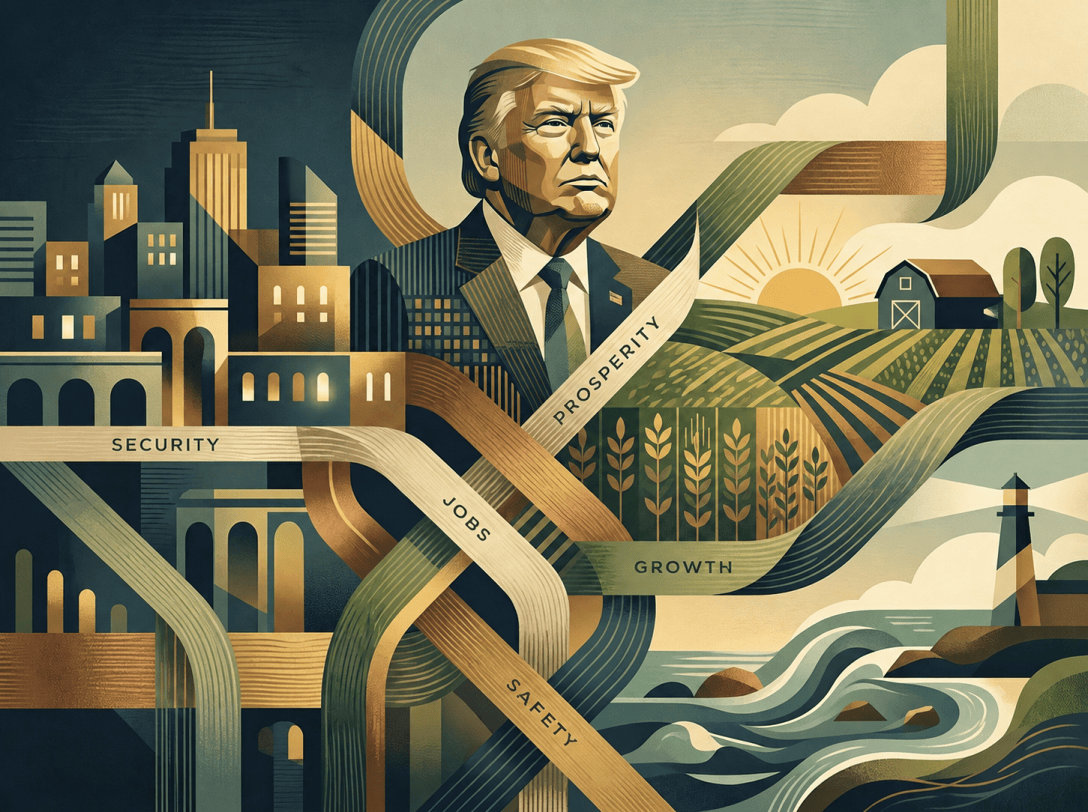
Do you want secure borders, less crime, less government, more manufacturing, more energy, more money in your pocket, and more economic growth over all to continue even if gas prices are higher than you would like, or do you want to go back to the malaise that prevailed before he retook office?
Contrary to the conventional wisdom in even some conservative leaning circles, the Republicans have a great story to tell barely a month away from the midterm elections. Despite the incessant doom and gloom promulgated by a mainstream media that blamed President Trump for planes crash landing in a foreign country early in his second term and who predicted thousands upon thousands of deaths as a result of his policies, the opposite has happened in most cases and if recent news is any indication, the results are beginning to become undeniable on a wide variety of fronts, from the economy to crime.
First, the economy. While we were duly informed that tariffs and trade wars would crash the international order and bringing back manufacturing jobs was merely a deranged fantasy, the latest data suggests the President was correct and his naysayers were wrong. The United States Manufacturing PMI racks factory activity; above 50, the sector is growing; below 50, it’s shrinking. In September, the metric spiked to 57, rising from 53.9 in August, well above expectations of 53.6. According to S&P Global, “The reading marked the strongest improvement in manufacturing business conditions since May 2022, with all five components contributing to the increase. Production growth rebounded after weakening over the previous three months, reaching its fastest pace since April 2022, while new orders accelerated to their strongest rate in nearly four and a half years. Employment growth rose to its highest level since February 2021, while inventories also increased at a faster pace. Meanwhile, supplier delivery times lengthened to the greatest extent since July 2022.” Similarly, the ISM Manufacturing PMI reached 54.6 in August, showing eight straight months of expansion. In Texas, the Dallas Federal Reserve found that “Texas manufacturing output growth accelerated sharply in September, according to business executives responding to the Texas Manufacturing Outlook Survey. The production index, a key measure of state manufacturing conditions, jumped 13 points to 29.5, a reading suggestive of a robust pace of output expansion. Other measures of manufacturing activity also pointed to rapid gains this month. The capacity utilization index jumped 11 points to 23.9, and the shipments index climbed 11 points to 24.8. The new orders index increased to 30.7 from 22.0. All three indexes registered above-average readings in September.” On a more anecdotal level, President Trump announced the construction of a new steel plant in Iowa on Monday, funded by some $15 billion in investment.
Perhaps not surprisingly, this has led wage growth to outpace admittedly high inflation. According to the Atlanta Federal Reserve, growth hit 4.1% in August, “The Atlanta Fed’s Wage Growth Tracker edged up to 4.1 percent in August from 3.8 percent the prior month. For those not changing jobs, the Tracker held at 3.6 percent in August, while the Tracker for those changing jobs increased to 5.0 percent from 4.4 percent in July.” Equally unsurprising, the job market has rebounded after a less than stellar second half of 2024 and first half of 2025. Described as “low hire, low fire,” the unemployment rate has occupied a narrow band of 4.1% to 4.3% with a low lay off rate of 1%. While we could always use more growth, the numbers are doubly astounding when you consider that they include the lay-offs of over 300,000 government workers as part of President Trump’s plan to reduce public sector employment and the either deportation or self-deportation of some 2.9 million foreign born individuals. Even if you exclude the fact that those workers counted negatively earlier in the year and last year, this means the new jobs created have been largely in the private sector, not requiring constant government funding and drains on the tax payer, and have largely gone to Americans. Even FactCheck.org, which compared the numbers to the previous administration, was forced to acknowledge, “Data from the Bureau of Labor Statistics — touted in a Dec. 16 post on the White House website — do show that this year native-born employment increased by almost 2.7 million from January to November. On the other hand, employment for foreign-born individuals decreased by 972,000 in that period” compared to “Joe Biden’s presidency, [where] the data show an increase of 7.5 million in native-born employment, more than the 6.5 million increase in foreign-born employment.” In other words, more Americans are taking advantage of relatively high paying, private sector jobs than ever before, and when you consider the expert class’ prediction that the combination of laying off large numbers of government workers and deporting larger numbers of foreign workers would cause economic catastrophe, the turn around is even more astounding (The Atlanta Federal Reserve also predicts growth this quarter of an incredible 5.1%).
For that matter, the decline in government workers and the foreign born population alone represents an incredible achievement. If you’ve been concerned about the inexorable growth of government, outside of a drop after World War 2 and the occasional fluctuation, the number of federal employees has risen consistently since 1940 and practically exploded since at least 2000, until President Trump retook office that is. Then, it suddenly starts plummeting, bringing it down to the lowest level since the 1960s. Regarding the foreign born population, between January 2009 and January 2017, when President Trump took office for the first time, the line generally goes up with 7.9 million foreign born added to the US across President Obama’s two terms and President Trump’s first term, then an incredible 8.3 million added during President Joe Biden’s term. Suddenly, however, it too starts going down, fast. In barely a year and half, there are now 2.9 million less foreign born people living in the United States. Between the two, there has been a massive undertaking to crack down on fraud, saving taxpayers hundreds of billions of dollars that once again kept being spent year after year after year.
The radical alteration in generational trends like this – including fraud, which didn’t simply happen out of nowhere and must’ve grown from somewhere – is practically unheard of in United States history, and considering both shrinking the government and deporting illegal aliens were key campaign promises made, now delivered though many have long insisted the challenges – and the challenges with manufacturing – were intractable, unsolvable. If these were the only successes, 21 months of the President’s second term would make for a solid story, but similar stories are playing out on crime – the crime rate is set to have its largest two year decline in recorded history, the number of drug overdoses is expected to be cut in half (or more) from their peak, and nine of the ten most wanted have been arrested – and drug prices – we just registered the largest annual decline in prices since 1963. At the same time, investment in the United States is skyrocketing with $11 trillion committed from foreign countries and private companies across manufacturing, technology, and other infrastructure, including the UAE ($1.4 trillion), Qatar ($1.2 trillion), Japan ($1 trillion), Saudi Arabia ($600 billion). There have also been major security and mineral rights deals with countries as diverse as Greenland and Ukraine, energy deals with Venezuela, a country that was aligned with Russia and China as recently as last year, the expulsion of China out of the Panama Canal, and more. There have been 20 trade deals as well, plus new benefits for the American people including no tax on overtime, tips, and social security, Trump Accounts for newborns, and matched retirement savings for those without a 401K.
Of course, there are some challenges as well, chief among them frustrations over what many believe is an ill-conceived Iran war and the accompanying spike in gas prices, but even then there are arguments to be made that begin by treating voters like adults. On the war itself, the messaging should be pretty simple and straightforward: I understand you might disagree with the decision, but the reality is that we have been engaged on and off with Iran since 1979. Even if you are skeptical, can we at least agree that the President has demonstrated the fortitude his recent predecessors have lacked and give him a little more time to achieve victory without the Democrats preventing us from prevailing, as they have promised to do? On gas prices, it might be even simpler: Copy a page from President Bill Clinton, tell everyone you feel their pain and understand their concern, but if you believe Democrats, the party that has called for high gas prices for more than a generation, are going to lower them, I’m not sure what to tell you. As always, you shouldn’t listen to what they say and instead pay attention to what they do, and consistently over the course of more than 20 years, they have called for gas prices to increase, not decrease. It wasn’t Republicans that tried to ban fracking over and over again. It wasn’t Republicans who refused to allow more offshore drilling. It wasn’t Republicans who blocked the Keystone pipeline and more. No one has any reason to believe they have changed, and instead we have every reason to believe they are simply playing politics because they think it will help get them elected
Ultimately, if the election hinges on President Trump himself, serving as a referendum on his tenure, the solution is to embrace that choice, not pretend otherwise, frame it in terms of the future, and ask voters a simple question: Do want secure borders, less crime, less government, more manufacturing, more energy, more money in your pocket, and more economic growth over all to continue even if gas prices are higher than we would like right now, or do you want to go back to the malaise that prevailed before he retook office? I know the media makes a lot of noise. I know prices remain high, but whatever you think about the President personally, the Democrats will not fix any of these things. They will only make them worse. We know that because they did make them all worse less than two years ago. That’s why the only choice is for the Republicans in November. Yes, it’s a simple argument, but the question is: Will the Republicans bother to make it?


Doesn’t matter. Since when are people (most) rationale? Blue wave coming and then … who knows what the next two years will bring.
LikeLike