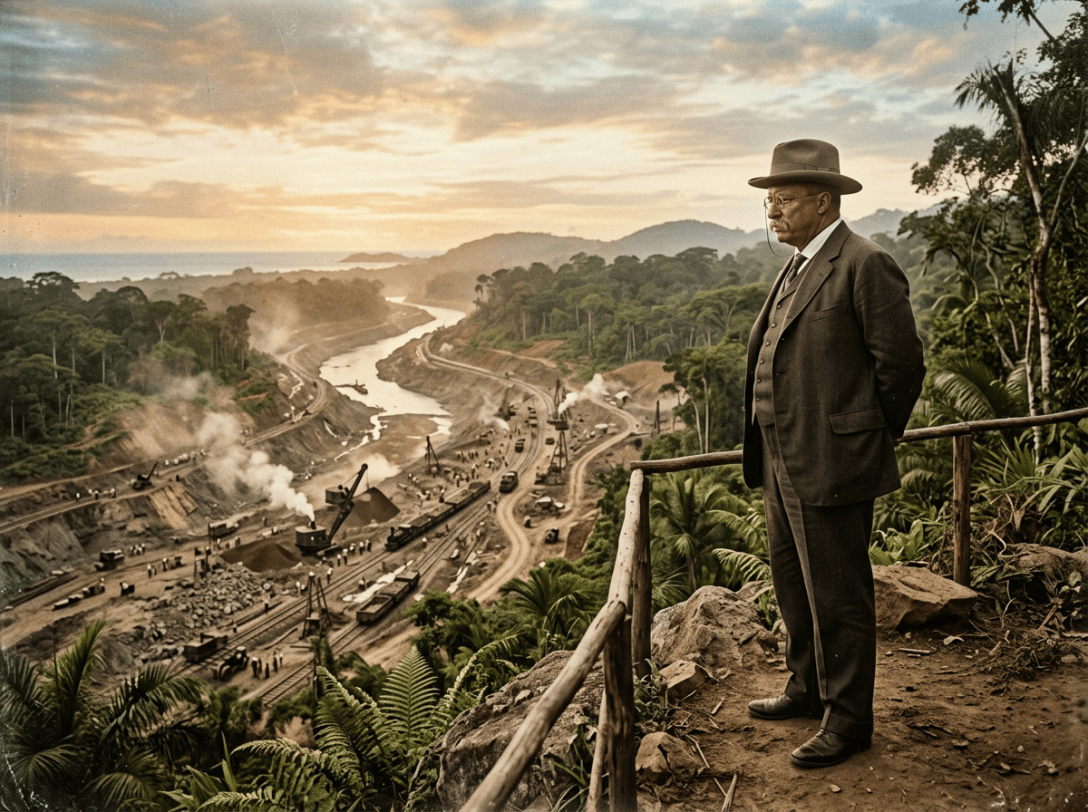
Almost 125 years ago, critics of President Teddy Roosevelt described another world-changing deal in Latin America as an un-American imperialist adventure despite having no solution of their own beyond the fantasy that countries will magically become modern democracies thanks to the power of words alone.
In 1903, President Teddy Roosevelt secured a deal with the fledgling government of Panama that would ultimately change the entire world. The Hay-Bunau-Varilla Treaty, named for its primary negotiators, Philippe-Jean Bunau-Varilla, the French diplomatic representative of Panama, and United States Secretary of State John Hay, created the Panama Canal Zone, a ten mile strip of land controlled by the United States in perpetuity in exchange for an up front payment of $10 million and $250,000 per year afterwards. The arrangement would allow the United States to build the canal and ensure it was protected while Panama would receive much needed monetary support after recently declaring independence from neighboring Columbia. Over the next eleven years, the US would embark on one of the most ambitious construction projects ever conceived, completing what the French began in 1881. At the time, the costs in blood and treasure were almost inconceivable, between the French and the American effort, some 25,000 workers lost their lives working under incredibly difficult conditions, with the two countries spending some $662 million in unadjusted dollars, over $25 billion today, but the end result would usher in a new age of international trade and US hegemony. The completed 51 mile waterway connected the Atlantic and Pacific Oceans, eliminating the need for ships to take the treacherous course around South America’s Cape Horn, reducing the voyage by an astounding 9,200 miles and around two months time, revolutionizing shipping for the 20th century. Geopolitically, it also transformed the United States into a global power, doing what the French could not and opening up new strategic possibilities to better defend our hemisphere. Combined with Roosevelt sailing the Great White Fleet around the world at the end of his Presidency in 1908, the great powers at the time were forced to acknowledge the United States was their equal, or perhaps even their superior. Even though we (foolishly, I would argue) relinquished control of the zone and the canal in 1999, the route Roosevelt conceived and ultimately built still supports around 5% of global waterway trade, roughly 40% of North American container traffic amounting to 500 million tons of cargo across 14,000 ships per year.
Of course, the original Hay–Bunau-Varilla Treaty was not without detractors, the same as any deal of this magnitude. As these events were unfolding and afterwards, critics of Roosevelt and the overall project claimed it was an imperial adventure that robbed a fledgling country of their sovereignty, accomplished through dubious diplomatic means that were disadvantageous to Panama. Democrat Senator Edward W. Carmack assailed the outcome from the floor of the Senate, claiming that Roosevelt had initiated the revolution in Panama for the sole purpose of stealing the land, “The United States didn’t protect a revolution; the United States created the revolution, financed the revolution, and guarded the revolution… We have acted as a receiver of stolen goods.” London’s Pall Mall Gazette echoed these claims, “The United States has long lectured Europe on the sins of aggression and territorial aggrandizement. Yet, at the first touch of self-interest, Washington has staged a comic-opera revolution in order to rob a weaker neighbor of its most valuable territory.” Paris’ Le Temps said much the same, “The United States has treated Panama not as an independent ally, but as a client state brought into existence purely to sign a deed of sale.” Berlin’s Die Kreuzzeitung insisted, “The Panama affair shows the true face of the Monroe Doctrine. It does not protect Latin America from foreign imperialism; it merely preserves Latin America as an exclusive hunting ground for American imperialism.” The New York Evening Post, now just The New York Post was an anti-imperialist newspaper back then, claiming “The maneuver is a vulgar piece of trickery, a shameful abuse of our power, and a lasting disgrace to the American name.” Even Secretary of State Hay himself had a few qualms, writing in a private letter to Senator John Coit Spooner, “As it stands now as soon as the Senate votes we shall have a treaty in the main very satisfactory, vastly advantageous to the United States, and we must confess, with what face we can muster, not so advantageous to Panama.” Bunau-Varilla was, however, far more accurate in my opinion when he described the terms to Panama itself, “If the government is looking for a path to follow, it must choose between two options: the ratification of the treaty which ensures its birth, or its rejection which will leave Panama to face Colombia alone.”
Perhaps not surprisingly, Roosevelt stood by his actions in both public and private. In a letter to a conservationist ally, Gifford Pinchot he assessed the situation as he saw it, “The taking of Panama was a matter of the highest national and international morality. Colombia had shown herself utterly incompetent to perform the duties of a sovereign power over the Isthmus… Her action was a mere dog-in-the-manger hold-up of civilization.” To the English historian George Otto Travelyan, he said much the same, “I did not lift a finger to incite the revolutionists… but I was entirely textually truthful when I said I should be delighted if they did revolt. The state of things had become intolerable. It was a choice between acting with drastic efficiency or allowing a great world interest to be sacrificed to the greed of a small band of corrupt politicians.” To his close friend and Senator from Massachusetts Henry Cabot Lodge, he wrote “The editorial harm-prowlers and the small-fry peace-at-any-price men are doing their best to make us look ridiculous… They would have preferred that I should sit still and pass academic resolutions while the people of the Isthmus were slaughtered and the canal indefinitely delayed. I have the satisfaction of knowing that the canal is being built.”
Despite the view of many historians and politicians since, who have largely turned the critics’ consensus into something of the conventional wisdom, it’s hard not to see how Roosevelt was ultimately correct in his assessment. Even if you set aside that Panama was paid for the land and being the location of the canal itself placed a new country in the middle of international trade in a way that never would have happened otherwise, the choice was not between simply leaving Panama alone to prosper and go on to build the canal on their own or intervening in what some described as an imperialist manner. Without the canal and our interests in the region, Panama would’ve been swiftly overrun by the much larger and more powerful Columbia, leading to a true civil war and the resulting death and destruction. Moreover, the broader geopolitical and economic implications were enormous. The canal would revolutionize global shipping, unlocking vast economic opportunity while simultaneously placing us at the forefront. As Roosevelt himself put it, what morality would compel us to sacrifice that for Columbia or even Panama itself? Why do those parochial interests outweigh everyone else’s? Why would American values prompt us to abandon the fledgling country and limit the growth of the entire world?
Last week, President Donald Trump announced the largest energy deal in history with Venezuela. As the White House framed it, “In the biggest oil deal in world history, President Donald J. Trump has secured U.S. majority control of more than 65 billion barrels of proven oil reserves in Venezuela – vastly expanding our current U.S. territorial proven reserves of roughly 46 billion barrels. This deal secures our energy dominance for the next century—all at zero cost to the United States. The deal, signed by Secretary of State Marco Rubio and Secretary of War Pete Hegseth, gives the U.S. government powerful governance rights, economic ownership, and guaranteed low-cost off-take from a new private Venezuelan oil champion, which will be the second-largest private oil company by reserves in the world.” As it stands, the agreement grants North American Blue Energy Partners (NABEP), the new private company, a 100 year concession across 17 oil fields while providing the US Department of War’s Office of Strategic Capital a 35% equity stake in its corporate parent, “representing up to hundreds of billions in value and dividends for the United States.” The equity stake gives the US veto power over the board of directors, ensures the majority are US citizens, and puts it under the jurisdiction of US courts. The NABEP also grants the United States the right to purchase at cost up to 20% of the oil produced, and the right of refusal to the rest. In exchange for these concessions, the NABEP is expected to receive up to $100 billion in investment to improve production across these fields from US companies while Venezuela will receive royalty and tax payments estimated at $200 billion over 25 years.
The President was equally sure to tie this with his goal to reinstate the Monroe Doctrine mentioned earlier in the context of the Panama Canal, claiming bluntly “The majority of the incremental oil fields to be operated by NABEP were previously controlled or operated by Russian and Chinese firms, or by corrupt cronies of Maduro and Chavez. These malign foreign actors looted Venezuela’s resources for the benefit of American adversaries like Cuba, Russia and China and failed to invest in Venezuela’s infrastructure or development. President Trump has re-established the Monroe Doctrine, purging foreign malign influence from our backyard and ensuring American dominance in our hemisphere is never again questioned. By working with both new and old partners, President Trump’s Administration is forging new robust, strategic and defensible supply chains in our hemisphere to support the revitalization of our manufacturing and energy sectors after years of globalist decline.”
Equally needless to say, critics, including at least some self-proclaimed conservatives, almost immediately pronounced the deal an un-American violation of our values and principles, similar to the charges leveled at Roosevelt. Professor Ricardo Hausmann of Harvard, who Britain’s The Telegraph described as the “doyen of the Venezuelan diaspora,” took to X to attack Secretary of State Marco Rubio, claiming “You have just lost any trust Venezuelans ever had in you. You opted to use US power, not to free Venezuelans, but to go to bed with our oppressors. You opted to push an asset grab, an unconstitutional deal with an illegitimate oppressive government, instead of using US leadership to re-establish constitutional rule and democracy first.” He continued, “Venezuelans will not respect this illegitimate deal and no major US oil company will take it seriously because they know it will not last. You are preventing our leader – María Corina Machado – from returning to Venezuela, and you have conspired to delay elections and the return to democracy. Shameful.” The Telegraph further editorialized these comments by broadening the issue, “Trump’s Venezuelan oil grab has much in common with his grab for Ukraine’s minerals and hydrocarbons, a predatory extortion also dressed up as a ‘deal’ and forced upon Kyiv at a moment of extreme vulnerability in Ukraine’s fight for national survival. Both are deplorable, reflecting Trump’s primal and atavistic urge to seize control of raw materials wherever he can and from whoever looks weak.”
For their part, the Cato Institute declared that “Everything About the US-Venezuela Oil Deal Is Troubling.” In addition to bemoaning “state corporatism by giving the US government a large, and possibly majority, stake in a major joint oil venture in Venezuela,” a lack of transparency because it was negotiated in secret, what Reuters described as “The agreement did not pass through a competitive process,” and concerns about its legality, the “authority and the legality of the US government’s announcement of a state-owned enterprise abroad and its commitment of government resources to it are unclear,” they too took aim at sidelining “the Venezuelan opposition and strengthens the dictatorship. The Venezuelan opposition played no role in the agreement, and it does not enjoy opposition or public support.” Ultimately, the concluded by referencing Ms. Machado as well, “The US-Venezuela oil deal is a gift to socialists all over the world who can now point to it with some credibility as an example of an imperial resource grab. But the deal flies in the face of economic freedom and the principle of voluntary exchange that made the United States prosperous, and it makes little strategic or economic sense. As some of us pointed out early on, the Trump administration could have achieved a Venezuelan oil sector completely open to US investment in a way that enjoyed widespread legitimacy by working with Maria Corina Machado, the leader of the opposition, on a democratic transition. It’s not too late for the United States to do so and achieve Venezuelan reforms that are far-reaching and durable.” Even Senator Ted Cruz, who is generally a Trump ally, had concerns, saying “This is a deal that was cut with Delcy Rodríguez, who is the interim president of Venezuela. She was Nicolas Maduro’s vice president. She is a communist. She is a Marxist. She has a long history of being viciously anti-American.” “Maduro was illegitimate, and Delcy Rodríguez is illegitimate,” Cruz added. “Neither one of them were elected by the people.”
While these criticisms and others might sound nice in theory, they neglect to inform you that no one has been elected by the people of Venezuela since 1999 despite that installing a democratic government in the country is what the United States has been trying and failing to do the entire time. Ever since President Maduro’s predecessor Hugo Chavez ascended to the office in 1999 itself, we have been attempting to reform the country from the outside, calling periodically for these so-called free and fair elections and getting laughed at for our efforts. In 2002, a short-lived coup installed Venezuelan Federation of Chambers of Commerce (Fedecámaras) president Pedro Carmona as interim president, a move that was recognized by then President George W. Bush. For the remainder of his time in office, President Bush frequently took aim at President Chavez, tying him to terrorists in the region including the Revolutionary Armed Forces of Columbia. “As it tries to expand its influence in Latin America, the regime claims to promote social justice,” he said in March 2008. “In truth its agenda amounts to little more than empty promises and a thirst for power.” “It has squandered its oil wealth in an effort to promote a hostile, anti-American vision,” he added.” “It has left its own citizens to face food shortages while it threatens its neighbors.”
In his first term, President Trump himself declared through Secretary of State Mike Pompeo, “The Maduro regime is illegitimate. The fact that Maduro decided to hold an inauguration after a sham election doesn’t change America’s direction and intent, and once again, we tried to install a new leader, National Assembly President Juan Guaido as the Interim President of Venezuela. “Today,” the President wrote in January 2019, “I am officially recognizing the President of the Venezuelan National Assembly, Juan Guaido, as the Interim President of Venezuela. In its role as the only legitimate branch of government duly elected by the Venezuelan people, the National Assembly invoked the country’s constitution to declare Nicolas Maduro illegitimate, and the office of the presidency therefore vacant. The people of Venezuela have courageously spoken out against Maduro and his regime and demanded freedom and the rule of law.” Afterwards, President Joe Biden attempted to make a deal with President Maduro to hold a free and fair election in 2024, claiming “Venezuela thus far is keeping their commitment toward a democratic election — it’s not over yet. They’ve made detailed commitments. We’ll see if they hold them. But we’re going to hold them accountable.” Yet, none of this worked and no one was held accountable. During this period, the country only became more and more impoverished, more and more anti-American, and more and more enmeshed with China, Russia, and Iran, destabilizing both the region and the world. By capturing President Maduro in January and helping to install his successor, President Delcy Rodríguez, President Trump chose a different course and fundamentally changed the dynamic, both in Venezuela and its relationship to our longstanding adversaries. While the country has not instantaneously become a democracy, what was the alternative when we’ve failed at that for almost 27 years? The sad reality is that we do not have the power to do as the critics say, we cannot “free” the Venezuelans or force elections, much as we might wish to. In fact, many are recommending we install Ms. Machado as President, when she isn’t even in the country to begin with, has been in exile for years, and has no control over any government body. How exactly would that work outside a fantasy?
Instead of continuing to do the same and expecting a different result, we can do as President Trump has done, similar to what Roosevelt did before him: We can make a deal that will benefit Venezuela with new revenue and a huge amount of foreign investment, the US will benefit from securing oil independent of the volatile Middle East, and our adversaries will suffer from having their own supplies reduced. In my mind, nothing could be more American.


