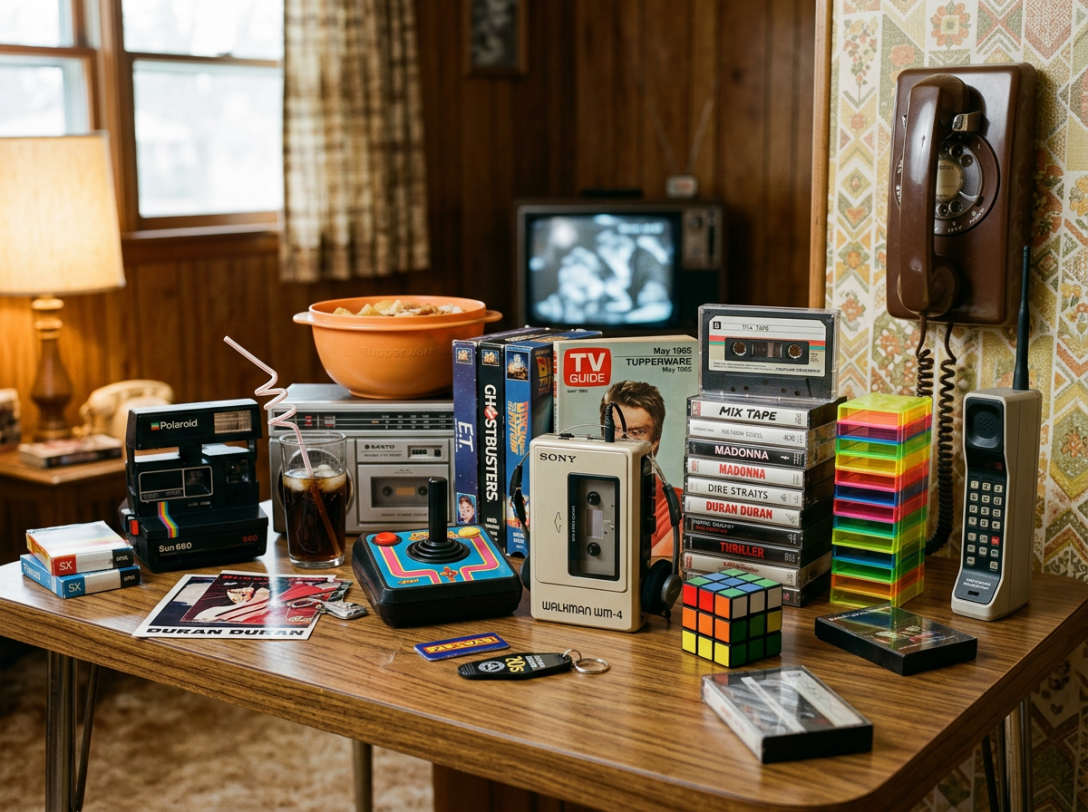
Though some might claim otherwise, I was there and few would really want to go back to a time when our lives were shorter, far less convenient, far less mobile, and far more of a pain in the ass in almost every measurable way.
Over the past several weeks, more than one person has mentioned to me that our quality of life has declined in recent years. While they haven’t been overly specific about what has changed for the worse, why, or even when, there is the general sense that some combination of the explosion of technology, particularly Artificial Intelligence, and rising prices, particularly for homes, college, and healthcare, has fundamentally altered our way of living in a negative fashion compared to either the 70s, 80s, or 90s. The underlying assumption is that there was measurably and immeasurably better about America, if not the entire world, back then. Though quality of life can be difficult to define, Gallup has polled Americans on whether they are satisfied or dissatisfied with their personal lives since 1979, and while the numbers have generally been within a stable range, between a low 76% and a high of 90%, they do show a measurable decline over the past six years, suggesting some not-insignificant number agree that something has changed. In January 2020, 90% of respondents reported personal satisfaction with their lives, compared to 78% in January 2026, a loss of twelve percentage points in just five years. At the same time, the 78% figure earlier this year is higher than it was in February 1979 (77%), July 1979 (73%), April 1982 (76%), November 1982 (75%), August 1983 (77%), January 1992 (77%), and around the same as it was in November 2011 (78%), December 2013 (79%), suggesting that the question is complicated, for what I would suggest are pretty obvious reasons. Whatever one may think and whatever conclusions one may leap to, these are not easy things to measure and given the pace of change over the past thirty years, it can be hard to keep up, especially as you get older. Sometimes, it seems like you’re lost, out of touch, that the world has simply moved on.
As a child of the 70s, who grew up in the 80s, and came of age in the 90s, at least a part of me understands the phenomenon and the enduring appeal of the past. Looking back on it now, the world of my childhood and teenage years seems like something out of an impossible dream, when kids roamed free, life had less distractions, the world was simpler, everything cost less, and for lack of a better word, people were more fired up, optimistic and not obsessed with politics, ranting to the others for no real reason at times save to vent their anger and frustration, effectively all day, every day. Back then, we were the Action Park generation, let loose to run wild from dawn to dusk in ways that are inconceivable today and at the time, we loved it, believing the innocent wildness and freedom could last forever. As silly as it may sound, the ethos may be best encapsulated in the movies of the era, from Tom Cruise portraying characters completely unconstrained by convention, so talented and cocky they cannot be confined by the rules which govern everyone else, to teenagers and college students who believed every problem in life can be solved by an appropriately raging party. Beneath the surface, both tropes reveal a philosophy that no longer truly exists and the world is likely worse for the lack. After all, the classic Tom Cruise character generally prevailed by making allies out of adversaries, proving to them that his unconventional ways backed by ridiculous talent were the key to victory in whatever endeavor. In Top Gun, Maverick and Iceman begin the movie as rivals, ultra talented pilots competing to be the best with vastly different personalities, but it’s only when the two learn to work together that they can defeat the Russian threat. In Days of Thunder, Cole Trickle and Rowdy Burns are fierce competitors before getting into a massive crash at the Firecracker 500, only to realize they’re not so different after racing wheel chairs in the hospital while they recover, then rental cars on the beach. Similarly, the 80s and early 90s teen and college films might have occurred under less intense circumstances, but the outcome was ultimately the same. In Animal House, Back to School, Weird Science, PCU, and others, the goal was to bring people together simply to rock, believing that if only the competing cliques that seemed so different on the surface could share a blow out evening, they’d realize these differences weren’t as important as they appeared at first glance, finding a way to get along regardless.
Though it saddens me that this world is gone, replaced by a much more complicated one where characters that break the rules generally suffer for it and simply getting along is no longer enough in many people’s eyes, the reality of day to day life was far more complicated and in many ways, more difficult despite the irresistible appeal of nostalgia. For every good back then, there was a bad. While people were more free in a sense, not tied to their phones, not constantly bombarded by information, not data mined or monitored, this wasn’t without significant challenges, risks, and costs. The freedom of hitting the road – when I was young without a freaking seatbelt and with people piled in layers in the back seat – was awesome. As Bruce Springsteen famously or infamously put it, “I got some beer and the highways free,” or Sammy Hagar once sang, “Cruisin’ and Boozin’,” we would drive simply for the sake of driving, doing the sort of stupid shit that would send you straight to prison today. (Seriously, I once lit the back of my best friend’s hair on fire while he was behind the wheel.) We were young, dumb, didn’t know any better, and didn’t care, and we loved it – until the car broke down, got a flat tire, or got lost. Then, we were shit out of luck without a cell phone or GPS, forced to either flag someone down on the road and hope they would inform a police officer, service station, or tow truck somewhere up ahead, or walk there yourself. As a man it could be daunting, as a woman potentially terrifying, not knowing if whoever arrived to help was a psychopath and not having any choice in the matter. If it was late at night, you might well have to sleep in your car because no one was around, nothing was open, and you had no way to call for help. Nor was freedom the only thing a car meant, there were an endless list of responsibilities that came with it like shopping. Without the internet, there were hours, if not whole days, exclusively devoted to traveling between various stores for basic items, fighting the crowds, dealing with the staff, only to find out they might not have what you wanted anyway. Even if they did, you were stuck with whatever was in stock, whatever brand they carried, which in many cases meant choosing from two types of pasta and believing Prego was a quality tomato sauce, Entenmann’s a real baked good, and whatever price they wanted you to pay. There was no means to browse dozens of stores in an instant, compare products from big and small brands, compare prices, read reviews, and have it shipped to your door without getting off your ass.
To say it was an inconvenience was an understatement. Sometimes, it was a monstrous, frustrating pain in the ass, where a six hour expedition would accomplish only half of what you planned, leading directly to another one, but there were other inconveniences, perhaps even worse because at least going to the store meant you came home with something you wanted most of the time. Bills were paid by checks that had to be mailed and checks required books that needed to be balanced, yet somehow never were. Even after adding it up three, four, or five times, for some reason your calculation never matched the bank statement, which was also physically mailed to you, meaning you couldn’t even say for sure how much money you had most of the time. Of course, your paycheck needed to be cashed at an actual bank, which frequently meant you had to wait in line on a weekly or biweekly basis at inconvenient hours, barely a half day on Saturday, never on Sunday, for the simple privilege of accessing your hard earned money. Similarly, ATM machines weren’t common outside of banks until the 1990s; if you wanted cash and generally, you needed to keep at least a small amount on hand, you had to go to the bank as well and if you didn’t have a credit card, another thing that really exploded in the 1980s, you could find yourself completely broke, not having the money you needed for a basic transaction, which was both embarrassing and time consuming, and meant you might not come home with what you wanted after all even if they had it in stock. If you happened to travel internationally – which few did, more on that in a moment – you either had to bring cash that might get stolen or a pay a fee for so-called travelers checks, then pay another fee to change your money into the local currency, and once again, if you didn’t bring enough, good luck withdrawing more. There’s a reason why the phrase “running errands” was popular at the time and meant one was on a mission that could not be messed with because between these tasks and shopping, you’d spend hours on inconvenient hours on end simply to accomplish basic tasks that no longer exist and you had no choice except to do so. Of course, this presupposes that you were lucky enough to have a car and could drive in the first place. If you did not or could not for whatever reason, good luck using public transportation or getting a cab in a suburban area, forget having whatever you needed delivered straight to your door. Instead, you’d have to beg for a ride, hope some neighbor or friend might help, walk, or simply do without.
Speaking of doing without, it’s common for people in my age bracket to claim the movies and music were better when they grew up and there might be some truth to that beyond the part it played in our lives at a susceptible age, but regardless, these things were only good when you could actually get what you wanted. Beyond the complete crappiness of a tube television set that was 36 inches diagonal if you were lucky, cranking out a barely watchable 320 lines of resolution (even when DVDs came along, they were a measly 480 lines compared today’s almost four thousand), this meant either going to the store – see above – and purchasing it, assuming they had what you wanted in stock – or renting it – see both because half the time the hot rental wasn’t available for weeks or months. Otherwise, you were stuck watching and listening to a handful of channels, hoping something you liked was on, while knowing that was probably not the case, flicking endlessly through the channels anyway, bizarrely convinced something might change, performing the lost art of what was once called “channel surfing.” On the off chance to you actually found something, it was already in progress if not almost over with no way to go back to the beginning, which required you to plan in advance by pouring through a TV guide and making notes about what you actually wanted to watch, then making sure you were in front of the TV before it started and hoping you didn’t have to go to the bathroom during an important part. In fact, Springsteen had a satirical song about it on his 1992 album, Human Touch, “57 Channels and Nothing’s On” where “home entertainment was my baby’s wish.” Despite trying cable and early satellite TV “pointed…out into the stars,” this wish couldn’t be fulfilled. Instead, “A message came back from the great beyond, There’s fifty-seven channels and nothin’ on. Well we might’a made some friends with some billionaires. We might’a got all nice and friendly If we’d made it upstairs. All I got was a note that said ‘Bye-bye John, Our love is fifty-seven channels and nothin’ on.’” Left alone with his failure of an entertainment system, John “bought a .44 magnum, it was solid steel cast, And in the blessed name of Elvis, well I just let it blast ‘Til my TV lay in pieces there at my feet, And they busted me for disturbin’ the almighty peace.” The song is undoubtedly satire, but the reality rang true, even as 57 channels became hundreds of channels.
Sadly, it’s equally true that the old phrase “Keep in Touch” written on many a middle school and high school year book was much easier said than done, a promise honored more in the breach than the observance. Even if you had the best intentions, keeping in touch took quite a bit of work back then, a concept well illustrated in a short scene from Hot Tub Time Machine, when the teenager from the future asks how he’s going to meet his love interest from the past again. “I’m kinda right in the middle of a thing right now, but can I text you later?” He asks. “Can you what?” She replies, baffled. “Are you online at all?” He hopes, only to have her say, “I have no idea what you’re talking about.” “How do I get a hold of you?” “You come find me,” she declared because that’s just the way it was. To him, however, “That sounds… exhausting” and it truly freaking was to anyone who has spent the first half of a high school dance searching for the girl they flirted with earlier in the week at school, only to discover she wasn’t even there to begin with. Many a night could be wasted, simply driving or biking around looking for your friends if you happened to miss them at home. While it has become fashionable to claim social media serves no purpose and has no benefit, that completely fails to explain why tens of millions of people use it daily when they certainly don’t have to. Facebook doesn’t force you to log on. X doesn’t force you to post. These are voluntary behaviors, and though both companies and others certainly do their best to ensure you keep coming back, that’s true of any product or experience that relies on repeat visitors. Restaurants don’t normally kick you in the ass on the way out and TV shows don’t generally end with a warning not to watch the next episode. Indeed, there’s an argument that every product short of a suppository is designed to be addictive in some sense, but that doesn’t make it true or negate the role personal choice plays in the matter. While I have several if not many friends who grew up without social media and who never created an account on any platform, and that’s their prerogative, to me and countless others, social media connects us to people around the world we’d never have had the chance to meet otherwise and allows us to keep the “Keep in Touch” promise to the people we grew up with. On any given day, I can be shooting the shit about how they prefer to smoke pork shoulders in Japan, discussing Shakespeare with an English professor in England, or learning about a major life development for someone I went to school with in a way that would’ve been impossible otherwise.
I could go on. I’ve focused largely on how improved convenience has improved our experience, and across those sorts of items, almost everything is better, so superior that if someone were to hand you an 80s boom box or camera, you might think it was from a hundred years ago, such a piece of crap it was hard to believe, but perhaps even more importantly, major technology driven advances in medicine and safety systems, combined with access to improved travel and hospitality options, allow us to lead longer, less risky, and more mobile lives. The average life expectancy in the United States in 1980 was 73.7 years, compared to 79 today, a difference of 5.3 potentially meaningful years. Your chances of dying in a car accident have been more than halved during the same period, from 3.35 deaths per one hundred million vehicle miles to 1.3. Your chances of dying from cancer have dropped from a peak of 240 per 100,000 people, to well under 150. If you are a man, your chance of dying from heart disease in 1980 was a staggering 543 per hundred thousand, cut to 263 today. During that time, there’s a good chance that you will experience far, far more than someone one would have barely 40 years ago. In 1980, barely 5% of Americans had passports, compared to over 50% today. Not surprisingly, there were only about 8 million overseas trips back then – counting trips to anywhere in the world – compared to 24 million for Europe alone. In other words, people are living more convenient lives, with more leisure time, and they are healthier, live longer, and see more of the world at the same time. If that’s not progress, if that’s not quality of life in real terms, I’m not sure what is. Though the irresistible pull of nostalgia might make some think otherwise, the truth is, neither they nor anyone else, or at least precious few of us would really want to go back. They are remembering the past, not as it it actually was, but as they want it to be, hanging onto the good and forgetting the bad. As I joke with my wife from time to time, much as I loved the 80s, if I woke up in 1985 tomorrow, I’d barely be able to function. I guess you could say I’m like Billy Joel in the classic, “I’ve Loved These Days.” Though he was singing about years and money wasted on booze, cocaine, caviar, and cars, rather than merely hitting the road as a teenager, life moves on either way and many times, you are far better off in the present than you believe despite the pull of the past.


I can’t agree, not even in the slightest. We can travel to Europe. So what? Seriously. Is that “progress?”
We have the Internet which means we don’t have to work, wait, or choose for ourselves. That’s progress??? In the 80s and 90s we had to think, be clever, be patient, be persistent to get what we wanted. And when we did, the payoff was 1000x better. I remember tracking down the Robotech videos one by one at various video rental stores across Colorado. I wanted to see the whole series and my mom and I were on a grand quest, which wouldn’t be completed until I was out of college (and met my best friend who was also a Robotech nerd). Now, I can just order the whole set from Amazon with no work, no toil, no satisfaction at a quest completed.
This is NOT PROGRESS.
QoL doesn’t mean progress. It just generally means laziness. And the kids grow up learning laziness as a way of life. Laziness of body (we’re all fat now), laziness of morality (fewer people go to church, but also fewer people seem to hold any kindness to fellow man unless they get something, i.e. virtue signal points, out of it), laziness of intellect (can we honestly say we have a smarter and more reasonable caste now compared to the 80s?).
You bring up partying as if it were the only thing driving the 80s/90s. I don’t know what kind of kid you were, but that was not my experience at all. Sure, the jocks and potheads did all that, but us nerds quietly built the world in which all these little Z and alpha kiddies play. It was awesome time, not of shirking responsibility and breaking rules (which you seem to imply drove the 80s), nor of just “making up with one’s enemies”, but of freedom, crazy ideas, respecting others beliefs, and generally not having our government interfere with every aspect of being a kid, nor having such a paranoid society where every person is a predator, every stranger a criminal, like we have now.
So, I call BS, and say you are wrong. Wrong wrong wrong. We are in a lesser time now, of nanny states and politically charged everything, with no respect for others and an entire caste of people looking to bring down a system so they can score virtue points for themselves in Armageddon.
Sorry, I’ll take my childhood instead, without the rose-colored glasses is also fine.
LikeLiked by 1 person
Thanks for the detailed note and your taking the time to comment. Believe it or not, I do not entirely disagree with you, but I think we are talking about two different things. There is the cultural way we were brought up then, which I agree was superior, and then there are changes in our relationship between the citizen and the state, that you referred to as the nanny state, which I agree was better back then.
I covered this aspect of it here:
https://confessionsofaconservative.com/2026/05/26/how-humans-have-gone-from-the-equivalent-of-wolves-to-domesticated-dogs-in-just-a-few-generations/
At the same time, I think those aspects are distinct from quality of life – as even you noted yourself, that’s not necessarily progress. Whatever you call it, there’s no denying that the modern world is a lot more convenient, we have a lot more choices, we can do a lot more things, and we also live quite a bit longer. You might not like it, but that doesn’t make it less true.
LikeLike