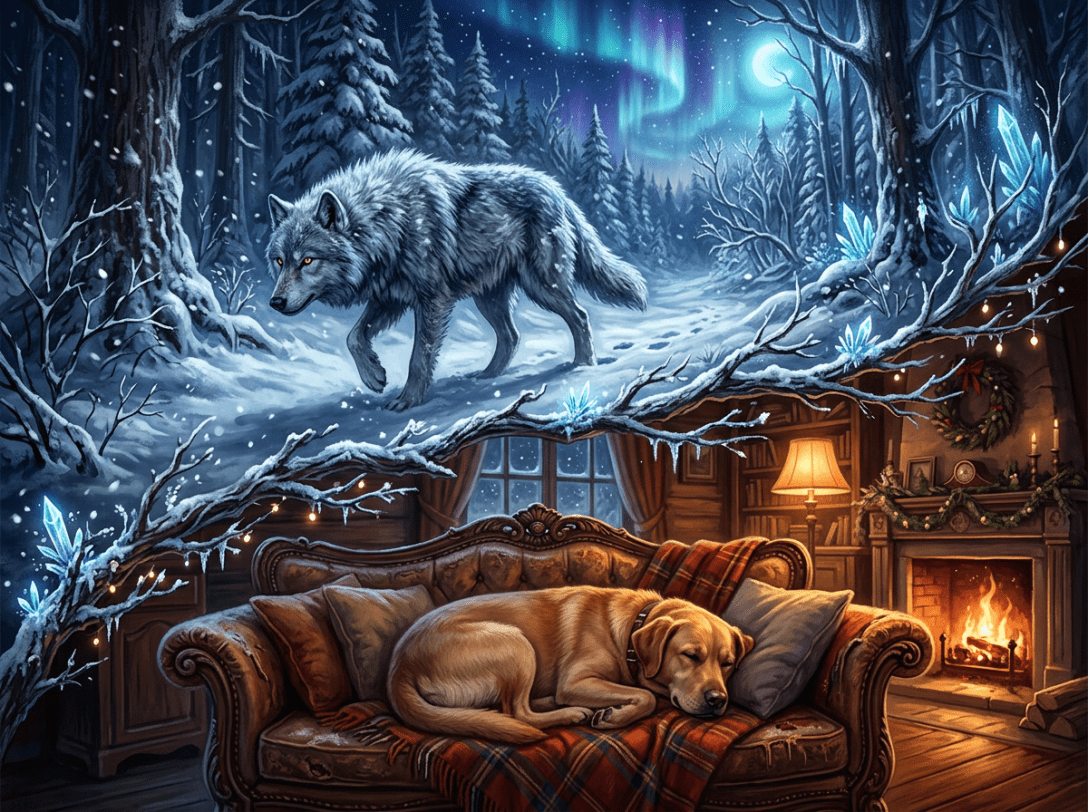
We might fault the wolf for fighting a losing battle, but there is something to admire in their tenacity compared to the dog, which is all too eager to beg for a meal rather than obtain one on its own.
Though wolves and dogs share enough DNA that they can successfully mate, producing offspring that can just as successfully mate with either species, there are notable physical and behavioral differences between the two. In controlled experiments, wolves prove to be loners incapable of seeking help from humans while dogs almost immediately do so. As an example, a wolf and a dog were placed in separate cages with a smaller cage holding a piece of meat in the middle. If there were no humans present, both the wolf and the dog tried unsuccessfully to open the cage and access the meat, pawing at it, gnawing at it, circling around it, hoping for some way in. When a human was present, outside the larger cage, however, their behavior radically diverged. The wolf would continue as it was, attempting to open the smaller cage as though the person wasn’t there at all, but the dog stopped trying on its own and instead planted itself in front of the human, hoping they would help. Though it might be easy to attribute this difference in behavior exclusively to the fact that dogs are domesticated and therefore more comfortable with people, the situation is somewhat more complicated than it might seem at first glance. The dog isn’t simply less bothered by the presence of the person outside the cage, especially as the wolf soon adjusts to the presence as well before going about its business. Instead, the dog realizes in some sense that they cannot get the meat on their own and actively seeks the help of a human, who they somehow perceive as more capable in that regard than they are. In other words, the dog gives up while the wolf sticks to it, however fruitlessly. We might fault the wolf for fighting a losing battle, but there is something to admire in their tenacity compared to the dog, which is all too eager to beg for a meal rather than obtain one on its own.
I was reminded of this when my lovely wife shared an article from artfulparent.com over the weekend that attempts to explain the differences in outlook and behavior between those who grew up in the 1960s and 1970s, and those who grew up afterwards. In their view, “There is a particular kind of internal capacity that one finds, on close observation, in almost every adult who grew up in the 1960s or 1970s, and almost no adult who has grown up since. The capacity is structurally distinct from what the wider self-help register tends to call resilience or grit. The capacity is not, on close examination, primarily about toughness, mental strength, or any other quality the contemporary cultural register has been calibrated to admire and try to cultivate. The capacity is, more accurately, the residue of a particular kind of childhood that the contemporary environment no longer reliably produces, and the residue continues to shape the daily operation of the adults who have it, several decades after the conditions that produced it have stopped existing.” The childhood in question is one they generally define as lacking adult intervention on a constant basis to deal with the daily difficulties and vicissitudes of growing up. Instead, when the “child encountered the difficulty…the child was expected to handle it. The adults were, in most cases, available somewhere in the background if things became genuinely serious, but the threshold for considering things ‘genuinely serious’ was considerably higher than it now is. Most of what would currently trigger an adult intervention was, in the 1960s and 1970s, left to the child to work out for themselves. The working-out was the work. The work, repeated thousands of times across a childhood, produced a particular internal capacity that adults who have the capacity carry with them for the rest of their lives. The capacity does not, in most cases, get articulated by its possessors. The capacity is, more accurately, just how their internal voice operates. The voice has been quietly running their lives ever since.”
To support this position, artfulparent.com provides several examples of near daily experiences the children of the 1960s and 70s, what they refer to as the post war period, were expected to deal with on their own. These included minor injuries, “The child fell off the bike. The child got up and continued. There was no parent watching from a window with their phone ready to call emergency services. There was, in most cases, no parent watching at all. The child was, by structural necessity, the first responder to their own injury. The injury was assessed, by the child, against a rough internal standard of what counted as serious. Most injuries did not meet the standard. Most injuries were, accordingly, handled by the child, in the absence of any adult intervention, by the application of whatever combination of dirt, spit, and continued playing the child had developed across previous similar events.” This extended to issues with other children, such as the “child was excluded from the group at school. The child went home, processed the experience without adult mediation, and returned the following day to figure out how to navigate the social situation. There was no parent calling the other parent. There was no teacher conducting an emotional intervention. There was, in most cases, no recognition by the wider environment that anything had happened at all. The child was, by structural necessity, the first responder to their own social difficulty. The first responding was, in most cases, ineffective in the short term and educational in the long term. The child learned, by the slow accumulation of failed attempts, how the social environment they were operating in actually worked, and developed the small repertoire of responses that would, across the years, allow them to navigate similar situations more effectively.” In addition, they noted that children were sometimes if not often asked to do household chores that were beyond their capacity. “The work was difficult. The work was, in some real way, not the child’s responsibility in the way the contemporary register would understand the term. The child was expected to do it anyway. The doing-it-anyway was the work. The child figured out, by trial and error, how to perform the task. The figuring-out produced, in the child, the structural capacity to figure out tasks. The capacity, accumulated across thousands of such episodes, became part of how the child related to unfamiliar work for the rest of their life.”
As a result, children growing up under these conditions, whether intentionally or unintentionally, developed an inner voice that informs them facing difficulties in life are simply part of the facts of life, a “structural condition that the person is going to have to handle on their own” because “the world, in their experience, did not respond by sending adults to intervene. The world, more accurately, presented the difficulty and waited to see what the child would do about it. The child did something. The doing-something became, by long practice, the default response to the arrival of any new difficulty in the adult’s life.” Therefore, adults raised this way, do not “in most cases, automatically reach for external support when difficulty arrives. The adult assesses the difficulty against the internal standard their childhood installed, and the standard is calibrated, in most cases, to a much higher threshold than the contemporary register’s standard. Most of what would currently prompt a younger adult to seek external support is, for the adult who grew up in the 1960s or 1970s, simply the kind of thing that the internal voice expects them to handle. The handling is performed, in most cases, without any conscious recognition that handling is what is occurring. The handling is, more accurately, just what the person does when difficulty arrives.” From there, artfulparent.com went on to reiterate that the trait should not be mistaken for any form of heroism, grit, determination, toughness, or other related aspect of a person’s personality that we might consider inherently virtuous under some circumstances, though it can seem so at times. “The adults who have it are not, in most cases, displaying any particular courage in their continued operation under difficulty. They are, more accurately, just doing what their internal voice has been telling them to do for the previous several decades. The doing involves no particular drama. The doing is, in some real way, almost automatic.” They were also clear to point out that the capacity can have some negative effects. “The same internal voice that allows the adult to handle difficulty without external support also, in many cases, prevents them from accessing external support that would, on the contemporary register’s evaluation, be beneficial. The capacity has produced, in some real way, a generation of adults who have not, in any sustained way, learned to ask for help even when help would be appropriate. The not-asking is the cost of the capacity.”
Regardless, Generation X and older can be seen as the wolves in our original analogy while Millennials and younger are the domesticated dogs using this framing and for better or worse, artfulparent.com concluded by noting that the conditions which “produced the capacity have, on the available evidence, mostly disappeared in the wider contemporary environment. The disappearance has been gradual rather than dramatic. The wider environment has, across the last several decades, calibrated itself to a different set of assumptions about how adults should relate to children. The assumptions involve, among other things, the assumption that adult intervention is, in most cases, the appropriate response to childhood difficulty. The assumption is, in many respects, well-motivated. The assumption has produced, on close examination, real improvements in various features of child welfare that the postwar environment had been less attentive to. The assumption has also, however, produced a structural change in what most contemporary children get to practice. The contemporary child is, in most cases, not practicing the small daily work of handling difficulty without adult mediation. The contemporary child is, more accurately, practicing the work of accessing adult mediation when difficulty arrives. The two are structurally different forms of work. The two produce structurally different internal voices in the adults the children grow into. The contemporary internal voice is, in most cases, better calibrated to recognizing when external support is appropriate and seeking it out. The contemporary internal voice is also, in most cases, less calibrated to handling difficulty without external support when external support is unavailable.”
In that regard, I’m reminded of another key behavioral difference that scientists believe allowed for the domestication of dogs in the first place: Flight distance, that is the threshold distance at which an animal will flee from a perceived threat. As the latest thinking goes, wolves exhibited a much broader range of flight distance before a portion of the population evolved into dogs, but those with a lower threshold distance – those that were less frightened and more willing to approach humans for whatever reasons – began to scavenge outside of early settlements, picking up the scraps rather than hunting. Over time, these evolved into dogs while their wilder cousins remained wolves, leaving the wolves of today only those descended from those with a short flight distance. In a sense, artfulparenting.com is referring to a difference in flight distance between generations. When I was young in the late 1970s and early 1980s, children of almost any age actively sought to escape their parent’s watchful eye – or any authority figure for that matter – whenever we could. We preferred to play on our own, unsupervised, and would make it happen if at all possible to the point where it was difficult for parents to get us to come home long enough for dinner, but at some point that changed. Children today tend to gravitate towards their parents rather than away from them, intentionally playing under their eye if not actively attempting to recruit them into an activity. The loss of flight distance – it seems to me at least – directly results in the need for their parents to mitigate almost any challenge. Though evolution and cultural inculcation are not the same process, they can produce the same result, especially if you accept the notion that thoughts evolve over time as memes, and – in the experiment between dogs and wolves mentioned earlier – it’s not entirely clear whether dogs behave as they do based on inherited instinct or learned exposure to humans, probably some combination of the two. For example, an African wild dog that has never seen a human is likely to behave much more like the wolf.
While I generally agree with artfulparenting.com that the inner voice in older generations which encourages them to solve problems on their own should not be viewed strictly as a virtue, I also believe they have understated the impact on a society increasingly populated by those who need and seek help at almost every turn. The tendency manifests at both the individual level, which we might consider somewhat amusing if you’ve heard stories from hiring managers who were contacted by their latest candidate’s parents to the point where they ask to sit in on a job interview, and the societal level, where the aggregate of these behaviors produces increasingly negative effects. Over the past week, for example, social media has been in an uproar over the eating habits of younger people, who choose to spend more money dining out and ordering in than older generations. Though this would be fine on its own as everyone is entitled to spend the money they earn as they please, the reaction from the younger people in question encapsulates the someone needs to help mentality. They are simultaneously spending more money on food than their elders while insisting that it’s impossible for them to save money for a house, education, or other significant purchase. In their minds, it doesn’t occur to them that having and keeping a budget is a personal responsibility, something that no one will do for them and that they must do on their own. If anything, it appears they believe the opposite: Even after someone explains how this segment of young people can save significant money by cooking more frequently at home and that those savings will generate interest, leading to more money in the future simply by changing their habits a little, they refuse to accept such basic, irrefutable advice. Instead, they insist the system is rigged against them, older people are lying about or misremembering how they lived in the past, and that the system itself needs radical change to rescue their personal budgets.
In other words, collectively there is a class of young people that demands help – and by help, we mean political shifts that would change things for almost everyone – with the simple task of planning a food budget. If such things are beyond them on their own, who knows what else will prove to be as they get older and conceivably find themselves in positions of more power? The problem with being a domesticated dog is that there will always be wolves out there somewhere, and in the real world, there are times when no one is coming to help. You’re either independent or dependent. A society of dependents is worse than domesticated dogs. They are sheep, and we know what happens to them.


Great article. Absolutely agree, at least for USA and Europe. Other nations are not following the same path, and many that are are lagging far behind. Japan, for instance, raises kids a LOT more independently than modern US parents would ever dream (see that show “Old Enough” for perfect examples). Even though they are also starting to over-coddle their kids, they are generations behind the US in that regard.
Much worse, however, are our global adversaries who don’t raise coddled kids. As American adults become weaker and less capable and Russian and Chinese kids grow up with more grit and independent ability, who is going to rule the world at that point? Even worse if we consider the Islamic nations who are, in basic terms, what we would consider as evil as humans can get.
Disturbing outlook for sure.
LikeLiked by 1 person