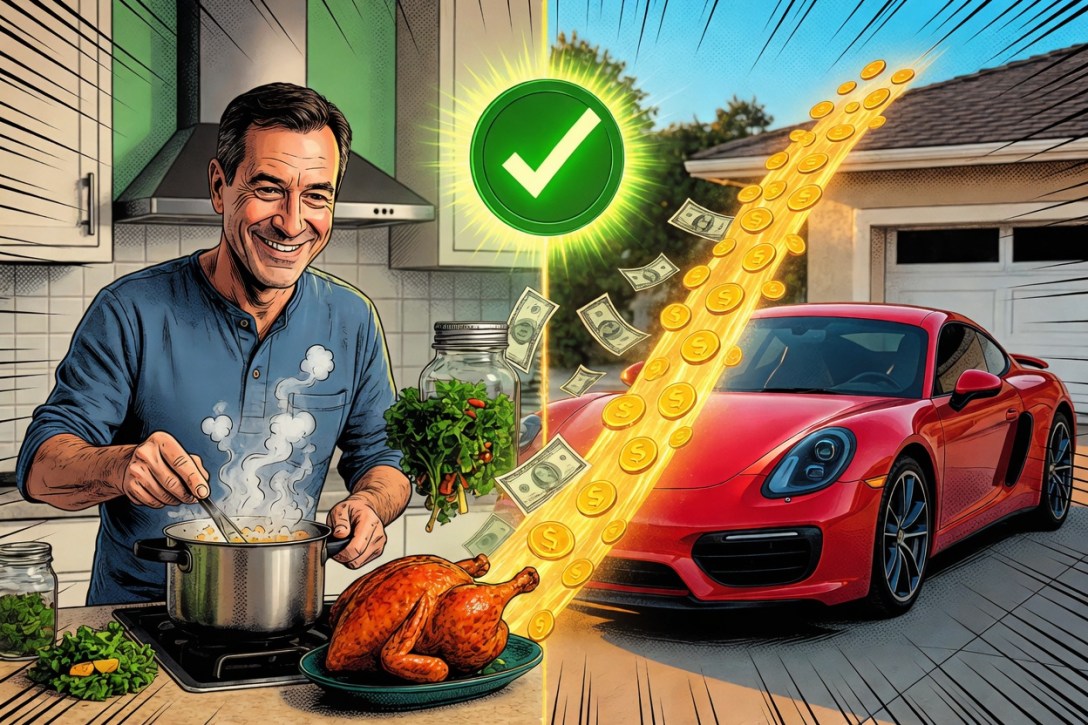
Whatever some may claim, it doesn’t take any particular genius, athletic ability, or stamina to boil a pot of water, roast a chicken, and toss a salad, and the difference between the cost of dining out or ordering in matters enough to purchase a luxury automobile over the years.
Earlier this week, Shark Tank’s Kevin O’Leary started a social media war between Boomers, Zoomers, and Gen X in between for stating what should be obvious to everyone regardless of age. Ironically, the statement that caused the eruption was actually made in late 2025, but like a dormant virus buried under the ice, for some reason it resurfaced suddenly and I would suggest rather unexpectedly. During an appearance on The Diary of a CEO podcast with Steven Bartlett last December, Mr. O’Leary was asked “So, are you in the camp that you shouldn’t spend money on the small things? Like the coffee? If you don’t need it, you should make the coffee at home?” He answered bluntly, “I can’t stand it when I see kids making $70 grand a year, spending $28 for lunch. I mean, that’s just stupid.” From there, he elaborated on the overall financial impact by noting “Think about that in the context of that being put into an index and making 8 to 10 percent a year for the next 50 years.” To those who have any sense of how saving and investing work, he was simply restating David Bach’s famous, or infamous if you prefer, “Latte Effect” or “Latte Factor,” popularized on “becomingminimalist” to showcase how wealth and income aren’t the same thing. The thinking is extremely simple and the math inescapable: If you spend $5 per day on a latte, that’s $150 per month, $1,800 per year. If you invested this money instead, you would accumulate over $170,000 in 30 years even at a relatively conservative 7% rate of return. The point was not to “command” readers to abstain from buying lattes, but to consider the impact of their daily or habitual spending habits long term. Everyone has their little indulgences, the things we spend money on that we perhaps shouldn’t because it helps get us through the day, but you can only spend money once and anytime you spend repeatedly on something that can be purchased less expensively, you are losing an opportunity to invest the savings and generate real wealth.
Once upon a time, this used to be the conventional wisdom. While Ben Franklin is generally credited with the phrase “a penny saved is a penny earned,” it actually dates back as early as 1640 and the first recorded usage was in George Herbert’s Outlandish Proverbs. Franklin updated it in 1737 for his Poor Richard’s Almanack, where he expanded the concept to include earning interest, “A penny saved is two pence clear.” Back then, two pennies made a pence, so Franklin was suggesting that one penny saved and invested ultimately becomes two. When I was growing up in the 1980s and early 1990s, this was generally taught as the “miracle of compound interest,” meaning that when you start from a small sum of money it seems to grow slowly at first, but over time, the amount becomes substantial because the future growth is based on the total amount that has accrued. Investors have encapsulated this in the “Rule of 72” which relates the annual rate of return with how long it will take to double the money invested. At a 5% rate of return, the money doubles roughly every 14 years, at 7%, every 10, and at 10%, every seven. Thus, an investment of $100,000 will become $265,000 in 20 years at 5%, or $387,000 in 20 years at 7%, or over $500,000 at 10%. In other words, even those who are not high earners can build meaningful wealth – if they start saving a small amount relatively early in their lives and that small amount can be the difference between buying something expensive versus inexpensive. Mr. O’Leary and the Latte Factor before him were merely illustrating the reality of the underlying math, pointing out that most people do not become millionaires because they made a lot of money. Instead, they do so later in life because they save a little bit each year, which has quintupled over the course of their career. This is why it shouldn’t be surprising that average retirement savings by age bracket are heavily skewed towards older demographics. According to the Federal Reserve, those under 35 have $49,000 saved, those between 35 and 44, $141,000, between 54 and 54, $313,000, between 55 and 64, $537,000, and over 65, $609,000.
For reasons both obvious and not-so-obvious, young people and at least some percentage of left-leaning individuals, look at those figures and assume that somehow older people have stolen from them, or taken advantage of them in some way, but the great majority of the disparity is directly attributable to the “Rule of 72.” Older people have had more time to save, and those savings have generated more interest over that time. Though reality and basic mathematics are undefeated in any and all arguments, many still try to make the case that there’s something radically different about life today which makes saving of any kind impossible, especially for young people. In this view, the entire system has broken down somehow, frequently because “Boomers” have rigged it to their advantage, and young people today have no hope of building wealth. Therefore, they should simply spend the money however they please, whenever they please, and any criticism of their spending habits compared to previous generations is out of bounds by definition. In that regard, many, myself included, have pointed out that Generation Z appears to spend significantly more on restaurants and take out or delivery food, among other things, than anyone else. A study in 2023 found that the “Interwar Generation,” those born before even the Baby Boomers spend 69% of their food budget on groceries, 29% on restaurants, and only 2% on delivery, but the younger you are, the more likely to spend a higher percentage on restaurants and delivery. Boomers spend 34% and 4%, Generation X, 38% and 9%, Millennials, 39% and 15%, and Gen Z, 46% and an incredible 22%. Based on these findings, Millennials and Gen Z are the only group that eats out or has food delivered more than they shop and cook. In other words, everyone born before 1980 spends more than half of their food budget on groceries while everyone after spends as little as 32%. There is no objective way to look at these numbers and avoid the conclusion that younger people can save – substantially considering delivery, which accounts for 22% of Gen Z usually comes with fees that could cost almost as much as the meal itself – simply by eating at home or bringing their lunch to work.
While they are certainly free to take this advice or continue spending as they please – so long as they don’t expect me to subsidize their habits, anymore than I expect them to subsidize mine – the general reactions suggest that such advice is more malicious than helpful, and expecting someone to either bring their lunch to work or cook chicken and pasta, is akin to demanding they exist purely on “shit on a single” left over from World War II or as others have characterized it, “prison food.” The problem, in their mind, isn’t that they are choosing to spend their money on what could be easily acquired less expensively and as someone who likes cooking, perhaps be enjoyed as much or more. It’s that the “system,” whatever that may be in this case, is preventing them from enjoying their lives – as they falsely insisted other generations have done, pretending that at some point in the undetermined past, college students and young professionals ate like kings on the cheap instead of coveting ramen noodles and Kraft Mac & Cheese. Rather incredibly, someone insisted to me on X that chicken and pork, which can both regularly be had for $2.99 a pound or cheaper, and which make up about 85% of my diet, is for suckers and losers, cheap food for the poor. Beef, which is more expensive, though some cuts can still be had for around $5 a pound, needs to be less expensive for some reason, or else it is only for the rich. Leave it to Taylor Lorenz, previously a tech reporter for The Washington Post, to combine all of these threads into a single, incoherent statement. “The poorest ppl,” she wrote on X, “often don’t have the capacity to make home cooked meals for many reasons, but that’s not stepping on ‘leftists’ for advocating to deny poor people access to pre cooked meals and things like rotisserie chicken. They cannot ever imagine a better world! It’s incredible.”
At the risk of being argumentative, there are a number of things that are truly incredible in this statement, but not the ones Ms. Lorenz had in mind. First, what is the “capacity” to cook and how do poor people in particular not have whatever it is? While not everyone is capable of being a world renowned chef – as the late, great comedian Richard Jeni pointed out in the 1990s, cooking shows at the time were characterized by food you couldn’t pronounce, ingredients you couldn’t afford, and kitchens bigger than your apartment – basic cooking requires very little capacity as far as I can tell. Whatever they may claim, it doesn’t take any particular genius, athletic ability, or stamina to boil a pot of water for pasta, roast chicken in the oven, and toss a salad for a healthy, well-balanced meal. The refusal to do so doesn’t mean that anyone lacks the capacity. It means instead, they cannot be bothered or simply aren’t interested, which would be fine on its own, except for the continued bitching about their plight. From there, Ms. Lorenz redefines the concept of a better world substantially downward, reducing elevated things such as longer lifespans, more time with your friends and family, expanded opportunities for work and leisure, and improved living conditions in general to “pre cooked meals” and “rotisserie chicken.” While there was an old political slogan in the late 1920s promising a “chicken in every pot,” prosperity and betterment in America shouldn’t be measured in the percentage of pre-cooked meals one consumes. Quality of life is not now nor has never been directly related to unlimited access to take out food at the same price as what one cooks at home, even setting aside that the sort of pre-cooked meals Ms. Lorenz referred to do not cost $28 and can likely be made a part of a reasonable food budget at current prices. Regardless, I am pretty sure she knows her statement doesn’t make much logical sense and is simply being obtuse to make what she believes is a cutting political point.
Sadly, she is not alone in being obtuse on the subject. Elsewhere, many have made the rather bizarre claim that those born before them dined out whenever they wanted when they were young, if not lived on palatial estates and were handed the keys to fancy cars, and therefore they should be free to do so as well. Anyhow who tells them otherwise, speaking from their own experience, is either lying at worst or misremembering at best because apparently, no one was ever broke in college – I was so broke at the time, I had a dollar in my pocket for the PATH train and a printed train ticket, if I lost either I would have had to beg for money to get home – or began their career at the same salary as someone with twenty years of experience. While they are fond of pointing out that prices have gone up since I was in my late teens and early 20s, they conveniently forget to mention that salaries have gone up as well. The average starting salary for a college graduate today is almost $69,000 while my starting salary as a college graduate in 1998 was $25,000. According to one thread on X, I was able to purchase lunch for around $11.49 at the time compared to the $28 cited by Mr. O’Leary and the difference is said to be one of the key reasons young people can’t save. However, if you apply the increase between my starting salary in 1998 compared to today’s, the current salary is 2.72 higher, that means the $11 meal should be $31.25, meaning by their own math they should be saving almost $3 per meal adjusted for inflation. While I would not suggest that young people today are living the dream, or that certain things like houses, healthcare, and recently gas have not increased more than others, pretending that money simply cannot be saved because of the price of lunch while insisting they don’t have the capacity to cook or bring their own lunch simply isn’t the truth.
Of course, it’s no secret that young people are not likely to take the advice of their elders and I am personally guilty of the tendency, at times to my own detriment, the thing about being an adult is that you don’t get to choose which aspects you prefer and which you don’t. The freedom to do as you please comes with the cost of paying your own way and taking responsibility for your own life. There is no in between, where you get to make poor choices and then blame someone else. If you choose not to save money by shopping and cooking for whatever reason, that’s your prerogative, but it doesn’t mean it’s impossible to save money at all. Even at that point in my life, I can afford to eat out more frequently or have more meals delivered, but I choose not to because it’s expensive in addition to being unhealthy. On the rare occasions we do opt for pizza or Chinese food, we go to the store to pick it up to avoid the fee and the tip. For the most part, we tend to plan our meals for the week based on what’s on sale at the time, rarely purchasing anything at full price. As my wife’s father was fond of saying, food is one of the easiest things to save money on if you take a little time, have a little flexibility about what you eat, and learn a few tricks of the trade in the kitchen; tricks that are easily acquired in age where you can pull up a how-to on anything using your phone. It’s also a great opportunity to spend some additional time with your spouse and the rest of your family, as cooking can easily become an enjoyable daily ritual.
Because you are younger and happen to think otherwise, does not make this any less true. It only makes you immune to learning how you can grow wealth, but what do I know? I started my career struggling like everyone else, built myself and my savings up over the decades along with my wife by living within our means, and these days, my most agonizing decision is whether to get a ridiculously expensive or an even more ridiculously expensive Porsche for my next car, next year. As any regular reader knows, I don’t write this to brag. As I wrote on my birthday earlier this year, “If you had told my younger self, the sort of life I would lead and the things I would enjoy at 50, he would’ve asked where to sign and thanked his lucky stars. I am married to a beautiful, smart, and mild woman in an amazing relationship to the point where I don’t really want to go anywhere without her. She is how I interact with the world. I don’t have any children of my own, but my wife has four and we just welcomed our third grandchild into the world, a baby boy after two girls, barely a week ago. We live in a beautiful house on three acres in the little known horse farm country of northwest New Jersey, complete with a pool, a hot tub, and a fire pit. In my garage, less than ten feet from where I type, there is a Porsche SUV, a BMW roadster with a stick, and a purpose built Porsche racecar, which technically belongs to my brother, but possession is nine tenths of the law as they say.” I write it instead because it can be done – if you have the will to do it rather than complain about how a rigged system prevents you from having a steak.


