We are present around the world, in every ocean, in some lakes, even on dry land. We are an old, proud order having shared the world with the dinosaurs 200 million years ago, but some of us aren’t even true crabs. They are imposters that have evolved separately, over and over again.
I am a crab. My shape is familiar to almost everybody. I have a flattened, somewhat circular body with widened carapace that is flat and broad, my body segments are fused together unlike many of my fellow arthropods, what are known as “fused sternites,” which are also generally wide, and I have a flattened abdomen or pleon, to which my many legs are attached, and the vestiges of a tail that tuck up under my body known as a pleon. Of course, I also have claws, but compare me to a lobster, which is also a crustacean, and you will instantly see what I mean about my unique shape. Though we have the same number of legs and we both have the infamous claws, a lobster has a long, properly segmented body and a flexible swimming tail, while I am compressed into a tight, I would say secure and elegant form. Personally, I am what is known as a “true crab” of the order Brachyura. I have five pairs of legs, the foremost of which have evolved into the claws, which are technically known as “chellae” and the hindmost have become swimming legs, though most of my kind do not swim much anymore. We are present around the world, in every ocean, in some lakes, even on dry land. This probably shouldn’t be surprising when we are omnivores who will eat just about anything including algae, random organic detritus, and smaller invertebrates such as mollusks, worms, and even other crustaceans. We are an old, proud order having shared the world with the dinosaurs 200 million years ago, boasting an evolutionary history characterized by our increasingly robust, compact body, the diminution of what is known as the telson, the final segment of the arthropod body, and the elimination of the uropods, essentially the “flippers” at the end of the lobster’s tail, which for crabs are believed to have evolved into the equivalent of small latches to better hold our shells together. In fact, the earliest known example of my order, Eocarcinus, looks something like a combination of a crab and a lobster. The main body is present and reasonably flattened, though not quite the familiar oval shape, but there is something like a small tail sticking out the back, segmented similar to the lobster, that is not present on modern crabs.
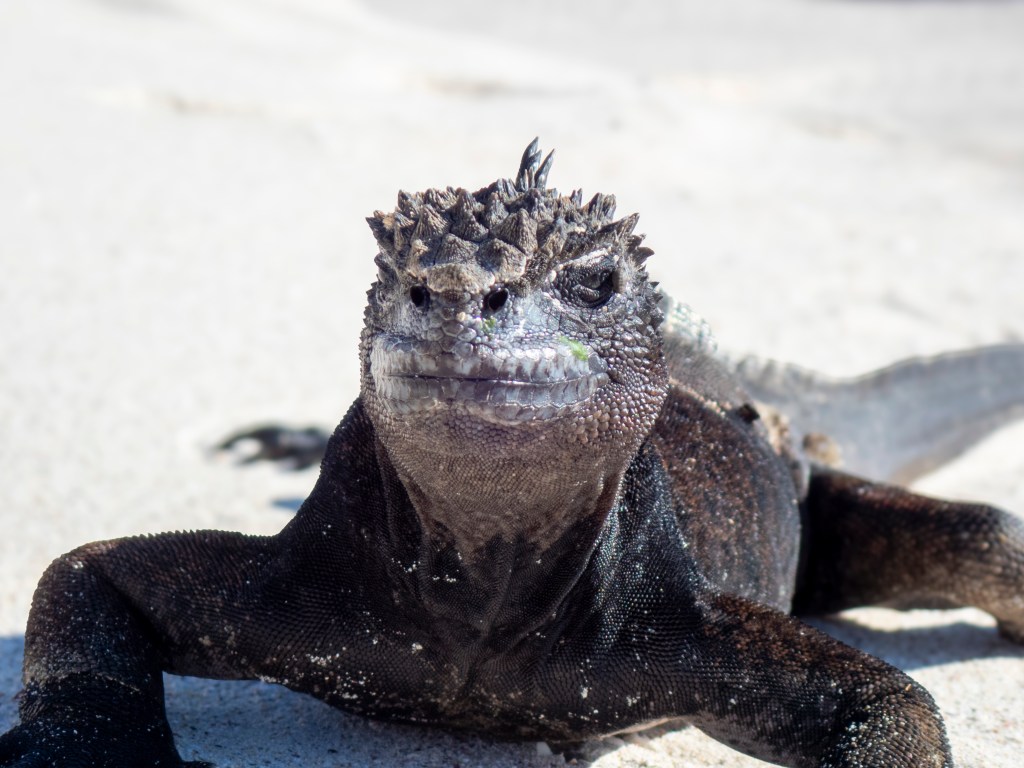
Thanks to our compact bodies and tough exoskeletons, we evolved rapidly throughout the Late Jurassic period as coral reefs grew in size and range, declined along with the reefs for a period, but then rebounded during the Cretaceous, when we became the most dominant group of decapods, outpacing lobster, shrimp, and others. Today, we come in a wide variety of shapes and sizes across around 98 families and a whopping 7,000 unique species, from the tiny pea crab, just a few millimeters wide, to the massive Japanese spider crab that boasts legs which span up to thirteen feet, imagining encountering that beast on a swim, knowing it would be large enough to pin you down with its legs alone. Most of us, myself included, walk sideways, hence the term “crabwise.” Personally, I am one of the famous Sally Lightfoot Crabs, technically known as Grapsus grapsus, native to the Galapagos Islands and other areas of the Pacific Coast. If you’ve been there, you’ve likely seen me and my fellows. We tend to congregate where the ocean meets the shore, standing out against the dark volcanic rock with our brilliant red, orange, and light blue shells though our young ones are well camouflaged in black or dark brown. We only measure a few inches across, but we gather in groups in what to most animals would be treacherous conditions, practically dancing in the waves and the spray from the ocean to avoid getting smashed on the hard, rough rocks that typify Galapagos in general. Like many of our kind, we eat mostly algae, but are known to dabble in plants, sponges, clams, young sea turtles, bird eggs and droppings, carrion, even bat guano. We have also developed something of a comradery, known as a symbiotic relationship with marine iguanas – one of the only kinds of iguanas in the world known to swim for a living – where we pick ticks off their bodies. While we remain completely unaware of the significance of the Galapagos Archipelago to the human understanding of evolution – I am a crab, after all – none other than Charles Darwin studied my ancestors and collected me.
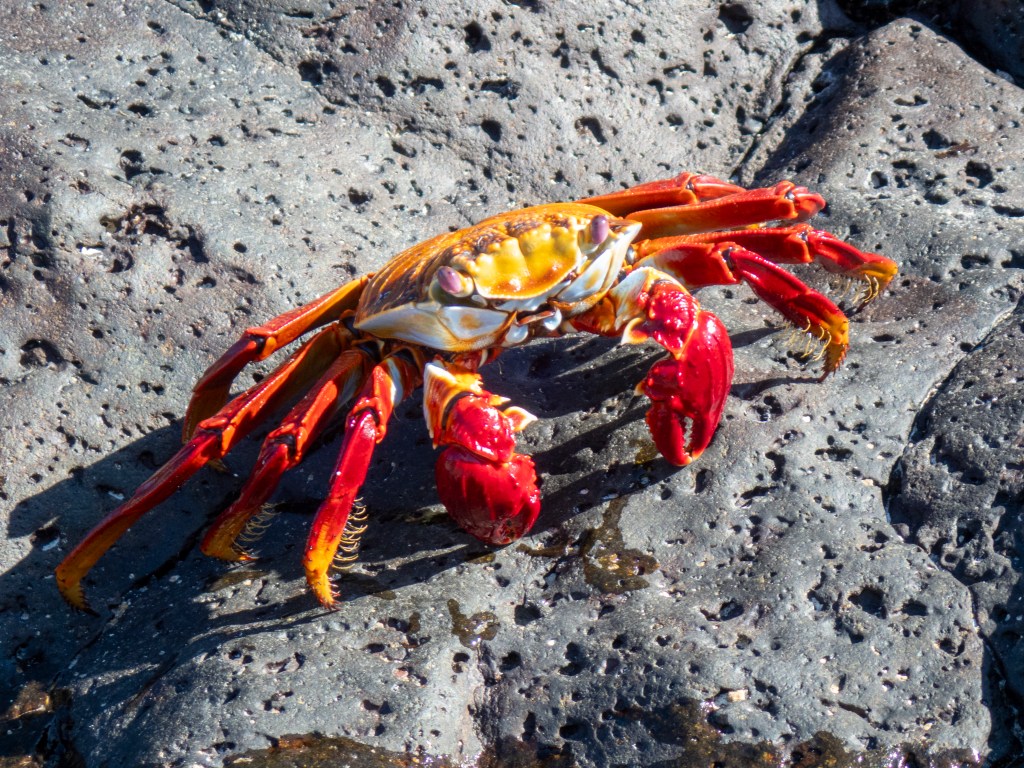
Decades later, the great American author, John Steinbeck described my cousins in the Gulf of California, writing “These little crabs, with brilliant cloisonné carapaces, walk on their tiptoes. They have remarkable eyes and an extremely fast reaction time. In spite of the fact that they swarm on the rocks at the Cape [San Lucas], and to a less degree inside the Gulf [of California], they are exceedingly hard to catch. They seem to be able to run in any of four directions; but more than this, perhaps because of their rapid reaction time, they appear to read the mind of their hunter.” Like most arthropods, I have a rather complex life cycle. As a male, I attract my mate using a combination of chemical scents and a dance, consisting of using my claws and legs in a rhythmic manner, essentially both drugging and hypnotizing the female. We copulate in what is known as a cradle carry, belly to belly, when I scoop the female up and carry her under me for protection, a process that can last for several days because the female can only be impregnated after she molts her lower shell, leaving her exposed and unprotected. I use my legs to insert the sperm into special receptacles, called spermathecae, then continue to carry her until the shell regrows. The female will then carry my sperm for up to a year, before fertilizing up to a million of eggs at her convenience, how’s that for the size of a brood? The eggs are attached to small appendages under the abdomen, sometimes known as the apron or described as being “berried” because of the resemblance to clusters of small fruit attached to the body. The fertilized eggs develop for two to nine months, depending on the species and water temperature, before our babies hatch.
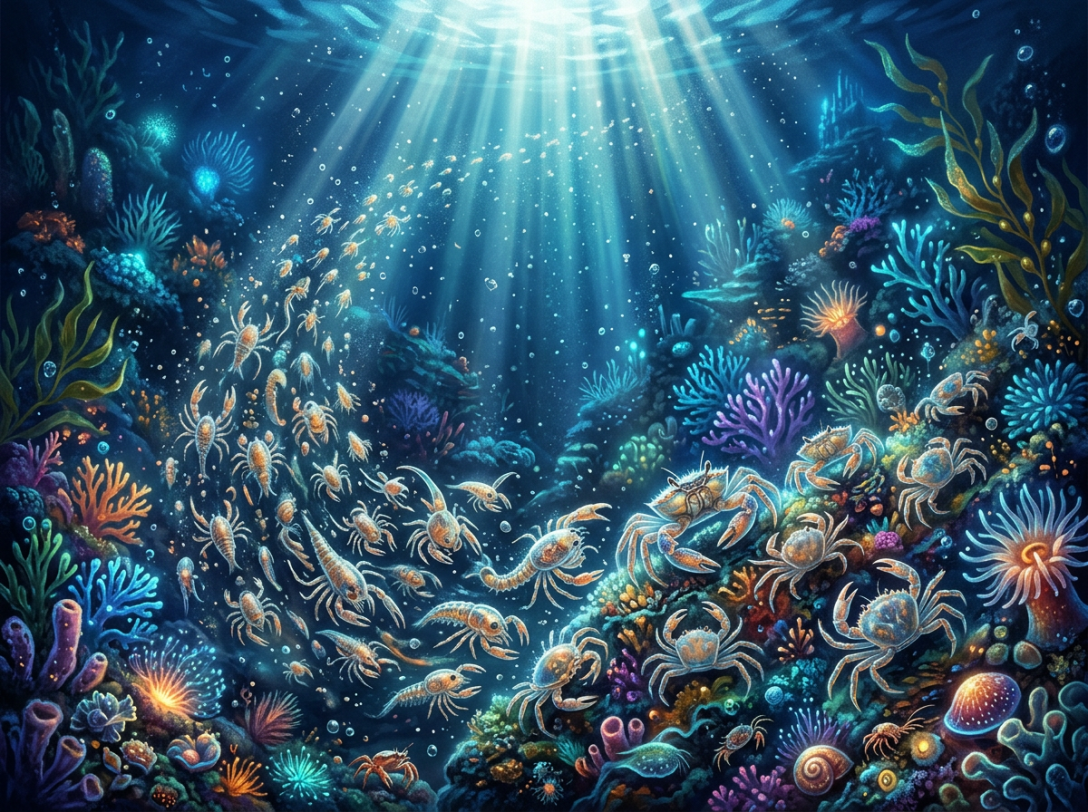
These babies, however, do not look anything like an adult crab. If I can’t recognize them, a human has no chance. They are instead, almost transparent, tiny shrimp-like creatures called zoea, that can’t even really swim, but instead drift around in the currents feeding on plankton. I spent my formative years in this weird, only semi-autonomous state, going through five stages, molting between each one, though some species have seven. If I could remember any of it, I’m not sure I would say it was fond of being so small and largely defenseless, but there was a certain serenity, a peacefulness to floating in the waters and practically having food delivered by the currents. Still, nothing lasts forever as humans are sometimes fond of saying, and before long, I found myself in a body with a radically new shape. Known as a megalopa, this stage is close enough to a crab that you would be able to recognize me as one, but tiny and dark, and rather than placing myself on the rocks along the shore, I crawl along the bottom of the water in search of food with my very small claws. As a juvenile, I slowly make my way back to the shoreline, molting and growing a little each time, before my last molt in what you would consider puberty, when I finally bear my final, vibrant, practically glowing form and striking colors. At that point, I begin my own search for a mate and repeat the process, as life in general is prone to do, but there remains something far more interesting about me than many if not most animals.
The infraorder Brachyura, the true crabs, are not the only ones that undergo a similar process and look like me while doing so. There are at least five other orders within the decapods that have evolved strikingly similar shapes in a strange case of convergent evolution. These orders include the Anomura, of which the familiar king crab is a member – which is not even a true crab and likely shouldn’t have the name, especially considering it is descended from anything but royalty, tracing its lineage to the lowly hermit crab. Within this order, there are other lineages including the fearsome coconut crab, which can measure almost three feet and dismember a person. The Porcellanidea, porcelain crabs, are so much like me, they even have the same slight differences between the sexes, where males have a shorter pleon than females. There is even an extinct order that is said to strikingly resemble crabs, the Cyclida. These similarities were so apparent that a biologist as early as 1916, Lancelot Alexander Borradaile, coined the term “carcinization” to describe it, wondering why so many different creatures seemed to be evolving into crabs, noting “the many attempts of Nature to evolve a crab.” As he put it, “the phenomenon which may be called ‘carcinization’ … consists essentially in a reduction of the abdomen of a macrurous crustacean, together with a depression and broadening of its cephalothorax, so that the animal assumes the general habit of body of a crab.” While convergent evolution, that is nature producing similar structures and strategies to deal with the same challenges, such eyes having evolved seven some odd times, fins evolving over and over again in creatures that swim, and wings at least several in those that fly, rarely does evolution produce almost the exact same overall shape, body plan, and mode of living in divergent animals. Normally, it is limited to one or more features and behaviors, and even in many of those cases the differences between the fins of a shark and those of a dolphin are very easy to spot. Though both spend their lives in the ocean, no one with any knowledge of either is likely to mistake one for another. If, however, you put a porcelain crab next to a true crab of a similar color, only a biologist would be able to say they aren’t closely related.
To this day, no one knows exactly why this is the case. The best you can say is there appears to be something special about the shape that makes it favored by natural selection. In addition to being strong, resilient, armed with claws, and allowing for the pleon to protect vital body parts, the body as whole has a lower center of gravity and this seems to allow for the evolution of sideways walking. While the advantages of moving crabwise – a behavior shared among true and non-true crabs, though not common in all species, meaning it too has probably evolved multiple times in another convergence, though to be fair a recent study said it only evolved once in true crabs – might not be obvious, they are many. First and foremost, it is believed to be confusing to predators, giving us the ability to scuttle away quickly in a direction their brains are not likely to predict. Imagine trying to jump on something that could move sideways, rather than forward and back as most animals do. If you missed, your momentum would carry you further away from the target, allowing it to escape. Second, it is streamlined compared to other modes of locomotion, requiring fewer nerve cells and the use of only two main joints, meaning it is less energy intensive. At the same time, it’s difficult to see how organisms went from one mode to another, given the huge shift in the muscles and ligature required. It is believed that a mass extinction even in the Triassic-Jurassic period that killed off almost seventy five percent of species on the planet accompanied by Pangea breaking apart, opened up enough of an evolutionary niche for this radical change to occur, but humans might never know for sure – and we’re not talking. What else do you expect? I am only a crab. I might walk sideways and I might boast one of the most successful body plans on the planet, one nature can’t help make over and over again, but everything else is a mystery to me and some of those mysteries reveal the what Darwin called the mystery of mysteries, how life evolved on this Earth. In my case, the combination of my shape and ability to walk sideways appears to be a decisive achievement, enough that nature never tires of creating me.


