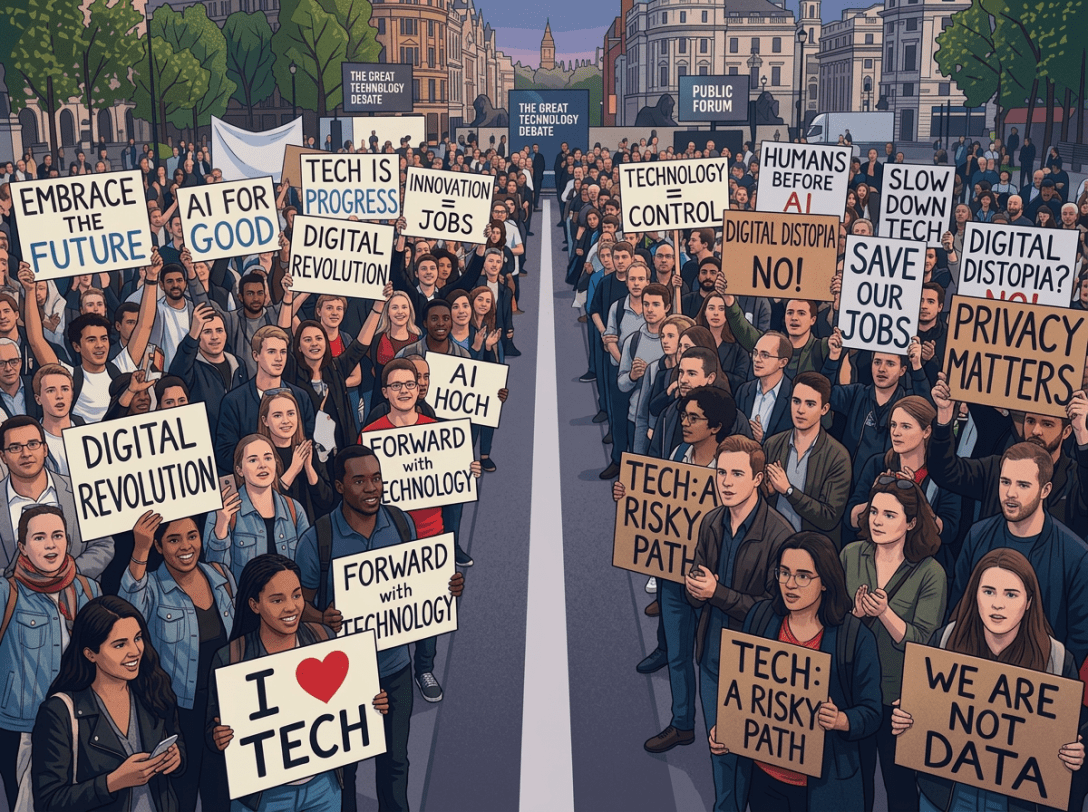
How can 70% of people be against the infrastructure for what most use on a daily basis and are only likely to use more? Has there ever been a useful, time saving technology we simply stopped using or have we tended to simply keep complaining while using it?
If recent polls are any indication, Americans hate Artificial Intelligence data centers, or perhaps even AI more generally. According to recent findings from Gallup, “Seven in 10 Americans oppose constructing data centers for artificial intelligence in their local area, including nearly half, 48%, who are strongly opposed. Barely a quarter favor these projects, with 7% strongly in favor.” Beneath the surface, the relative handful of data center supporters tend to cite “economic benefits” while those opposed are concerned about excessive use of resources, noise and air pollution, the impact on local quality of life, and concerns the promised economic benefits will never be realized and could, in fact, be negative such as higher utility bills or cost of living increases if not outright job loss. Though majorities of all major demographic groups and political parties generally oppose the construction of new data centers where they live, “Democrats are much more likely than Republicans to be strongly opposed, 56% vs. 39%, with independents between the two at 48%. Women (55%) are also more likely than men (43%) to register strong opposition to data center construction.” Incredibly, the construction of new AI data centers faces more opposition than even the old boogeyman of nuclear power plants, at least according to Gallup’s findings dating back 25 years. “The data center question parallels the wording Gallup uses to ask about local nuclear power plant construction. In the same March survey, 53% of Americans say they oppose building a nuclear energy plant in their area, far less than the 71% opposed to data center construction. Since Gallup first asked the nuclear power plant question in 2001, the high point in opposition has been 63%.”
Of course, at least some of this opposition is due to fears about AI in general. While these rage from the outlandish – literally computers taking over the world straight out of the Terminator franchise – to the mundane – it’s somehow impossible to teach kids today because they use AI – there’s no doubt that the technology will have an impact on the job market. The details might be hard to predict, but even at this early stage, computers are beginning to excel at many tasks that previously required the human mind including creative ones like writing and generating images or video. Gallup found some evidence of this in the survey itself, where negative economic effects and negative views of AI were a recurring theme in those opposed to new data centers. In the survey, the negative views included “Dislike AI/Not necessary/Don’t need it” and “Scared of AI/Don’t trust it/AI will take over” while the specific concerns included “Ethics/Privacy/Cybercrime/Misuse/Safety concerns,” “Impact on humanity/society/thinking/human contact,” “Moving too fast/Industry needs regulations/restrictions/testing,” “Too dependent on tech/Overreliance on AI/Accuracy of results,” and the potential for an “AI bubble/uncertain future.” “Jobs/AI replacing human workers” was also cited under negative economic effects, as alluded to in the first paragraph. Earlier this year, Pew Research compiled thirteen findings on how Americans view AI based on surveys taken over the past 18 months. According to their results, “Americans continue to be wary of AI’s impact on daily life” with half of respondents saying they were more concerned and excited and 38% saying they were equally concerned and excited. “U.S. adults are generally concerned about AI’s effect on creativity and relationships but are more open to using it for data analysis” with about half claiming the technology will have negative effects on creativity and personal relationships while many were open to using it for data analysis tasks, such as forecasting the weather. Similarly, “Americans are more optimistic about AI in medical care but pessimistic about its impact on education and jobs.” Overall, Pew also found that distrust was higher among progressives, “Democrats have less trust than Republicans do in the U.S. to regulate AI, according to a March 2025 survey,” though admittedly some of that may simply be President Donald Trump being in the Oval Office at the time.
If Pope Leo XIV’s new encyclical, Magnifica Humanitas (“Magnificent Humanity”), is any indication we can count the pontiff in the skeptical camp as well. In a warning that totalled a whopping 43,000 words, he cautioned that AI can erode human judgement, simulate care without an actual relationship, deepen inequality, destabilize democracy, and make war easier to use Axios’ framing. Whether you agree or disagree with each of these points, or would add your own, a rather deep skepticism was apparent from the very beginning when he compared our modern machines the infamous Tower of Babel. “Humanity, created by God in all its grandeur, is today facing a pivotal choice: either to construct a new Tower of Babel or to build the city in which God and humanity dwell together. Each generation inherits the task of shaping its own era, of guiding history to become a place where the dignity of every person is safeguarded, justice is promoted and fraternity is made possible. Yet every era also runs the risk of creating an inhumane and more unjust world. Whenever humanity is in danger of marring its true identity, we Christians lift our eyes to the Incarnate God, knowing that it is ‘only in the mystery of the Word made flesh that the mystery of humanity truly becomes clear.’ In Jesus Christ, this humanity in its grandeur becomes the Way, the Truth and the Life, opening the path for each of us to grow toward fullness.” In the Pope’s view, “we must ask God for the wisdom to interpret the great trends of our time, particularly technological advances. In recent years, it has become increasingly evident how rapidly and profoundly digitalization, artificial intelligence (AI) and robotics are transforming our world.” While “Technology should not be considered, in itself, as a force antagonistic to humanity,” “we find ourselves facing a new situation. The power and prevalence of emerging technologies are interwoven into the fabric of daily life, shaping decision-making processes and deeply affecting the collective imagination: ‘Never has humanity had such power over itself.’ New technologies open up a horizon extending in directions that are imaginable but not yet fully predictable. This complicates the assessment of their potential impact and the long-term effects they may have on both the dignity of individuals and the common good.”
Though this is probably true – no one knows where and how this revolution unfolds, much less ends, assuming it ever ends when technology has only tended to accelerate in recent years, unleashing ever new wonders on the world – it appears to me at least the proverbial genie is already out of the bottle. Despite these and other concerns, even the Pope admitted that AI has already infused itself into our daily lives and is not likely to stop. According to Pew, “A growing share of U.S. workers say at least some of their work is done with AI” with almost a third claiming the interact with the technology “at least several times a day.” Perhaps not surprisingly, younger generations are embracing AI even more rapidly. While “around half of adults under 50 say they interact with AI about once a day or more often,” “Smaller shares of those 50 and older say the same, according to the June survey. We see a similar pattern in the shares of employed Americans who say they’ve ever used ChatGPT at work. While 38% of employed 18- to 29-year-olds say they’ve done this, that drops to 30% of those 30 to 49 and 18% of those 50 and older, according to a February-March 2025 survey. When asked about the increased use of AI in daily life, younger adults are slightly more excited than older adults. Still, majorities of younger adults are wary of AI’s impact on things like human creativity or forming meaningful relationships.” Regardless of these concerns, six in ten teenagers say “students at their school use chatbots to cheat at least somewhat often. This includes about a third who say it happens extremely or very often” and even young children are starting to use it. “In a May 2025 survey, we asked parents of young kids about their child’s use of technology. About one-in-ten told us that their 5- to 12-year-old uses AI chatbots. And 11% of parents with a kid 12 or younger said their child uses a smartwatch, which often has AI-assisted features. This share rises to 21% among parents with an 11- or 12-year-old. Parents of older children are also more likely than those with a younger child to say their kid uses a voice-activated assistant like Siri or Alexa.”
Alex M. Parker, writing for Ordinary Times, recently addressed both the emerging ubiquity and some of the concerns. As he put it, “Already as common and ordinary as a Google search, LLMs are on the cusp of becoming another once new-fangled technology you can’t imagine life without, like GPS. When it becomes irremovably intertangled with our daily lives and thought processes, what happens next? The day that humanity and the giant computer mind merge into something new seems a little less theoretical than it once did, as does the day when the giant cyborg symbiosis decides that the remaining humanity is a troublesome vestigial organ that needs to be cut out and discarded. Maybe a natural point in the evolution of a species with technology is when the technology becomes the species. Well, we’re not there yet.” Mr. Parker proceeded to identify some of the challenges with current technology including generating wrong answers for no apparent reason, and that some of these problems at least, seem “oddly persistent, like it’s baked into the very concept. The promise of AI is to have a calculator that can move beyond mechanical computations and find intuitive connections, and it’s a very, very thin line to go from that to inventing connections out of whole cloth.” At other times, the AI can be technically correct, but altogether wrong. “Then there are the times where it’s right but not right—summaries that leave out something crucial, conclusions that miss the mark, or writing that just feels off. It can do a lot of verbal throat-clearing (a curious habit for a machine) and wastes time answering questions it wasn’t asked. Sometimes it feels like it’s hit the Uncanny Valley, or maybe it fell off an Uncanny Cliff.” Ultimately, he believes that “something’s missing. It sounds odd for someone who works with words for a living to say this, but it’s true: words are just words. They’re inherently imprecise, even in the hands of the greatest wordsmiths. There’s invisible meaning in between and underneath every word that’s been written. A universe built with words, disconnected from human experience, is a lesser copy, like Plato’s cave of shadows. That’s why, amid all of this chaos, anxiety and confusion, I feel an odd sort of serenity. I don’t think AI’s about to do what I do—at least, not for a while. Long enough for me to get my arms around what’s coming.”
Personally, I tend to agree with Mr. Parker, but would add that there’s an irony here that nicely encapsulates a certain, somewhat perverse aspect of the human experience. How is it possible that 70% of people are against building the infrastructure for what most of us are using on a daily basis and are only likely to use more? Has there ever been an extremely useful, time saving technology that we simply stopped using or have we tended to simply keep complaining about it while using it? While it might be easy to say the same about opposition to nuclear energy or power plants in general, energy is invisible in a sense that AI isn’t. We simply want the lights to turn on when we flip the switch and most of us tend not to give too much thought to what makes that happen, so long as it does happen. AI, in contrast, is largely in your face. Google proudly brands its search results and encourages you to dig into AI mode for more. Microsoft has made Copilot equally ubiquitous on both your desktop and your apps. Apple is pushing Apple Intelligence. Facebook, X, Amazon, and others all heavily promote their own technologies. Though it’s possible some are using AI without knowing it, the vast majority are choosing to access the technology intentionally, likely because it’s simply better than the old way of doing things, much better. Are we addicts in that sense, in need of a fix or are we claiming we aren’t willing to pay the price for a future we’re already bringing into existence? Whatever the case, we remain bundles of contradictions, doing one thing and saying another. The only thing that seems clear to me is that this genie will not be put back into the bottle, as the saying goes. For better or worse, technology is here to stay. The only question is how we adapt.


Why can’t I “like” your post here, on the reader on my Macbook Air? To like this post I have to use my phone. I’ve “spoken” to
Wordpress’s AI, and its Happiness Engineers’ several times – AI’s a bad joke, and the HEs aren’t much better. Set that aside.
In the middle of night I woke, bothered by a show I sort of remembered but couldn’t. 4am I get up and go to my phone and ask Google: “what is the show about garbage men who rob drug dealers?” It knows instantly! TASK on HBO. Now that’s something! Great show btw. However, I don’t know why I was so bothered as to be woken by that. That’s a question for Psych-girl – in the flesh. 🙂 PS, I’m not a fan of all of this; but I use it like everyone else.
LikeLiked by 1 person
Hahaha! My wife has been using the Google Speaker while cooking. For easter, we did a rotisserie leg of lamb for the first time, and it talked us through a citrus marinade, pesto crust, and finally a sauce, giving options for each, and keeping it peppy. Interestingly, my 82 year old mom is using it for lesson plans now for her grandchildren. She wrote this on Facebook:
Before Christian introduced me to AI. and taught me its value, it took me hours to complete educational unit. I’d start with Google, search references, compile data, develop plans, etc. Now I ‘tell’ AI, develop a 6th grade unit on ‘Survival Skills’ include gathering food, locating water, building a shelter and fire, etc. I can go further with ‘add a few activities around the camp fire or a scavenger hunt or identify poisonous berries or leaves. The possibilities are endless!!!
LikeLiked by 1 person