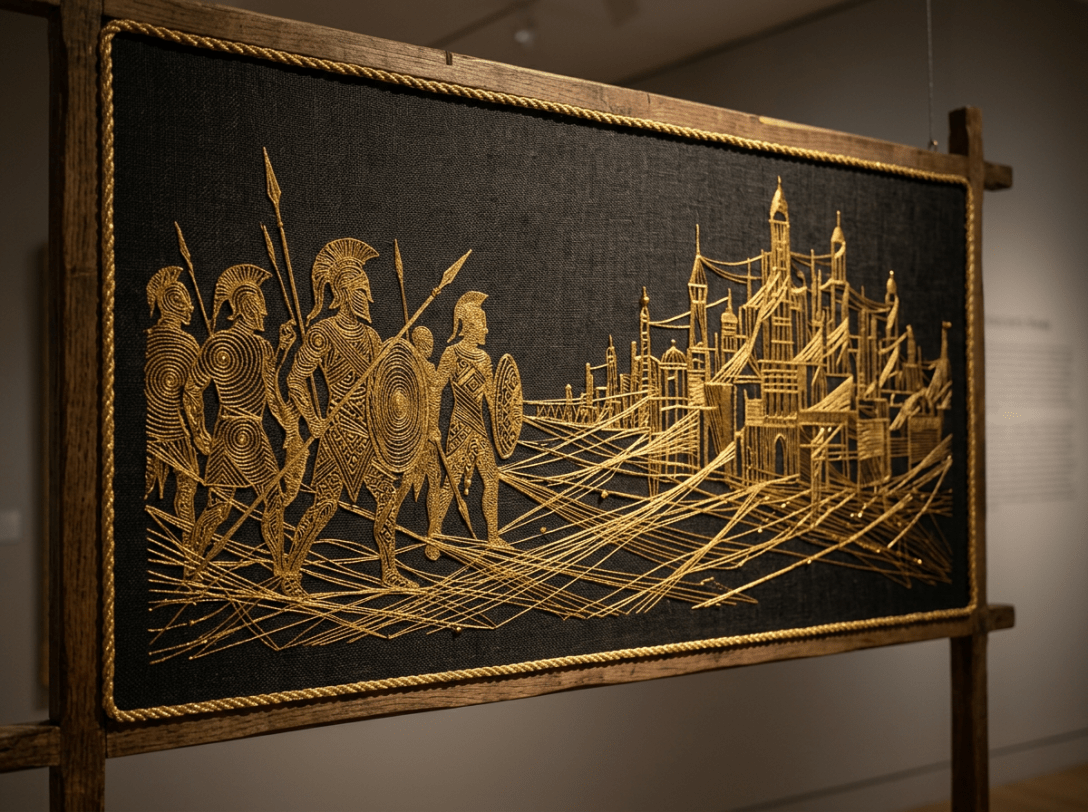
When I was born, my mother was cursed with a prophecy from the dreaded fates themselves. I could either remain at home to enjoy a long and peaceful life remembered by no one, or I could fight and die before the walls of Troy and become an immortal hero.
I am Achilles, the greatest warrior who ever lived, but I don’t want to fight. When I was born, my mother, the sea nymph Thetis, was cursed with a prophecy from the dreaded fates themselves. They told her that my future could take two very different directions. I could either remain at home to enjoy a long and peaceful life remembered by no one, or I could fight and die before the walls of Troy and become an immortal hero. Fate works in mysterious ways, however, and as I lay dying, I realize I didn’t really have a choice at all. When Agamemnon began the epic war to retrieve his brother’s wife, Helen, from Paris’ arms in the walled city, the face that would live on in history for launching a thousand ships, I wanted no part of the effort and did everything possible to avoid joining my fellow Greeks in the first place. Instead, my mother hid me among the women on the island of Skyros, dressing me in women’s clothes and calling me Pyrrha, so no one would find me even should they look, but the seer, Calchas, prophesied that Troy could not be taken if I wasn’t part of the host. Odysseus and the other chieftains were dispatched to retain my sword to prevent catastrophe and few can outwit that legendary trickster, much less a born warrior like myself. Suspecting I was hiding in plain sight, he arrived disguised himself as a traveling merchant bringing gifts to the women as a gesture of good faith, but he hid a few weapons among them to catch me out. As the gifts were displayed on a large table along with plentiful food and wine, the men and women gathered round enjoying the bounty with me doing everything possible to hide myself in my women’s clothes, one of his men sounded a trumpet, as though battle was about to begin. Even knowing my disguise would be blown, I couldn’t resist the thrill of arms. As Odysseus’ expected, I threw off my women’s robes, leapt up from the table, grabbed the shield, helmet, and sword to join the fight, brandishing it like a man on fire in the middle of the hall and frightening the other women present.
At that point, honor compelled me to join the host, but not to actually fight against the city itself, as though I could cheat the fates somehow, as many have tried and failed before me. While yet another prophecy declared that the first Greek to set foot on Trojan soil would be killed, my fifty ships were the first to storm the beaches after crossing the wine dark Aegean Sea. We arrived on the coast before the rest of the fleet, eager to capture the glory of the landing for ourselves, but something deep within me hesitated at first, whether a fear of my own death, a desire to live, or some combination of the two. Prophecies are dangerous, mysterious things, intersecting with one another in ways unknown even to the gods, who are subject to the whims of fate the same as mortals. While I was doomed to die before the walls of Troy itself and therefore, the prophecy dooming the first Greek to set foot on her soil shouldn’t have applied, no one, not even Zeus himself could say for sure. Odysseus, however, was always the clever one. He and he alone divined a loophole in the fate’s decree. Before jumping onto the shore, he threw his shield down and jumped on top of it, technically never setting foot on the beach, but poor Protesialaus, believing the prophecy was false after seeing him on land, followed immediately after and was slaughtered where he stood by the mighty Hector, soon to be my own nemesis. As Protesialaus fell, I regained my courage, snapping out of my stupor like a bow string firing an arrow, and threw myself at the Trojans with the fury I am known for throughout the ages. In a sense, I was an arrow myself that day cutting through the enemy ranks single handedly and forcing them to yield the beach. I even managed to fulfill a prophecy of my own. Cycnus, the son of the sea god Poseidon, was among the Trojan’s greatest warriors and it was said he could not be killed by a mortal weapon, but he died on the sand, leaving a corpse like any common man when I strangled him with his own helmet strap. I can remember the rage I was in; my entire mind was overcome like someone had tipped over a brazier and let a fire spread over the floor, and the only thing that could quench it was the taste of his last breaths as I held the dying demigod to me.
Afterwards, however, I refused to engage the city directly for nine long years. Instead, I set myself to ravaging the surrounding countryside, sacking the neighboring towns, and securing supplies for the Greek army. At the same time, a great warrior like me cannot simply admit their weakness and refuse to fight. I could not say that I didn’t want to die to have my name live forever and would prefer to simply live until a ripe old age as the prophecy demanded. No, I needed to make excuses as to why I wouldn’t join King Agamemnon’s host at the walls themselves and so I created a long running feud between us over the disciple of Apollo, Briseis. While the Greek army was traveling to Troy, I led my Myrmidon’s against one of their allies, the city of Lyrnessus, where I captured her, killing her husband and all her relatives in the process even though they were highly favored by the sun god. For better or worse, this didn’t matter to me at the time. I didn’t fear Apollo because my fate was already written, but as the subsequent decade unfolded I came to realize too late that no fate unfolds completely independent of all others. The sun god might not have been able to interfere with me personally – anymore than Poseidon could take his revenge for slaying Cycnus, that would ultimately fall upon poor Odysseus himself who would survive the war yet require a full decade to make it home to Ithaca – but he could vent his anger at the entire Greek army, stymying our efforts to sack Troy and setting in motion the chain of events that led directly to my death. Initially, however, it seemed a convenient excuse more than anything else. To appease my crime against Apollo, Agamemnon was forced to give up one of his own slaves, Chryseis, and he demanded I give over Briseis in compensation. Though my relationship with her had grown complicated – at some point, I would refer to her as my wife even though we were never married – this gave me the perfect excuse to quit the field and remain in my tent, hiding from my fate for those nine long years.
Fate, however, is not so easily escaped. During this time, Patroclus – some call him my cousin, others my lover, I will not say except the man was dearer to me than anyone or anything, saving for maybe Briseis – convinced me that he could take the field in my place, donning my armor and leading the Myrmidons at the edges of the battle. Though I recognized the danger, I wasn’t the first or the last to let my feelings get the better of me, relenting to the desire of a loved one eager to prove himself in combat even as I knew no good could come of it. Still, I warned Patroclus to fight defensively only as he donned my breastplate and greaves, protecting our ships on the shore instead of leading the charge and commanding him not to pursue the Trojans or approach their dreaded gates. He was young, however, and not surprisingly in retrospect, didn’t listen. Instead, he pursued the Trojans as they retreated from an attack on our ships and though he fought valiantly, Apollo chose this moment to take his revenge upon me as all of the gods looked on, even Zeus himself, who was always said to favor me personally. The king of the gods wasn’t happy that day, as he and his wife Hera watched Patroclus slay his own son Sarpedon and was powerless to interfere. As the two warriors came face to face on the field, like raucous vultures fighting over a high crag, Zeus rained blood upon the entire host in honor of his doomed son. Though Sarpedon killed Patroclus’ horse with a mighty blow, striking it in the right shoulder, and causing him to fly from the chariot when the other horses pulled away, he recovered quickly and dodged the second blow. Patroclus then threw his own spear, striking Sarpedon where the ribs pressed upon the beating heart, causing him to fall as an oak in the mountains, downed by axes. He lay there stretched at the feet of the horses, dying in a storm of blood from the equivalent of his crying god of a father.
Afterwards, the Trojans rallied and a fight ensued over Sarpedon’s body, giving Apollo the opportunity to strike. In the middle of the melee, a fog of battle impossible to describe, as the armies fought like the tides themselves – in a sense were the tides themselves with the gods directing much of the action as the moon does the sea – the sun god slapped him on the back, knocking off his helmet and clouding Patroclus’ mind in an even deeper fog if that were possible, dimming his vision, and leaving him unable to think clearly. He stood motionless in the middle of the field, unaware even where he was as soldiers were cut down around him until a spear took him in the back. Incredibly, he might’ve survived that attack, but noble Hector saw his opportunity and drove him through the belly with his own bright spear, running him entirely through. As he lay dying in the bloody mud, Patroclus warned Hector that he had only a little while left to live himself. Whether it was a divine prophecy or merely human intuition, he promised the prince of Troy that he would soon die at the hands of me, Achilles. Though Patroclus probably didn’t realize it at the time with the blood streaming from his wounds and his eyes about to close forever, he was setting in motion the final prophecy that would govern my own fate, for love – a goddess herself – can cloud the mind as much or more as Apollo. Antilochus found me already worried about Patroclus’ fate beside the Greek ships, confirming my fear that my beloved cousin had been killed, causing me to become enshrouded by a black cloud of grief. I ripped the sands and the ash, covering my face and my body, soiling my clothes, then threw myself into the dirt and wailed loud enough my demigoddess mother, Thetis could hear my lament. Even knowing it would mean my own death, I swore to her that Hector would die by my hand before the gates of Troy to avenge Patroclus. When she asked me if I was sure what that meant, that the prophecy would be fulfilled, I told her that I wanted to die instantly, the moment after Hector was gone from this world. At that, she asked only that I should wait a day for her to bring me new armor, forged by the gods themselves.
While I agreed, the gods intervened as they frequently do. Hera, their queen, compelled me to the field to frighten the Trojans, and though I didn’t directly engage, my presence and my cries broke their ranks and enabled the Greeks to retrieve Patroclus’ broken body. After conducting my lamentations and receiving my armor, I made amends with Agamemnon and entered the battle for real, ravaging the Trojans like no one before or since, seeking, always seeking Hector. Though he was brave, he knew I would come for him and avoided me on the field until the goddess Athena prodded him onward. We met, exchanged words, and commenced the greatest duel in the decade-long entire war. Hector knew he was about to die, but committed to do so gloriously, hurling his mighty spear and falling upon me like an eagle, a sick lamb or cowering rabbit. While some may insist the outcome had been decreed by the gods, the rage at seeing Hector in brave Patroclus’ armor – my armor – fueled a fire in me that exceeded even their power. I was possessed by grief-fueled anger, battering him as one might destiny itself until I found an opening. There was one spot on his entire body that was uncovered, where the collarbones knit neck and shoulders, and I thrust my spear through, killing him instantly – or so I thought. The gods, however, kept him alive long enough to beg for a proper burial inside the walls of Troy. I refused, still in the midst of my rage, and though he warned me that despoiling his remains would make my fate impossible to escape, that his brother, who started the whole war, would kill me right before these same gates, I couldn’t stop myself. I tied Hector to my chariot and dragged that great hero’s body behind me like a dog, parading him before the walls of Troy.
Despite spending a lifetime in battle, mowing people down as a farmer harvests wheat, this was my worst moment. I knew it even as I tied Hector’s body behind my chariot, that my actions were an affront against the laws of both gods and mortals, and that my noble enemy deserved better, but there was nothing to be done. I was both myself and not myself at that moment. A part of me watched in horror like my actions were driven by another, but they were driven by an anger, grief, and an insatiable desire for a humiliating revenge that was all my own and no one else’s. Ultimately, I relented and returned Hector’s body, but there was no escaping the prophecy at this point and as Hector himself foretold, his brother Paris delivered unto me an ignominious death. I did not die in fierce combat with a demigod or even a mortal. I did not fall after an epic struggle against a worthy foe. I was not run through or felled by a mighty blow. I was not risking my life to save another. Instead, I was taken in the heel by a poisoned arrow like a common soldier. Though my name has lived on for thousands of years and will continue for as long as people tell each other stories of battle and glory, this wasn’t the fate I wanted. I wanted to live and to love, and be left alone. While the events leading to my death are many, some prophesized in unpredictable ways for fate is always a complex thing, a tangled chain with many different crossed, locked ends that are impossible to divine, I did not die for duty. I did not die for honor. I did not die because it was right, or just, or morality compelled me. I did not die for any principle or universal truth. I died for love that burned into revenge, but in that, I am not the first or the last. Many might claim they died for more, but just as many are lying to themselves. Ultimately, I, like so many others, had no choice, for love compelled me.

 Confessions of a Conservative Atheist