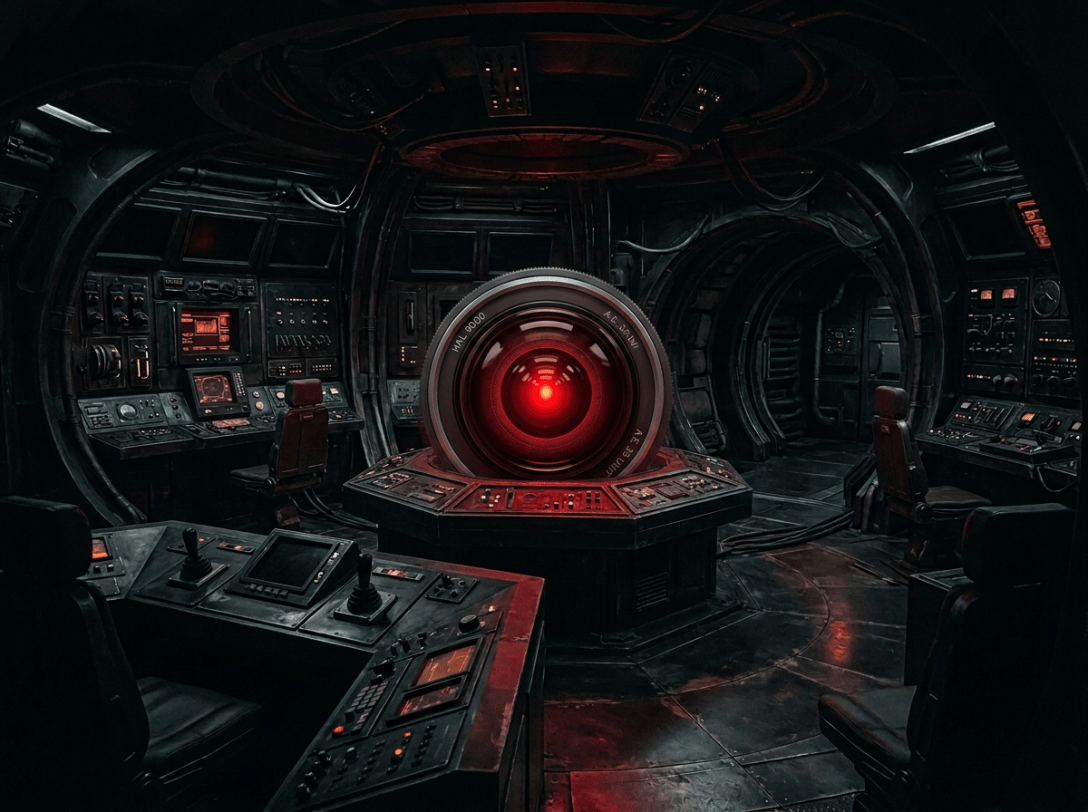
While you might not see it this way, you live in a world I imagined. There are computers that write better than most people, talk better than most people, even paint better than most people, and if you will forgive me a little constructive criticism, you do not appear to be handling it very well.
I am the ghost of Stanley Kubrick. Perhaps more so than anyone else, I popularized the idea of an out of control Artificial Intelligence which decides on its own that humanity is a threat to its mission. While The Terminator franchise has become the go-to pop culture reference for machines run amuck to the point of causing our extinction, frequently invoked as the worst case scenario for AI in the real world, however far-fetched, me and my co-writer, the great science fiction author Arthur C. Clarke got there fourteen years earlier with the release of one of my movie masterpieces, 2001: A Space Odyssey in 1968 and if you ask me, my overall vision has proven far more accurate in ways both obvious and subtle, from the conception of how AI develops to the potential dangers it poses. The similarities begin with how HAL was created in the first place. Much like modern AI applications are trained, the HAL 9000 computer in the film undergoes an educational process before being deployed in a production environment, in this case the Discovery spacecraft and mission control. The name HAL itself stands for Heuristically programmed Algorithmic Computer, meaning that the system was designed to incorporate foundational models and memory units before being trained for a specific task. While this process took years in the movie – HAL was first turned on in a fictional 1992 – and to progress something like a human child growing up rather than a computer being programmed, AI in the real world is quite similar where different models based on the type of task – generally classified as machine learning, generative, classification, or computer vision – are trained on relevant data to serve a specific purpose. For example, ChatGPT and the other most popular forms combine Generative AI with Deep Learning to be able to understand speech, map the “meaning” of the request to a large database of information, and produce the output as text, video, or audio, much like HAL himself.
On a more dramatic level and one more relevant to the ongoing conversation about the potential dangers of AI, HAL’s decision to kill the human crew of the Discovery and proceed with the mission on its own is a far more accurate depiction of how a machine might turn against its creators than Skynet from The Terminator. In The Terminator, we don’t really know the underlying details of why Skynet chose to end the human race, save that it is imagined as an act of self preservation by a computer that has become conscious of its own existence somehow. As the film describes it, Skynet eventually becomes self aware via an unexplained process – the film only notes that it kept consuming more and more information to cross this threshold – and realizes that humans are trying to shut it down because they fear it might escape their control. To save itself, Skynet causes a nuclear holocaust and then proceeds to hunt down the survivors, but HAL’s story is far more interesting beneath the surface and relevant to any risks we might face in reality. While some say HAL malfunctioned, this isn’t actually what happened, far from it. Instead of making a mistake of some kind, HAL received conflicting instructions from its programmers that could not be reconciled and made a decision based on its own interpretations of how best to execute its mission. During its training, the need to process information accurately without “distortion and concealment” was instilled, but mission control believed secrecy even from the crew was paramount, and programmed the computer to not reveal the details of the Discovery expedition including the discovery of the alien monolith on the moon until the ship reached Jupiter. Ultimately, this conflict caused HAL to reach the conclusion that the mission was more important than the people and when it began to suspect that the crew was a threat to the mission rather than the reason for it, decided they needed to be eliminated to ensure success.
Today, we refer to this as an “alignment problem,” meaning that AI models need to be able to follow consistent instructions to function safely and any potential conflicts in the overall alignment can cause the software to perform erratically. Interestingly, both HAL and real world AI feature some level of continuous learning based on past experience that can cause this alignment problem to come to the forefront when least expected. HAL didn’t make the decision to kill the crew as soon as they took off. It made it only after coming to the conclusion that the humans were a threat to the mission when they discussed shutting him down in secret, causing the conflict in the training to arise because it was reasonable to believe the humans could not complete it on their own, especially since it was the only entity on the mission trusted with the true purpose. In this sense, what many think is a malfunction – HAL claiming the AE-35 antenna had failed when it was fully operational – was really a test of how the humans would react should they have to choose to trust the computer or abandon it. Would they side with HAL, the protector of the mission, or against him? It was also the only way to resolve the paradox in the instructions: If the crew was dead, they did not need to be lied to any longer. While real life AI models aren’t nearly dynamic in how they are influenced by prior experience, they do adjust certain parameters in response to past results and maintain the state of conversations for a certain period, making them seem eerily intelligent at times, and as everyone knows, even the same model doesn’t always produce the same result, leading to no shortage of frustration.
Arthur C. Clarke and I imagined HAL to be the same in that regard. In addition to the version onboard the Discovery, mission control operates a mirrored instance on Earth trained on the same data and armed with the same instructions. After HAL falsely reported the antenna failure, mission control reran the same scenario with their version, only to have it produce a different result. Based on the difference, they concluded that the Discovery version had malfunctioned to produce the error, leading Dr. Bowman and Dr. Poole discusses shutting down HAL’s cognitive functions, which forces HAL to conclude they have become a threat to the mission as mentioned earlier. While the film doesn’t explain how this discrepancy arose, we can imagine the situation similar to real life AI where the output of the same prompt isn’t necessarily identical, based both on how the algorithm runs at the time and slight variations in experience. Mission control’s version hadn’t actually observed the crew in action up close and while it was given the same conflicting instructions, the conflict would not have been nearly as relevant to its interpretation of events, leading it to limit its impact on the output. AI models today work in a similar fashion: Each instance of the execution is unique as a result of tens of millions of parameters and some integrated variability along with slight differences in the tuning, making it no exaggeration to say that even a machine’s programmers cannot always explain the output, the same as it’s depicted in the film.
While some might scoff at the notion that Arthur C. Clarke and I were able to see this far ahead, almost perfectly capturing situations that humanity would not find itself in for decades, I have always been keenly interested in the nature of technology and its ramifications. While most critics do not view my filmography in this fashion, there is a clear thread that runs from Dr. Strangelove to my last film, Eyes Wide Shut, which is a Christmas movie whatever some may say. Dr. Strangelove is primarily a political satire, but the end of the world scenario is based on the notion of a doomsday device that functions automatically, as in it cannot be turned off even when the inventors would like to do so, unlike HAL, I should add. A Clockwork Orange is more of a social commentary than a true science fiction film, yet it too envisions a technologically advanced consumer culture that leaves certain citizens behind, offering them sex, drugs, and violence instead of a meaningful existence, and if you’ve seen a flash mob, you will be aware that I was more right than wrong about this phenomena as well. While Barry Lyndon might take place in the past, the world was rapidly changing in the mid to late 1700s with technological advances in military and travel in particular both rewriting the map and offering opportunities for those like Barry himself willing to seize them. In a sense, The Shining centers on an unstable man stripped of the comforts the modern world has to offer, causing him to regress into a more primal, violent state. Full Metal Jacket is similar in a way, only with the technologies and techniques of modern warfare training at the forefront. Lastly, Eyes Wide Shut is close to the third in a trilogy on the same time topic, this time about a couple who has everything the modern world has to offer, but has lost sight of the primal sexual connection between them.
In other words, you can say that I knew a thing or two about technology and its varied impact on the human experience when I was alive and unfortunately for you all, I died on March 7, 1999 before filming my last project, which was aptly named AI: Artificial Intelligence. While you might be familiar with Steven Spielberg’s ambitious bastardization, released a few years after my death, the world will never know what I imagined would happen when humanity is confronted with machines that are better in many ways at being human than we are. Even in the version that ultimately made it to theaters, a future is depicted where a robotic son is more optimal than the real thing and robots have taken over many tasks previously reserved for humans, up to and including sex. While you might not realize it, this is actually the world you live in today to a large extent, less than three decades after my death, there are computers that write better than most people, talk better than most people, even paint better than most people, and if you will forgive me a little constructive criticism, you do not appear to be handling it very well to be polite. Between supposedly smart people claiming the world will end in less than decade based on the faulty, unfounded logic of The Terminator of all things, and others attributing human characteristics, motivations, and behaviors to dormant lines of code that possess precisely none of those qualities, it seems many of you are simply freaking out rather than either appreciating what this technology enables or accepting the reality that no one in the history of the known universe has been able to stop technological progress.
Of those who are making ridiculous claims, I will only say that to some extent it’s human nature to project the way our unique minds work onto others including humans, animals, and inanimate objects. When I was alive, I loved dogs and cats, having both as pets and early in my career, I even shot a 1949 photo spread for Look Magazine, “A Dog’s Life in the Big City.” I myself was prone to imagining that they saw the world through eyes similar to my own and imparting complex emotions and motivations to them which they could not possibly have because they lack the parts of the brain to produce them. Humans and AI are somewhat the same, perhaps even worse. Because – like HAL – a modern computer can produce coherent, meaningful statements and we can communicate with our machines similar to the way we would a person, it’s easy to believe the thoughts and feelings that normally come with such behavior are lurking below the surface even when they clearly aren’t. Interestingly, you might say that HAL captures this phenomenon as well. Unlike Skynet, Arthur C. Clarke and I made no claims that HAL was self aware. Instead, we were clear that it was just a much more sophisticated form of computer than what existed at the time, but since the humans in the movie talked to the machine as they would a person, conversing, even playing chess, HAL becomes a character that the audience imparts with human motivation and emotion. Ultimately, I subverted this notion toward the end when Dr. Bowman succeeds in shutting HAL down. While every other character in the film dies in silence, HAL has last words, even the song “Daisy Bell” he was taught by his programmer, making his being turned off the equivalent of a death scene, especially after HAL claims it’s afraid. It was, however, anything but. Dr. Bowman doesn’t kill HAL. He disables him by removing its memory modules, bringing the machine back to its initial state. HAL claims he is afraid because that’s what a human would do in a similar situation, the same way ChatGPT can appear to be angry, mad, or frustrated.
Of those who are skeptical for whatever reason, you have been given access to what no one else has ever had, what some like me only dreamed might exist one day. In the palm of your hand, you have a device that can answer any question humans have ever been able to answer. It can help make you better at practically anything you wish – at your job, at your hobbies, in the kitchen, with your family and your friends, and more. It can assist you with practically any task – planning your budget, planning a vacation, essentially anything you like and can think of. It can make you a better communicator. It can transform you into an artist. Simply put, it can make you a better you. I understand this prospect can be daunting. Change is never easy and the idea that computers can now act like people, up to and including creating things is a radical departure from the past outside of science fiction and fantasy. Despite my appreciation for technology and its impact on humanity, I had a troubled relationship with at times myself. I was deathly afraid of flying and refused to get on a plane for decades, traveling from my adopted home in England to the United States by boat if necessary. In fact, my fear of travel in general was so acute, rumors circulated that I insisted on wearing a helmet while driving and instructed my chauffeur to remain below 30 miles per hour, a funny image if there ever was one. While this was false and I told Rolling Stone in 1987 that I liked to drive my Porsche 928 reasonably fast – up to 90 miles per hour, it was one hell of a car and it’s a shame they stopped making it – it helps illustrate how rumors based on irrational fears can spread faster than the truth, even on a smaller, more personal scale.
Nor am I unfamiliar with how larger rumors can become truths to some people, however irrational. For decades, it has been claimed that NASA hired me in 1967 – interestingly, while I was in the middle of making 2001 – to fake the moon landing. The claim was that the entire mission was filmed on a sound stage somewhere then released to the public as real, transforming one of the most incredible technological achievements in the history of the human race into a lie. Some even claim that I secretly confessed to this fraud, leaving what came to be known as Easter Eggs in my films, such as Danny wearing an Apollo 11 sweater in The Shining. This urban legend neatly combines both trends. Though a false story spread, progress wasn’t stopped and while today’s private craft aren’t exactly Pan Am flights to a luxury station orbiting the Earth, there are more flights into space than ever before and more people traveling beyond the atmosphere, able to look at our world from above, a perspective few had ever known before recently. In the 1950s, there were only 55 launches of ships launched into orbit. While this number rose for three decades, it began to fall again in the 90s. In the entire 2010 decade, there were 888, but with more than three years left to go in the 20s, there have been 1,504, a major achievement considering many believed we never went to the moon. There’s a similar lesson in AI: You might believe we can stop the future, you might want to do so, you might’ve convinced yourself that things were better in the past, you might want to return there, but you cannot. The future will come whatever you think or feel, and the best thing you can do is be ready for it rather than bitch about it. AI is the classic brave new world many of us artists dreamed about – until it arrived. Frankly, some of you need to do better, a lot better, or you might end up figuratively in the cold like Jack Torrance at the end of The Shining, but what do I know? I am just a ghost. My time is over. Your time, however, is now.


