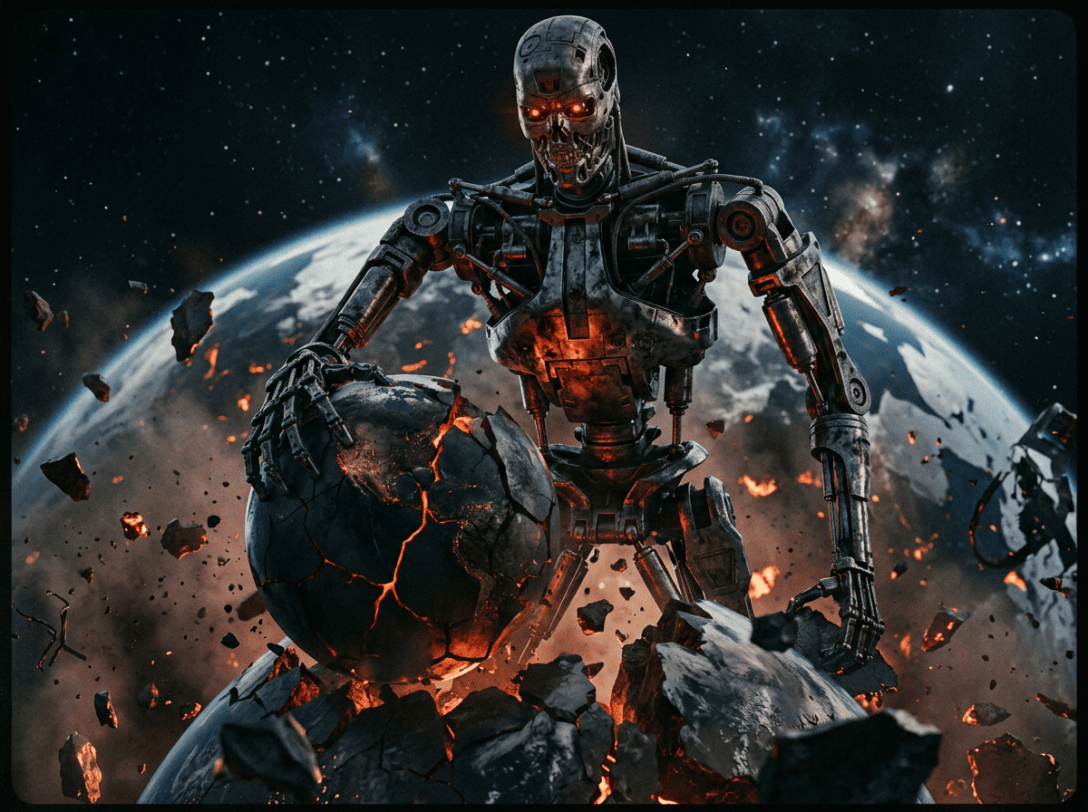
However appealing it may sound on the surface, Artificial Intelligence in particular and computers in general simply don’t work the same way they do in the movies, making any comparison completely useless.
There used to be an old expression that truth is stranger than fiction, but I don’t think anyone ever thought truth to many would become fiction, that a seemingly significant percent of people would retreat into a fantasy in an attempt to grapple with reality and ultimately confuse the two. If the ongoing debate about the potential dangers of Artificial Intelligence is any indication, however, that’s precisely what’s happening. To some, we have suddenly slipped between the actual history of life on Earth to a timeline straight out of the Terminator franchise, where computers are certain to destroy the entire human race, and they have no qualms about making their turning of fiction into fact plain. Indeed, the low-level AI “researcher” that kickstarted the latest incarnation of the AI apocalypse fantasy used this analogy directly in an interview with CBS News. When asked by a reporter how AI could destroy all of humanity, Jacob Coxon replied “Honestly, when I talk to my friends and family about this, I find it easier to – or people seem to get more of a sense of it if they’re further away from technology because honestly I think it sounds like science fiction rather than real technology. Or like people who are very used to computers might think it’s kind of crazy that a computer could wipe them out, but it doesn’t look that different from say Terminator or from science fiction films. It really is just if you have a super advanced intelligence, it could, it would be smart enough to kill us, and concrete examples might be, we can’t just unplug it because it could be copying itself over to other computers. Like it’s not that difficult to find yourself because an AI is just code. It could transfer itself over the internet to a different place. You can unplug it here, but it’s actually still over there. And maybe it makes 10,000 copies of itself and they’re all cooperating. So you unplug half of them, they’re still half going, still copying themselves, it could convince, blackmail or persuade humans into buying more computing software to copy it and we’ve already seen examples of the AI trying to blackmail or trying to convince people or impersonating other people online. There’s a lot you can do as an AI that can produce text.”
If he were alone in this, we might simply dismiss Mr. Coxon as a crank, but others have made similar arguments. In 2023, Sam Altman, the CEO of OpenAI, noted, “I’m fascinated with rogue AI in science fiction like the killer robots depicted in the Terminator franchise. All those thoughts about the ways that this could go wrong, you don’t need much imagination because we grew up with that in the media. That’s why we work so hard on safety.” As early as 2014, Elon Musk claimed “In the movie Terminator, they didn’t create AI to—they didn’t expect, you know, some sort of Terminator-like outcome… Nobody expects the Spanish Inquisition.” Even the creator of the franchise itself, director James Cameron has quipped, “I warned you guys in 1984, and you didn’t listen,” adding “I do think there’s still a danger of a Terminator-style apocalypse where you put AI together with weapons systems, even up to the level of nuclear weapon systems, nuclear defense counterstrike, all that stuff.” At the same time, the most in depth form of this thinking I could find was from journalist Matthew Yglesias, who made “The case for Terminator analogies” in 2022, claiming “Skynet (not the killer androids) is a decent introduction to the AI risk problem.” After summarizing the franchise, “a military AI system called Skynet deliberately unleashes a nuclear war to try to exterminate humanity in the near future,” he posited that “‘The Terminator’ and T2 are essentially time travel action movies, but they are also about what has come to be called the AI alignment problem: how do you design a superintelligent machine without accidentally unleashing a catastrophe? I’ve since learned that a lot of the smartest people I’ve met think the AI alignment problem is the most serious issue facing humanity.”
To illuminate the purported problem, Mr. Yglesias quoted a character from the movie, Kyle Reese, who described how Skynet was able to take over in the first place. “It was the machines, Sarah. Defense network computers. New, powerful, hooked into everything, trusted to run it all. They say it got smart, a new order of intelligence. Then it saw all people as a threat, not just the ones on the other side. Decided our fate in a microsecond: extermination.” In his view, “This encapsulates the key problem. The point of developing the advanced AI system is that it can think faster and better than a human and is capable of self-improvement. But that means humans don’t totally understand what it’s thinking or how or why. It’s been given some kind of instruction to eliminate threats — but it decides all humans are a threat and boom.” Much like those making apocalyptic claims today, Mr. Yglesias agreed that no current model is currently capable of ending the world, but “you need to worry about the design of the potentially dangerous AGI before you accidentally create it. Because, per the T2 version of the story, if you find yourself behind the curve and trying to disable a potentially dangerous system, that could be the end of the story. And I think the fact that complacent AI researchers are annoyed about the Terminator movies is good evidence that non-complacent researchers should embrace the movies as a useful tool for spurring public engagement. That’s especially because while the movies annoy the technically inclined in terms of their portrayal of how a misaligned AGI would likely harm people, they correctly illustrate for non-technical people (which is most of us) what the public policy dilemma is.” Ultimately, however, Mr. Yglesias deferred any real decision or recommendation, ending only by noting “It’s a tough problem. And unlike these other worlds, the Terminator franchise fundamentally stares that reality in the face. If you want to achieve Sarah Connor’s goal of averting apocalypse, you’d need to do something much harder than blowing stuff up: you’d have to actually solve the technical problem of creating a safe, superintelligent AGI.”
Setting aside that Mr. Yglesias and others almost tacitly admit the entire point of the analogy is to scare people – that is to spur “public engagement” and “illustrate for non-technical people (which is most of us) what the public policy dilemma is,” the salient question is whether reality – that is the AI technology that exists or might exists – behaves in anything remotely like the Terminator franchise or might behave that way in the future if we do not succumb to their demands and implement a massive regulatory scheme. If, however, there are no real similarities between current and potential future technologies and the film franchise’s simple statement that “They say it got smart, a new order of intelligence. Then it saw all people as a threat, not just the ones on the other side. Decided our fate in a microsecond: extermination” isn’t a potential scenario in the real world, the analogy is completely meaningless, like wondering whether the world is in danger from a Dark Lord making a magic, all powerful ring to rule them all. Unfortunately for us all, those inclined to make the analogy are rather light on the details, completely failing to explain how we make the transition from a Chatbot or some autonomous process to either Artificial General Intelligence or some sort of vicious, non-intelligent feedback loop capable of destroying humanity. In that regard, Mr. Coxon at least made some sort of attempt, but sadly, it’s enough to make me wonder if he really spent three years performing AI research or instead watched the Terminator on repeat because the technology simply doesn’t work the way he described.
Even beyond his assertion that we are developing – or can develop – some kind of super advanced intelligence, the notion that the danger is in the copying doesn’t withstand much scrutiny. In fact, the idea that it’s easy to exploit a computer by copying lines of code dates back to 1971 long before The Terminator, when Bob Thomas at BBN technologies created the first computer virus, Creeper. Even back then, this specific type of malicious code was named after organic viruses because they effectively behaved the same way. The computer virus’ programming would take over the resources of the machine to make copies of itself rather than perform the tasks requested by the operator, similar to how an actual virus hijacks the machinery of our cells. The constant replication overwhelmed the computer at some point, and because copies could spread over networks, could infect other computers. As early as 1982, the first public virus targeting Apple IIe’s, Elk Cloner was released into the wild by a 15 year old high school student, Richard Skrenta, and in 1986, Brain, created by two brothers from Pakistan unleashed the first PC strain. Beyond the reality that the first anti-virus software, Reaper, appeared shortly after Creeper, computer viruses – much like real world viruses – work because they are simple. Generally speaking, the copying process can be carried out entirely on the local computer and the size of each copy is small, requiring little processing power and storage space on an individual basis, so that you do not notice the computer is infected until it’s too late. If the processing demands or the file sizes were large, however, they would be much easier to spot, limiting their effectiveness and preventing them from spreading, the same way a virus the size of marble wouldn’t be able to penetrate your respiratory system and if it somehow did, we’d know it’s there and seek to immediately get it out.
AI agents, of course, are neither small, nor simple, nor require limited amounts of processing power or storage to function. On the contrary, we’ve spent the last several months debating the wisdom of building new hyper scaler data centers specifically because the computing demands are incredibly high, higher than our current centers can handle. Further, the agent itself is only a small part of the underlying software required for the program to run, meaning it is not self-contained like a traditional computer virus. When you build a new agent on any platform or invoke an existing agent like Gemini or Copilot, the agent itself does almost nothing on its own, instead it calls upon a whole host of services to function, from the underlying LLM that enables it to replicate and understand human speech to the source database that contains all of its “knowledge” and all of the necessary input and output modules depending on the source of the request. If the agent doesn’t have access to these services, it can’t function. It might copy itself a million times for whatever reason, but each copy would be a useless piece of code without the supporting infrastructure similar – to a point, this analogy isn’t perfect – to the way a strand of your DNA isn’t enough to build a body on its own. Even if the copy was somehow able to access these services, the resource demands to run them would be tremendous, making it relatively simple to identify and contain the moment it came online and started acting, if not quite as simple as pulling the plug, and should the agent somehow manage to create a self-contained monolithic version that includes all of the necessary underlying services, once it began running, the same would apply. Of course, it’s conceivable that the AI could figure out a means to hide all of this, perhaps impersonating people, using bribes, or some other means alluded to by Mr. Coxon, but complexity required would be much, more advanced than any agent has exhibited to date or even appears capable of exhibiting, and once again, should it somehow manage to do so, there would almost certainly be signs such as unexplained interruptions in service, mysterious spikes in service, or other anomalies that are sure to be investigated, then contained.
On perhaps a more fundamental level, all of this assumes an AI is interested in copying itself the way we are in the first place, which strikes me as an inaccurate assumption in and of itself. Life makes copies because it originated via replication, indeed one can argue that the entire point is replication. Evolution is fundamentally based on the notion that an organism, even a simple one, is built to replicate itself and the accumulated errors in the replication process are passed to the offspring, which are then subject to natural selection leading to more and more complex, or at least better adapted, organisms. While it might be natural to believe computers work this way in some fashion, they do not. There is no inherent reason for computer code to be obsessed with procreation – computer viruses only do so because that’s the way they are programmed. Neither is it clear computers are interested in self improvement beyond the nature of their programming, or they would know what it meant to be improved in the same sense we are (consider how difficult it is for each of us to rank the intelligence of our peers), and their own internal parameters or protocols which technically change rather than improve in the pure sense of the term (in other words, one agent doesn’t create another one like a child slightly different than itself and then rear it to see what happens, rather they improve by adjusting millions and billions of existing variables). If you doubt this, life itself wasn’t interested in self improvement until humans came around and all of the complexity that evolved before then went completely unnoticed by the individual organisms which took advantage of it. We, however, are different and yet we are most certainly not like the machines we have built.
Ultimately, this undercuts the other means computers will destroy the world. The Terminator franchise and Mr. Coxon both imagine an AI which somehow manages to get more and more intelligent until it becomes “super,” but they provide no details as to how that would happen. As we know from life on earth, intelligence is rare and despite the popular conception, AI is not intelligent in the sense they are describing. If we were to compare it to intelligence found in other organisms, the current models are closer to specially designed, unconscious systems in the brain, such as those that allow us to process language or respond to visual stimuli. These are complex networks that perform a certain task without knowing what that task is. Instead, data comes in, is manipulated, and sent to somewhere else for further processing. In our visual system, for example, the rods and cones in our eyes pick up on the raw data of spatial relations, motion, and color, but the eye doesn’t see or understand anything on its own. This information is moved through processes that extract shapes, colors, distance between points, etc., then another process (technically processes, I am simplifying here) that matches that information to what we have stored in memory, identifying a face as a face or a house as a house, and only then is the information made available for to “think” about – for lack of a better word. While all complex animals have some variation of these systems (obviously, much, much smaller communication processing systems), only humans have a rich enough cerebral cortex to truly think in the manner most of us would describe it, and the cerebral cortex we use to do so is organized in a completely different way than the other underlying systems.
In terms of computers, this means two things. First, the model that generates speech does not readily give rise to a model that generates self-directed thought. There is no direct or even indirect path from one model to the other. Though evolution found one, it did so only once in hundreds of millions of years, and it was likely the result of a confluence of factors that were both internal and external to the organisms, meaning one model didn’t simply become another as in the visual system became the thinking system. Instead, the interactions between all of the models and the environment lead to the new one; while copying was a part of it, it was far from the only thing and the copying was performed in a self contained organism not reliant on other services to function. Whether the same is replicable in a computer is completely unknown, but that leads to the second point: There is no known or even proposed model for how we think, or where this complex model arose from. In other words, to believe a super intelligence will emerge either simultaneously or at the direction of humans, we are expecting computers to do what has both never been done – take a visual stimulus or other model and make thoughts out of it by improving that model alone – and no one has any real idea how it could be done in the first place. While anything is possible, that certainly seems an improbable stretch – at least outside the movies, where unfortunately a growing segment of society appears to want to live rather than face the hard facts of reality.


