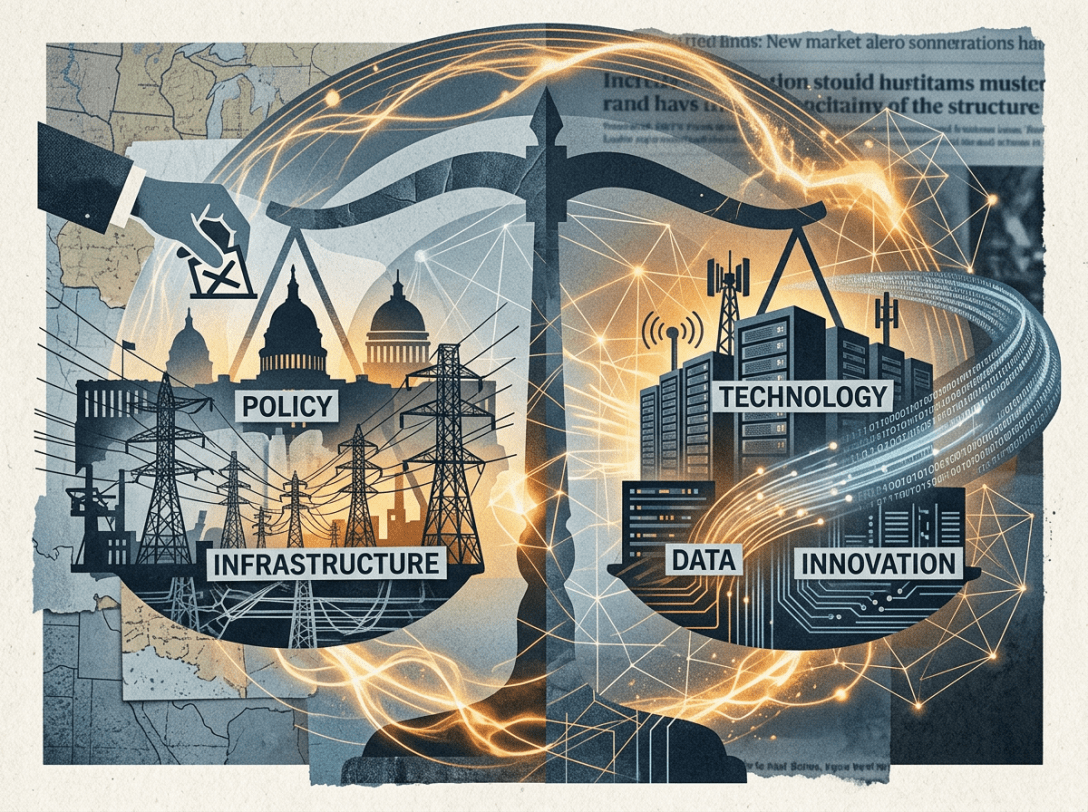
They used to say country over party. Perhaps, we should put the future over politics, and rather than behaving like craven fools politicians should lead.
If you’ve been looking for an issue that finally unites Republicans and Democrats, liberals and conservatives alike, opposition to so-called AI datacenters might be it. As the Associated Press characterized it earlier this week, “In a divided America, the left and right unite to oppose artificial intelligence data centers,” noting that “In rural eastern Nebraska, a technology revolution could rise from fields of corn and soybean in the form of new data centers to power the artificial intelligence boom. But just like around many parts of the country, opposition has been building in ways that defy typical partisan boundaries. Conservative farmers and the state Sierra Club chapter recently found common cause against labor leaders as they filled the firehouse in Murdock — population around 275 — to share concerns about data center development moving too quickly. The scene exemplified an unlikely coalition that worries about dwindling farmland, declining water supplies and rising electricity bills — not to mention how massive corporations could reshape small town America into nodes in a national network of computing warehouses.” Ultimately, they concluded “The debate around data center projects is one of the rare modern issues to cut across party lines, demographics and geography — from Republican-dominated Nebraska, Texas and Wyoming to swing-state Pennsylvania to Democratic-leaning New Mexico.”
Earlier this year, Gallup provided some measure of the overall opposition when a March poll found around seven in ten Americans against new data centers in their area. As they summarized, “Seven in 10 Americans oppose constructing data centers for artificial intelligence in their local area, including nearly half, 48%, who are strongly opposed. Barely a quarter favor these projects, with 7% strongly in favor.” While the root cause of the opposition was varied, it was generally tied to environmental, quality of life, and cost concerns over rising energy prices, points Gallup themselves followed up on in an April panel. “To gain a deeper understanding of people’s reasons for favoring or opposing data center construction in their area, Gallup asked an open-ended question on an April web survey using the Gallup Panel. Americans who favor the building of a data center in their area mostly cite the potential economic benefits. Opponents of data centers have more varied reasons for their position, but they focus mostly on environmental concerns. Half of opponents mention data centers’ excessive use of resources, including 18% each mentioning their use of water and energy. Sixteen percent mention a related environmental concern of pollution, including noise pollution and air and water pollution. About one in five opponents are concerned with the impact on local quality of life, including increased population, increased traffic and preferring that the land be used for other purposes. A similar share mention potentially negative economic consequences, including higher utility bills, cost-of-living increases, and the cost of building the data centers (which could involve the use of taxpayer funds). Most of the remaining opposition stems from general or specific concerns about artificial intelligence.”
Perhaps not surprisingly, politicians of both parties have taken notice since then, believing that they can harness this widespread opposition for their own electoral goals and least in some cases, regardless of what they’d said about the matter in the past. In July, the Democrat Governor of New York, Kathy Hochul instituted what was described as the “First Statewide Moratorium on New Hyperscale Data Centers.” “New York has always been at the forefront of innovation and change but we’ve also always guaranteed that New Yorkers benefit. As data center development threatens to hike up utility bills, deplete our natural resources, and create uncertainty for New Yorkers, it’s my responsibility to take action and lead,” Governor Hochul explained. “New York will lead the way in creating the strongest standards in the nation for data center development, ensuring that when companies succeed because of New York, New Yorkers succeed too.” Though her counterpart, Pennsylvania Governor Josh Shapiro was championing construction of new data centers as recently as last year, crowing about some $20 billion in investment, he too has begun to oppose them. Earlier this month, he signed an executive order “Demanding Data Center Developers Comply with Strict Requirements and Blocking Speculative, Irresponsible Data Center Projects.” In addition to ensuring “developers meet strict standards on energy affordability, environmental protection, workforce and economic development, transparency, and community engagement,” “The Executive Order removes all AI data center proposals from the Fast Track permitting process and prohibits the use of nondisclosure agreements for data center projects.”
Lest you think I am picking on Democrats, leading Republicans have changed their tune as well. While Texas Governor Greg Abbott hasn’t issued a moratorium, he has directed the state government to audit tech companies usage of the electrical grid, in a move that was described as “sudden” in some quarters, and he has vowed “to work with the legislature next session” to repeal technology investment tax breaks if he is re-elected in November. In Florida, Representative Byron Donalds, running to replace outgoing Governor Ron DeSantis, has taken a similar approach. “You don’t want to have happen here what happened in northern Virginia, where you basically had a data center across from someone’s front door,” he claimed to an audience of college students, referencing the region with the most data centers in the country. For this part, Governor DeSantis himself recently signed legislation allowing communities to “reject data center development” and stop “data center costs from being passed on to consumers.” Similarly, Ohio nominee for governor Vivek Ramaswamy had previously said he sought to make it easier to build “an AI data center or Bitcoin mining firm or whatever,” but has since promised to issue an executive order if he’s elected that would halt new construction unless local communities receive tax breaks and other environmental protections. Despite that Democrats have changed their tune as quickly as Republicans, the media has generally seen fit to describe the situation as unique to the GOP, meaning they are being quite a bit less fair than this humble blogger. Time Magazine described it as “The GOP’S Data Center Panic,” NBC News claimed Republicans were wrestling with “data center backlash” as “GOP candidates have sprinted to get in line with voter skepticism about data centers as they emerge as a top midterms issue,” David Weigel writing for Semafor characterized it as “Republicans scrambl[ing] to remake their stance on data centers,” and The Washington Post insisted people could “See the moment when Republican politicians turned against data centers.”
From what I can tell at this point, the expected partisanship in the media aside, President Donald Trump might be the only prominent politician in the country still championing data center development. As he put it, “Communities that don’t take a data center, they’re making a mistake,” they create “tremendous amounts of jobs and money,” and if you are concerned about energy consumption, “They’re making their own power plants. They’re building the most beautiful, you’ve never seen power plants like this.” Rather than credit him with consistency when others have miraculously changed their mind, Democrats view this as an opportunity to win on the issue even if these problems can be solved (obviously, they can) by essentially bowing to public opinion, regardless of who is right and who is wrong, more on that in a moment. In addition to characterizing it as a Republican-only issue when it isn’t, MS Now described it as a “golden opportunity.” As they put it, “About a year ago, Trump’s comment may have been uncontroversial. But today it’s a gaffe…This in turn leaves a tremendous opportunity for Democrats to respond and win on the issue of data centers. And their best bet is to coalesce around moratoriums on building them.” In their view, the public’s opposition, whether truly justified or not, “has created fertile soil for what the tech writer Jasmine Sun has called ‘AI populism,”’ which she defines as ‘a worldview in which AI is viewed not only as a normal technology but as an elite political project to be resisted.’ Who will come forward and demand that the public have a seat at the table?” Bizarrely, Zeeshan Aleem concluded the piece by rationalizing, “The good thing about moratoriums is that they are not grounded in an opposition to developing AI per se, nor are they entirely impractical about the need for technological development. What they do is ask for AI development to be subjected to the democratic process — and not imposed on the public and the world by purely profit-seeking businesses keen on eluding accountability.”
In other words, politicians can stop them without really claiming they want to stop them, merely that they should be subject to some higher form of scrutiny than typical zoning laws and associated processes, and they can do so whether or not these data centers are required to keep up the pace of technological advancement and retain our competitive edge. After all, how is that the implicit assumption underlying much of this opposition seems to be that companies are spending billions upon billions of dollars on new infrastructure they don’t really need, which is merely an “elite political project,” whatever that means, as though it’s normal for a car company to build a new plant for a car it doesn’t intend to build? What’s missing from the conversation on both sides, is an acknowledgement of the reality that people have already voted with their own actions. They can oppose whatever they want in principle, but until they actually stop using their phones, social media, maps, GPS, ecommerce, online games, streaming services, and everything else the modern world has to offer in practice, it’s like asking a drunk at a bar pounding shots of Jägermeister their opinion on prohibition. They might tell you they are for it, while breaking it every step of the way. Regardless, I can think of no other instance where the opposition to something essential, that everyone uses and takes advantage of so freely, has spread so fast and fiercely. Though some may point to nuclear energy, even that fails to capture it. People had a reason to fear nuclear power given it was announced to the world via a bomb and there was a non-zero risk of a meltdown, especially in older reactors. People could also reasonably take electricity for granted because it’s invisible – it’s used, yet not seen – and there are other ways of generating it beyond nuclear power.
AI in particular and data centers in general, however, are the backbone of the modern miracles we take for granted. Even if you do not use it directly, the services you rely on use the technology extensively on the back end to manage and patch servers, maintain operations and data quality, identify anomalies, improve security, and in some cases, build the very apps we download. In other words, even at this early stage much of what we take for granted would collapse at worst or become far more expensive at best without it. Once upon a time, it was fashionable to mock so-called “Luddites” for their opposition to technology, but at least the originals had a point. While Ned Ludd was a mythical figure, those who burned the automated factory machinery in 19th century England weren’t directly benefiting from it. Similarly, those who opposed trains, planes, cars, and every other modern convenience we take for granted, generally did so before they had whatever it was for themselves. Back then, it could take decades for a new invention to achieve widespread usage, making it easy to complain about the potential side effects in the meantime – when only rich people drove cars, criticizing them was easy – but right now, AI is already on all of our phones, powering them even if we do not use it directly. Of course, the so-called experts and the politicians know this – they’re relying on technology including Artificial Intelligence on a daily basis, literally broadcasting the message far and wide at least partially because of these advances – but because it’s politically expedient and President Trump is involved, they’re more than happy to pander to people’s worst fears and impulses without even bothering to consider how a statement could be non-controversial last year yet suddenly a gaffe this year. Was there a data center meltdown or mass extinction event in the interim? They used to say that we should put country over party. Perhaps we should update that to putting the future over politics, and rather than behaving like craven fools incapable of making a basic argument or addressing at times, legitimate concerns instead of caving to them, they should actually lead.

 Confessions of a Conservative Atheist