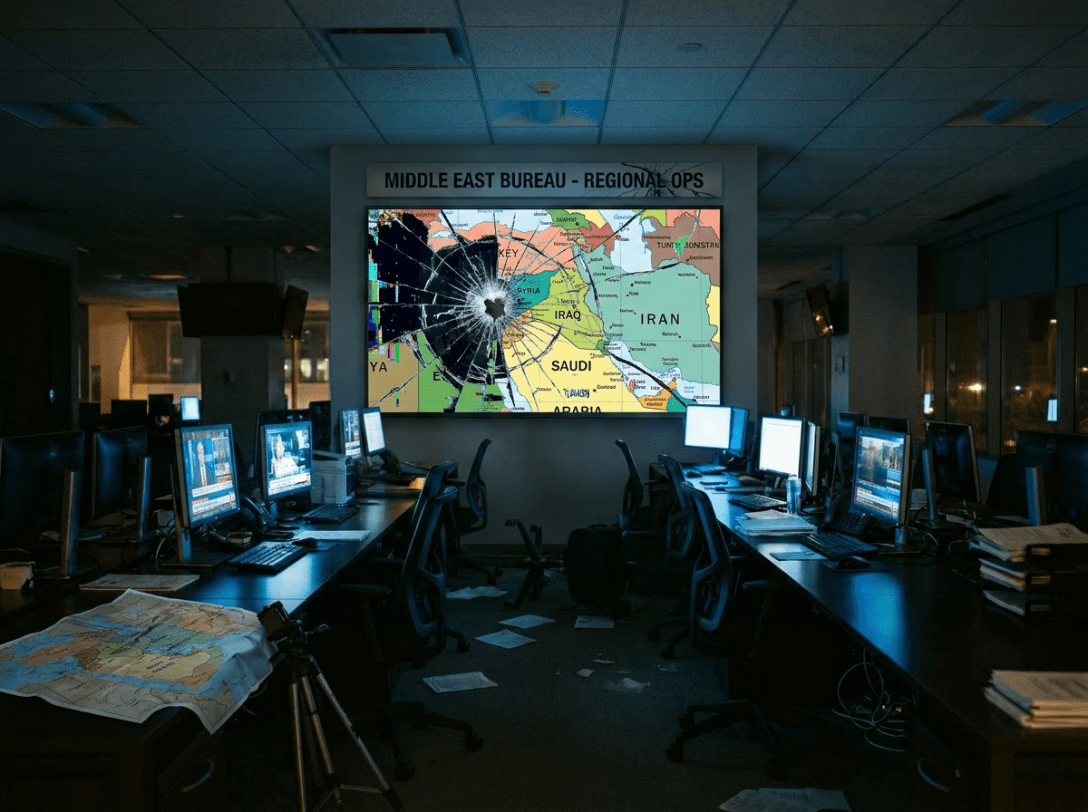
It’s almost impossible to know where to begin with the sheer multitude of increasingly hysterical claims regarding both the day to day performance of our campaign and the broader economic and geopolitical repercussions, many of which were ridiculous from the start.
As the conflict in Iran enters the third week of a shaky ceasefire with negotiations under way to reach what is likely to be an admittedly shaky resolution, it’s hard to over exaggerate how completely and totally wrong the so-called experts and their allies in the mainstream media have been over less than two months. Forget exaggerating, it’s almost impossible to say where to begin with the sheer multitude of increasingly hysterical claims regarding both the day to day performance of our military campaign and the broader economic and geopolitical repercussions that resulted, many of which were ridiculous from the start. Regardless of the claim in question, the insanity took two general forms. First, no news was ever good news. Whatever we did on the battlefield, was never enough and would never be enough, whether that be killing Supreme Leader Ayatollah Ali Khamenei, who ruled the country since 1989 on day one, or killing his top commanders such as Ali Larijani in the following weeks. Second, frequently following fast on the first, everything we did was certain to produce the worst possible outcome, whether that outcome came as some dire prediction about the future or in simply repeating the statements of our Iranian adversaries as if they were the absolute truth. The death of Mr. Larijani himself serves as a perfect example. A week before he was killed, his presence, walking in public on the streets of Tehran, was used to suggest the Iranian regime had no fear of the United States, perhaps even nothing to fear in the first place, but when he was taken out, the script suddenly flipped and his death was now seen as a reason the war would stretch on.
The New York Times’ Nicholas Kristof was among the first to posit this fantasy, writing on X, “When I met Ali Larijani I found him an absolute insider kingpin of the Iranian regime — but also the kind of strong and pragmatic leader who just might be able to hammer out a peace deal. Not sure, but I wonder if the war will now be harder to end.” The Times as a whole went on to claim, “Israel Is Picking Off Iran’s Leadership, but Decapitation Has Its Limits,” noting “Ali Larijani’s death highlights how heavily Israel is relying on targeted killings to achieve its war aims. That approach can backfire.” For its part, CNN attempted to provide additional, but equally nonsensical detail. “As Iran’s top national security official and de facto leader, Ali Larijani had emerged as the key architect of the country’s military and diplomatic strategy since the start of the conflict with the US and Israel. On Tuesday, Israel said it had killed him in a strike – a move that experts warned could prolong the fighting.” Setting aside that it’s far from clear a country launching missiles at other Arab Nations with abandon can be said to have a “diplomatic strategy” in any meaningful sense of the world, CNN continued to describe a cold blooded killer as an “astute and powerful voice” in Iran before quoting Hamidreza Azizi, a visiting fellow at the German Institute for International and Security Affairs. She repeated a variation of the oft touted claim that the Iranian government is somehow so advanced, diversified, and resilient, unlike any that has ever before graced this Earth, where leadership no longer matters except when the experts say it does. “The Islamic Republic is designed to survive the loss of individuals, but figures with such diversified experience are not easy to replace.” In that regard, Mr. Larijani was a “true insider who spent decades at the center of the system, which gave him credibility across different parts of the elite.”
Sadly, this was far from the only example. Tactically speaking, our military moves were questioned at every turn, frequently deemed completely ineffective, and presented in a broader context that we were rapidly running out of munitions, making the only possible way forward to escalate because we had lost any and all control. The Nation, for example, declared in late March that “there is no avoiding the truth: The United States is, in fact, losing this war.” Though we had reduced Iranian missile and drone capacity by around 95% in the less than four weeks preceding this article, the fact that Iran remained capable of firing any weapon at all meant that we were certain to be dragged into a quagmire. As “anyone with eyes can plainly see,” they wrote, “ the Iranian military continues to fight, not just in a flailing and minuscule way as the president implies, but with consistent levels of ballistic missile fire towards both Israel and American bases in the Gulf,” remains capable of “additional waves of attacks and shows no sign of stopping or even dropping the number of missiles and drones it fires.” As a result, “there is a growing consensus among the Trump administration that ground troops are, in fact, needed to impose the control that the US has supposedly already taken. As of this writing, thousands of US troops are heading to the Persian Gulf region, as reports swirl about a potential landing on Kharg Island, or perhaps any number of other Iranian islands in the Gulf and in the Strait, where thousands, if not tens of thousands of Iranians, could soon come under direct American military occupation. The Iranian military, for its part, has been increasing its previously bombarded defenses on Kharg, anticipating the kind of invasion its military strategists have been anticipating for most of the Islamic Republic’s history…Whatever happens next, this is not what a won war looks like. Instead, the mission creep of the war against Iran continues to lurch forward. The question of a potential new forever war that will cost many more thousands of Iranian lives, to say nothing of the American soldiers who would be in the line of direct Iranian fire, has been treated with a completely cavalier attitude.”
Of course, how we were supposed to fight this forever war while we were running out of weapons remained unsaid, but running out we certainly were, as other experts claimed. Business Insider put it this way on March 25, “US stockpiles of advanced air defense interceptors and ground-attack missiles will run dry in weeks if the fighting pace with Iran continues, three analysts have warned. Their commentary, published on Tuesday by the UK-based think tank Royal United Services Institute, indicated that the US would have depleted its Terminal High Altitude Area Defense, or THAAD, interceptors by April 17. Munitions stockpiles for its Army Tactical Missile Systems and Precision Strike Missile, or ATACMS and PrSM, would run out more quickly, by April 12, they said. The three analysts — independent researcher MacDonald Amoah and The Payne Institute of Public Policy’s Morgan D. Bazilian and Lt. Col. Jahara Matisek — projected a more dire situation for Israel’s Arrow 2 and Arrow 3 anti-ballistic missile stockpiles. Those would last only until Friday, they estimated.” “While the war could proceed with other munitions, this implies accepting greater risk for aircraft and tolerating more missile and drone ‘leakers’ damaging forces and infrastructure,” the analysis said. It is now April 22. Are we out yet? More recently, The New Yorker warned, “Defense officials inside the Trump Administration were already concerned that American stockpiles were insufficient for a potential standoff with China. A war of choice in the Middle East has only made matters worse.” In their view, “Despite spending more than eight hundred billion dollars a year on defense, the U.S. is uncomfortably short on key munitions, weapons platforms, and even some ships and planes after six weeks of fighting Trump’s war of choice in the Middle East.” “Citing ‘people familiar with the matter,’ the Washington Post reported that the U.S. used more than eight hundred and fifty Tomahawks in just the first month of the war in Iran—that’s as much as three billion dollars’ worth of a single weapon. Meanwhile, the 2026 U.S. defense budget funds the purchase of only fifty-seven new Tomahawk missiles. ‘If you’re in China, you are gleefully counting on a little hand clicker all the Tomahawks that are being expended,’ Tom Karako, who directs the Missile Defense Project at the Center for Strategic and International Studies, said. ‘Iran is not what the Tomahawk is for. Iran is what Small Diameter Bombs—gravity bombs—are for. Thousand-plus-kilometre cruise missiles are for when you have to suppress a wicked thicket of air defenses in China, because you don’t want to fly your bombers in without doing that.’ U.S. interceptor missiles and air-defense systems turn out to be similarly ill-provisioned.” Incredibly, they noted earlier in the article that the precise number of these munitions is classified, but Tomahawk missiles for example, are believed to exceed 2,000 if not 3,000, meaning we likely have thousands and yet the claims continued.
Rather incredibly, almost none of this analysis was applied to the state of Iran’s munitions and other defenses despite suffering almost 14,000 strikes, many targeted specifically at their ballistic missiles, drones, and manufacturing in addition to their navy, air force, and other military installations. Instead, whatever claim the Iranians themselves made about the level of force they could project was taken almost completely at face value, broadcast without any comment about whether such a thing was even possible in the first place. The situation can be said to have reached the point of absurdity on March 22, when Iran claimed that “critical infrastructure and energy facilities in the Middle East” would be “irreversibly destroyed” if President Trump followed through with his threat to target Iranian power plants and railways. “If Iran’s fuel and energy infrastructure is attacked by the enemy, all energy infrastructure, as well as information technology…and water desalination facilities, belonging to the US and the regime in the region will be targeted pursuant to previous warnings,” Iranian military spokesman Ebrahim Zolfaqari said. In addition, the Iranian Revolutionary Guard claimed “The Strait of Hormuz will be completely closed and will not be opened until our destroyed power plants are rebuilt,” a process that would take years if not a decade given the state of their economy. Despite off-handedly acknowledging that there had been “more than three weeks of heavy U.S. and Israeli bombardment that officials say has sharply reduced Iran’s missile capabilities,” media organizations such as Reuters repeated these claims with no skepticism whatsoever – or even any questions as to what such thing would look like given the broader Middle East is almost the size the of the continental United States and it’s not clear even a major power could target infrastructure scattered over such a large area – headlining them boldly instead, “Iran threatens to retaliate against Gulf energy and water after Trump ultimatum,” while quoting the requisite experts. “President Trump’s threat has now placed a 48-hour ticking time bomb of elevated uncertainty over markets,” explained IG market analyst Tony Sycamore, “who expects stock markets to fall when they reopen on Monday.” Markets, meanwhile, are trading at or near record highs.
Economically, most of the focus has been on oil prices as a result of the snarling of the Strait of Hormuz, and perhaps needless to say, the claims have been just as dire. Though oil prices had not risen past levels seen in both 2008 and 2022, the experts repeatedly claimed that they “could reach record highs” to quote CBS News on March 19. “Intensifying violence in the Middle East could send oil prices careening above their all-time high, raising the risk of higher inflation and slower economic growth, experts said.” At the time, “Brent crude briefly topped $119 a barrel” as compared to “record highs in July 2008, when both Brent and West Texas Intermediate, the U.S. benchmark, reached around $145 per barrel, or about $215 a barrel on an inflation-adjusted basis, according to data from FactSet.” Though we remained almost $100 below the record high in inflation adjusted dollars, experts didn’t stop there. Some claimed they could “could eventually top $200 a barrel if the conflict drags on, TD Securities said in a research note last week.” Nor were the impacts limited to oil prices alone. High oil prices were said to cause a global recession, and so the experts took the $150 figure as a fact and applied it to the world economy. As Forbes summarized it on March 17, “The Iran war has boosted oil and gas prices in recent weeks, raising concerns—and betting odds—among economists that a recession may be coming if oil costs remain elevated for an extended period.” “Mark Zandi, Moody’s chief economist, wrote Monday that a recession is ‘once again a serious threat’ and that the firm’s economic models placed the odds of a recession starting in the next 12 months at 49%, pointing to the latest decline in the job market…That probability will likely increase if oil prices continue to surge during the Iran conflict, according to Zandi, who said every recession since World War II—except for a recession during the pandemic—was preceded by rising oil costs.” The OilPrice.com website took it even further on March 31, “The world economy is heading for a ‘rare’ recession in the middle of this year as a prolonged war seems likely amid the prospect of US troops heading to the Middle East. Economists have warned that activity will fall in the middle of the year if oil prices surge to $150 per barrel and remain there for a period of four months.” Oil prices as of this morning? Under $90 got WTI Crude and under $100 for Brent Crude.
Geopolitically, the predictions were equally bad. Iran was said throughout most of the conflict to be ascendant despite losing their leaders and most of their military. General David Petraeus of Iraq War fame combined both, claiming they could emerge “militarily weakened” yet “strategically strengthened.” CNBC saw fit to repeat talking points from the American Iranian Council, simply headlining an article two weeks ago, “The U.S. has lost the war and strengthened Iran’s regime: American Iranian Council.” Globally, China was frequently seen as the real winner though they aren’t even directly involved and have done absolutely nothing of note. As Axios described it, “China wins by watching,” claiming that the “conflict allowed China to bolster its diplomatic leverage, clean-energy muscle and intelligence on the U.S. military — all without firing a shot or spending a dollar.” Somehow, China was supposed to have pulled off a trifecta of wins simply by observing from the sidelines. “The military impact is the part that should scare the hell out of Pentagon planners,” “On energy, China emerged as a huge winner of the ongoing Hormuz shockwaves,” “China’s AI push got a clear boost from the war’s second-order financial consequences,” and “The bottom line: The country that may have gained the most from this war never fired a shot.” Of course, to believe this one needs to ignore that Chinese military hardware was decimated in Iran and previously Venezuela, that China has been ejected from Venezuela and also the Panama Canal, that a weakened Iran weakens one of China’s biggest allies, that oil production in the United States is sky high and many tankers are redirecting to the Gulf of Mexico, and that the United States just signed a defense agreement with Indonesia for the Strait of Malacca, right in China’s backyard, through which 40% of global trade and 80% of China’s oil travels. Other than these things and more, China is triumphant.
As I’ve said before, one day the experts might be right and President Trump (and his supporters) will be wrong, but that day hasn’t happened yet and at the rate they’re going, it will not happen anytime soon.


Hello friend, Are you sticking by your thought that a “deal” will be struck? I lean toward only total destruction of the current Iranian “Philosophy” is necessary, and is inevitable. In other words, revolution from within or without. Maybe the current “leaders” flee (to Russia?) to save their asses. They won’t surrender. I don’t think DJT will either. It’s an impasse. Nobody trusts anybody. With good reason. There will be blood. That’s who we (humans) are. cheers
LikeLiked by 1 person
Yes, I am, but I should be clear that I don’t think a deal ends it either. Obviously, they can’t be trusted whatever they end up agreeing to in the short term. At the same time, I think a deal offers a chance for reform down the line. Regarding total destruction, I agree with you, but it’s gotta come from within. It does not work from without, as we should all know by now. 🙂
Interestingly, on the there will be blood front, did you see the civil war among the chimps in Uganda? I’ll have a post on that next week.
LikeLiked by 1 person
No, I didn’t see that. I don’t know how you do it. I agree- kick the can down the road. That is something we humans are great at.
But, we might be at a cliff, or the Abyss. Oh wait, we’ve been here before.
LikeLiked by 1 person
True, but I tend to start from the position that nothing is permanent anyway and today especially, we put too much stock in trying to come up with some perfect deal or bill, then when it’s revealed to be imperfect, we do nothing about it anyway. One of the things I like about Trump, is that everything is a grind for him. He signs the updated NAFTA, then goes immediately to renegotiating it. It’s tiring, but reflects the way the world actually works IMHO.
LikeLiked by 1 person