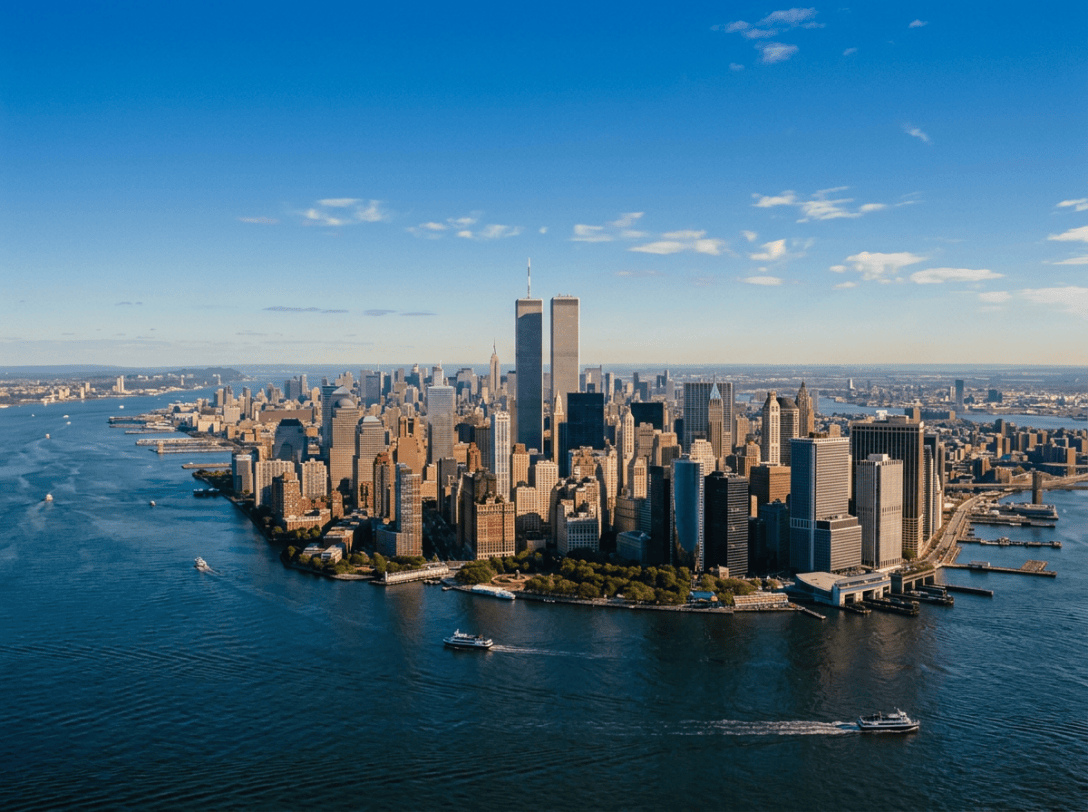
In the minute or so it took to turn off the car and walk less than fifty yards to my cubicle, the second plane hit the other tower and I sat down at my desk in a completely different world. Of course, the real question was what that world would look like.
When the first plane hit the Twin Towers, I was exiting the Garden State Parkway, a few minutes away from work on what would turn out to be a Tuesday morning unlike other, as bright, blue, and beautiful as can be with a sky that seemed to stretch on for days and yet as dark as one can be for reasons that need no explanation twenty five years later. The old-school radio in my 1994 Dodge Neon, which was pushing some 100,000 miles at that point, stinking of cigarettes and other misuse over the past seven years, interrupted their regular programming – I believe it was Q104.3, New York City’s rock station, still broadcasting today even after the satellite and streaming revolution – to let listeners know it appeared a small plane had flown off course somehow and hit one of the towers. The DJ’s seemed confused and surprised rather than horrified, convinced it was a tragic accident, and I didn’t think much of it myself, other than how the hell could that have happened? How does a plane go off course and collide into a skyscraper? I pulled into the company parking lot, surrounded by trees, way up in Montvale, NJ, the northern tip of the state, shut off the radio, and made my way into the building believing it would be an ordinary, if extraordinarily beautiful day. Perhaps, a few people would mention the strange accident with the plane, but once everyone got to their desks and started tackling their work, the chatter would quickly fade. I was a web designer at the time, working for a publishing company, and all of us had deadlines to meet. Whatever happened in New York City, however tragic it was for the few passengers, at that point it didn’t occur to me or the DJs that there’d be fatalities in the building itself, had nothing to do with us, but by the time I made it into the building itself everything had changed. In the minute or so it took to turn off the car and walk less than fifty yards followed by going up two flights of stairs to my cubicle, the second plane hit the other tower and I sat down at my desk in a completely different world.
Of course, the real question was what that world would look like. Knowing something is different, that something has radically changed and likely for the worse, is not the same thing as understanding what those differences actually are, what they mean, what unintended consequences will result, and how all of it will impact your life, indeed everyone’s lives, in the future. In that sense, the fog of misinformation – though we didn’t use that term then – following the initial strikes encapsulated the fog we would be forced to navigate for the foreseeable future, indeed until this day. The internet was a relatively new phenomena at that point, but there were news sites and blogs providing information as it unfolded, both before the towers collapsed and afterwards. As my friends and I, or at least the ones that worked office jobs, attempted to make some sense of what was occurring, reports abounded about more than a dozen potential planes in the air planning similar attacks, bombs on the Washington Mall, and other threats that failed to materialize. I don’t think any of this information, at least some of which was on reputable sites, was intended to mislead. Instead it was simply the reality of the chaos unleashed when no one at the time knew when – or even if – the attacks would stop, and in a way they didn’t. The Pentagon itself was hit, flight 93 went down in Pennsylvania, and the towers themselves fell within a couple of hours, making it seem like the entire United States itself might come down around us. Some of my friends were in the city itself, a few blocks away from the fiery explosions, then the massive clouds of smoke and debris as first one tower, then another came down. Internet service was spotty, and the emails that came in suggested they were safe, but stuck. No one knew how they were going to get out of New York, when all the bridges, tunnels, and mass transportation were shut down for obvious reasons. Less than sixty miles away in New Jersey, people were crying in the offices, shaken in a way I have never seen before or since.
Though we were a small company of about 70 employees at the time, a colleague, more than six months pregnant with her first child, lost her husband, a clear sign the fall out would touch everyone and there was no hiding from it even if you weren’t directly impacted, but at the risk of repeating myself, some of these impacts were unforeseen, hidden even in the policies we chose to pursue afterward. As we readied for war against Afghanistan, where the terrorists were provided safe haven to launch the attack, I don’t think anyone could have foretold that we’d be there for 20 years pursuing an effectively impossible mission or if the mission was possible in the first place, pursuing it ineffectively and incompetently. To be honest, I’m not certain anyone really foretold anything outside of a handful that might as well have been screaming into the wind. Instead, the vision was narrow and the need simple: Action was required, not realistic plans or well-thought out long-term solutions. While it’s hard to put myself back in the mindset in those first few months after 9-11, most wanted justice and a righteous vengeance, and next to none disputed Afghanistan was responsible. When President George W. Bush informed America we would topple the Taliban government and find Osama Bin Laden to the point of smoking them out of their caves if necessary – I believe I was at The Wiz, a now defunct electronics chain for one of these announcements, or at least I remember his face on all the TVs like something out of a movie – it seemed the most natural, logical course of action available. After all, the United States was the most powerful military in the world while it had taken three days for the tribal elders in Afghanistan to gather to discuss whether to turn over Bin Laden in the first place, journeying to the meeting place on horseback and camel. What could they possibly do to thwart our ambition?
As it turns out, quite a bit and even in those early days, the seeds of our own failure were sown, most of us – myself included – were simply too naive or blinded to see it. From the very beginning of the Afghanistan invasion, President Bush and his team embraced a fundamentally flawed concept that passed without much scrutiny. After toppling the Taliban, we would install a new government based on democratic principles, and admittedly the idea was not without a certain appeal at first. In what became known as the “Forward Strategy of Freedom,” the plan was to spread democracy around the world, particularly in the Middle East. By 2003, President Bush issued a fact sheet after speaking to the National Endowment for Democracy. “During this time of change in world history, the President said that the advance of freedom is the calling of our times. Promoting democracy and freedom in the Middle East will be a massive and difficult undertaking, but it is worthy of America’s effort and sacrifice. As long as freedom and democracy do not flourish in the Middle East, that region will remain stagnant, resentful, and violent — and serve as an exporter of violence and terror to free nations. President Bush believes that democracy and Islam can coexist. Millions of Muslims from Turkey to Indonesia to Niger have proven that Islam and democracy are fully compatible. America has accomplished the task of spreading democracy where it has not existed before, and the President believes that the advance of freedom will increase chances for peace and security for Americans as well as for the people of the Middle East.” Incredibly, they claimed even then there was “a record of accomplishment” for the policy, that included Afghanistan, and Iraq, which the United States invaded as part of the broader War on Terror earlier the same year. Though both conflicts were already showing signs of potential failure, I, at least, still believed the strategy could work. After all, we loved our freedom in the United States – and all the things that came with it, from beer to new cars in a world where technology was already starting to seem like magic – why wouldn’t they love it in Afghanistan and Iraq?
Ultimately, it seemed we were asking the wrong question, even beyond answering it in the wrong way. While it’s become something of the conventional wisdom to believe that democracy cannot be given at the point of a gun and that is largely true on the surface, it fails to capture the complexity of the underlying dynamic. Democracy was the principle we were trying to export, but principles do not govern countries, people and institutions do. In both Afghanistan and Iraq, the countries had neither. The principles simply didn’t exist – both were totalitarian states without even the most basic of freedoms – and the institutions, to the extent there were any in Afghanistan in the first place, were corrupted by their association with the prior regime. Not only did we seek to instill the principles, we hoped to build these institutions from scratch and we sought to do so in countries with competing factions and outside influences we could not possibly understand. Politics – whether democratic or totalitarian – is a zero sum game, and whatever we did, however carefully, and however fairly we tried, we ended up picking the winners and pissing off the losers even beyond an radicalism lurking in certain sects of Islam. In retrospect, it seems obvious that the entire enterprise was doomed to failure and it’s almost astounding that supposedly intelligent, experienced individuals in the expert class believed we could successfully micromanage the formation of a new government in a foreign culture with a different historical, cultural, religious, and ethnic background at the point of a gun, recreating what takes years if not decades when it happens organically on our schedule and at our command. Moreover, they didn’t simply believe this in theory, as a discussion topic in some foreign policy class, they invested trillions of dollars, thousands of lives, and our entire international presence and prestige in the effort. The result was a catastrophic failure in Afghanistan and a limited success in Iraq, even forgetting the wasted money, lives, and resulting power vacuum on the world stage that led to a more aggressive China, allied with countries even in our own hemisphere.
If that was the only way the world changed after 9-11, a lesson in the limits of our own power and well-intentioned desire to limit its use moving forward, the future would be grim, but something completely unexpected by these same experts also happened in the meantime. Though they were either uneasy allies or actual adversaries on the day the towers fell, the Arab States not directly involved in our democracy crusade, flush with oil money at least partially driven by the crusade itself when prices skyrocketed, realized they wanted a bigger piece of the global economic pie and they began heavily investing in new infrastructure that would attract international attention. The United Arab Emirates, for example, underwent a rapid modernization program that culminated in construction of the world’s tallest building, the Burj Khalifa, a 2,722 foot spire that rises from the heart of downtown Dubai. Other countries in the region followed suit. Qatar invested heavily in Doha, building an artificial island, the Pearl Qatar off the coast of West Bay, a new sports center, and other modern buildings to rival the United States and Europe. Elsewhere, Saudi Arabia’s Noem megaproject in Tabuk plans to modernize 10,200 square miles at the northern tip of the Red Sea east of Egypt across the Gulf of Aqaba, close to Jordan. Though the project has been plagued by cost over runs and delays, it can’t be faulted for its ambition. Beyond the mere size, there are plans for a man-made bay, a new airport, a floating industrial complex, a man-made skiing complex in the desert of all places, a luxury island, an upside down skyscraper, and other, more normal amenities like hotels, offices, restaurants, and shopping.
Whether it was intentional or not, building this new future required outside investment and talent, but to attract both, the countries in question needed to become more attractive. While they retained their largely authoritarian systems of government, they underwent certain key reforms that resulted both in foreign interest and a more free populace. In the United Arab Emirates, women were granted the right to vote in 2006, liquor laws were relaxed and reformed, laws preventing unmarried couples from living together were relaxed and more, resulting in a much more vibrant, dare I say Western appeal. Today, if you are fortunate enough to be in downtown Dubai you could easily mistake it for any other tropical metropolis, even if it is not properly a democracy and they don’t want it it be one. The city is bustling with people, men and women from all over the world in all different styles of dress, from the traditional to the modern, including citizens from countries with a long history of violence between them such as India and Pakistan, enjoying world-class amenities, from beach clubs to amusement parks. Other Middle Eastern countries have followed suit as well, representing a marked shift in the region. Politically, these countries might still be autocracies by our definition and in that sense the Forward Strategy of Freedom has failed, but they have also moved significantly closer to the United States, Europe, and even Israel. Though they largely opposed every action we took after 9-11 twenty five years ago, they have actively participated in and supported our efforts against Iran. In fact, other than Afghanistan, which remains stubbornly primitive – for lack of a better word – backward, Iran is the lone country in the region at this point that should rightly be considered an adversary. While we might not be best friends with the others, they are closer to us than at any period in the past fifty years and if we continue to increase our economic partnerships, we should likely be even closer in the future, closer and hopefully even more open and free.
The lesson, twenty five years later, which part of me thinks was yesterday, part of me another life entirely, is not an easy one for anyone to accept. After 9-11, the US was chastened, learning the limits of our power to direct events as we saw fit, to order the world to our liking. At the same time, we learned that sometimes the world changes for the better almost on its own, or with a little financial nudge rather than a coordinated effort. The wisdom, it seems to me, lies in knowing the difference as it applies to our personal and professional ives as well.


