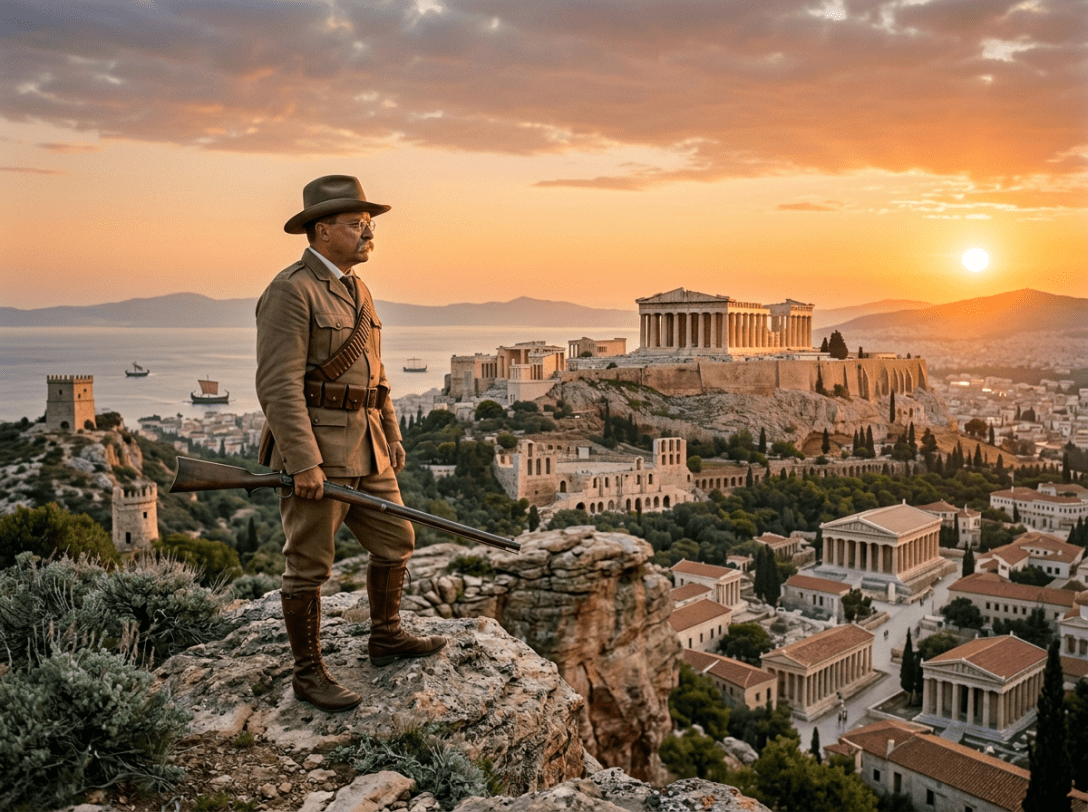
To some of the film’s detractors, casting a black woman as Helen of Troy, a transgender man as Sinon, and updating the story to reflect some aspects of modern values is an assault on the foundations of all they hold dear, but Teddy Roosevelt might disagree.
Teddy Roosevelt spent much of his life advancing the idea of Americanism. In his view, America was the pinnacle of the rise of the English begun a thousand years earlier under the reign of Alfred the Great, representing a “perfect continuous history.” Even as late as the reign of Queen Elizabeth in the 16th century, Britain and her native tongue, English was “a relatively unimportant insular kingdom,” but by the late 1800s, it held “sway over worlds whose endless coasts are washed by the waves of three oceans.” The fulfillment of Manifest Destiny, our expansion across the continent was, to him, the “crowning and greatest achievement” of this magnificent sweep of history, but crucially, Roosevelt didn’t believe it would end there, nor did he think the world would be controlled by white, proper English speaking elites ensconced in Washington, DC. He was instead a believer in what historian Frederick Jackson Turner described as the combination between intelligence, practicality, and the drive to explore new frontiers that was found primarily in the West, but could be present anywhere around the world. “That coarseness of strength combined with acuteness and inquisitiveness; that practical, inventive turn of mind, quick to find expedients; that masterful grasp of material things; lacking the artistic, but powerful to effect great ends; that restless nervous energy; that dominant individualism.” Thus, as Roosevelt put it himself, “Americanism is a matter neither of birthplace or national descent, but of the soul and of the spirit.”
As the battle raging over Christopher Nolan’s The Odyssey has expanded from the film being merely “woke” to some kind of radical subversion of Western culture, I was reminded of this and the enduring importance of Roosevelt’s vision. To hear some of the film’s detractors tell it, casting a black woman as Helen of Troy, a transgender man as Sinon, and updating the story to reflect at least some aspect of modern values is nothing short of an assault on the very foundations of all they hold dear. When conservative film critic Giancarlo Sopo, who had high praise for the film and like many others, believes there are conservative themes underpinning the venture, noted “There’s no 2,000-year rule for how this myth must look. From Aristotle to Scruton, art is mimesis: imitation of the universal, not the literal particular. Skin tone is not the essence of this story. Odysseus’s cunning and his longing for home are. It’s been remade and adapted by people of every race and nation for centuries,” the historian Christian Heins shot back on social media, insisting there is no such thing as the universal. “Stop universalizing Western Civilization’s founding myths and pretending like they don’t belong to anyone. They are a story detailing the collapse of Bronze Age Greece and the founding myth of Rome. By their very nature, they are not ‘for everyone’. The Iliad, the Odyssey, and the Aeneid ‘belong to everyone’ in the same way the Shahnameh and the Romance of the Three Kingdoms ‘belong to everyone’. Are we going to start seeing Hollywood cast a black guy to play Cao Cao too? I doubt it. The only ones who ever get erased in this endless quest towards making everything for everyone at all times is Western man himself.”
While I understand the impulse – it is undoubtedly true that if Hollywood were to start casting white people in traditional minority roles the outrage would be heard around the world – the underlying premise is misguided for two reasons in my humble opinion. First, one of the fundamental underpinnings of the Western view of art – as Mr. Sopo alluded to in his reference to Aristotle and “mimesis” – is that the greatest works are not constrained by a particular people, place, or time. The artist, in this view, does not simply copy the world he sees before him or her for posterity, recording specific events like a historian. He or she does not depict things as they are, but as Aristotle himself put it “as they ought to be.” The goal is to discover not what has happened, but what could happen in the quest for universal truths about human nature. In an illuminating passage, he compares the pull great art has on the mind and spirit as something beyond the limits of nature itself. When a person cannot turn their eyes from a beautiful statue, they do not do so because of their “incidental associations.” They do because of the art’s “intrinsic qualities” that strike us deeper than any mere time or place, touching something within us beyond our control, “no one would be considered to be unself-controlled for gazing at a beautiful statue or a beautiful horse or human, or listening to someone singing, without any desire to eat or drink or have sex, but just to gaze at beautiful objects or listen to the singing—any more than those who were spellbound by the Sirens would.”
Whether or not Mr. Nolan’s adaptation of The Odyssey qualifies as a great work of art is obviously an open question and one subject to debate, but the reality that the Western vision of art – dating back ironically to the Ancient Greeks themselves – as something far more than merely a representation of the world is well established and in my opinion, extremely valuable. Why is Shakespeare considered the world’s greatest playwright, rather than merely England’s? The answer, again in my opinion, can only be that the characters and stories he conjured are not confined to Elizabethan England. We are not Elizabethans after all, in many ways we don’t even speak the same language as any novice who’s tried to read Shakespeare can attest, but because they touch on things we believe to be universally true about ourselves, they still speak to us today and they do so around the world to the point where Maya Angelou once claimed she was convinced The Bard was a young black woman growing up in the segregated United States. Shakespeare in this view is not merely an Elizabethan playwright, he is an explorer of the human mind across all times and places, a view that is fitting considering many of the stories he repurposed, including Hamlet, predated him by centuries and originated elsewhere. How could that be the case if there was not some element of them independent of their particular origin, or was Shakespeare merely a thief, robbing another culture’s treasures?
Second, these detractors are taking a rather weak, limited, and parochial view of Western culture in addition to art. Though Mr. Heims and others are positioning themselves as defenders of the faith, their implicit assumption is that even one of the texts they consider foundational doesn’t have what it takes to survive in the modern world, unless it’s transformed into a walled garden where only those they consider Westerners can enter. Setting aside the reality that if we aren’t Elizabethan English, we certainly aren’t Ancient Greeks, meaning the average white person today in Europe or the Americas has next to no direct connection much less lineage to Homer, and the category is being almost arbitrarily defined, the driving force of the belief is that somethings are ours, others are theirs. Rather than believing as Roosevelt that Western culture is of universal value to the entire human race, a flowering of values, customs, and knowledge benefitting everyone instead of merely those they define as the inheritors, they see it as something that belongs to an exclusive, admittedly impossible to truly classify subgroup. If other groups lay claim to it anyway, the culture as a whole is somehow devalued. In many ways, this is the progressive view of “cultural appropriation” in another guise. The same way a white or even black American cannot write music inspired by Latin or Reggae rhythms, create recipes inspired by Asian traditions, or tell stories either inspired by or taking place in cultures that are not their own according to adherents of this view, a minority can no longer participate in or perhaps even enjoy a work they consider foundational. As I have previously argued, this, in my opinion, is antithetical to the nature of art itself, which necessitates absorbing the fullness of the world around you regardless of the origin of any aspect, and perhaps even worse in some ways, it also strikes me as incredibly dim and restrictive. If I find beauty in something outside my heritage, why am I somehow barred from enjoying it for fear I might damage or pollute it in some way?
In a further irony, many have made complaints that Mr. Nolan has updated the moral framework of Ancient Greece, which was wild and by modern standards absolutely barbaric, to something closer to a Christian ethos, but doesn’t that claim undercut the entire Western civilization argument? Whether or not it’s strictly true – I haven’t seen the film and cannot accurately comment – it does lead to a conclusion at odds with the purported champions of Western civilization. As important as Homer surely was to Greek, Roman, and then world literature, we no longer live in his world. The foundations of art, ethics, morality, politics, mathematics, and science have all been revolutionized, in some cases many times over, meaning as of today, Homer is foundational to nothing and no one – unless you believe the work possesses some universal aspect. For that matter, one need not go back to Homer to see such revolutions. The world of 15th century England would be largely unrecognizable to us, leaving it adrift as well. Indeed, one can argue that almost everything in Western culture before the first English Civil War in 1642 belongs to a time that has vanished, but of course, no one does so because aspects of that time exist beyond it, living on to his day in a different form. Thus, Aristotle and Roosevelt have the far superior position in my opinion. The same way art no longer belongs to the artist once it enters the world, it cannot possibly belong to a certain people, especially a group that is incredibly ill-defined and no longer truly exists. Instead, the strength of the art and the culture is its universality and spreading it further than the creators could’ve possibly imagined is both desirable and exactly what they would have wanted, or at least as an unknown creator myself, I can only dream that some time in the distant future someone will be stealing my stuff.

 Confessions of a Conservative Atheist