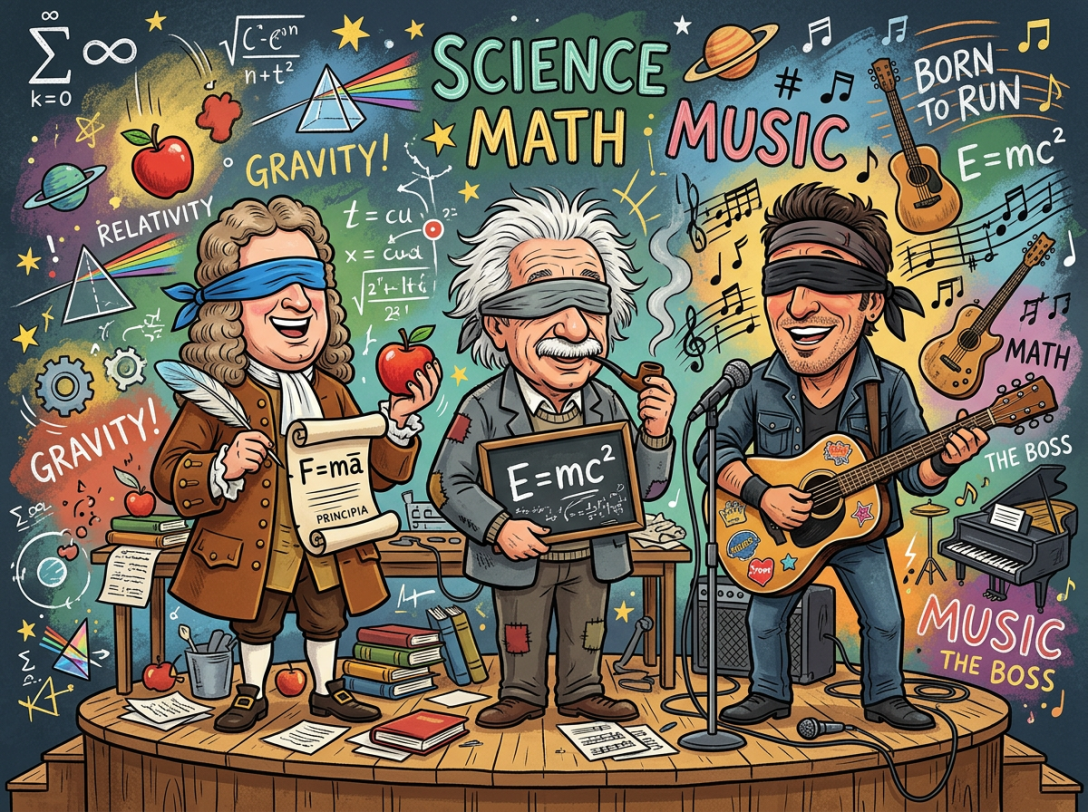
While Bruce Springsteen isn’t a scientist or a mathematician and is not likely to develop any grand theories of space or time, he appears to have developed a similar flaw in his thinking late in his career.
Sir Isaac Newton was both one of the world’s most brilliant physicists and a devout Christian. When he realized his new theory of gravity held that the universe would collapse given enough time because of the attractive force inherent in matter, he refused to accept that God’s creation wasn’t eternal and rather than follow his own idea to its logical conclusion, posited that the universe must be infinite instead, believing time and space that stretched on forever would prevent the dreaded collapse. The only problem: Another of his own achievements proved that wasn’t the case. If you apply concepts from Newton’s calculus to the gravitational theory, an infinite universe collapses in exactly the same manner. As the radius of the universe reaches the limit of infinity, the force generated keeps growing at the same rate, but when he was confronted with this truth, Newton continued to refuse to trust in his own theory, claiming instead that God must make tiny corrections to keep the universe stable. Today, however, we acknowledge that the universe is finite and we believe it is expanding, which counteracts the pull of gravity. Newton, at least in principle, could’ve hit upon that idea two centuries earlier. What advancements did the world miss because one of the greatest scientists whoever lived was blinded to some of the key conclusions of his work by another set of beliefs? To a large extent, Newton’s scientific successor, Albert Einstein made the same mistake for almost the same reason. After formulating his own theory of gravity, the general theory of relativity, he too refused to accept that the universe could be constantly changing, either collapsing or expanding, and to prevent that catastrophe, the equally brilliant scientist added an unnecessary parameter to his equations, the Cosmological Constant, to ensure the universe didn’t collapse. Barely a decade later, the famous astronomer, Edwin Hubble, discovered that galaxies appeared to be moving away from us, leading to the conclusion that the universe was expanding instead of constant. Confronted with this discovery, Einstein was said to remark that adding the Cosmological Constant was his “biggest blunder” and regretted he did not follow his own theory to arrive at the discovery of an expanding universe ten years earlier.
Though Bruce Springsteen isn’t a scientist or a mathematician and is not likely to develop any grand theories of space or time, even as some theorists argue that music is math and of course, the more great music in the world, the more beauty for everyone to enjoy, he appears to have developed a similar flaw in his thinking late in his career. As a man, Springsteen has always been a liberal. While he was less vocal about his political preferences in his earlier years, one of his most legendary concert performances was at 1979’s “No Nukes” rally at Madison Square Garden and he only became more vocal from there. By the late 1980s, he was urging fans not to vote for President Ronald Reagan’s successor, George H. W. Bush, and by the early 2000s, he was actively campaigning against his son, George W. Bush. After, he championed Barack Obama, raged against Donald Trump, championed Kamala Harris, then raged against Donald Trump some more, leading us to the present. Throughout this same period, there has also been Springsteen the artist and creator, whose unique ability to channel the challenges and opportunities, hopes and fears, desire and defiance of the working class allowed him to amass what he himself referred to a “pirate’s treasure” in a self-referential song and achieve the heights of world fame. Crucially, however, these two sides of his personality are not the same, anymore than the two sides of Newton or Einstein (to be sure, Einstein’s religious beliefs were more complicated, but he still embraced the same notion of a stable universe). As is true of us all, humans are bundles of contradictions, where one mode of thinking exists independent of another. While most of us aren’t legendary rock stars or world-changing scientists, each of us tend to be different people at home, at work, with our spouses or loved ones, with our family. with our friends, doing and thinking things in one situation we might not in another, and genius is no different.
In Springsteen’s case, his artistic personality somehow managed to discern a near universal truth about life in America in the late 1970s, 1980s, and beyond, but that truth was never political whatever he himself may claim. As I and others have noted, a strict reading of (most of) his songs – even during his far more political periods – doesn’t lend itself to either a liberal or a conservative interpretation. Instead, the characters and the stories they find themselves taking part in are set against a backdrop of a much wider range of forces, many of which go well beyond politics. The speaker in “The River,” for example, faces challenges that are cultural – he comes from “down in the valley, Where mister when you’re young, They bring you up to do like your daddy done” and is forced to marry a woman after getting her pregnant – and economic – he got a job working construction, but “lately there ain’t been much work on account of the economy.” Whether the man in question is a Democrat or a Republican – given the reference to a “union card” in 1980, there’s some reason to believe he might be a Democrat – is irrelevant to the reality that he’s trapped in a situation he cannot control, questioning how he got there and whether the magic he felt with his wife when they were younger was either real or meaningful. When he laments:
Now all them things that seemed so important
Well mister they vanished right into the air
Now I just act like I don’t remember
Mary acts like she don’t care
But I remember us riding in my brother’s car
Her body tan and wet, down at the reservoir
At night on them banks I’d lie awake
And pull her close just to feel each breath she’d take
Now those memories come back to haunt me
They haunt me like a curse
Is a dream a lie if it don’t come true
Or is it something worse
He doesn’t do so as a liberal or a conservative. He does so as a human being. Similarly, the same is true of Springsteen’s classic “Badlands” released two years earlier, when another speaker feels trapped by his life. This time he “don’t give a damn For the same old played out scenes,” he “don’t give a damn for just the in-betweens.” Instead, he wants “the heart,” he wants “the soul,” he wants “control right now.” If anything, “Badlands” builds to an even more universal statement independent of politics. After spending years “workin’ in the fields” and “workin’ ‘neath the wheels,” the speaker has learned a thing or two about life, namely that “Poor man wanna be rich, Rich man wanna be king, And a king ain’t satisfied ‘Til he rules everything.” The poor man, rich man, and king in question, however, are neither Democrat nor Republicans. Instead, they’re simply human beings, the same as the speaker in both songs, who by our nature generally want more than we have, believing there is some state we might reach where we will be satisfied even as a part of us is aware that’s far from the case. Further, the apolitical nature of Springsteen’s songs certainly doesn’t end with these two alone. I could pick almost any – such as “Something in the Night” where the speaker rages that “Soon as you’ve got something they send, Someone to try and take it away,” even “Born in the USA,” which has generally been seen as anti-American, except for the pounding, fist pumping music, and the ra-ra chorus – and read whatever politics I choose to into it because in the songs themselves, politics are largely subservient to the far more universal truths of human life and human nature. Indeed, I have even argued that some of his more overtly political work later in his career can be read as conservative.
Of course, some of Springsteen’s detractors might argue that this ability doesn’t matter because Springsteen himself has never had a real job in his life and is in that sense, a fraud, forget a genius. Setting aside that he admitted as much in his memoir, Newton wasn’t the apple which supposedly hit him in the head, Einstein wasn’t a beam of light, and in the artistic world, Shakespeare wasn’t Hamlet, Macbeth, or King Lear, and John Milton certainly wasn’t Satan. It’s the nature of genius to see beyond who and what you are to a point where others can’t. For whatever reason Newton, Einstein, and Springsteen were able to do that to a point, but at some point their vision failed them because it was occluded by another competing perspective. In Springsteen’s case, he spent decades being able to place himself in the minds and lives of working class characters for whatever reason, and yet as he approaches the end of a stellar career, can no longer seem to do so. Whatever he might think about President Trump or the state of our current politics, there is no doubt the characters he once specialized in – those he once understood on some deep, emotional level – feel quite differently than he does. Despite Springsteen’s ire and efforts on the campaign trail, working class voters in 2024 chose the President over his opponent, Kamala Harris by a significant margin, besting even Ronald Reagan’s performance in his landslide election victory, capturing 66% of the vote compared to 56%. The American Enterprise Institute described it as nothing short of a “Working-Class Realignment” immediately after the election, noting that the shift was true of both the largely white voters Springsteen has sung about and minorities. “Though the Democratic Party has sought to represent working-class Americans, these voters have steadily shifted away from the party. Initially, white working-class voters shifted right, and now Asian and Latino working-class voters are following,” they claimed based on an analysis of exit polls.
While we can assume Springsteen is aware of this realignment, his political self has gotten the better of his artistic self, and rather than attempting to do what he’s done for decades, placing himself in the minds of one of those voters and understanding why they have changed while he hasn’t, he’s been completely unable to do so, at least so far. Instead, his political side has been reduced one of the world’s foremost singers and songwriters – as you know, I would argue THE foremost by a wide margin – into the equivalent of a parrot, spouting the same talking points about President Trump as every other progressive, unable to say anything new or add anything meaningful to the discourse. Perhaps he might recover his artistic sensibilities one day, recognizing the truth he sang that all men want to be king, not simply Donald Trump or another Republican, but regardless, he’s neither the first, nor the last genius to lose sight of what made him so in the first place.


