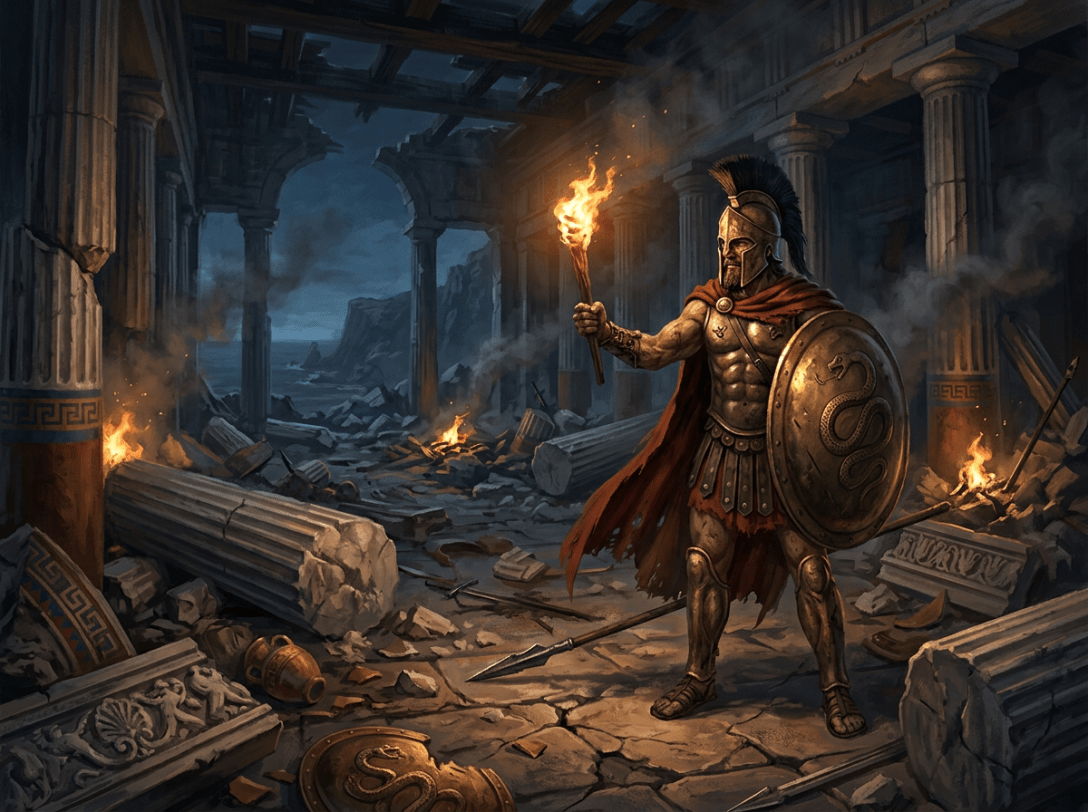
Thousands of years later, some will claim I’m no hero because of these horrific, bloody actions and the moral code I live by is too alien for the modern world, but I beg you to wonder, is that really the truth or is it merely something you say to yourselves to make you feel better?
I am Odysseus, I have slain the Suitors who ransacked my home, and am about to execute twelve women for treason. History might not judge me kindly for this bloodshed, considering these actions to be bloody revenge rather than justice, but as ever, the truth is far more complicated and the nature of my decisions more subtle. When I arrived home after twenty years of waging war and roaming the high seas, suffering perhaps more than any mortal alive at the time at the hands of the even more vengeful gods, Ithaca was effectively under siege from within. Believing I must be long dead despite receiving various reports of my whereabouts, a group of nobles from the surrounding area led by Antinous sought to steal my wife, Penelope, my lands, my people, my crown, and kill my son, Telemachus. Though dear, faithful Penelope did everything possible to hold them at bay by refusing to accept any marriage proposals, claiming that she was completing a work on her loom to honor me before deciding who to wed, only to unravel what she’d completed every night and start again, they pretended to be guests of the court, ensconced themselves in my dominion, and ravaged the surrounding area, stealing the livestock and food from my people, leaving them poor and practically starving, spreading much misery through a normally happy and prosperous land. While these actions alone would’ve warranted a death sentence, they insulted and abused me personally, violating one of the few rules by which the gods themselves abide, xenia, the sacred law of hospitality.
This, I experienced for myself to be absolutely certain. Before concluding they must die, I entered my own home disguised as a beggar to observe their behavior first hand. Antinous, as I had heard, was the ringleader. Rather than taking pity on a poor stranger, he mocked my haggard appearance almost the moment he saw me led into the palace. “What god is it,” he asked, “who brings this creature here to blight our feast? Get away from my table, stand over there in the middle, you insolent and shameless beggar, lest you end up in a place more bitter than Egypt or Cyprus. Every man in turn you try will no doubt give to you without conscience or restraint, since there’s never a thought of holding back when there’s plenty to hand, and they’re making free with another man’s wealth,” he bizarrely remarked, considering that’s exactly what he himself was doing. “How’s this?” I replied calmly, with the clever tongue that has made me famous for thousands of years “It seems your brains don’t match your looks! If you can’t bring yourself to break off a piece of bread, when there’s plenty here, and give it to a suppliant at another man’s table, is it likely you would give even a grain of salt from your own?” Though I had only stated the truth in a way, it angered Antinous further, prompting him to grab a stool and strike me, a defenseless man, on the back, below the right shoulder, but still I stood firm, having suffered much worse in war. Not to be outdone, Eurymachus taunted me next, claiming he would hire me to work his fields, but “I doubt you’d care for hard work, since you’ve learned bad ways. You’d rather skulk about, begging to feed your greedy belly.” At this, I alluded to my own return rather than ignoring the insult, prophesying their doom though they were too blind to hear it by saying, “if Odysseus came back to his own land, those doors, wide though they are, would prove all too narrow for you as you fled the threshold.”
Nor was this the end of the insults heaped upon me or even the abuses given to the gods themselves in my own house. Telemachus, already following in his father’s footsteps in being clever for his age, set me next to them in the great hall at a shabby table and small stool to better observe their behavior. After serving me a portion of food with his own hand, he chided them further by bidding me, “Sit here, among the noble Suitors, and drink your wine, and I will protect you from any insults and violence. This is no common house, but Odysseus’ palace, and destined to be my inheritance. And you Suitors can keep words of abuse and blows from your thoughts, and make sure there’s no sign of a quarrel or a brawl.” Ctesippus of Same, a man known as an untrustworthy scoundrel eager to bed my wife, though that was far too common as you can see, was the first to rise to the bait, mocking the very idea of Zeus’ hallowed guest rites by declaring, “Pay attention to me, you noble Suitors, and hear what I have to say. The Stranger has received a fair share, as is fitting, since it is right not to fail in hospitality to Telemachus’ house-guests, whoever they may be. Come, I too will give him a guest-gift, and he can give it as a present to a bath-girl or one of godlike Odysseus’ other slaves” before hurling an ox hoof at my head, some gift considering it wasn’t even his ox to begin with. Though Telemachus managed to shame the Suitors into silence briefly afterwards, their heads were so clouded with their own glory, greed, and sense of righteousness, only the godlike Thecolymenus, a seer and priest of Apollo, was wise enough to understand the danger they were in and the fate they were taunting. As they laughed, he foresaw the Suitor’s deaths in another prophecy they refused to heed, saying “Oh, you luckless men, what evil is this you suffer? From head to toe you are shrouded in darkness. The sound of weeping rises and your cheeks are bathed in tears, while the walls and panelling are soaked with blood. And the porch and the court are filled with ghosts, ghosts hurrying to Erebus by night: the sun has vanished from the sky, and a foul mist blankets all.”
Rather than recognizing the influence of the gods at work urging them to renounce their ways or realizing the beggar before them might be more than he seemed, Thecolymenus too was mocked, declared mad and sent packing from the great hall against his will, to which he answered, “I need no helpers of yours to show me the way. I have ears and eyes and feet enough, and a sound head on my shoulders. They will guide me past the doors, since I foresee evil coming to you, that none of you Suitors can evade or escape, not one of you who display violence, and plan your mindless wickedness in godlike Odysseus’ house.” Upon his departure, the Suitors immediately turned their ire back to me in disguise, taunting Telemachus for bringing “such a lousy beggar as this, always after the bread and wine, and without a job in peace or war, an encumbrance on the earth,” but by then, their fates were sealed. They would listen to neither humans nor gods. It might have been one thing to insult a king in his own house, attempt to steal his kingdom, his wife, or kill his son. Such were the ways of war and the vicissitudes of fate for mortals, but despite being given multiple chances to properly honor the will of the gods, only Thecolymenus recognized the truth. The rest heaped insult on insult, and continued ravaging my home, demanding my wife surrender what was left of my kingdom and her own marital vows. While I was more than weary of war and bloodshed, justice – to me, my family, my lands, and the gods – required me to act and further steep my hands in gore, but even then, I was not completely without mercy, though many fail to remember that part of the story.
After throwing off my rags and revealing myself to the suitors during the contest for Penelope’s hand, I wielded the bow that none of them were strong enough to string and taunted Antinous myself, saying, “Here is a clear end to the contest. Now I’ll see if I can hit another target no man has as yet, and may Apollo grant my prayer!” I hoisted the bow to my eye and took aim at the chief villain, striking him through the neck while he held aloft a golden, two-handed cup as if he were invincible, the lord of this domain instead of a vile, corrupt, godless interloper. He flopped to the floor, blood gushing from his neck, throat, and nostrils like a human volcanic eruption, and died kicking at the table, spilling and fittingly, fouling the food. Even then, the rest of the Suitors still remained ignorant their doom was upon them, believing this was some kind of accident or mistake, that the man they thought was a beggar had fired falsely. Rather than repenting of their own crimes, they insisted I would pay for this crime until I declared myself plain, “You dogs! You thought I’d never return from the land of Troy, so you laid waste my house, forced my maids, and wooed my wife in secret though I was still alive, without fearing the gods who rule the wide sky, or that mortal vengeance would find you. Now the net of fate is thrown over you all.” The recognition I was among them finally prompted them to a necessary, righteous fear, but only Eurymachus attempted to respond, blaming the slain Antinous for everything despite that he had mocked me when I was disguised as a beggar. To make amends, he promised the remaining Suitors would pay recompense for the food and wine they’d consumed, as though that were their only crime and they hadn’t taken things so far their continued existence was an affront to the gods. This, of course, could not be. Their ledger among both mortals and immortals was too high, even if they gave me everything they owned and then some. I replied, fiercely, the heat of the moment rising in my cheeks and my body, “Eurymachus, even if you Suitors handed over your inheritances, everything you own and whatever might come to you after, even then I’d not keep my hands from slaughter until you’ve all paid the price. Now you can choose to stand and fight or run, if you think a single one of you can cheat death and fate. I don’t think you’ll escape death’s finality.” Upon realizing I would not relent, Eurymachus attempted to rally the Suitors to fight back, but I took him below the nipple while they remained in disarray, piercing his liver with another arrow, and causing him to sprawl across the table in his death throws, beating his forehead in agony as he died.
With Telemachus now by side and another loyal servant guarding our backs, the slaughter continued from there. As I warned them in my beggar guise, we barred the threshold with our bodies so they could not escape the hall and set upon them with arrows and bronze tipped spears, cutting them down without mercy for a time – until they realized they were outmatched and there was no escape. Then, Leodes, a supposed priest, was the first to beg for his pathetic existence, feigning ignorance at the Suitors’ plans to rob me of everything I held dear, but I knew his heart wasn’t true and though he was still trying to plead his case, I cut off his head right there in the middle of the hall, spilling more blood on my once peaceful floor. Phemius, the minstrel, begged for mercy next, and though my sword hand remained twitchy, having a taste for blood that came close to transforming justice into a much cruder vengeance, Telemachus intervened and declared the minstrel true, while urging me to spare Medon the Herald as well. Thus, in the middle of one of my darkest hours – when I killed man after man in my own hall, turning it into a slaughterhouse until the walls ran with their blood and bits of their brains, guts, and other organs served as cruel, glistening decorations – I granted mercy to these two loyal men, declaring “‘Be calm! My son has saved you so you might know in your heart, and say to others, how much better it is to do good than evil. Now go outside, and sit in the courtyard away from the killing, you and the versatile singer, till I have done what I must in this house” before returning to the gruesome task at hand and delivering justice to the rest. So incensed was I, it took me another moment to realize they were all dead and the crowd of men who had abused me and the gods looked more like fish on a dry, sandy beaches, heaped one upon the other, a few still struggling for breath as they gurgled on their own blood, caught in a literal net of fate as well as figurative. Sadly, I myself did not look like a plain fisherman at that moment, so covered with gore, stained crimson from head to foot, festooned with the same bits of body parts covering everything else, able to test a sliver or two of human flesh in my mouth, I was closer to a lion let loose in a pen of sheep, sword still in my now exhausted hand, but my job wasn’t finished yet. There remained justice to be delivered, although of a much sadder kind.
The Suitors didn’t act alone. They were aided and abetted by members of my own household, female maids and servants who plotted against their own queen and prince, committing treason. They had taken the men to bed and helped them in other ways to ensure they would have a position of honor should Penelope be forced to marry another and Telemachus, my dear son, killed. While I was less indiscriminate dealing with them, they could not escape justice either, not be me or the gods, and Erycleia, the kindly old nurse, identified twelve out of fifty women in my household. Among them was Melantho, said to be the worst traitor of them all, the female equivalent of Antinous and the only one who personally abused me when I was disguised as a beggar. Though Penelope had reared her and loved her as her own, she betrayed her queen’s trust, took up with Eurymachus, and claimed I must’ve been mad when I entered the palace. “‘You must be mad, you wretch, to stand here, talking shamelessly, in the company of great men, and not feel afraid, when you should be off to sleep in the smithy, or some other place where common people go. The wine must have addled your brain, Stranger, or else your mind is always like this, making you babble endless nonsense.” When the Suitors were dealt with, I ordered Telemachus to have them clean the hall of the bodies and blood, before putting them to the sword for their treachery, but Telemachus himself ordered a more gruesome death by hanging, even as he saved the worst death for the traitorous goatherd Melanthius, who had his nose and ears cut off with a bronze dagger, and his manhood cut away for the dogs, and then his hands and his feet.
Thousands of years later, some will claim that I am no hero because of these horrific, bloody actions and the moral code I live by is too alien for the modern world to understand, but I beg you to wonder, is that really the truth or is it merely something you say to yourselves to make you feel better about the barbarities in your own time? While it is undoubtedly true that laws, customs, and religious beliefs have changed substantially since I slaughtered the Suitors and punished the treasonous women of my household, and the world, at least in parts, has generally become less violent, some things still remain punishable by death, high treason among them, and some crimes against nature remain unforgivable without proper repentance. I was myself punished for a decade because the Greeks didn’t properly honor the gods after prevailing at Troy, and those who sought to steal my kingdom, kill my son, and rape my wife committed crimes against both gods and men, even as they refused to heed numerous warnings that they were on the path to destruction. They could have turned back at any time, as at least a few of them did. All of those who were killed made choices they were aware were wrong, or certainly should have been as these things are known, choices they refused to take back and change though they were given the chance. Call me what you will, but it is not immoral to see them suffer for their own actions and agency, the decisions they themselves made, whether they are women or men. It is instead, justice.
Moreover, morality, as ever, remains an, at times, hard to entangle set of principles with competing demands and more shades of grey than the black and white we frequently want to admit. Recently, much has been made of my complicity in the sack of Troy itself, having been the originator of the infamous horse that gained us false entry with many claiming I am responsible for the pillaging which occurred afterwards and I am somehow guilty because it was my idea. That, however, strikes me as a narrow view which doesn’t consider the lives of my own Greek countrymen, who had spent ten years outside those high walls after Paris, son of Troy’s ruler, Priam, committed an affront against the gods and men by stealing Helen from her rightful husband when he was a guest under his roof. How many thousands had died delivering justice for the rape of Helen and how many more would have died if I had not conceived of the horse as a means to enter the city? Why do their lives not seem to count in your modern moral ledger? All the same, it is equally true that codified morality is not the same as the raw emotion which fuels it. Though I know myself to be guilty of no crime – not even one in your own eyes, after all there are much more recent wars in your own era that ended much worse – that doesn’t mean I feel no guilt or shame, or take no responsibility. On the contrary, like every thinking, feeling human being I am well aware that men have died at my hand as a result of those actions. As humans, I mourn them and grieve for their families, carrying with me the full weight of all who died. If we spent our lives in some better world – for you it might be heaven or some secular utopia, for me, it would be the Elysian Fields – none of this, not the rape of Helen, the war at Troy, the city’s sack, or my killing of the Suitors and the traitors would’ve happened. This was not my world, however, nor it is your own. In both of our worlds, there are situations that demand justice and those who must bring it, or the world itself will collapse under the anarchy of the wicked. Whatever the era or the prevailing morality, this is a lesson every civilization must learn, or suffer from the lack.


