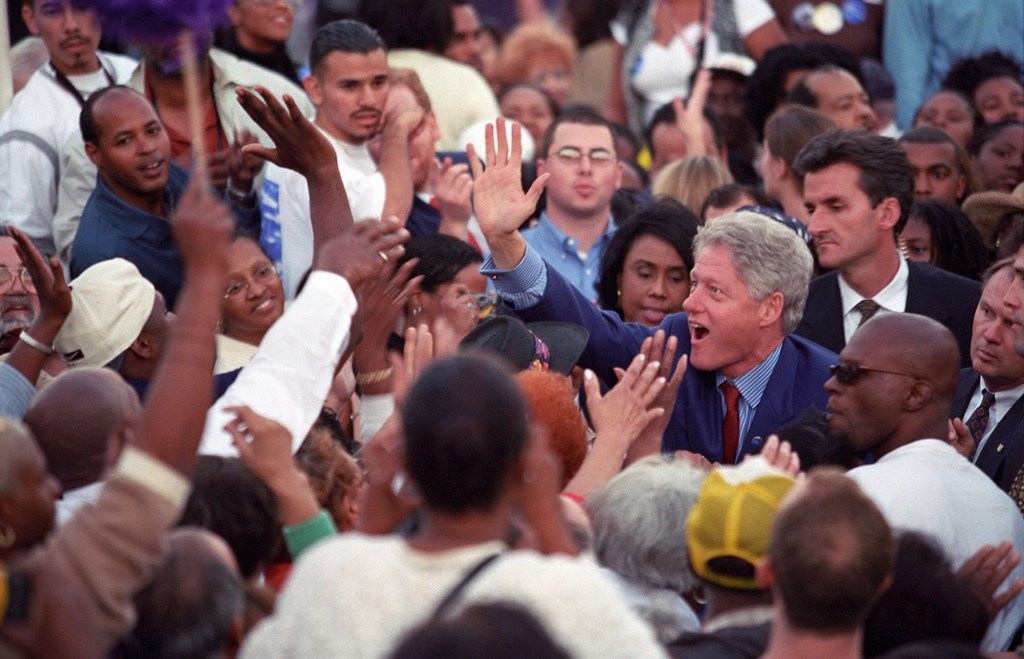
President Clinton isn’t quite a Republican by today’s standards, but he’s much closer to one than the current Democrat Party, and if Democrats still held his positions, or anything like them, there would be broad bipartisan support for any number of major reforms that would benefit the entire country.
In yet another common refrain, the Republican Party has grown more extreme over the past twenty years, making it more difficult for moderate, even keeled Democrats to compromise with a rejuvenated, recalcitrant radical right wing. Last year, The New York Times declared “The G.O.P. Goes Full-on Extremist,” insisting that there are no “moderate Republicans” left in the House of Representatives. The year before, the same publication asked “Why Did Republicans Become So Extreme?” while noting that “Many political analysts have spent years warning that the G.O.P. was becoming an extremist, anti-democratic party.” Needless to say, President Joe Biden agrees, recently lamenting the good old days when segregationists were easier to deal with. “I’ve been a senator since ‘72. I’ve served with real racists. I’ve served with Strom Thurmond. I’ve served with all these guys that have set terrible records on race. But guess what? These guys are worse. These guys do not believe in basic democratic principles,” the President said at a fundraiser in San Francisco last month. “Time and again Republicans show they are the party of chaos and division.” While there is some truth to the notion that Republicans have become more aggressive in their tactics in recent years, leveraging the debt ceiling and other procedural maneuvers to advance their agenda and thwart their political opponents, the real question is why? Are Republicans simply becoming more extreme for the sake of extremity or because their ideology has shifted? Or are they simply reacting to extremism from Democrats, who have moved dramatically to the left in recent years? Fortunately, the reality of Bill Clinton’s presidency provides something of an objective answer apart from the media consensus. President Clinton was, once upon a time, the darling of the Democrat Party and the mainstream media, a two term President whose economic policies ushered in unprecedented prosperity, achieving the first budget surplus in decades, and whose domestic policies resulted in unprecedented reductions in crime. He left office in early 2001 with the highest approval rating of any president since Harry Truman, 65%. In February 2007, Gallup asked Americans to rank the greatest presidents in history. President Clinton placed fourth, with 13% of the vote. More recently, a survey of academics that ranked presidents in terms of their overall greatness had President Clinton in the 12th spot, right behind the Father of the Constitution, James Madison, and right above Founder John Adams. These achievements are even more astounding considering he was mired in personal scandal throughout much of his two terms, facing impeachment in the House of Representatives for perjuring himself over an affair. As ABC News characterized his Presidency, “You can’t trust him, he’s got weak morals and ethics – and he’s done a heck of a good job.”
Given his popularity with the public, the media, and academics, it seems reasonable to consider President Clinton’s policies and statements to see how they compare with the current Democrat Party. Perhaps no policy statement was more famous or quoted during his Presidency than the 1996 State of the Union Address, when he declared “The era of big government is over. But we cannot go back to the time when our citizens were left to fend for themselves. Instead, we must go forward as one America, one nation working together to meet the challenges we face together. Self-reliance and teamwork are not opposing virtues; we must have both.” President Clinton continued, “I believe our new, smaller government must work in an old-fashioned American way, together with all of our citizens through state and local governments, in the workplace, in religious, charitable and civic associations. Our goal must be to enable all our people to make the most of their own lives — with stronger families, more educational opportunity, economic security, safer streets, a cleaner environment in a safer world. To improve the state of our Union, we must ask more of ourselves, we must expect more of each other, and we must face our challenges together.” Thirty years later, this is a sequence that’s almost impossible to imagine a Democrat president, or indeed any Democrat delivering. Even setting aside that President Biden’s most recent budget called for a doubling of the size of government in ten short years, the idea of “self-reliance,” the “old-fashioned American way,” a focus on organizations outside the government, much less religious ones, and a mention of “opportunity” where we “ask more ourselves” have become anathema in progressive circles. President Clinton, of course, ushered in welfare reform with much stricter work requirements, expecting the able-bodied among us to be self-sufficient and self-reliant. In contrast, President Biden’s recent State of the Union Address clearly views Americans, or at least lower income and minority Americans, as victims of rapacious companies and their own fellow Republican citizens. Self-reliance is no longer part of the equation, as progressives seek to subsidize everything including purchasing a home and going to community college, plus the ever growing list of healthcare, child care, and more. The notion of “opportunity” has been replaced entirely with “equity,” that is equality of outcome regardless of what one asks of themselves or how one relies on themselves, and any disparity of outcome is now seen as insidious racism to the point where Democrats believe government subsidies should be provided based on race. President Clinton wasn’t finished either, further declaring that, “Here, in this place, our responsibility begins with balancing the budget in a way that is fair to all Americans. There is now broad bipartisan agreement that permanent deficit spending must come to an end.” Democrats are not solely to blame, but permanent deficits have been the norm ever since and any and all recommendations to shave a single dollar off of trillions in spending are met with howls that someone is literally going to die as a result.
President Clinton also referred to “safer streets” in this same State of the Union Address, and had previously signed the 1994 Crime Bill with mandatory sentences for violent offenders, what was considered a crucial piece of legislation that directly contributed to a record decline in crime across the country. Even before he took office, President Clinton declared, “We cannot take our country back until we take our neighborhoods back. Four years ago this crime issue was used to divide America. I want to use it to unite America. I want to be tough on crime and good for civil rights. You can’t have civil justice without order and safety.” His platform, Putting People First, called for “Fight[ing] crime by putting 100,000 new police officers on the streets. We will create a National Police Corps and offer unemployed veterans and active military personnel a chance to become law enforcement officers at home.” The bill itself was supported by a majority of the Congressional Black Caucus, and Gallup found more support among black voters (58%) than white voters (49%) at the time. The final vote in the Senate was 95 to 4, though support declined after conference with the House. As sociologist and criminologist William R. Kelly described it, “While the longer-term impact of the Violent Crime Control and Law Enforcement Act of 1994 was questionable, the political impact was clear—crime control or ‘tough on crime’ became a bipartisan issue.” Since then, however, Democrats have completely abandoned their prior positions, declaring them irredeemably racist, President Biden, who originally authored the original Senate version of the bill, included. During the 2020 campaign, The Guardian asked if then-candidate Biden could “overcome the racist legacy of the crime bill he backed?” At a town hall in Philadelphia, he agreed with moderator George Stephanopoulos, who was a part of the Clinton Administration, that it was a “mistake.” “But here’s where the mistake came,” he said. “The mistake came in terms of what the states did locally” in his traditional habit of blaming everyone except himself. “Things have changed drastically,” he added. Asked if more police officers translated into less crime, he agreed, but only “if in fact they’re involved in community policing.” While he did voice opposition to the defunding of the police movement that was popular in progressive circles at the time, the left-wing of his party including the Congressional Black Caucus has gone so far as to call for the outright abolishment of federal prisons. Locally, progressives have cut police forces in major cities to disastrous effect, leading directly to an unprecedented crime wave, while embracing policies like no cash bail whose express purpose is to put more criminals back on the street, claiming that crime is merely some kind of social construct.
A similar leftward shift can be seen on border security and immigration. At his 1995 State of the Union Address a year earlier, President Bill Clinton sounded downright Trumpian when he declared, “All Americans, not only in the States most heavily affected but in every place in this country, are rightly disturbed by the large numbers of illegal aliens entering our country…The jobs they hold might otherwise be held by citizens or legal immigrants. The public service they use impose burdens on our taxpayers. That’s why our administration has moved aggressively to secure our borders more by hiring a record number of new border guards, by deporting twice as many criminal aliens as ever before, by cracking down on illegal hiring, by barring welfare benefits to illegal aliens.” Democrats, meanwhile, have become so extreme in recent years that President Biden merely describing a criminal alien who brutally murdered a 22 year old nursing student in his State of the Union Address as an “illegal” was met with calls to apologize, which he promptly did by saying he regretted not using the parlance of the day, either “undocumented” or “migrant.” He has also rather infamously presided over the largest influx of illegal aliens in the United States history, some 10 million streaming unchecked into the country in just three years. While he professes to have had a sudden change of heart, this is the same man who declared during the campaign that illegal immigrants were welcome should he become President. At a debate with rival candidates Senators Bernie Sanders and Elizabeth Warren, he openly called for migrants to “surge” the border, “all those people who are seeking asylum. They deserve to be heard. That’s who we are. We’re a nation that says you want to flee and you’re freeing oppression, you should come.” He also promised to overturn President Trump’s policies, which had reduced border crosses to near record lows, orders of magnitude lower than what we are experiencing right now. “If I’m elected president, we’re going to immediately end Trump’s assault on the dignity of immigrant communities. We’re going to restore our moral standing in the world and our historic role as a safe haven for refugees and asylum-seekers,” he said in his acceptance speech at the virtual Democratic National Convention. Others in his party would go even further, calling for open borders entirely and the abolishment of Immigrations and Customs Enforcement.
Social issues have witnessed the same trend, if anything even worse. President Clinton backed the notion that abortion should be “safe, legal, and rare” as opposed to the on-demand up to and even after pregnancy progressive fetish which goes so far as to claim a heartbeat really isn’t a heartbeat. The trans movement didn’t exist in anything like it’s current form, but he backed “don’t ask, don’t tell” in the military and signed the Defense of Marriage Act, both positions that would have you branded as an outright bigot by Democrats today. To be certain, President Clinton would not quite be a Republican by today’s standards, but he would be much closer to one than the current Democrat Party, and if Democrats still held these positions, or anything like them, there would be broad bipartisan support for any number of major reforms that would benefit the entire country. In other words, Republicans have not moved to the right on any of these issues and more. They, roughly, hold the same positions right now as they did 20 years ago. There are few Republicans indeed who would object to a true, stand-alone border security bill, a reduction in government spending, or an increase in the size of police forces to combat out of control crime. These are issues that Republican presidential candidates discussed at length during the primary and are held in some form by Donald Trump himself. Few things would make conservatives happier, politically speaking, than Democrats embracing these policies, making it almost impossible to believe that the real shift toward extremism hasn’t been the Democrats launching themselves off a radically progressive cliff whatever the so-called experts might claim.


Fascinating. People are so delusional. Both inside and out.
LikeLiked by 1 person
Hahaha! Very true, never underestimate the human capacity for self-rationalization.
🙂
LikeLike