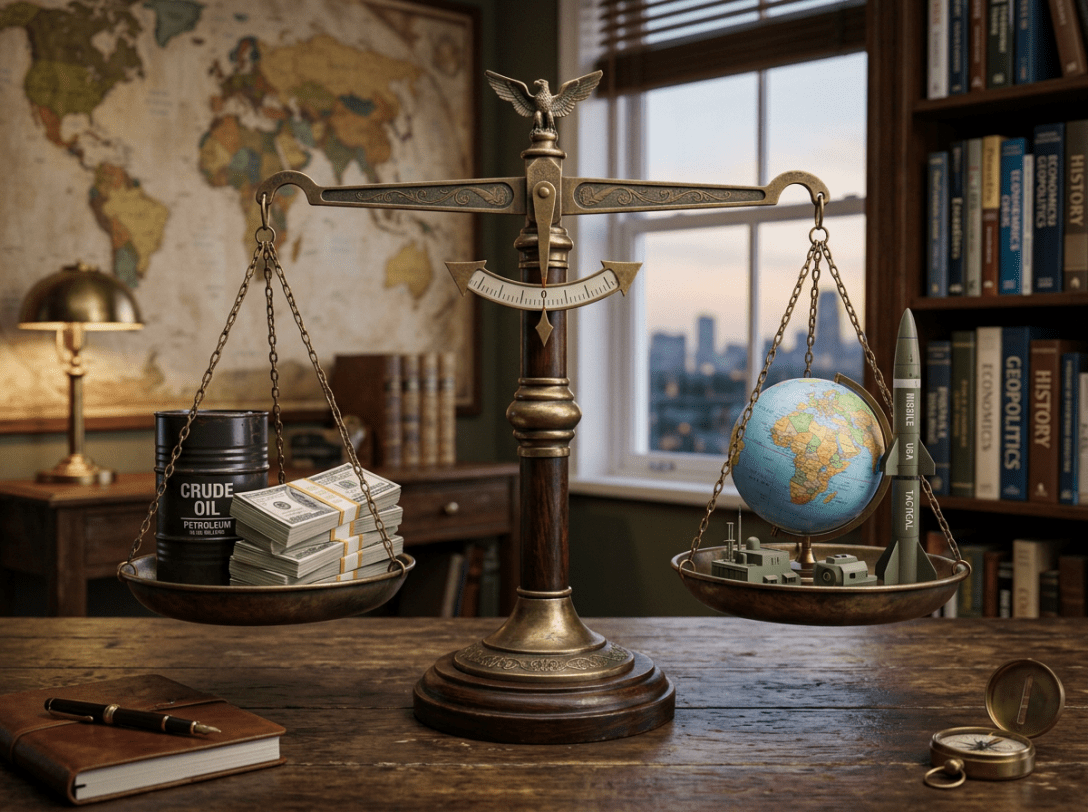
From where the average American sits, the choice facing the leaders of Iran seems like no choice at all, but after Saturday’s peace negotiations failed to produce a deal, it clearly is to the remnants of the regime and no one really knows what they will choose, however much they may bloviate otherwise.
Throughout the war in Iran, I have questioned whether the newly minted leaders of the Islamic Republic are rational actors who use religion to secure their own power and prestige or religious zealots who place their faith above even their own lives. To hear some tell it, those who rose to power after the death of the Ayatollah Khamenei and other top members of his government are akin to terrorists who would rather die than accept a deal of any kind. In their view, the acquisition of a nuclear weapon at some point in the near future is a matter of existential importance to the remnants of the regime, and they will not be dissuaded from that goal by any means short of death itself. To support this position, they often sight the Taliban in Afghanistan, which essentially waged an almost two decade insurgency only to rise to power once again once US troops withdrew from the country in the summer of 2021, or the insurgency in Iraq which fought fiercely for over five years before ultimately being quelled. In both cases, there was no accommodation that could be made short of victory by either side. Others, however, including possibly President Donald Trump himself and me to some extent, believe there are fundamental differences between the situations that might lead to a different outcome. While Iran is a terrorist state, it’s also a large, potentially prosperous country of almost a hundred million people, equipped with vast oil wealth. Compared to Afghanistan, Iran’s leadership enjoys a lavish lifestyle and therefore, has a lot to lose by fighting to the death. Nor are they in the same position as their counterparts in either Afghanistan or Iraq, where we announced in advance that the entire government of both countries would be dissolved and reconstituted under a new structure and leaders, rendering anyone in current position of power as an exile in their own country. The new generation in Iran, however, can choose to remain in power by making a few simple concessions that, to an outsider like myself, seem to have no direct bearing on either their position in the country, their political fortunes, or their wealth, or if they do have a direct bearing, are likely to improve all of these things and more.
While it’s rarely stated plainly by either supporters of the war or detractors, one of the outcomes of making a deal will be a greatly strengthened Iran and Iranian leadership class. Long before President Donald Trump chose to go to war over the issue, the goal has always been for Iran to abandon the pursuit of nuclear weapons (and an assortment of other initiatives that have varied based on the occupant of the Oval Office) in exchange for sanctions, trade embargo, and banking relief, which would allow Iran to sell oil and other goods and services on the global market. Though we might not say it so bluntly, the end result would be a massive influx of cash, so much that the equivalent of pennies on the dollar released during some of the negotiations under previous administrations that produced no shortage of outrage would be beggared in comparison. When President Barack Obama pursued a nuclear deal during his second term, he released $1.7 billion in cash as a combination of a good faith effort to legitimize the proposal and a ransom to secure the release of four prisoners. Perhaps needless to say, his opposition seized on the payout and continues to cite it as an example of appeasement to this day, but this would be nothing compared to what Iran stands to gain if all sanctions and other restrictions were removed as part of a potential future peace deal, even the one President Trump appears to be offering. The Washington Institute for Near East Policy attempted to calculate the scale of this staggering windfall in 2022. According to their findings, somewhere between $29 and $40 billion in cash reserves that have been frozen as a part of the ongoing banking sanctions would be released almost immediately, followed by a near doubling of oil exports, which between the higher prices on the global market and increased volume, would triple daily income compared to 2021 levels to some $205 million per day. Over time, their economy would also benefit from increased investment, trade, and generally better relationships with the region and the world. From this perspective, the key to Iran’s future isn’t a nuclear weapon, but joining the international economic community.
Beyond the potential for monetary gain, there is also the likelihood that President Trump would lavish any deal makers with potentially undue praise, transforming the remnants of a failed terrorist state into the Founders of a modern country on par with the Iranian equivalent of George Washington. If how he treats Venezuela’s new President, Delcy Rodriguez is any indication, Iranian leaders can expect some serious public rehabilitation if not actual ass kissing. Though President Rodriguez was a high ranking member of Nicolas Maduro’s regime – the number two person, in fact – and a hardline socialist, his Vice President and a member of the United Socialist Party of Venezuela, the daughter of a guerrilla leader and politician who began her career as a result of a failed coup attempt against President Maduro’s predecessor, the President regularly praises her in absolutely glowing terms. In January, he said she was a “terrific person.” In February, he described the relationship between the US and Venezuela as a “10.” In March, he posted on Truth Social, “Delcy Rodríguez who is the President of Venezuela, is doing a great job, and working with U.S. Representatives very well. The Oil is beginning to flow, and the professionalism and dedication between both Countries is a very nice thing to see.” Given the much higher stakes at play in Iran – both politically for the President, and globally for the economy – we can reasonably expect even more effusive praise for anyone willing to make a deal. Contrary to the conventional wisdom which holds that the President seethes at even the slightest betrayal and has a penchant for holding grudges, he likes almost nothing more than someone willing to make a deal – sometimes to his own detriment – and those that do so, can be instantly transformed from adversaries into friends.
Between the two, a politically and economically rehabilitated Iran would be almost certain to rapidly emerge as a premiere power in the Middle East, a region that is itself rapidly emerging on the world stage. Over the past twenty years, Saudi Arabia, the United Arab Emirates, and others have undergone incredible transformations into international leaders in architecture and technology, embarking on a construction spree unrivaled in modern memory. Dubai, for example, where I was fortunate enough to visit for a technology conference last October, currently boasts the tallest building in the world, the Burj Khalifa, rising 2,717 feet. The Burj sits in an almost entirely new downtown among other state of the art skyscrapers in the middle of an artificial lagoon. In addition to advanced buildings, the United Arab Emirates has rebuilt its coastline as a world class beach destination, featuring luxurious clubs, resorts, marinas, and every other amenity to attract travelers from Europe, India, Asia, and other parts of the Middle East. Dubai – along with Abu Dhabi, which I unfortunately didn’t get to visit – has become a truly international melting pot as a result, where people of all nationalities gather for business and recreation, which is perhaps not surprising in a country where barely 10% of the residents are actually citizens and most of the population comes from India, Pakistan, Egypt, and others. Interestingly, I had the opportunity to meet people from around the world at the tech conference and as a still somewhat provincial American who was on their first trip to the Middle East, some of it was surprising. The name badges included the person’s country of origin and some of the attendees were from Iran and others not exactly known for close relations with the United States. At first, it was a little jarring to be discussing technology investments and plans to deploy Artificial Intelligence with someone who hailed from a longtime adversary, but ultimately, people – at least those who attend such conferences in the first place – are people, and those from Iran I met struck me as no different than anywhere else.
From where I sit, the choice facing the leaders of Iran seems like no choice at all, but after Saturday’s over 20 hour peace negotiations in Islamabad, Pakistan failed to produce a deal, it clearly is to the remnants of the regime and admittedly no one really knows the answer, however much they may bloviate otherwise. The truth is likely somewhere in between, reminding me of an old thought experiment in evolutionary biology regarding what scientists refer to as “evolutionary stable sets.” These are defined as variations in behavior that are robust enough to prevent a population from destroying itself or new strategies from outside infiltrating and taking over, generally meaning that a species which settles on a stable set will continue as a species without changes to the environment. The idea that some animals are hawks and others are doves is a classic example, and perhaps not surprisingly, a population composed entirely of hawks doesn’t tend to last long. Animals that fight to death all the time, too frequently kill each other off, preventing them from reproducing in enough numbers for stability. To be stable, a population needs a certain percentage of both doves and hawks (technically, a population of all doves is also stable, but there is only one known species of spider that follows such a strategy) to be aggressive enough to fight and passive enough to know when to live another day, but interestingly, the underlying mathematics do not differentiate between individuals who behave always as hawks, always as doves, or those who change roles depending on the circumstances. When scientists study how the theory works in the real world, that is usually what they find. Individuals who behave as a hawk in some cases and as a dove and others. Few fight or flee all the time, in all possible cases, which should not be surprising based on our own experience in grade school, when the local bully sometimes finds themselves getting bullied.
For better or worse, we are about to find out where the remnants of the Iranian regime land on this spectrum, and if I had to guess, I suspect a lot of people are going to be surprised.


