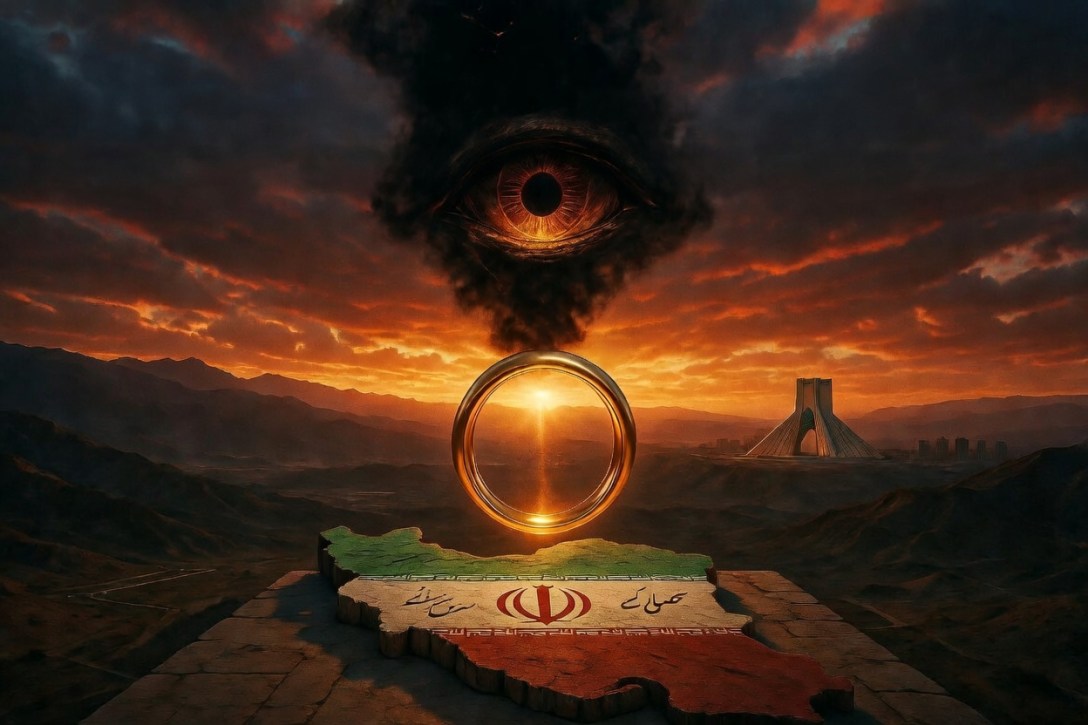
Given the choice between pursuing wholesale regime change or making a deal that can be improved in the future, I’d take my chances with the deal and hope that like Sauron in Lord of the Rings, Iran’s evil can be diminished such that it will never rise again even if it can’t be destroyed.
“For he will lose the best part of the strength that was native to him in his beginning, and all that was made or begun with that power will crumble, and he will be maimed forever, becoming a mere spirit of malice that gnaws itself in the shadows, but cannot again grow or take shape,” and so the Grey Wizard, Gandalf describes what will happen to the Dark Lord, Sauron should the Fellowship of the Ring succeed in breaching Mordor and casting the One Ring into Mount Doom. To casual fans of the J.R.R. Tolkien’s classic The Lord of the Rings, it’s easier to claim that Sauron was destroyed once Gollum tumbled into the lava after biting off Frodo’s finger in his desperation to regain his precious, but the truth as Tolkien wrote it is far more subtle. Sauron is defeated, but evil is eternal in his conception and cannot be completely destroyed. Instead, the Dark Lord is diminished such that he will not be able to rise again to threaten the world. Nor is Tolkien the only fantasy author to take this approach. At the conclusion of Michael Moorcock’s Elric Saga, conceived to a large extent to be the opposite of the Lord of the Rings, the anti-hero Elric vanquishes the evil threat to the multiverse, only to be killed by his own sword, Stormbringer, which becomes the diminished evil in the new world. More recently, Robert Jordan’s epic The Wheel of Time concludes with the Dragon Reborn realizing that evil can never be truly defeated. It is a fact of our existence, a part of who we are, but it can be diminished and better controlled. Instead of trying to kill the Dark One outright, Rand seeks to limit it.
Fantasy isn’t reality, but I was reminded of this oddly as the chattering classes debate the best way to end the Iran War as the conflict approaches its third week. To many, nothing less than total victory will suffice and by total victory, they appear to mean the complete expulsion of the current Iranian government and its replacement with some vaguely defined democratic construct. After it was revealed that President Trump was potentially negotiating a cease fire with remnants of the current regime including the speaker of the Iranian parliament, Mohammad Bagher Ghalibaf, who was formerly a member of the Islamic Revolutionary Guard Corp and mayor of Tehran with close ties to the non-existent Supreme Leader, the New Reagan Caucus, for example, almost immediately claimed this was unacceptable and nothing less than full on regime change would do. When I asked, “Honest question: Why are you averse to making a deal after we’ve wiped out their leadership and killed the Ayatollah, probably both? If the leaders of a country don’t matter and it’s just the ‘regime,’ would the US be the same right now if Biden were still in office?” They replied, “They have many lines of succession of people hellbent on nuking Israel. The person purportedly negotiating with them is Nazi level evil too. He had college students thrown off buildings and was responsible for the murder of thousands of others. He’s also a liar.” I replied with agreement on one point, disagreement on another. “Sure, I’m certain he’s an opportunistic scumbag, but an opportunistic scumbag in a box with no military to speak of and no allies in the region is not the same as the status quo before the war and of course, we can keep the pressure on afterwards. The real question to me at least, is who do you think you are going to get without installing our own regime and replicating the failures of Iraq and Afghanistan? The alternative is not George Washington, I assure you. :)” To which, they replied by embracing the installation of some form of democratic regime driven by the people. “We prefer Israel’s route to foster the uprising of the Shah supporting opposition. They comprise like 80% of the Iranian population. Let them take their country back.”
While I can certainly understand the impulse and in an ideal world, would welcome a democratic Iran myself, back in the real world, the position seems fundamentally misguided. Even setting aside that our track record of installing democratic governments in the Middle East is less than stellar and assuming the 80% figure is accurate, it’s unclear what such an uprising looks like in practice. As everyone who lived through the last ten years of democracy in the United States should know by now, self-government is a fractious, rough and tumble, give and take, ups and downs, polarizing affair to the point where a significant percentage on both sides still cannot agree on the results of the 2020 election and the meaning of January 6. To many of President Trump’s detractors, it was the most secure contest in history, no one has any reason to question the results, and the riots at the Capitol Building were a literal insurgency to overthrow the legally elected leader, Joe Biden. To many of his supporters, the election was either stolen outright or rigged to the point where considering it stolen isn’t a stretch, and January 6th was an unfortunate, if somewhat natural reaction to being disenfranchised. My point is not to judge who’s wrong or right, but if we can’t agree on the fundamentals in the United States after almost 250 years of self-government, why does anyone reasonably believe a mass uprising in Iran will magically turn out well? Given that there is no apparatus to hold elections of any kind, how does the 80% decide who does what, when, and how? There’s a difference between 80% of people wanting a new regime, and actually bringing that regime into existence when those people start forming competing factions with different leaders and different ideas about what the regime looks like in the first place.
Once again, the United States’ own story is telling. The Constitution didn’t simply spring into existence after the Revolutionary War with George Washington as President. Indeed, there were significant portions of the leadership and the population that didn’t believe we needed a Constitution in the first place. The one which ultimately emerged as painstakingly debated for almost 100 days hot, long, and fractious days in Philadelphia, but even then it didn’t go into immediate effect. From there it took nine months to be ratified by the states, another six months for the first elections to be held, and another four for Washington to be sworn in. During this close to two year period, the colonies remained governed by the Articles of Confederation, which were not sufficient for the long term, but at least provided a framework for the government to operate and to resolve disputes among the colonies themselves and other competing factions while the United States as something close to what we know today was forged. Needless to say, Iran has none of this, not a framework to govern the country assuming a public uprising occurs, not a mechanism to choose representatives to create such a framework, nor any leaders that could serve temporarily with or without a formal election or selection process. Without them, any public uprising is nothing more than a mob, seizing power and then doing what with it once the inevitable disagreement between factions arises? Who’s going to prevent them from turning on each other and devolving into a bloody Civil War should one of these disagreements turn violent? In Iraq, we served that role, taking operational control over the entire country while these institutions, however fragile to this day, could be created. The elapsed time was approximately 15 months, during which an insurgency and an actual Civil War that took another six or so years to quell erupted. Who precisely is going to serve that role in Iran? If about 135,000 US troops alone in Iraq couldn’t prevent a Civil War, what could stop one in Iran, a much larger and more diverse country with almost twice as many citizens?
The fantasists don’t really say. Instead, they seem to assume that somehow this all works out when history and the current state of affairs makes it overwhelmingly clear, at least in my mind, that it won’t. Whatever we may wish, someone needs to manage the government of Iran as it exists right now, and without any democratically elected, acknowledged government in waiting, that means it must be some remnant of the current regime. At the same time, “remnant” is the operative word. Their Supreme Leader, the Ayatollah Ali Khamenei, who has ruled the country since 1989 is dead. His son and purported replacement, the Ayatollah Mojtaba Khamenei has never been seen in public since his selection, and is either ruling Weekend at Bernie’s style dead or seriously incapacitated. The majority of the senior leadership has been eliminated as well, including the head of Iran’s security forces and a person who CNN described as a “de facto leader” of the entire country, Ali Larijani, Intelligence Minister Esmail Khatib, the Minister of Defense and Armed Forces Logistics Ali Shamkani, a second Minister of Defense and Armed Forces Logistics Aziz Nasirzadeh, the Chief of Staff of the Armed Forces Mir-Hossein Mousavi, the commander of the Islamic Revolutionary Guard Corps Mohammad Pakpour, the commander of the Basij Forces Gholamreza Soleimani, another head of intelligence Saleh Asadi, and well over a dozen more. In addition, their ability to project force beyond their borders via drones and missiles has plummeted by well over 90%, and reports suggest they are running out of missiles entirely. Their navy has been almost completely destroyed, some 150 ships sunk, and their air force is non-existent.
There’s an old thought experiment in philosophy, Theseus’ Ship, that illustrates how difficult it can be to say when a thing becomes something else. If you imagine an old fashioned sailing ship and replace a single plank on the deck, everyone or almost everyone would agree that it remains the same ship as it was before. The same is true for the second, third, fourth, or even fifth plank, but what if you replace half of them, three quarters, all? At some, admittedly ill-defined point, Theseus’ Ship is no longer Theseus’ Ship. While a government isn’t the same as a ship, leadership certainly matters and it’s not an unreasonable question to ask whether the current Iranian regime can be said to be the same as it was on February 27, before the war started, in any meaningful sense. As it was with Sauron in the Lord of the Rings, they might still be “evil” in the eyes of a Western democracy, but they are so greatly diminished, their capacity to commit evil acts is severely limited and is likely to be even more so in the immediate future. While this might not be the ideal outcome, there are no ideal outcomes. Even the US Constitution represented dozens if not hundreds of compromises, and we should not expect reforming a government in the Middle East with no recent history of democracy of any kind to be an ideal process or lead to an ideal state. Like anything else in life, a measurably better state might be all that we can hope to achieve and in that regard, I am hard pressed to understand how the previous leaders wiped out, the military essentially destroyed, and agreement around nuclear weapons, ballistic missiles, terrorizing their neighbors, and brutalizing their people is not far, far superior to the status quo before we started.
The Lord of the Rings holds another lesson as well: There is no permanence in even immortal affairs. Perhaps hidden more subtly, if Sauron’s power waxes and wanes, we can question if Gandalf is truly correct that he “cannot again grow or take shape” under any and all circumstances. Might there be some way he could return that even Gandalf was unaware of? Applied to Iran, there is the implicit assumption that any deal President Trump might or not make in the immediate future is permanent and binding for all time, that we cannot use a ceasefire with the 14 proposed points and reforms as a starting point to build upon in the future. While the establishment readily embraces the idea that there permanent solutions in Iraq and around the world, this is clearly false in my opinion. A defanged Iran, somewhat reformed, isolated from its neighbors, and with little ability to influence world affairs (assuming the Strait of Hormuz is secured by the international coalition) would be extremely susceptible to internal and external pressure, especially knowing that a President is in office willing to go to war again if we must. To jumpstart their economy, they would need to rely on trade with other nations. To maintain good relations with those neighbors, they would need to refrain from rapidly building up their military. To remain in power, an emasculated leadership would need to be more willing to accept the will of the people. The world would be watching the entire time. Personally, given the choice between pursuing wholesale regime change or making a deal that can be improved upon in the future, I’d take my chances with the deal and hope that like Sauron, Iran’s evil can be diminished such that it will never rise again.

 Confessions of a Conservative Atheist