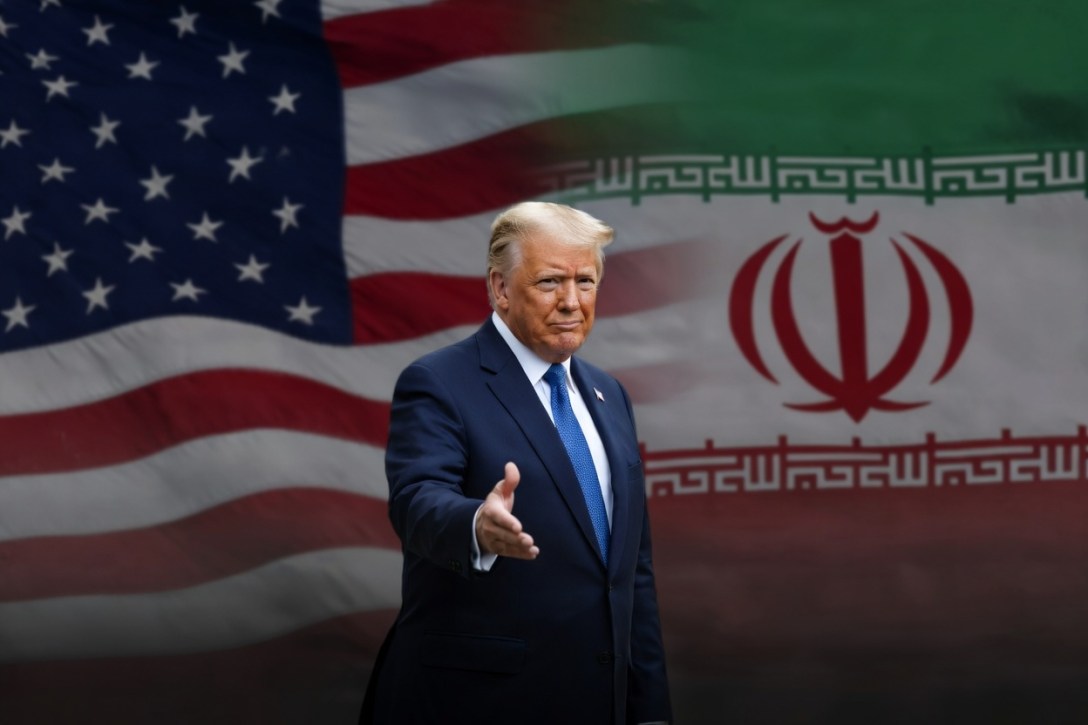
Last week, they claimed killing any enemy’s leadership only prolongs a war. On Monday, they claimed the President lied about engaging in talks with Iran. On Tuesday, they insisted we should not have talks at all, pretending Iran is the same now as it was before the war.
On Monday, President Donald Trump announced that the United States has been engaged in negotiations with the “country of Iran” to end Operation Epic Fury which began on February 28. At first, his detractors claimed that no such talks had taken place after the Iranian foreign ministry insisted otherwise, pretending as though the enemy’s public statements during a war are a reliable source. The assertion at that time was some bizarre repeat of the TACO meme, that the President had somehow chickened out after staking the majority of his second term on the boldest foreign policy decision in recent memory and he had done so purely to manipulate the stock market and oil prices because apparently, the best way to make money these days is by starting a war we had no intention of actually fighting. The impulse to decry anything the Orange Man does was so strong that CNN and others picked up on this idea even into the following day long after it was shown to be false. In a supposed “analysis,” Aaron Blake claimed on Tuesday, “Trump’s critics are calling it Trump’s latest TACO — an acronym for ‘Trump Always Chickens Out.’ That’s difficult to prove, but the decision follows another undeniable Trump pattern: His announcements often seem conveniently tied to the open and close of financial markets. Trump said he was giving Iran more time shortly before the markets were due to open Monday morning, on what was bound to be a pretty brutal day in light of Trump’s threats of escalation. Instead, it turned out to be a strong one.” Mr. Blake continued to offer some rather unconvincing examples of other instances of suspicious timing, such as his announcement on tariffs of all things. For its part, The Guardian took a similar angle, noting “The trouble is that Mr Trump’s talks may not exist. Tehran denies having them. If real, they would be a welcome de-escalatory step. They are also an admission that Mr Trump’s threat risked consequences more damaging than its intended target. But it also means that after markets close on Friday, Mr Trump could return to ‘bombing our little hearts out,’” more on the source of that phrase in a moment.
Unfortunately for the President’s detractors, multiple sources reported that some form of talks had indeed taken place and were still taking place on Monday itself with Pakistan, Turkey, Egypt, and perhaps other Middle Eastern countries serving as intermediaries. Contrary to the claims of falsehood, Reuters reported these developments this way, “Although there was no immediate confirmation that talks had already taken place as described by Trump, there were indications of outreach, with third countries acting as potential mediators or helping to set up contacts. Iran’s foreign ministry described initiatives to reduce tensions, without giving further details.” While President Trump did not reveal who had spoken to or the details of their conversations, more information was provided by an Israeli source to Axios, who reported “An Israeli official told Axios that U.S. envoys Steve Witkoff and Jared Kushner had been in touch with the speaker of the Iranian parliament, Mohammad Bagher Ghalibaf.” Mr. Ghalibaf is later described as a “former general in the Islamic Revolutionary Guard Corps., a former mayor of Tehran and a close associate of the new supreme leader, Mojtaba Khamenei,” who “played a key role in managing Iran’s war effort during the 12-day war in June and is currently seen as the most senior civilian official in Iran’s decision-making circle.” Though Mr. Ghalibaf had initially responded to President Trump’s 48 hour ultimatum to either open the Strait of Hormuz or risk having their power plants destroyed with threats of his own; it appears that the talks were far more substantive. Even Israeli Prime Minister Benjamin Netanyahu issued a video in tentative support claiming, “The President believes there is a chance to leverage the military achievements of the war to get all the objectives of the war through an agreement. Such an agreement will safeguard our interests.”
To anyone not heavily invested in the President’s failure and subsequent humiliation on the world stage, this should be welcome news, especially when President Trump himself was more clear than usual about what he believes must happen to end the war, providing additional context and detail about his thinking and the basis of the discussions occurring to date. Speaking to reporters on Monday, he claimed there were “major points of agreement” between the two countries including that Iran suspend its nuclear weapons program, the key sticking point for more than a decade. “We want to see no nuclear bomb, no nuclear weapon,” he said before going one step further, insisting that we need to take control of their stockpiles of enriched uranium. “The nuclear dust. We’re gonna want that. And I think we’re gonna get that. We’ve agreed to that,” he said. “They want very much to make a deal. We’d like to make a deal too,” he added, noting that there will be more phone conversations followed by an in-person meeting “very, very soon” likely with Vice President JD Vance according to other reporting, making it the highest level meeting ever between the United States and Iran. “We’re doing a five-day period, we’ll see how that goes. That if it goes well we’re going to end up with settling this. Otherwise, we just keep bombing our little hearts out,” he closed with a rather obvious threat that the war will continue if Iran refused to agree to these terms or something close. Later in the day, Israeli media also reported that Iran had agreed to freeze its ballistic missile program for a period of five years, though to be certain, I have not seen that reported elsewhere, some have claimed it is not accurate, and like everything else in the even purely metaphorical fog of war, might well prove inaccurate. On Tuesday, a 14 point document was released further defining the goals.
Perhaps needless to say, rather than acknowledging they might have been wrong when they claimed the President fabricated the talks to soothe the market, detractors including the mainstream media immediately changed the nature of their criticism after being confronted by these developments, moving on to some other perceived outrage. CNN rapidly reversed its own course to report that even Iran acknowledged “outreach” was underway and they are willing to listen, only to move onto impugning the person President Trump might be working with by claiming he could “be a war veteran with a record of suppressing dissent.” Instead of chickening out, making stuff up, and prosecuting the war as part of a Dr. Evil scheme to manipulate the market, the President was suddenly in danger of giving up too much to the once again evil Iranians, presumably out of some mad desperation to end the war. In the view of at least some, President Trump’s terms were essentially the same as what his predecessor President Barack Obama had negotiated without bloodshed, turning the entire episode into some kind of tragic farce, or even worse. Citing the usual anonymous sources, The Washington Post went even lower, describing the “end game” as merely reopening the Strait of Hormuz rather than achieving any objectives at all, “Reopening the strait – a critical conduit for global energy supplies – has emerged as perhaps the paramount objective of a war that security officials now believe is unlikely to achieve goals that briefly seemed possible at the outset of the U.S.-Israeli military operation, including overthrowing Iran’s theocratic regime and putting a nuclear weapon permanently out of reach. Instead, breaking Iran’s stranglehold on the strait could enable Trump to wind down the war while claiming victory, halt an expanding global energy crisis and deprive Iran of a potent deterrent against future strikes – which senior Israeli officials described as inevitable if Tehran resumes ballistic missile production or moves to develop a nuclear weapon.” This article prompted Shashank Joshi, a writer for The Economist, to quip “The war aim is now re-opening a strait that would not have been closed were it not for the war itself.” If anything, MSNOW was not-surprisingly even harsher, claiming that “More broadly, Trump’s Iran policy is bafflingly incoherent. It makes little sense to pursue peace negotiations with a country at the exact same time as pursuing a strategy of decapitation and regime change. And given the fact that Trump has already blown up talks with Tehran not just once but twice, with airstrikes in the past year, Iran has little incentive to ever take Trump’s word in future negotiations. Trump might be sincerely looking to end the pointless, deadly war he started.”
Sadly, to reach these conclusions one needs to pretend that we haven’t been at war with Iran for more than three weeks, pretending that the current state of affairs is the same as it was before we carried out well over 9,000 targeted strikes. In truth, the Iran the President is attempting to negotiate with right now isn’t the Iran that existed on February 28. Their Supreme Leader, the Ayatollah Ali Khamenei, who has ruled the country since 1989 is dead. His son and purported replacement, the Ayatollah Mojatba Khamenei has never been seen in public since his selection, and is either ruling Weekend at Bernie’s style dead or seriously incapacitated. The majority of the senior leadership has been eliminated as well, including the head of Iran’s security forces and a person who CNN described as a “de facto leader” of the entire country, Ali Larijani, Intelligence Minister Esmail Khatib, the Minister of Defense and Armed Forces Logistics Ali Shamkani, a second Minister of Defense and Armed Forces Logistics Aziz Nasirzadeh, the Chief of Staff of the Armed Forces Mir-Hossein Mousavi, the commander of the Islamic Revolutionary Guard Corps Mohammad Pakpour, the commander of the Basij Forces Gholamreza Soleimani, another head of intelligence Saleh Asadi, and well over a dozen more. In addition, their ability to project force beyond their borders via drones and missiles has plummeted by well over 90%, and reports suggest they are running out of missiles entirely. Their navy has been almost completely destroyed, some 150 ships sunk, and their air force is non-existent. As I and others have argued, the only strategy they have left is to make passage through the Strait of Hormuz too risky for commercial vessels to attempt, and a coalition the likes of which the world has never seen – boasting European, Asian, and Middle Eastern allies working with Israel – is forming to secure the area while thousands of American marines and paratroopers are en route.
Even setting aside that last week the same detractors were claiming killing Iran’s leadership would only extend the war, under these circumstances, two things should be apparent. First, it shouldn’t be surprising that some remnant of the regime wants to make a deal of some kind. Contrary to conventional wisdom, the entirety of the government of Iran is not a terrorist network with nothing to lose, nor should we assume that no one in the government is capable of responding to rational incentives. We should also not expect whoever emerges to be George Washington. Whether we like it or not, Iran doesn’t have a deep bench of Western style leaders eager to put in place a democratic utopia. The fantasy that this was the case is one of the key mistakes that doomed us in Iraq and Afghanistan, and it is not one we should want to repeat. Second, it shouldn’t be surprising that President Trump is interested in a deal as well, one that is likely to accomplish our objectives from the beginning including no nukes, no ballistic missiles, no terrorizing neighbors, and some reform of how the Iranian people are treated. From the very onset, the President has always insisted Operation Epic Fury would require four to five weeks to achieve our goals and those goals do not include Iraq or Afghanistan style regime change; halfway through week four, we should have all expected this pivot to talk of peace. Indeed, the real question is whether there is anyone left in the Iranian leadership with the power to make a deal in the first place, but even then, these negotiations serve a critical purpose: If no one has yet emerged, the idea alone creates an opportunity for members of the regime to potentially rally around. Lastly, to those who insist this isn’t regime change, I beg them to explain what precisely removing the entire leadership of a regime is in that case. If the person who occupies the highest office in the land doesn’t matter, does that mean there is no difference between having Joe Biden or Donald Trump in office right now? Regardless, if nothing else is clear at this point, it’s that the President’s many detractors refuse to provide anything resembling objective analysis, effectively creating their own fog of war to all of our detriment.

 Confessions of a Conservative Atheist