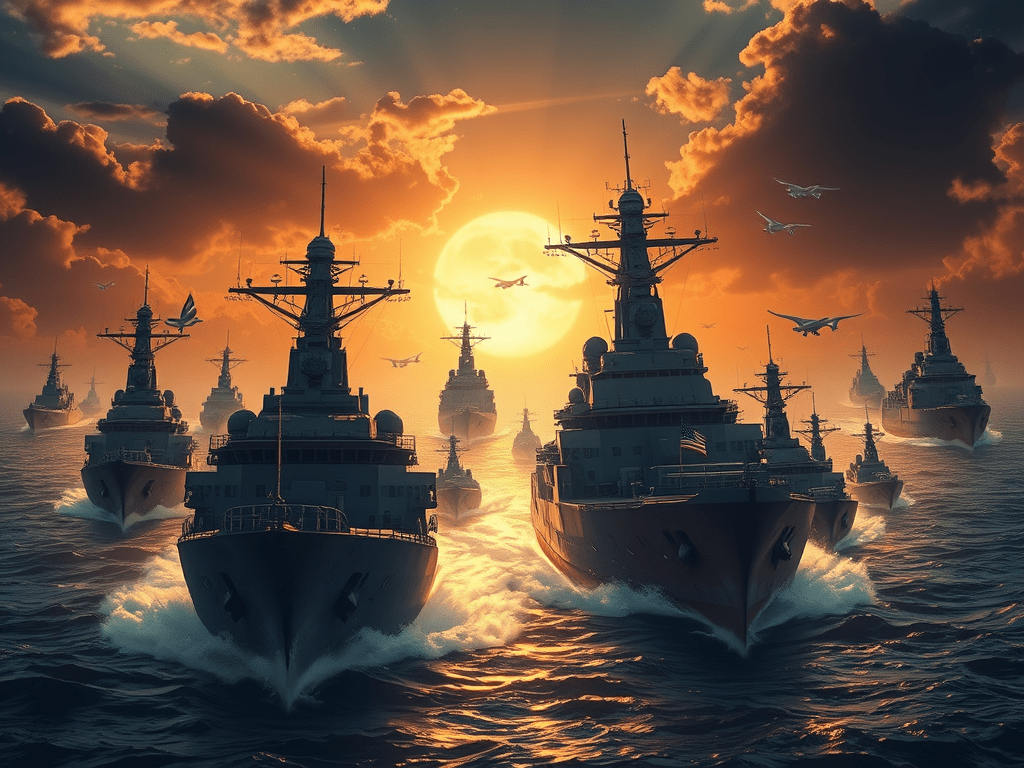
The sight, however symbolic, of the Arab Nations joining traditional European, North American, and Asian allies along with their long term adversary Israel in a joint mission would be something no one has ever seen before, perhaps as important as Teddy Roosevelt’s Great White Fleet was way back in 1907.
Last week, the media was convinced President Donald Trump had so alienated our allies they simply would not participate in a joint effort to secure the Strait of Hormuz under any circumstances. “I’m demanding that these countries come in and protect their own territory, because it is their own territory,” the President said aboard Air Force One Sunday, March 15. “Whether we get support or not, I can say this, and I said it to them: We will remember,” he added. After several nations responded negatively to these demands at first, the media settled on the word “rebuffed” to describe the reaction. The Washington Post claimed “European leaders rebuff Trump’s call to open Strait of Hormuz,” insisting he “expressed frustration over the lack of military assistance.” The New York Times said, “Nations Rebuff Trump’s Call to Send Warships to the Strait of Hormuz.” The Wall Street Journal had it, “U.S. Allies Rebuff Trump’s Demand or Help Opening Strait of Hormuz,” Reuters, “US allies rebuff Trump’s request for support in Strait of Hormuz,” The Los Angeles Times chose “refused,” and NBC News, “Rebuffed by allies, Trump now says U.S. doesn’t need help defending the Strait of Hormuz.”
According to their reporting, “Trump had gotten a chilly response from U.S. allies he’d tried to enlist in a joint effort to police the strait, which has been effectively shut down in the face of Iranian attacks that have jeopardized oil supplies.” Therefore, he “dropped his push Tuesday for U.S. allies to join in protecting the Strait of Hormuz from Iranian threats — an about-face that came just one day after he called upon nations to ‘get involved’ so oil tankers can safely navigate the crucial shipping lane.” If there was any mistaking their belief that this initial rebuff was an unprecedented occurrence due entirely to the President himself, they proceeded to provide a broader context to the war and the reasons behind the supposed rebuff in the first place, citing experts and comparing this effort to those mounted by previous presidents. “The Iran war amounts to a test of Trump’s ‘America First’ approach to global conflict. He has long been skeptical of military alliances, warning that the U.S. builds a protective umbrella around other nations without any guarantee that those beneficiaries of American power would come to its aid when needed. That position has alienated NATO countries that have sent troops to U.S.-led wars in Iraq and Afghanistan, only to see them die in action.” “Trump’s bullying and tendency to negotiate by megaphone don’t go down well with European allies,” explained Peter Westmacott, a former British ambassador. Another European diplomat said, “He’s asking us to help for a war he started. There is not much enthusiasm for this. And even if European navies are sent to the Gulf, it would not ensure the strait is reopened. Iran can keep it closed as long as it likes because all it takes is a drone or a mine.” In comparison to past efforts the experts feel have been superior, “In 1990-91, President George H.W. Bush knitted together a broad coalition of nations to confront Saddam Hussein, the Iraqi dictator, before he launched Operation Desert Storm. By virtue of Bush’s painstaking diplomatic work, that conflict became, literally, Saddam Hussein against the world,’ said Aaron David Miller, a former State Department official and now a senior fellow at the Carnegie Endowment for International Peace.”
By Thursday, the story had completely changed and to anyone who has been paying attention for the past decade, not surprisingly so. Despite their initial misgivings, a growing roster of allies from around the world began pledging to participate. The United Kingdom, France, Germany, Italy, the Netherlands, Japan, and Canada issued a joint statement, saying in no uncertain terms, “We condemn in the strongest terms recent attacks by Iran on unarmed commercial vessels in the Gulf, attacks on civilian infrastructure including oil and gas installations, and the de facto closure of the Strait of Hormuz by Iranian forces. We express our deep concern about the escalating conflict. We call on Iran to cease immediately its threats, laying of mines, drone and missile attacks and other attempts to block the Strait to commercial shipping, and to comply with UN Security Council Resolution 2817. Freedom of navigation is a fundamental principle of international law, including under the United Nations Convention on the Law of the Sea…We express our readiness to contribute to appropriate efforts to ensure safe passage through the Strait. We welcome the commitment of nations who are engaging in preparatory planning. We welcome the International Energy Agency decision to authorise a coordinated release of strategic petroleum reserves. We will take other steps to stabilise energy markets, including working with certain producing nations to increase output. We will also work to provide support for the most affected nations, including through the United Nations and the IFIs.”
Perhaps needless to say, the media was much less enthusiastic about this turn of affairs than the initial rebuff. Rather than acknowledging that President Trump was rallying the world or rallying around a specific word to describe his failure, they either reported on the statement without describing the details – the Reuters’ headline was literally “Joint statement on Strait of Hormuz by European Nations, Japan, Canada” – or expressed skepticism that the statement meant anything at all except to make the President feel better. As Axios framed it, “The statement does not include any commitment to send naval vessels or other resources to make that happen. For now, it’s largely a gesture to placate President Trump, who has railed against allies for declining to help secure the strait and warned that a failure to do so could undermine the future of NATO.” When you consider the facts, however, the reality is a bit different than initially framed. First, the United Kingdom, who was said to have been among the most forcibly opposed to our efforts, was actually the country that had “been pushing over the last few days to get as many Western countries as possible to sign a political statement expressing support for a Strait of Hormuz coalition.” Second, though Axios was at pains to note it’s unclear whether the countries would actually send naval assets after claiming they wouldn’t, “The U.K. sent military officers to CENTCOM headquarters in Tampa, Florida to start working with the U.S. military on planning for a Strait of Hormuz coalition, according to a source with knowledge. The UK navy has dispatched two war ships to the region to be ready to join a potential joint effort to reopen the strait.”
In other words, it might be unclear the number of ships and other assets that will ultimately be dispatched, but despite the naysayers at least some are already being dispatched as we speak. Further, the reality that there are other allies, namely our new allies in the Gulf States themselves, already participating has been largely left unsaid. Axios noted only in passing, “Trump has said the U.S. could reopen the strait with just Israel and the Gulf countries, but would remember those who failed to step up” as though the Arab Nations participating in an effort with Israel isn’t among the biggest and most important international developments in several lifetimes, a truly word changing event. Two days earlier, Reuters itself reported, “The United Arab Emirates may join a U.S.-led effort to protect shipping in the Strait of Hormuz after Iran all but shut the vital waterway to ships as Tehran wages war with Israel and the United States, a senior Emirati official said on Tuesday. Anwar Gargash, the diplomatic adviser to the UAE president, said talks were ongoing and no formal plan had been agreed, but that ‘big countries’ in Asia, the Middle East, and Europe bore responsibility for ensuring the flow of trade and energy.” “This is something that is in the interest of everybody,” he told an online event hosted by the American think tank the Council on Foreign Relations. “Everybody has a responsibility.” While the other Arab Countries have not made public statements on the matter, it seems likely that Saudi Arabia and Qatar perhaps more will participate to at least some extent. Qatar in particular remains incensed that Iran senselessly attacked one of their largest natural gas facilities. Also last week, their foreign ministry condemned the incident as a “dangerous escalation” and a “flagrant violation of sovereignty,” while retaining their right to respond.
While we do not yet know the precise form of this emerging coalition – dare I call it an armada? – will take there are a few things that are apparent in both the short and long term beyond the media remaining among the President’s biggest detractors, leaping in unison to cover what they consider bad news while downplaying anything that can be considered good (if you doubt this, witness their claim that killing the enemy’s leadership is now a sure fire way to lose a war). First, there is little to no doubt that the US and Israel could’ve undertaken the effort to secure the Strait on their own. Not surprisingly, the reporting about our allies “rebuffing” President Trump studiously avoided the reality that most do not have many naval assets of their own, much less actual warships to speak of. The United Kingdom, for example, was characterized as early as November 2024 by Naval Technology as a “second rank European naval power,” “Top heavy, ageing, the UK Royal Navy is creaking at its bilges as decades of government procurement delays, misadventures into carrier strike, and a markedly more complex global security environment, are coming home to rust. The Royal Navy’s surface fleet is now smaller than the navies of the two other main European Nato members’ navies – France and Italy – being on paper able to field just 16 major surface combatants, comprising two aircraft carriers, six destroyers and just eight frigates. In reality, the availability of the 16 major surface combatants in the UK fleet is far lower, with the number of Type 23 frigates available for operations this year fluctuating between five and six hulls at any given time. The remaining hulls ‘in service’ are being put through expensive and time-consuming service life and recertification programmes, with their replacement Type 26 and Type 32 vessels still years away from joining the Royal Navy surface fleet.” In comparison, Canada and the Netherlands have even smaller navies, while Germany, Japan, France, and Italy are around the same size or slightly larger, albeit with different types of ships in different numbers.
In other words, the allied involvement in securing the Straits was always going to be largely symbolic from the beginning, but in war, symbols matter, bringing us the second point. President Trump, wisely in my opinion, has been seeking an international coalition not solely because it was needed, but for much larger and more important strategic and tactical reasons. Tactically, the Iranian are making the argument that the US and Israel are the aggressors in the conflict. From that perspective, attacking our ships in a battle for the Strait of Hormuz is fair game, but that’s a far more difficult argument to make if the ship in question securing the Strait is flying the flag of Denmark or Japan. If anything, the strategic implications of an international coalition are even greater. Though Iran might remain a regional nuisance for the foreseeable future should our efforts to reform the regime fail, the only strategic option that remains for them to exert worldwide influence is to maintain control of the Strait and prevent unapproved ships, most of them bound for China, from passing. As everyone knows by now, the impact of an effective shutdown of traffic over the past couple of weeks has been felt around the world in higher oil prices and a lower stock market with fears that both get substantially worse in the near future. If the Strait is secured, however, Iran has no – or at least very few – options with international impact, leaving the regime effectively impotent on a large scale. Further, the coalition that would lead to securing the Strait is a statement of its own, representing one of the most radical shifts in the world order since the founding of Israel in 1948. The sight, however symbolic, of the Arab Nations joining traditional European, North American, and Asian allies along with their long term adversary Israel in a joint mission would be something no one has ever seen before, perhaps as important as Teddy Roosevelt’s Great White Fleet was way back in 1907. Then as now, Roosevelt sent a fleet of ships around the world as a statement that America had arrived on the world stage, much to the chagrin of his detractors. It would crystallize the fact that the entire world has changed, adversaries have become tenuous allies, and a new, better order awaits. To me at least, it’s hard to see the Iranian regime surviving such an occurrence for long, thwarted in their only strategy by a coalition that was unimaginable a decade ago, not to mention the impact on China and Russia, who have been strenuously opposing this new world order and doing everything in their power to undermine it. The conservative historian Victor Davis Hanson alluded to this last week, reasoning that our allies are well aware this shift is already underway. “If Trump sees it through, and I think he will, I think they’re [going to] fall pretty soon, in two, three, four weeks,” he explained to Sean Hannity. “And I think they know it. And I think the Europeans know it. And I think the Middle East knows it,” he added. Trump’s Armada would make this reality plain, a visual metaphor for the new world. Everyone should hope it sails soon and is a smashing success.
Of course, things move fast in the Trump Era. Between completing this post on Saturday morning and posting it this morning, President Trump issued an ultimatum to Iran, giving them 48 hours to clear the Strait, then announced that he had had productive talks with Iran to resolve the contract. What’s that about being cursed to live in interesting times?

 Confessions of a Conservative Atheist