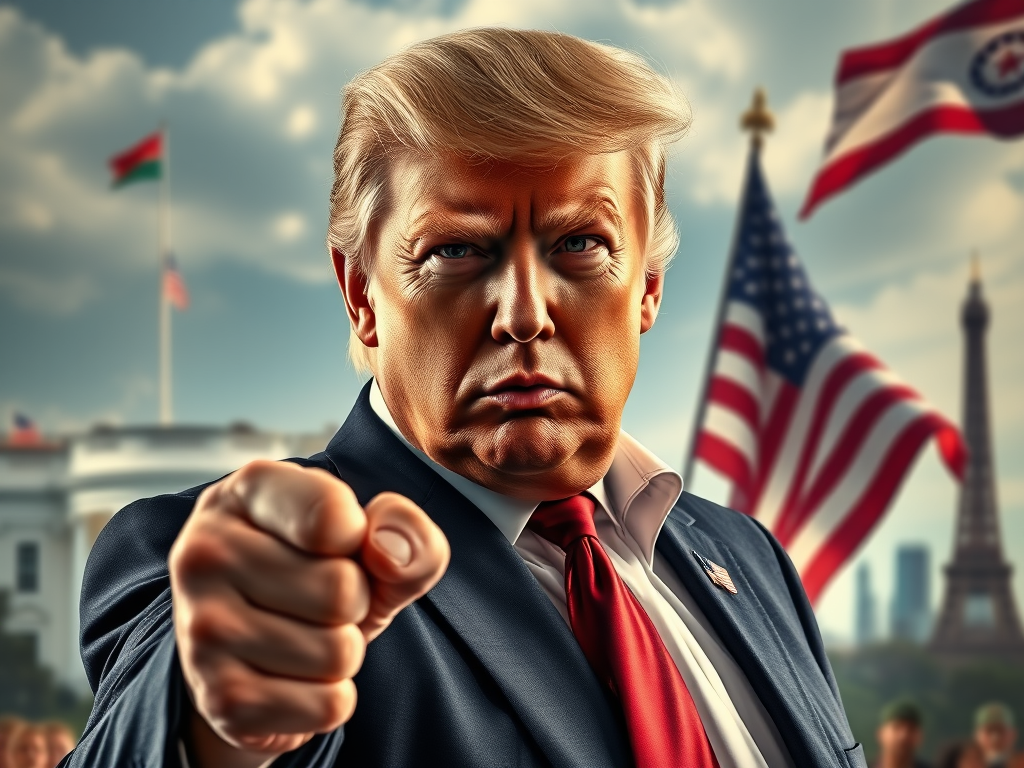
There doesn’t seem to be a single element of the status quo the President finds acceptable and whenever he happens to determine something is unacceptable, he has not hesitated to put his entire Presidency and its ultimately legacy on the line.
In some other universe, Donald Trump retook office on January 20, 2025 and proceeded to have something resembling a normal Republican Presidency, implementing a few supposedly conservative policies such as slightly lower taxes or reduced regulations, but generally choosing the go along to get a long approach typical of politicians in the modern era. While Trump would necessarily continue to be Trump in terms of his unique style and tone, the result would be yet another presidency that either disappears largely without a trace or leaves a lingering hangover on our politics as we’ve been forced to endure since at least Bill Clinton, if not earlier. The sort of Presidency where the chief legacy is continuing to fight over their supposedly singular achievements forever like mass incarceration or welfare reform, not to pick on President Clinton in particular as the Affordable Care Act certainly meets the same criteria, but nothing that actually solves a domestic or international problem permanently, or more properly, as permanently as anything can be in human affairs. Love him or hate him, President Donald Trump has clearly decided to pursue a different path entirely and by clearly, I mean blindly clear, like looking into ten thousand suns without shades, as in no one can possibly mistake it for anything else. While he simultaneously attempts to reorganize global trade, the federal workforce, and the entirety of international relations as they have been known for decades, in some cases half a century or more, the pace and volume of his actions alone would be stunning even without the scope. From American shores to the Middle East, from Europe to the Far East with India in between, there doesn’t seem to be a single element of the status quo the President finds acceptable and whenever he happens to determine that something is unacceptable, he has not hesitated to put his entire Presidency and its ultimately legacy on the line. To him, there appear to be only two choices: Go down in history as one of the most consequential Presidents, if not world leaders in general, or simply go down in flames with no possible in between.
Though most of the recent attention has been on the decision to strike Iran for obvious reasons, the action unfolding now began less than two months after the strike in Venezuela that captured President Nicolas Maduro, which occurred barely three months into the decision to use military force against drug cartel smuggling boats in the Caribbean and the Pacific, which was less than three months after the initial strike on Iran’s nuclear facilities. Two things unite each of these disparate cases, even what we may call the Iran redux given that we’re going in for a second time in far less than a year. First, there is a willingness to completely disregard the prevailing dogma, establishment consensus, conventional wisdom, or whatever you would like to call it. While presidents since Richard Nixon have waged a so-called war on drugs, only President Trump has turned it into an actual war, blowing them out of the water before they reach our shores in what his opposition describes as illegal killings if not outright murder. Likewise, presidents since George W. Bush have struggled to deal with the socialist regime in Venezuela, going so far as to support coup attempts against President Maduro’s predecessor, Hugo Chavez, and threatening consequences for Maduro himself if he rigged another election as President Joe Biden did less than five years ago. The challenges with Iran date back to the time between the two, when the first Ayatollah Khamenei took American hostages under Jimmy Carter and proceeded to bomb army barracks under Ronald Reagan. Second, each of these moves are inherently risky, some have even said reckless. Americans crave success, or at least the appearance of it, and in response to this phenomena in an era of 24/7 media coverage, most presidents in recent memory have been inherently risk averse, seeking to minimize what could blow back on their administrations. Even if they believe an action is right, even if – as in the case of President Biden threatening consequences or President Obama demanding the former Syrian regime refrain from using chemical weapons – they have drawn clear red lines in public, the fear that their Administration could be permanently damaged by failure, a botched raid, a raid that devolves into a civil war, or some wider war out of control war that is always being promised by the experts, has prevented them from doing something bold. Though the outcome in Iran remains unclear, a catastrophe during the other operations would have been disastrous in more ways than we can reasonably foresee, just imagine what reporting on the raid in Venezuela would’ve looked like if a chopper went down and killed everyone on board, or if it simply failed.
President Trump has been no different on the domestic front. Despite massive opposition from establishment experts and free-market thinkers in his own party, he has staked his reputation as a good steward of the economy on one of the least popular measures imaginable both with the credential classes and to some extent, average people, tariffs. Even after the Supreme Court ruled against his authority to level these measures without an act of Congress under the International Emergency Economic Powers Act, providing what many said was an easy off-ramp to eliminate them entirely while blaming it on the Courts rather than himself, the President forged ahead anyway, citing authority under a different statute and in some cases raising them even further. In addition, he has done so even amid a challenging job market, during which the economy has lost jobs in five of the thirteen months he has been back in office, losses many attribute to the tariffs or at least the uncertainty around them. He has also done so as economic growth in general has made some jarring turns, contracting in the first quarter last year, only to rebound in the second and the third, then sputter again to somewhat anemic growth in the first. Even if you believe the impact of tariffs on these metrics and others is overblown by experts as I do and even if you rightfully acknowledge that the President himself warned there would be some short-term disruption, there is no doubt that they have increased economic uncertainty in an environment where companies large and small crave stability. Though the final outcome of the policy is not yet known and might remain unknown until the end of this term or later, it’s difficult to imagine any other President in the modern era implementing such a policy against massive opposition, continuing the policy in the face of some signs the underlying economy was shaky, and refusing to reconsider the policy after being rebuked by the Supreme Court.
Similarly, President Trump has proceeded with the largest reduction of government workers in the modern era, shedding some 311,00 federal jobs and planning for more even as bureaucrats in the government itself and supposed experts on the government have insisted the result would be disastrous. From predictions to planes falling out of the sky, even in foreign countries in some cases, to an inability to properly respond to extreme weather, from claims that people will die horrible deaths in some future global pandemic that we are unprepared for due to a lack of credentialled expertise to a failure to rapidly approve life saving drugs, there is no doubt that those who are supposed to know about these things believe reducing the government workforce at this scale is a disaster waiting to happen, the only question is when and how major. President Trump, however, obviously thinks otherwise and has relentlessly proceeded in major staff reductions across the State Department, the Centers for Disease Control and Prevention, and others, in some cases cuts of huge percentages. As of last year, this included 100% of the US Agency for International Development, accounting for around 10,000 employees. 86.4% of the Consumer Financial Protection Bureau, or about 1,500 employees. 84.8% of the Agency for Global Media, some 1,400 employees, 41.5% of the Small Business Administration, 2,700 employees, 33.3% of the Department of Education, 1,378, 18.6% of the FDIC, 1,200, 16.7% of the FDA, 3,500, 12.7% of the CDC, 1,622, 10% of the Geological Survey, 1,000, 9.3% of the State Department, 1,353, 8.8% of the Forest Service, 3,475, 8.6% of General Administration, 1,000, 7.4% of the IRS, 7,315, along with some 21 other departments with cuts ranging between 100% (Institute of Museum and Library Services) to .2% Citizen and Immigration Services. Even Washington’s traditional sacred cows haven’t been spared with cuts of 5,400 employees at the Department of Defense (.8%) and 1,200 employees at the CIA (5.5%). Moreover, in many of these departments, this is simply the first round. Earlier this year, the President announced up to 50,000 more potential cuts even as the establishment continues to decry the risk.
Of course, he has also launched what has been described as the most aggressive, largest deportation campaign since President Dwight D. Eisenhower in the early 1950s, unleashing ICE and Border Patrol Agents on city streets to round up criminal illegal aliens in unprecedented numbers while offering incentives for every illegal alien to self-deport. Though he campaigned on doing precisely this, these policies have been met with fierce, organized resistance from progressive cities and states, leaving two dead in Minneapolis, complaints from economists that we are destroying an essential workforce to the point where the economy cannot function without it, even protest songs from aging musicians Bruce Springsteen and U2. There is also some evidence the public believes President Trump’s measures have gone too far, with polls from slightly over 50% to close to 60% claiming he has been too aggressive and confrontational, causing more chaos than necessary to achieve the same goal. Rather than scaling back, however, the President effectively doubled down at the State of the Union less than two weeks ago, insisting that he and his fellow Republicans are the only ones who stand between the American people and out of control open borders and calling Democrats “crazy” for refusing to stand up for the American people over illegal immigrants. He has also refused to accede to any Democrat demands to reform ICE or the Border Patrol, even as the Department of Homeland Security, the Federal Emergency Management Administration, and the Coast Guard have been shut down for weeks in the middle of a war as a result of yet another dispute over spending. This after a more widespread shutdown, the longest in history, in September and October last year, when the President refused to cave to Democrat demands for more healthcare funding.
Likewise, President Trump has not hesitated to take on embedded progressive interests in the government and elsewhere, rolling back, eliminating, or removing a broad range of Diversity, Equity, Inclusion and transgender initiatives despite repeated claims that it is racist or anti-LGBTQ to do so. Immediately upon retaking office, he began completely reversing these policies in the military, renaming the Department of Defense to the Department of War, reverting physical fitness standards to what they were decades ago, actively shaming older and out of shape military leadership, and barring transgender people from combat roles. He has also stopped these practices in government hiring and slashed every government department associated with them. In the private sector, he has threatened to cut the funding or outright sue organizations that receive government money such as universities if they don’t do the same. Beyond the accusations of racism, critics have regularly decried these moves as inherently authoritarian and anti-free speech, unamerican to the core, and yet the President persists undeterred. While the risk of someone dying as a result or some Presidency ending disaster are necessarily lower than across some of his other initiatives, we see the same bold, in your face defiance, the willingness to seek out what has been the consensus and ruthlessly destroy it despite fierce opposition.
Less than fourteen months into a forty eight month term, the results of some or even all of these policies are necessarily unknown. Anyone who tells otherwise either at home or abroad suffers from wishful thinking likely for partisan purposes, declaring them a smashing success or an abject failure depending on your political preferences, or has a vastly overestimated sense of their predictive powers. There are only two things we know for sure right now. First, there is no real historical parallel to a President doing so much in so many areas so fast and so different from how it’s been done. From Abraham Lincoln to Franklin Delano Roosevelt, there have been world-changing, Earth-shattering presidents that represented radical breaks from the past, but there has never been one that has moved this quickly across so many different areas, smashing consensus after consensus while promising more to come – see the unfolding situation in Cuba if you think this will slow down. The media is frequently fond of claiming Democrat Presidents are historic for some reason, often based on race or gender. President Trump is historic in a far more meaningful sense in my opinion. The problem for all of us is simple: The first draft of history isn’t always the correct one and understanding the impact of radical changes happening in real time is always exceedingly difficult. At times, all we can do is wait and see, which is never a satisfactory feeling in a world of instant gratification. Second, whatever the President’s other faults, a lack of audacity, drive, and desire to change the world certainly isn’t one of them and whether he succeeds or fails on all of these fronts, nothing will ever be the same. Presidents simply don’t make bets this big, this frequently, but they might well be forced to in the future by a public that demands a lot less talk and more action. In the meantime, we can confidently declare him the boldest person to ever sit in the Oval Office by a long shot, knowing that we are unlikely to see a politician so bold and daring ever again. Whether that turns out to be for better or worse, we will simply have to wait.

 Confessions of a Conservative Atheist