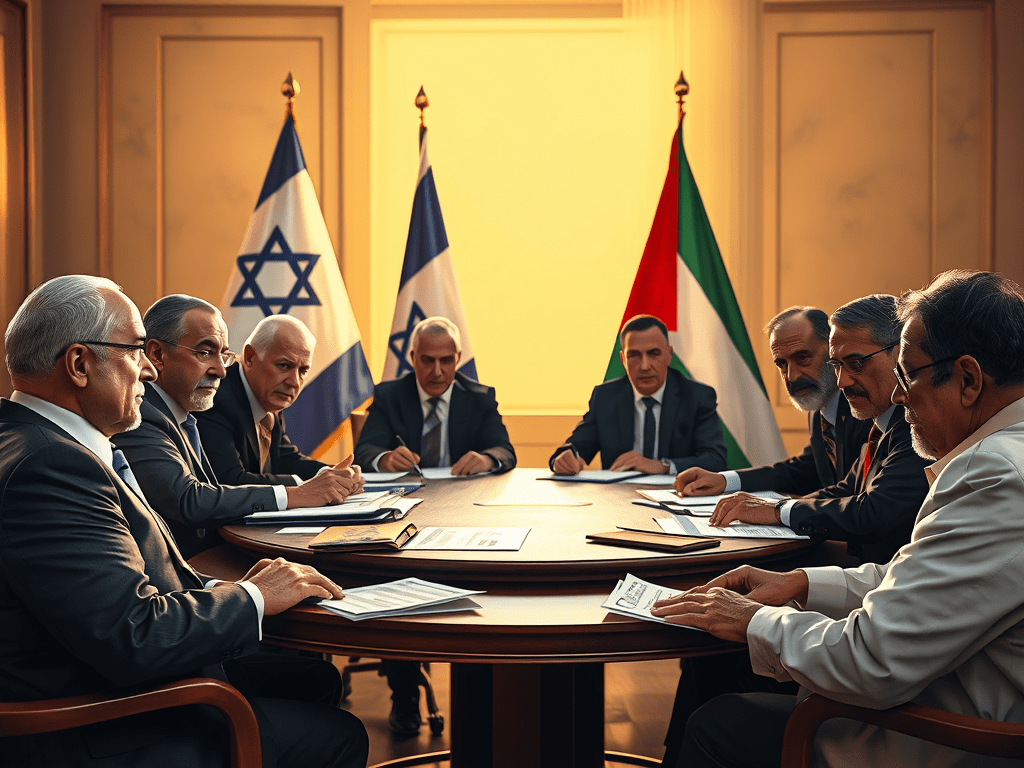
While it remains to be seen if a ceasefire between Israel and Hamas, Syria joining the Abraham Accords, and even a group of sheikhs in the West Bank, will come to fruition, clearly something has changed radically in the region over the past six months and just as clearly, that something is President Trump.
Shortly after President Donald Trump secured a cease fire between Israel and Iran, I noted that it wouldn’t be surprising if a broader settlement between Israel and Hamas came to fruition sooner rather than later, and it appears that’s exactly what’s happening. While it’s still early, Hamas can’t possibly be trusted, and anger between both sides runs decades or longer deep, several recent developments suggest that there is a path forward in both Gaza and the West Bank. As we speak negotiations are underway in Qatar between delegations from both Israel and Hamas, mediated by Qatar itself and Egypt. The latest proposal includes provisions for a 60 day initial cease fire, a release of hostages and a prisoner exchange, a significant increase in humanitarian aid, the withdrawal of Israeli troops to designated areas of Gaza only, and an agreement to continue discussions for a more permanent truce. For its part, Israel has already committed to the deal while Hamas has suggested it has potential. According to ABC News, beyond some relatively minor disputes on the provisions such as the details of the prisoner exchanges, “Officials familiar with the negotiations say that the biggest sticking point is consistent with failed talks in the past: Hamas wants assurances that a ceasefire will lead to a permanent end to war. It wants assurances that talks during the ceasefire on a permanent end to the war will continue beyond the 60-day window if it’s necessary. Israel, meanwhile, is reluctant to sign on to any language that restricts military action. Israel is also adamant that Hamas can’t be allowed to play any part in governing Gaza — a term the Trump administration is aligned with. Both governments are wary of allowing for a situation similar to what existed in Lebanon with Hezbollah, where a civilian government is in place but the militant group holds significant control.” Later this week, United States envoy Steve Witkoff is expected to join the ongoing talks after Israeli Prime Minister Benjamin Netanyahu met with President Trump at the White House on Monday. President Trump himself believes there is an opportunity for a “victory with a capital ‘V’ and that his efforts in Iran offer both “leverage” and “goodwill” according to Dana Stroul, a former Deputy Assistant Secretary of Defense for the Middle East from 2021 to 2023. “President Trump has put resources in the game, not just words. And so he has leverage at this moment in time to tell Netanyahu, it’s time to wind down the wars in Gaza,” she said. “It certainly has the makings of a grand bargain.”
Last week, The Times, a British daily, also reported that Qatar has become more forceful with Hamas, where key leaders have been offered refuge from the war zone in Gaza. Those leaders have now been asked to hand over their personal weapons. According to i24 News, “This measure, apparently orchestrated by Qatari mediators, is seen as a positive signal in the ongoing negotiations for a hostage release agreement and a ceasefire in Gaza. This initiative is part of diplomatic efforts led by the United States, with the mediation of Qatar and Egypt, to reach a ceasefire agreement.” The leaders in question include Zaher Jabarin, a founder of Hamas’ armed wing in the West Bank, Muhammad Ismail Darwish, the chair of Hamas’ advisory council, and Khalil al-Hayya, the head of Hamas’ negotiation team. While described as largely symbolic, the decision addresses a central Israeli demand for Hamas to disarm, and “a gesture of confidence on the part of Qatar, possibly intended to reassure the United States of its commitment to the peace process.” Previously, Qatar didn’t engage directly in the twelve day conflict between Israel and Iran, but they did assist the United States in blocking missiles directly at our Udeid Air Base, located in the country, and helped broker the subsequent ceasefire agreement. While no one would suggest Israel and Qatar have a close or easy relationship, over the past several years the two countries have engaged in direct talks over regional matters and there appears to be an opportunity for them to join the historic Abraham Accords if a cease-fire can be reached in Gaza. Nor are they alone in the region, with Syria, Lebanon, and Saudi Arabia all potentially interested in normalizing relations with Israel. Perhaps most surprisingly, Syria, which has until very recently been a rogue terrorist state supported by Iran and Russia, might be the furthest along with “direct dialogues” happening between the two countries. According to Open Source Intel, these direct dialogues include Syria’s Ahmad Al-Sharaa meeting with Israeli National Security Advisor, Tzachi Hanegbi, in Abu Dhabi. The plan is to cede the Golan Heights to Israel in exchange for support for the new Syrian regime to remain in power. This would include the establishment of three demilitarized zones in southern Syria, Daraa, Quneitra, and Sweida, and the removal of all heavy weapons from the Syrian army barracks in the south. Afterward, the Syrian army and police will only be allowed to carry light weapons in the demilitarized zone, per Al Mayadeen sources. Whether or not they come to fruition in the immediate future, that they are occurring and that Qatar and Syria in particular appear to be (somewhat) legitimate partners in seeking peace.
There are also some stunning developments inside the Palestinian community itself, where certain members of Hamas are insisting the organization is finished and certain leaders in the West Bank are seeking to separate themselves from the current ruling regime, known as the Palestinian Authority, hoping to sign on independently to the Abraham Accords, representing perhaps a new approach to peace that wasn’t even considered in recent memory. In Gaza itself, an unnamed Hamas member told the BBC, “Let’s be realistic here – there’s barely anything left of the security structure. “Most of the leadership, about 95%, are now dead… The active figures have all been killed. So really, what’s stopping Israel from continuing this war?” “Logically, it has to continue until the end. All the conditions are aligned: Israel has the upper hand, the world is silent, the Arab regimes are silent, criminal gangs are everywhere, society is collapsing,” he added. In the West Bank, the Sheikhs of Hebron have engaged in direct talks with Israel outside the prevailing government structures. “We want cooperation with Israel,” says Sheikh Wadee’ al-Jaabari, also known as Abu Sanad, from his ceremonial tent in Hebron, the West Bank’s largest city located south of Jerusalem. “We want coexistence.” To that end, they have sent a letter to Israeli Economy Minister Nir Barkat, a former mayor of Jerusalem, who has hosted Mr. Jaabari and others at his home, meeting with them more than a dozen times since February. According to The Wall Street Journal, the letter “seeks a timetable for negotiations to join the Abraham Accords and ‘a fair and decent arrangement that would replace the Oslo Accords, which only brought damage, death, economic disaster and destruction.’” They propose Israel admit 1,000 workers from Hebron for a trial period, followed by 5,000 more with a long term goal of over 50,000 workers. They also promise “zero tolerance” for terrorism by workers, “in contrast to the current situation in which the Palestinian Authority pays tributes to the terrorists.”
While it remains to be seen which of these various opportunities will come to fruition and it’s certainly conceivable none of them will, clearly something has changed radically in the region over the past six months and just as clearly, that something is President Trump. It’s true that he’s taking advantage of the reality that Israel has decimated Hamas, Hezbollah, and even struck Iran following the atrocities of October 7, but it’s hard to see how any other President in recent memory would have done so as effectively. First, he recognized the reality that Israel was ascendent and Iran was impotent when much of the foreign policy establishment wanted to preserve the status quo, believing there was some type of simmering stalemate that can continue indefinitely. Putting this another way it’s almost impossible to believe a President Joe Biden or a President Barack Obama would’ve directly struck Iran’s nuclear facilities, then immediately sought peace. Second, President Trump has long understood that the Palestinian problem was a proxy for broader issues in the region, leading him to conclude that it could never be resolved by maintaining the status quo. This meant two things, engaging Israel with other Arab nations more interested in economic growth than religious squabbles and limiting Iranian influence. The Abraham Accords were built on that premise, which of course also bound them further to us, as evidenced by President Trump’s triumphant trip earlier this year. The combination of the Twelve Day War and our targeted strike achieved the latter. The product of the two seems likely to change the future of the region and the world forever. We should all hope that’s the case.

 Confessions of a Conservative Atheist