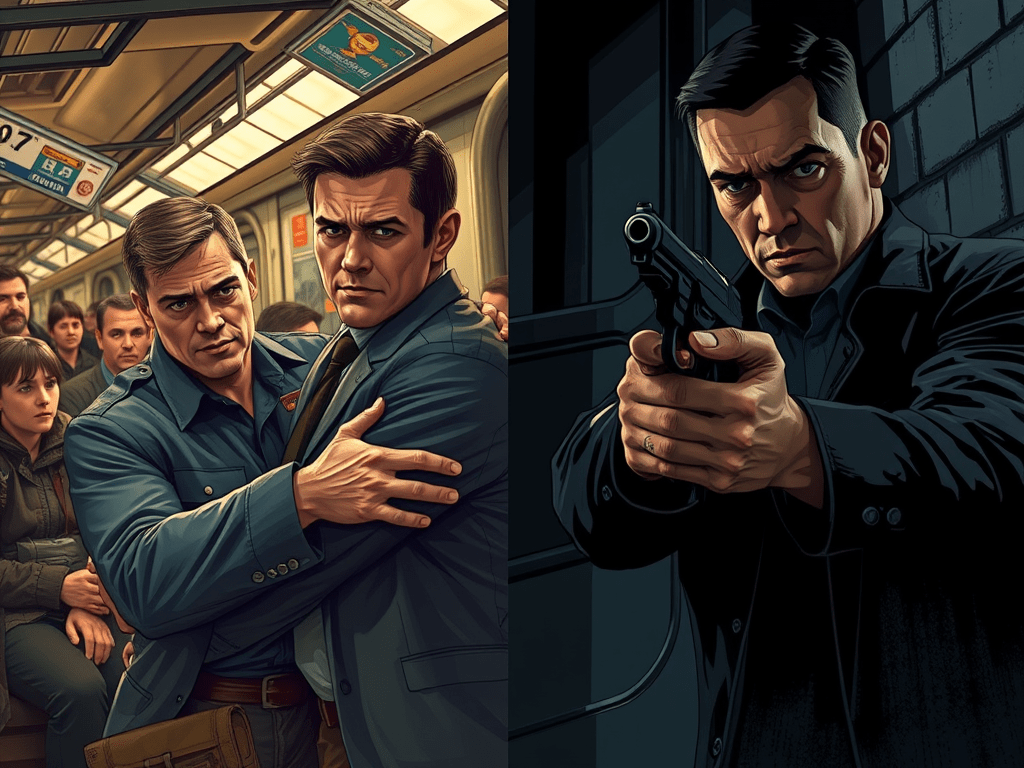
Progressives have been quick to proclaim a not guilty verdict after a man defended passengers on a crowded subway was a travesty of justice while praising the death of the UnitedHealthcare’s CEO, abandoning all pretenses of morals in the process.
Earlier this week, CNN’s Scott Jennings held up a piece of paper on Aby Phillip’s NewsNight, stating the obvious about progressive reaction to the deaths of two very different men at the hands of two equally different men in radically different situations that have recently been in the headlines. On one side of the paper, he had the word hero and on the other, villain. In this scenario, Daniel Penny, a former Marine, who attempted to detain a mentally ill homeless man harassing people in public on a subway in New York City and accidentally choked him to death in the process, was the hero. Luigi Mangione, the son of wealthy parents, who apparently went crazy and executed the CEO of UnitedHealthcare, Brian Thompson, in cold blood on the streets of the same New York City like something out of a movie, complete with a silencer of all things, was the villain. To the average person, it’s probably easy to see why. Mr. Penny unintentionally killed an out of control man, who had been arrested some forty times including violent incidents, that was threatening others. During his recent trial for homicide and manslaughter, where the more serious charge was dismissed at the last minute and the jury found him not guilty of the lesser, multiple witnesses testified that they feared for their lives and that they didn’t believe Mr. Penny purposely killed the assailant, Jordan Neely. A mother on the train with a 5-year-old described Mr. Neely as “very erratic and unpredictable,” leading her to protect her son from his antics. “I actually took the stroller that I had and put it in front of my son to create a barrier.” Alethea Gittings, who was also in the subway car, claimed Mr. Neely refused to yield even after he was restrained at the scene. “I heard the young man that’s on the floor saying, you know hey, I’m willing to die. You know, I’ll do anything. I’ll go to jail. I don’t care. I don’t care,” she told the police on body camera footage immediately after the incident. She also noted that Mr. Penny wasn’t overly violent or intentionally forceful as he tried to restrain Mr. Neely. “The guy in the tan did take him down like, very respectfully and just like held. He just held him. Yeah, yeah, he just held him. He didn’t choke him,” she said. Mr. Mangione, on the other hand, thought he was an assassin in a B-movie and killed a man with a wife and two children by shooting him in the back multiple times for no proximate cause, given the two had never met. We do not know for sure what his motives were yet, but as far as we can tell, there are none that are rational or could be attributed to anything except what Bruce Springsteen once described as a “meanness” in this world.
Progressives, however, have been quick to proclaim Mr. Penny’s not guilty verdict a travesty of justice while praising the death of the UnitedHealthcare’s CEO. (For clarity’s sake, I am not referring to those on the left who might have made a macabre joke, I’m talking exclusively about the hard left, and I think everyone knows who they are.) “Let’s be clear ‒ mental health crises are medical emergencies, not crimes,” the NAACP wrote in response to the Penny verdict. “We are constantly reminded that the law is not enough,” explained Jamila Hodge, who is a former assistant U.S. Attorney and current CEO of Equal Justice USA, referencing a speech Martin Luther King Jr. gave in 1965. “Jordan Neely is dead and Daniel Penny has been acquitted because of the assumption of dangerousness that attaches to Black skin. America has yet again criminalized our community and subverted accountability.” “(Because) Jordan was houseless and crying for food in a time when the city is raising rents and stripping services to militarize itself while many in power demonize the poor, the murderer gets protected,” progressive firebrand Alexendria Ocasio-Cortez tweeted immediately after Mr. Neely’s death. On the opposite side, Politico covered the reaction to Mr. Thompson’s execution. “In the wake of the early morning killing of UnitedHealthcare CEO Brian Thompson in New York last week, social media lit up not with shock and horror, but something more akin to joy. ‘This needs to be the new norm,’ posted one X user, ‘EAT THE RICH.’ ‘My only question is did the CEO of United Healthcare die quickly or over several months waiting to find out if his insurance would cover his treatment for the fatal gunshot wound?’ posted another. The glee with which so many people online responded to the news of the killing shocked the consciences of politicians and pundits alike. How are we to make sense of such a grim, ugly public sentiment?” While Politico attributed this glee at someone’s murder to “social banditry,” “sometimes fictional, sometimes real figures who operated outside of the law and were widely revered for their efforts to mete out justice in an unjust world,” many conservatives have insisted that the two reactions taken together represent how inverted or backwards the progressive moral compass has become in recent years. Piers Morgan, writing for The New York Post, summarized it this way, “The reaction to the two deaths has been very illuminating about the woke left’s shocking double standards and warped, hypocritical morality. They promote the hashtag #BeKind and profess to be so much more caring, sensitive and tolerant than conservatives. But they also think courageous veterans like Daniel Penny are villains, and deranged shooters like Luigi Mangione are heroes. If you believe those two things, you’re a disgusting excuse for a human being.”
For better or probably worse, both are wrong: The problem isn’t that progressives are suffering from a moral malady, either hypocrisy or an inversion of traditional moral principles. It’s that they have no morality at all anymore because they have rejected the fundamental principles underlying morality itself. For centuries, if not millennia, philosophers and religious scholars have debated where morality comes from, whether it emanates from a higher power or from within the individual, arises as a necessity of the social contract or even the necessary evolutionary adaptation of a social creature. They have also debated the specific precepts of various moral systems, and identified various contradictions in every system. A few of these moral systems and theories include Kantian ethics, where an action is deemed morally right if done out of a sense of duty and if the principle motivating the action can be applied universally. Virtue ethics where the role of character and virtue is emphasized, rather than duty or consequences. Divine command, where God has given humans commandments to obey, compared to natural law where we are imbued with a moral compass for some reason. Other, less positivist theories to use another philosophical phrase, include utilitarianism where actions are judged by their consequences, particularly the good and the bad, deontology, which focuses on duty instead of consequences, and finally, ethical egoism where people maximize their self interest. While a few have claimed there’s no such thing as morality, most believe such a thing exists, or has to exist for the good of the human race, and the common thread in these and other theories is their universal applicability. With the possible exception of ethical egoism, moral theories aren’t contextual, based on the unique characteristics and life histories of the individuals involved. If murder is wrong for me, it’s wrong for you. If theft is wrong for me, it’s wrong for you. We might exercise some judgement about why a given person commits a certain crime, and deem some circumstances worse than others. As in Victor Hugo’s classic Les Misérables, a starving person who steals a loaf of bread has more justification than someone who steals simply for the sake of stealing, and perhaps should be given more leniency, but this doesn’t change the fact that stealing is an immoral act. We might also understand that sometimes morals come into conflict with one another, where the right choice is itself a judgement. Murder is almost universally condemned as morally abhorrent regardless of your specific theory, and yet killing someone to prevent an immediate, imminent threat to someone else is sometimes justifiable.
If recent history is any indication, however, progressives simply no longer believe this or anything like it. To them, morality is based entirely on the immutable characteristics of the individual in question, which is no longer morality, coupled with their perception of the underlying power dynamics. In their view, cheering on the murder of a health insurance company executive is acceptable if not desirable because he was of the privileged class and has power, power they believe has been used to oppress other people by denying healthcare claims. It doesn’t matter whether or not Mr. Thompson was personally involved in any decision that might have affected Mr. Mangione, much less whether he knew Mr. Mangione personally. It doesn’t even matter if Mr. Mangione was negatively impacted by the company Mr. Thompson led, or the industry he was a leader in, or any other such causal connection. All that matters is that Mr. Thompson was a leader in an industry they believe oppresses people, and therefore his life has value only in its absence, as an example to others, and Mr. Mangione’s actions were heroic. Inversely, Mr. Penny is a villain whether or not he was defending other people, and whether or not he intended to kill Mr. Neely by restraining him. Neither does it matter what the other people in the subway car felt, saw, or heard regarding Mr. Neely as a potential threat to their safety or Mr. Penny as not purposefully committing murder. The only things that matter were Mr. Penny being white and Mr. Neely being black, making Mr. Penny the oppressor regardless of whether he actually did any oppressing or even his own political beliefs about oppression, and Mr. Neely the oppressed, regardless of his role in the altercation, any decisions made in the lead up to the altercation, and a history of violent behavior. Crucially, it doesn’t even matter if Mr. Penny acted in self defense and potentially saved the lives of others. He must be sacrificed, made an example of, because Mr. Neely is oppressed, a victim by birth and circumstances. We can see this clearly even in the thoughts of commentators who’ve not chosen to remark specifically on the verdict, but have insisted instead that “the system” or some other vague entity has failed Mr. Neely because he is black, homeless, and had mental problems. The notion is frequently coupled with the idea that Mr. Neely didn’t “deserve” to die, which might well be true as few people on this planet “deserve” death, thankfully, but is irrelevant to the facts at hand. We can sympathize with this plight, but the reasons that led him to terrorize passengers on the subway are irrelevant to Mr. Penny’s reaction to that terror, unless we assume he had a time machine and could travel back to right whatever wrongs were suffered. Further, the “deserve” standard would never apply to Mr. Thompson in these same progressive eyes. Why is no one on the left side of the political spectrum saying he didn’t deserve to die while in the same breath they lament Mr. Neely?
Whatever the root cause, the consequences are potentially disastrous. This is true at micro and a macro level, where intersectionality leads directly to praising the slaughter of thousands because of the perception they are oppressed. Either personally or throughout society, there is no fairness, accountability, justice, or basic trust without underlying morals that apply universally to everyone. Morals, shared and consistently applied, are the basis of all functioning democracies and Republics in the history of the world, even in the Roman Republic twenty five hundred years ago where their sense of morality would seem alien and abhorrent to ours. In order for society to function, people need to believe there are rules of the game, even if certain outcomes might be unjust or undesirable, the foundation of these rules are morals. Without them, all that remains is power, raw, uncontrolled, ultimately destructive power, which progressives clearly crave – while failing to understand that power shifts in unexpected ways, often producing outcomes the opposite of what one would expect or desire. Even the greatest politicians and rulers can have power one day, find themselves without it the next, and in many cases find that power is back in the hands of those they hate and fear. Over the past thirty years, we have seen the presidency and Congress switch hands between Democrats and Republicans, frequently after some assured us a permanent power base had been secured. In reality, no one knows who will have it after the next election, much less three decades from now. Over the sweep of human history, the most powerful people on Earth have found themselves suddenly alone, destitute, and exiled (Napoleon, Marc Antony, Sulla, etc.) Morality, however, is the great equalizer, ensuring fair and respectful treatment regardless of whether one has power at the moment. We submit to the will of the government, the laws of the land because of the belief that whoever is in power, we will be treated fairly, morally, justly. Progressives, sadly, would deny all that for their own short term gain – until the revolution eats its own, as it always does because anarchy and confusion reign when might makes right, if you will allow me to combine a few old sayings in a single sentence.


