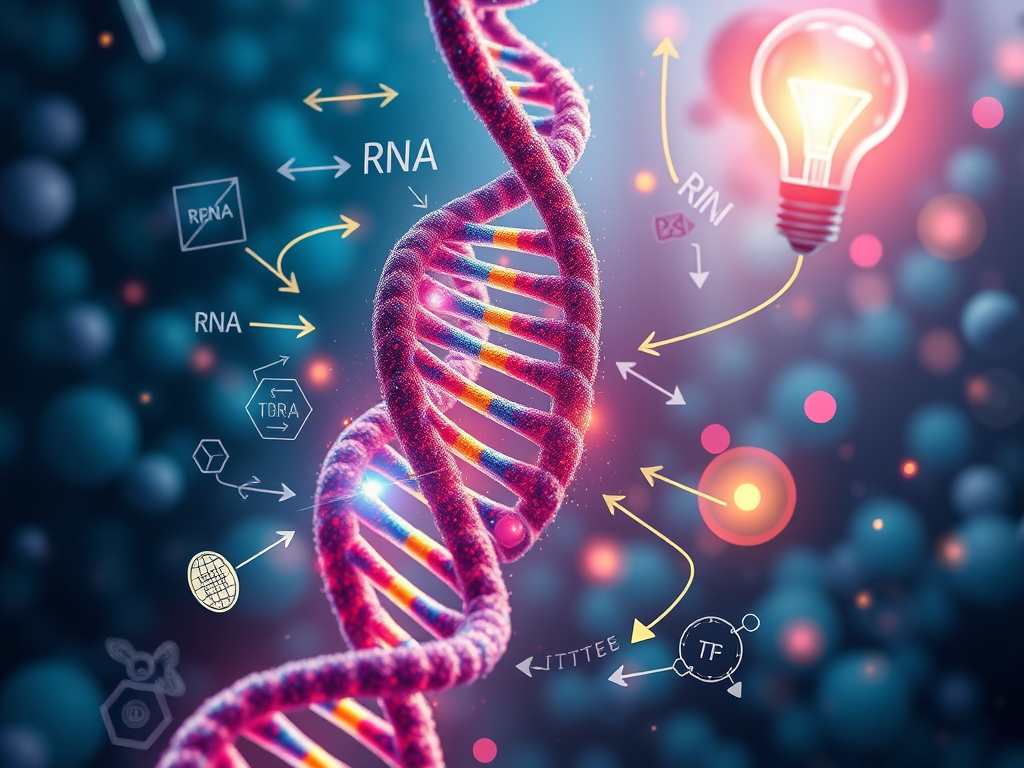
Since the 1960s, scientists have focused on a gene’s ability to encode proteins, resulting in a causal chain of gene expression from the initial coding in a strand of DNA, to the extraction of the code into RNA, to the formation of the protein and it’s ultimate expression in an organism. This view now appears to be incorrect, but that has also been the case for at least forty years.
The American physicist and philosopher Thomas Kuhn is credited with coining the phrase “paradigm shift” to describe fundamental changes in the concepts and experimental practices underlying a specific scientific theory. In his breakthrough 1962 book, The Structure of Scientific Revolutions, he detailed how the natural sciences alternate between periods of radical upheaval and routine practice, what he referred to as “normal science” occurring between revolutions in thought brought on by “extraordinary” research that causes scientists to question what they truly believe. Necessarily, these paradigm shifts are rare. In the past century and a half we might have seen three of them, from Newtonian mechanics to Einsteinian mechanics, from pre-quantum mechanics to post-quantum mechanics (frequently considered from Newtonian to quantum), and from evolution by natural selection to the neo-Darwinian synthesis with the discovery of DNA, but according to Dr. William A. Haseltine at least, we are witnessing one right now in the field of molecular biology. As he sees it, the current paradigm was established by Jim Watson, co-discoverer of DNA along with Francis Crick, in his seminal 1965 textbook, The Molecular Biology of the Gene. At the time, Watson placed extensive focus on the ability of a gene to encode proteins, resulting in a causal chain of gene expression that ran from the initial coding in a strand of DNA, to the extraction of the code into RNA, to the formation of the protein and it’s ultimate expression in an organism. Dr. Haseltine described it this way recently for Forbes, “The theory holds that Gregor Mendel’s concept of a gene (a discrete heritable trait or phenotype) is the consequence of a change in the text of DNA that alters the function of a protein and, therefore, the phenotype. Sickle cell anemia is a prime example. A single-letter change in the DNA that encodes the hemoglobin protein changes the structure of the protein so that it aggregates to create sickle-shaped red blood cells, leading to the blood clots that define the disease. While true, we now view this paradigm as a special case of a broader reality. Why?” He continued to describe how advancements in our ability to actually read the genome of a wide variety of organisms turned up something highly unexpected: “The vast majority of changes in DNA sequence of consequence are not in the 2% of the human genome that specify proteins but rather in the 90% or more of the genome that does not. In other words, most of what Gregor Mendel described as a trait is usually NOT a change in the sequence of a protein. If most genes are not proteins, what are they?”
Before answering that question, Dr. Haseltine cites two other emerging lines of evidence. First, all organisms, even single celled ones, possess DNA for almost the same 20,000 proteins, leading the Nobel Prize-winning biologist Jaques Monod to quip, “What is true for phage lambda is true for the elephant,” and second, the great majority of DNA is used, or at least is copied into RNA. Despite the previous assumption that it was “junk,” “Humans copy at least 70% of our genome into RNA, vastly more than the 2% specifying protein. Previously, non-protein coding DNA was related to a trash heap called ‘junk DNA’. Additionally, many variants that affect heritable traits occur in other non-protein-coding regulatory regions, including RNA transcription start, stop, and splicing sequences.” As a result of these three instances of “extraordinary” research, Dr. Haseltine is calling for a new paradigm, which he refers as the DNA/RNA dogma, “a description that assigns equal importance to both DNA and RNA, a focus on the control of protein expression as a key to understanding Mendelian inheritance.” Thus, the current DNA to RNA to Protein to Phenotype approach is reimagined as a much more complex, and dynamic back and forth process where DNA goes to RNA, RNA can go back to DNA, and control is exercised at both stages prior to construction of a protein and the ultimate expression in the phenotype, making the role of the great majority of our DNA and RNA primarily regulatory in purpose, instructions instead of building blocks. “Analogy may help,” he wrote, “I now have extensive experience with Lego in building entire cities for my grandchildren. Lego sets come with a set of colored plastic parts and a set of instructions to assemble them. In this analogy, the plastic parts are the proteins, limited in number, each with a defined form. The instructions are the regulatory RNAs. With the same parts, you can build either a simple or complex structure. Change the instructions, and you change the structure. A single error in the instructions (or much less frequently in a building block) results in a fault in the final structure. There are many more words in the instructions than there are in the different types of building blocks. Most organisms produce very similar sets of proteins but differ markedly in the way those proteins are used. Kits for complex structures, like Ninjago sets, also include a minority of customized blocks analogous to specialized proteins.”
While this is a welcome development, it’s also yet another example of how the experts frequently miss the forest for the trees as the old saying goes. To me at least, it has seemed obvious that the original DNA-protein driven model had to be wrong from the very beginning because it’s incompatible with evolution by natural selection for three reasons. It might make sense in terms of strict molecular biology, but not in terms of how life actually works, much less how life could build complex organisms that appear to have evolved to evolve. First, evolution is essentially its own harshest critic, operating on an incredibly strict budget when even tiny changes in resource consumption can make the difference between life and death. It’s unlikely organisms would be carrying around reams of extra baggage in every cell for millions of years, when excising the junk would offer a competitive advantage, as it does in prokaryotic cells where the efficiency of the genome is paramount. Second, and perhaps much more importantly, it’s hard to see how evolution works at all if new proteins are constantly required, much less how evolution could have produced anything like the Cambrian Explosion where most of the current body plans appeared practically overnight in geological terms. Making new proteins is exceedingly hard from the perspective of random chance filtered by natural selection; most combinations aren’t stable or, like sickle cell anemia mentioned earlier, are actively harmful to the organism if they are. If animals could only acquire new traits via mutations that produced new stable, functional proteins, it would either take much, much longer, or life would be limited to very simple organisms. To build on Dr. Haseltine’s analogy about Legos, a gifted chef can come up with brand new recipes using the same ingredients rather than creating new ones, and a gifted musician comes up with new songs using the same notes. If new ingredients or notes were required, we wouldn’t have new food or new music, or such things would be exceedingly rare. Evolution has to have worked the same way or things wouldn’t evolve, nor is this simply an opinion that cannot be tested or studied, bringing us to third reason there was always reason to be skeptical: While natural selection is frequently credited with building the body (the phenotype), it also builds the mind and imbues it with instincts, built in behaviors that the body executes in response to external stimuli, from mating to hunting to building a web. How can this be done purely with proteins?
The famed evolutionary biologist Richard Dawkins illuminated this idea in his 1982 masterpiece, The Extended Phenotype, which sadly remains one of the most misunderstood and underappreciated concepts in modern evolutionary theory. Essentially, he proposed this new paradigm out of whole cloth more than four decades ago, long before we’d mapped a single genome. As he described it, the concept of a phenotype should not be limited to biological processes like protein synthesis and tissue growth. Instead, it should include all the effects a gene has both inside and outside the body including behaviors that changed the environment around it, such as a beaver building a dam which he referred to as “architectural constructions,” adaptations that manipulated other organisms, “parasite manipulation,” and even “action at a distance,” also present in some parasites. The parasite manipulation and action at a distance is particularly compelling for our purposes. Here, Professor Dawkins details the lifecycle of hairworm, popularized in sci-fi fashion on HBO’s hit show The Last of Us, a parasite that transforms crickets into zombies, visible outside of the body as hairs protruding through the exoskeleton, literally forcing them to drown themselves. The horror-movie nature of the process aside, it is a complex behavioral response that could be initiated by a protein produced by the hairworm, but once initiated, relies on the nervous system of the host. Professor Dawkins also detailed the infamous cuckoo bird, which lays its eggs in the nest of another species, relying on them to feed and nurture their offspring at the expense of their own progeny. The cuckoo achieves this remarkable feat of trickery in an incredibly simple manner. It doesn’t rely on chemicals or mind control at all to trick the target. It doesn’t actually interact with the target at all. Instead, it simply lays eggs that look like the target’s own, frequently meadow pipits, dunnocks, or reed warblers, and these eggs hatch chicks that look like the target’s own offspring at a young age — and only at a young age. As the cuckoo matures, it grows larger than the target, too large for the nest. In fact, it looks like the growing cuckoo could eat the target if you see a photo of a warbler feeding one, but the mere appearance of the eggs and the hatchlings triggers the behavioral response to feed and nurture the cuckoo over its own offspring. In this case, the DNA of the cuckoo produces proteins nearly identical to the target, DNA that has nothing to do with the internal processes of an adult cuckoo, and unless we are to assume the protein in the coloring of the egg has a specific protein receptor in the target, which is also a protein, it can only be that the behavior response in the target is driven by something other than direct DNA transcription into RNA and proteins. Professor Dawkin’s summarized his view this way, “Taking these three things together, we arrive at our own ‘central theorem’ of the extended phenotype: An animal’s behaviour tends to maximize the survival of the genes ‘for’ that behaviour, whether or not those genes happen to be in the body of the particular animal performing it.”
This can only be true if genes do more than code for proteins, meaning the new paradigm could’ve been established almost fifty years ago, but reviewers at the time were locked into the current paradigm and unable to see past it. The American Scientist, for example, took issue with the very idea that genes do so much and mean so much, clearly viewing them as simple protein builders. Its “main theme – that the gene is the only unit of selection – results from incorrectly interpreting the constraints on organismal adaptation and from too narrow an interpretation of replication, a process of more general relevance than the author is willing to allow.” More than four decades later, it seems we are finally catching up to Professor Dawkins, better late than never.

 Confessions of a Conservative Atheist