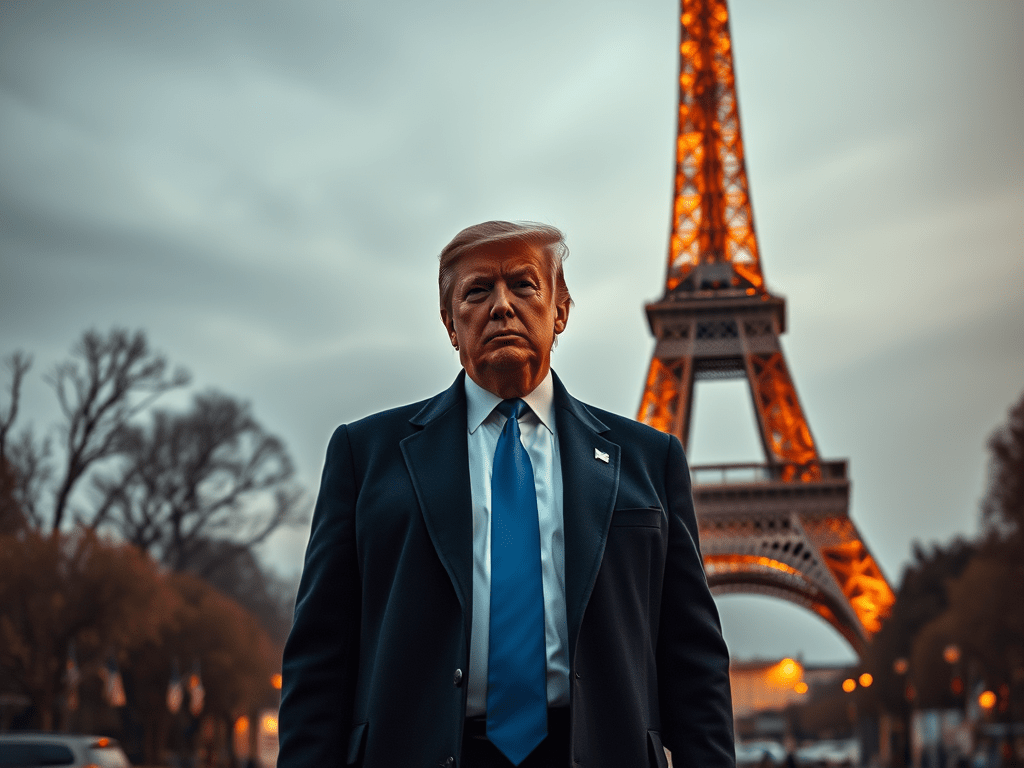
When Trump first entered office in 2017, he was a political neophyte, but his challenge was even starker with seemingly no awareness that a resistance in the very body he was supposed to lead would soon be actively plotting against him.
By now, everyone knows that President-elect Donald Trump is only the second Chief Executive of the United States to win two non-consecutive terms, following in the footsteps of Grover Cleveland, who won in 1884, lost in 1888, and then won again in 1892. Needless to say, the world of 2024 is radically different than it was in 1892, almost a century and a half ago. The federal government the President headed at the turn of the 20th century was like a mite upon a mastiff compared to today’s behemoth. The differences are almost impossible to capture, but consider that it wasn’t until 1918 that the government spent a combined $1 trillion dollars across more than a century of existence. Last year, we spent almost seven times that in less than a hundredth of the period. Likewise, the government has almost 3 million civilian employees today, but numbered less than a thousand in 1892 (how far less I couldn’t even find in a search). The Departments of State, Defense (known as War prior to World War I), Treasury, Justice, the Post Office, and a few other major branches existed, but the alphabet soup that defines modern government would’ve been incomprehensible to someone who’d been asleep for far less than a century. There was nothing resembling a Department of Education, an EPA, a Social Security Administration, Health and Human Services, Homeland Security, and countless others. To the average person, the federal government had almost nothing to do with their day-to-day existence, some far off power in a place called Washington, DC with precious few exceptions such as the Great Riot of 1886. Few probably even thought about it outside election season, much less obsess over who was President to the point where some need support groups after an election loss. Beyond the size, scope, and influence on our lives, technology didn’t yet permit much in the way of real time communications or rapid travel whoever was in charge. The first telephone wasn’t installed in the White House until 1879, but the telegraph remained the preferred communication channel over long distances, especially overseas. There were no cars (Karl Benz patented his three wheeled protocar, the motor wagon in 1886, but it would be 20 years before mass production), much less planes. A sitting President simply didn’t embark on overseas trips of any kind, though some ex-Presidents such as Ulysses S. Grant toured the world after leaving office, and when they did venture beyond Washington, DC, they’d frequently be gone from the oval office for months on long trips by train (Rutherford B. Hayes was the first sitting President to visit Oregon, traveling for two months in September and October 1880). The President’s will was projected internationally almost exclusively through Ambassadors stationed in foreign countries with even smaller staffs of their own. Military intervention outside the borders of the United States was almost inconceivable, having occurred only twice, during a brief war with Mexico when the we occupied Mexico City under General Winfield Scott, immortalized in the “halls of Montezuma” in the late 1840s and the war against the Barbary Pirates a few decades earlier, “the shores of Tripoli.” It wouldn’t be until 1907 when Teddy Roosevelt ordered the “Great White Fleet” around the world, a journey that took more than a year and comprised only 16 ships.
While the Presidency was certainly a powerful and prestigious position, the mite upon a mastiff metaphor applies just as well compared to the almost ridiculous level of force the occupant of the Oval Office wields today, all of which is to say that Grover Cleveland reentering that same office after four years out of power isn’t remotely comparable to Donald Trump. Cleveland certainly benefited from his prior experience as Chief Executive, but remained essentially powerless in many ways, still beholden to Congress for almost everything. Donald Trump, on the other hand, has the benefit of both experience and the power of executive orders to broadly reshape key policies almost entirely on his own. When he entered office in 2017, he was a political neophyte, never having served in any government position. It’s no secret that navigating the contours of an office as vast as the Presidency is a daunting task, and even the best Presidents can take time to come into the role despite the traditional focus on the first hundred days. Trump’s challenge was even starker with no experience whatsoever in government, and seemingly no awareness before he took office that a resistance in the very body he was supposed to lead had already been formed and would soon be actively plotting against him, much to the joy of the mainstream media. Unlike Cleveland 140 years ago, who served as Mayor of Buffalo and then Governor of New York, Trump had no real political connections either, no circle of advisors to pull from who were connected to the Washington establishment, and perhaps even worse, few friends who truly wanted to see him succeed. Though he had won a clear victory in the Electoral College, his opponent Hillary Clinton bested him in the popular vote by over two points, suggesting at a minimum that he lacked broad support and at a maximum that he was illegitimate, fundamentally unable to govern. It is little exaggeration to say he was a man alone with nothing to guide him other than his, at times, mercurial instincts, nor was skepticism of his potential limited to the United States. Leaders around the world, both allies and adversaries, were equally unknown to him, rightly unsure of how he would lead beyond campaign rhetoric and promises that suggested a major shift in foreign relations if not a complete overthrow of the international order. To a global establishment with a fetish for pedigree and the proper credentials, Trump, a bold businessman and celebrity, was the ultimately party crasher, the caricature of a bull in a China shop made real. Adding to his challenges, the newly elected President was dogged with the completely fabricated notion that he was effectively a Russian plant, a secret ally of Russian President Vladimir Putin, elected through Russian trickery to serve Russian interests. The near immediate appointment of Special Counsel Robert Mueller, less than five months after he took office, to investigate these outlandish claims, though they originated with his opponent’s campaign and were essentially laundered through the FBI and Department of Justice by the self-styled resistance, further weakened him at home and abroad, suggesting that he might not even finish out his term, either resigning in disgrace or being removed from office under impeachment or the 25th Amendment.
As the saying goes, what a difference eight years can make. Trump returning to office next month is a far cry from entering it the first time, leading to even generally unfriendly sources such as CNN’s Stephen Collinson to correctly describe him as the most powerful President starting a term in modern memory or perhaps any memory. The contrast couldn’t possibly be more profound, politically and culturally, both domestically and internationally. Perhaps nothing encapsulates this dynamic better so far than the President-elect’s invitation to attend the reopening of the Notre-Dame Cathedral in Paris last weekend. The French Government has been struggling, teetering on the brink of oblivion after a no confidence vote in parliament prompted the current Prime Minister’s resignation. French President, Emmanuel Macron, is set to remain in office until 2027, but he has been under considerable pressure himself, caught between far left and far right factions that refuse to pass a budget. He’d previously added to the drama by dissolving the current parliament in June, which ultimately led to an election with the dead-locked result. While acknowledging his role in the crisis, “I do recognize that this decision wasn’t understood. Many criticized me for it,” President Macron has remained defiant, insisting he will appoint a new Prime Minister and form a new governing coalition somehow, someway. Set against these significant challenges, the reopening of the world’s most famous cathedral five years after it was destroyed by fire represented a unique opportunity to project France’s resilience and solidarity, especially as other world leaders were desperate for an invite. Given this opportunity, President Macron chose to extend a personal invitation to President-elect Trump, marking what would be his first trip abroad after the election, almost six weeks before he’s set to officially take office, despite the pair having a somewhat tumultuous relationship during Trump’s first term. The move was immediately hailed in the French Press as a “diplomatic coup,” turning the once and future President into the star attraction. As even the rather Trump-unfriendly Washington Post described it, “Once-spurned Trump is feted in Paris,” noting that any “unfriendliness has not survived Trump’s election victory last month” and “the president-elect returned to Paris on Saturday not as a punchline but as a guest of honor.” Before the event at the Cathedral itself, President Macron greeted his incoming US counterpart at the Elysée Palace. “Mr. President, it’s a great honor for French people. We welcome you – five years later – I remember the solidarity and your immediate action, so welcome back again.” For his part, President-elect Trump praised the “great relationship” the US holds with France and the “talented,” “extremely energetic” French people themselves. After a meeting on the situation in Ukraine with Ukrainian President Volodymyr Zelenskyy, where he’s promised an almost immediate end to hostilities, President Trump was given pride of place at the ceremony between President Macron and his wife, where some said he even managed to charm current First Lady Jill Biden.
Perhaps needless to say, Trump’s supporters were even more enthused than the mainstream media, heralding his return to Europe as an absolute triumph down to the body language shown in his initial handshake with his French counterpart. The New York Post’s Miranda Devine claimed, “The reopening of Notre-Dame Cathedral in Paris also marked the de facto coming out of Donald Trump as leader of the free world. His overbearing handshake with French President Emmanuel Macron sent a powerful message to the rest of the world. America is back, whether they like it or not.” In comparison, “Joe Biden is a pitiful afterthought in history. The ostentatiously Catholic president was somehow too busy to fit Notre-Dame into his sluggish schedule and sent his wife instead, who made googly eyes at Trump. Joe is PINO — President in Name Only — short for Pinocchio, appropriately enough, given his penchant for lying. Trump, on the other hand, is at peak triumph before he even officially takes back the presidency.” Ms. Devine continued to identify President Trump’s Florida compound, Mar-a-Lago as the “center of the universe,” noting what a stark contrast the resurgence has been considering the FBI was conducting a first of its kind raid there barely two years ago, shattering democratic norms and suggesting that the walls were closing in on him for good. By any standard, the transformation is truly astonishing as political and economic leaders gather to introduce or reintroduce themselves to the incoming President in his house, on his terms. While Paris might’ve been President Trump’s first trip overseas, Canadian Prime Minister Justin Trudeau had already visited him in Florida, as has Facebook CEO and former Trump nemesis Mark Zuckerberg. Former Amazon CEO and owner of the Washington Post, Jeff Bezos is expected to make a visit in the near future, perhaps as early as this week. To some extent, this is a natural part of any transition, as power flows from the outgoing to the incoming Chief Executive, but this time around, there’s a sense things are different both with Trump personally and with his future Administration generally. On a personal level, the President appears to have broken through a barrier many claimed was unbreakable. The President’s approval rating has jumped substantially, with Emerson now reporting 54% of Americans approve of his job performance despite never having cleared 50% across almost a decade on the political stage. CBS News found that 59% of Americans approve of the transition so far. There are players in the NFL imitating the Trump dance on the field, proudly proclaiming their opinion for all to see.
Progressives, for their part, appear to have been caught flat footed in response, largely fighting rearguard actions to the point where they’re still claiming he can’t be “normalized” as though reality hasn’t radically shifted, in fact The Atlantic recently carped that Trump 2.0 was bizarrely normal, though it’s not surprising that the world at large has a deeper understanding of what the President has achieved. Simply put, American presidents do not come back from bruising losses, certainly not after multiple indictments and a conviction. They understand that Trump has accomplished the impossible, and they are acting accordingly. The question is: Can he keep it up? While only time will tell, it seems clear to me that he is infinitely better prepared for the dangers he faced the first time around, having chosen perhaps the most radical and radically diverse cabinet in history, adopting a unique strategy of selecting individuals who are as skeptical of the departments they will ultimately lead as he is. The media, meanwhile, leads that rearguard action mentioned earlier, expressing shock and dismay at key appointments that doesn’t appear to be shared by the Republicans or the public, including Pam Bondi for Attorney General, Pete Hegseth for Secretary of Defense, Robert Kennedy for Health and Human Services, Tulsi Gabbard for Director of National Intelligence, Kash Patel as Director of the FBI, and others. Progressive commentator Paul Waldman, for example, has referred to the selections collectively as “without an iota of doubt the most appalling collection of choices any president has made to lead federal government departments.” Alicia Menendez and Evan Brechtel of “The Weekend” claimed, “There are still 45 days until Donald Trump takes the oath of office, but the steady stream of unqualified and audacious picks for key roles in his administration has already given the American people an insight into how he will govern in his second term…’This is not normal’ was a familiar refrain during Trump’s first term. It was repeated by former President Barack Obama. It was splashed in big bold letters across headlines for The New York Times, Vanity Fair and The Washington Post, to name a few. It became a defining mantra for protests against the first Trump administration. But normalcy is only defined by what a society is willing to accept, and the Senate’s decisions in the coming months will play a key role in how far that window is allowed to shift.” At the same time, few believe the Senate will be able to derail anyone save for perhaps Mr. Hegseth, who could be replaced by a figure they might loathe even more in Florida Governor Ron DeSantis. The result in either case appears to be that Trump is normal now, and people like it whatever progressives may claim.


“By now, everyone knows that President-elect Donald Trump is the first Chief Executive of the United States to win two non-consecutive terms, following in the footsteps of Grover Cleveland, who won in 1884, lost in 1888, and then won again in 1892”
Is this a contradiction or am I just dumb?
LikeLiked by 1 person
No, I just type too fast and have no fact checkers. It’s updated now to say “only the second.” Thanks for keeping me honest and on my toes.
🙂
LikeLike
👍🙂
LikeLike