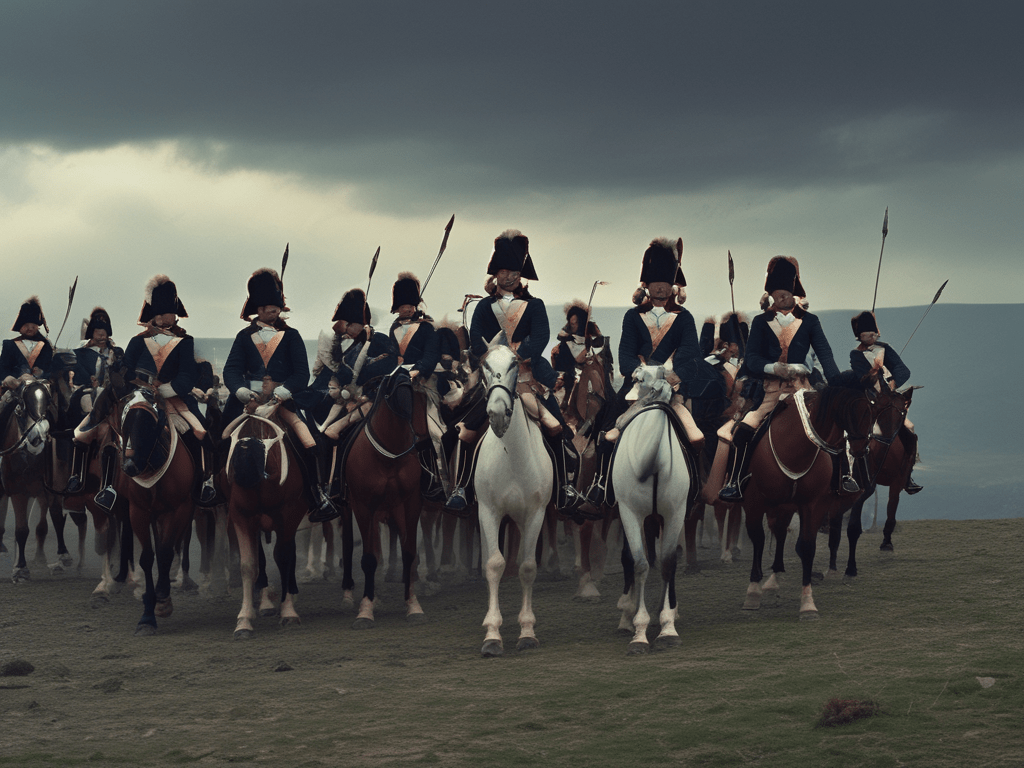
Rather than the fearless, master horseman who led charges, the film depicts a far more reserved and fearful man. Rather than the dynamic, workaholic it shows us a moribund, borderline depressive. Rather than anything resembling the whirlwind of actions and contradictions the real man must’ve been, we are left with only with a poor, bittersweet shadow.
Ridley Scott’s Napoleon isn’t a bad film. While certainly not a masterpiece, it’s not without redeeming qualities, even beyond the expectedly excellent production values, set designs, and costumes. The scenes and sequences Mr. Scott and his screenwriter David Scarpa chose to depict are more or less the right ones to distill an epic life into a less than three hour running time, and even for a relatively long movie, the pacing is rather robust. It never feels slow, or particularly ponderous, which can be a feat in and of itself for films in this genre. The duration is well-punctuated with critical, generally well conceived and executed set pieces including the Siege of Toulon, the Battle of the Pyramids, the Battle of Austerlitz, and ultimately Waterloo. Even more impressive, Mr. Scott managed to bring something at least somewhat new and interesting to these sequences, not merely recreate scenes from Braveheart for the hundredth or even thousandth time with marginally better special effects than Mel Gibson had in 1995. Toulon and Austerlitz are particularly effective, with a shocking shot of Napoleon himself blown of his horse, guts spilling out, before mounting the castle wall, and ordering the cannons to fire on British ships down below, and a perhaps even more impressive sequence of thousands of soldiers getting swallowed by shattering ice, drawn down into a frozen lake after Napoleon lured the Austrians and the Russians into a surprise attack. The performances are also respectable, if not inspired, as is the script, which while not exactly a Shakespearean history on par with Henry V or Julius Caesar, does manage to do condense complex events into digestible scenes with reasonably engaging dialogue and avoid being overly pedantic or drawn out, another accomplishment in the overall genre. With this in mind, it wasn’t surprising that critical response was mixed to slightly positive. Rotten Tomatoes summarizing the overall feeling as “Ridley Scott is intent on proving the emperor has no clothes in Napoleon, a slyly funny epic with bravura set pieces and a divided runtime that keeps it from outright conquering.” Perhaps needless to say, European critics, the French in particular who still have a far more complex relationship with their favorite tyrant, were far less enthused, calling it “lazy, pointless, boring, migraine-inducing, too short and historically inaccurate.” Le Figaro actually parodied the effort, with its focus on the love story between Napoleon and his first wife, Josephine, as “Barbie and Ken under the Empire.”
Others, however, felt making the most important relationship in the Emperor’s life the central element of the story helped illuminate what drove him. Wendy Ide, writing for The Observer, described the film as a “sturdy epic” that struggled to “show us what drove the military mastermind,” noting, “A man, even a man as combative as Napoleon, amounts to more than the battles he has fought. And it is in this respect that the film is less successful.” Perhaps closest to the truth, in my opinion at least, was Johnny Olekinski of The New York Post, who wrote, “it’s too bad Scott could not deliver a brilliant character study of one of the world’s great military leaders — and instead settled for letting a self-indulgent Phoenix fly over the cuckoo’s nest.” Personally, I wouldn’t blame Mr. Phoenix alone for the lack, but somehow, Hollywood has managed to transform one of the most dynamic, energetic, charismatic, and engaging figures in the history of the world into a brooding, boring, lovesick mope, who does precious little except look depressed and declare his love for Josephine over and over again. Sure, he is smart, he is ruthless, he has some passion, but otherwise Mr. Scott’s Napoleon is about as compelling as a second tier Presidential candidate in a long primary debate cycle, a victim of events or responds to what happens around him rather than their creator, the driver of much of history at the time, which he most certainly was in real life. Narratively, the film largely ignores the majority of his accomplishments, essentially the fact that Napoleon, for all of his obvious faults and idiosyncrasies including a penchant for attempting suicides, revolutionized almost everything he touched, from how wars were conducted in the 18th century to the government of France, putting place techniques that lasted to the start of World War I and institutions that continue to this day. As Andrew Roberts’ epic biography, Napoleon: A Life noted, the United States had George Washington, Thomas Jefferson, Ben Franklin, James Madison, Alexander Hamilton, and John Adams to help forge a country, rebuilding it after the old aristocratic order crumbled, but France had only Napoleon Bonaparte playing all of these roles and more. In addition to participating in the 63 battles mentioned in the film, for many of which he was responsible for every aspect of the army, raising the men, supplying them, arranging their transport, and actually leading them on the field, he reorganized almost every expect of French government including the judicial system, the banking system, the educational system, even the sewage system. Moreover, he managed to accomplish all this despite spending most of his springs, summers, and falls in the field rather than ensconced in a palace in Paris actually running the government.
To do so, he began by revolutionizing communication, logistics, and the operational organization of both the government and the military. A logistical mastermind, untouched in the annals of military history until perhaps Ulysses S. Grant effectively deployed railroads in the Civil War, Napoleon understood that consistent, effective, and fast communications were critical to a nation’s success, and in many cases, he designed and implemented these systems almost entirely on his own. This allowed him to work on a larger scale and field larger armies than ever before, marshalling forces that hadn’t been seen in Europe or anywhere else. From 1800-1811, he raised 1.3 million conscripts and one million more from 1812-1813. According to historian Hew Strachan, “The levee en masse gave France a numerical superiority over her enemies, a seemingly inexhaustible reservoir of manpower which allowed her two or three times as many losses as her opponents.” It also required an entirely new organization, that reimagined how army divisions and corps operated. Napoleon combined decentralized maneuvering, that is, allowing the commanders of each corps the flexibility to operate on their own, with centralized command, ensuring all commanders in a campaign were working towards the same goal. Each corps combined cavalry, infantry, and artillery, making them both self-contained combat forces in their own right, and effective in groups. They were larger, but moved faster than anything at the time; far more complex, but communicated better and acted in a more synchronized fashion. As a result, enemies rarely knew what hit them, to use the old expression, at least until everything he did was copied by every other army in Europe. This reorganization required changes to everything, from how an army was fed to how it was led. To feed them, Napoleon took advantage of advances in farming and foraging techniques, which unlike many of his contemporaries, he understood to be as critical as any other equipment and provisions. “To know…how to draw supplies of all kinds from the country you occupy makes up a large part of the art of war,” he wrote. He also embraced the potato, relatively new in Europe at the time, as an easy to access, easily portable source of nutrition. To lead them, Napoleon eschewed the traditional role of aristocrats, and promoted officers based on merit rather than rank. As a result, much of his command was composed of talented, experienced individuals rather than those there by accident of birth. It would be another hundred years before rivals like Austria and Prussia fully embraced these trends.
Outside of the military, Napoleon took to the reorganization of government with the same gusto, introducing the Napoleonic Codes in 1804, a process that had begun more than ten years earlier to centrally organize various legal systems that were managed more by custom than law, with special privileges and dispensations for the aristocratic class. The historian Robert Holtman has described it as one of the few documents that influenced the entire world, with some 120 countries adopting the approach, structure, and some of the contents including the Middle East and even South America. The German speaking peoples of the Rhine, the Duchy of Berg, and the Grand Duchy of Baden adopted the code until 1900. It was also adopted in Romania, and used there until 2011. Canada’s legal system was heavily influenced by it, even the state of Louisiana in the US. France’s educational system was completely reformed as well, with the establishment of the École Polytechnique and the Université de France to support the needs of the government, military, and civilian institutions. In a more tangible way, Napoleon was also keenly involved in rebuilding France in general and is primarily or at least partly responsible for many of the landmarks the world associates with Paris, the City of Lights. He commissioned the Arc de Triomphe and the Vendome Column, and reinvigorated and reimagined the Madeleine Church and the Palais des Invalides. He rebuilt parts of the Louvre, and the streets around it including the Rue de Rivoli, one of the most famous in the city. Elsewhere, his influence was apparent in everything from architectural styles to interior design, to art and theater. It’s little exaggeration to say that a visitor to Paris today, more than two hundred years later, is still walking around Napoleon’s city – striding atop his sewer and sanitation system, striding past his monuments, buildings, and universities. Given that Napoleon only served as Emperor for ten short years, and First Consul for merely five before, fighting five major wars during this period, the number of institutions he influenced is truly astounding, perhaps unrivaled by anyone else in all of history, and yet Mr. Scott and Mr. Scarpa captures precisely none of this, vaguely alluding to changes in battlefield strategy and little else.
The failure seems even more glaring when you consider that Napoleon’s megalomaniac penchant for micro management proved to be one of his more tragic flaws, angering his adversaries and leading to his undoing at Waterloo. In an attempt to inflict economic pain and suffering on the United Kingdom, he implemented the Continental Blockade, effectively an embargo on all goods to and from England in 1806. The result, however, was the opposite. It managed to inflame the British while doing little to damage them economically, damage French industries reliant on British goods, and cause Russia to ally with the British against France, but rather than recognizing it was a failure and seeking another approach, Napoleon revised it over and over again, believing some small change to some minor detail could make an unworkable plan work. In fact, he doubled down with a complex licensing and tariff system that did even more damage to French trade, as though he could solve the problem simply by manipulating the underlying numbers, which ultimately precipitated the crisis of 1811. On a more character-driven level, Mr. Scott completely fails to capture the sort of driven, constantly moving, dynamic personality required to accomplish any of this, both the successes and the failures. Napoleon was what we would describe today as a workaholic, regularly working 16 hours per day for this entire life. He was so obsessive, he kept his meals short, and had someone read news and dispatches while he was shaving and bathing. As he described it, “I am always at work…. I work all the time, at dinner, in the theatre. I wake up at night in order to resume my work. I got up last night at two o’clock. I stretched myself on my couch before the fire to examine the army reports sent to me yesterday evening by the Minister of War. I found twenty mistakes in them, and made notes which I have this morning sent to the minister, who is now occupied with his clerks in rectifying them.” His private secretary, Claude-Francois de Meneval, described his penchant for working at night, “the Emperor used to have me waked in the night, when – owing either to some plan which he considered ripe for execution, and which had to be carried out, or to the necessity of maturing the preliminaries of some new project, or to having to send off some courier without loss of time – he was obliged to rise himself. It sometimes happened that I would hand him some document to sign in the evening. ‘I will not sign it now,’ he would say. ‘Be here tonight, at one o’clock, or at four in the morning; we will work together.’ On these occasions I used to have myself waked some minutes before the appointed hour… [H]e used to make his appearance, dressed in his white dressing-gown, with a Madras handkerchief ‘round his head. When, by chance, he had got to the study before me, I used to find him walking up and down with his hands behind his back, or helping himself from his snuff-box…. His ideas developed as he dictated, with an abundance and a clearness which showed that his attention was firmly riveted to the subject with which he was dealing…. When the work was finished, and sometimes in the midst of it, he would send for sherbet and ices. He used to ask me which I preferred, and went so far in his solicitude as to advise me which would be better for my health. Thereupon he would return to bed, if only to sleep an hour, and could resume his slumber, as though it had not been interrupted.”
Further, there were no details, however small, that were beneath his notice. While planning an invasion of England that was never actually attempted, he personally supervised the provisioning of the fleet at Bologne, checking anything and everything including simulating how fast soldiers could board and unboarding the ship, working with them side by side. Meneval also described how nothing escaped him, “Napoleon would deal with in turn, at one sitting, matters relating to war, to diplomacy, to finance, to commerce, to public works, and so on; and rested from one kind of work by engaging in another. Every branch of the government was with him the object of a special, complete and sustained attention; no confusion of ideas, no fatigue, and no desire to shorten the hours of labour, ever making themselves felt.” He was also said to be possessed of great charisma, especially when dealing with his men in the field, who absolutely adored him. While his great adversary, Lord Wellington, once referred to his soldiers as “the scum of the Earth,” Napoleon, even as Emperor, enjoyed their comradery, teasing them and joking with them, sharing their triumphs and struggles. In fact, he earned the nickname the “The Little Corporal” early in his career because as an officer, he helped load cannons like a grunt and the crew joked that he could take over as their corporal any time. There was a certain self-serving interest in this as well. Napoleon was a firm believer that the spirit of the men, what he called the “espirit de corps” could mean the difference between success and failure on the battlefield, and he took great pains to ensure his army was convinced they would be victorious whatever the odds. Lastly, Napoleon was a master propagandist and inveterate bullshit artist, which also helped the army’s fighting spirits, reporting on defeats as victories, greatly exaggerating the damage done to the opposing soldiers and minimizing that done to his. Sadly, this man doesn’t truly exist in the film, except in a few brief flashes that make little sense considering the overall context. Rather than the fearless, master horseman who led charges, Mr. Scott depicts a far more reserved and fearful man for reasons that are unclear. Rather than the dynamic, workaholic he chooses to show us a moribund, borderline depressive. Rather than anything resembling the whirlwind of actions and contradictions the real man must’ve been, he leaves us only with a poor, bittersweet shadow.

 Confessions of a Conservative Atheist