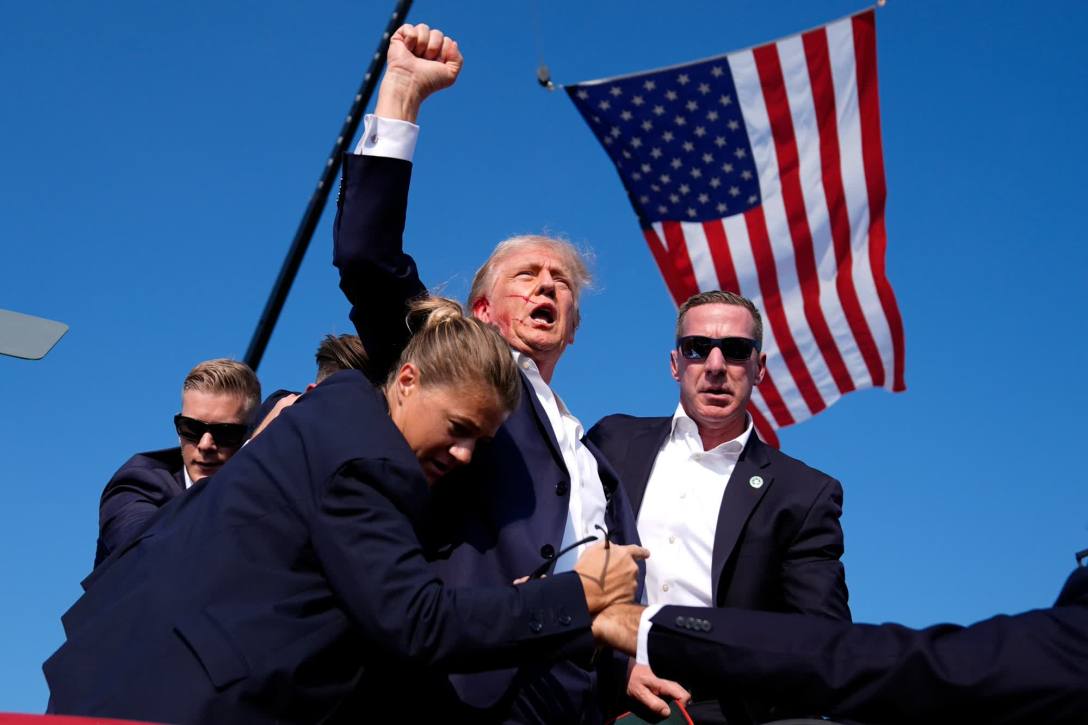
Saturday’s heinous events will not prompt his detractors to reconsider, but to the average American, it seems sure to be a defining moment, one that allows President Trump to transcend the political box Democrats, some Republicans, and the mainstream media have tried to imprison him in for nine years.
On October 14, 1912, former President Teddy Roosevelt was campaigning in Milwaukee, WI for his longshot third-party, “Bull Moose” White House bid. Running as a third-party candidate was not his preference, but after establishment Republicans rejected him in favor of William Howard Taft at the formal convention earlier that year, he formed the Progressive Party, and immediately began prosecuting his case as aggressively as ever. He was hosted for dinner that evening at the Gilpatrick Hotel before a speech at the Milwaukee Auditorium, but as he waved to supporters outside before making the short trip, a deranged gunman approached from the shadows and fired at Roosevelt from just a few yards away. The bullet cracked through the normally quiet city streets, echoing off the concrete buildings as only firearms can, shattering what had been a peaceful evening until then. Roosevelt stumbled for a moment, struck almost square in the chest, obviously in shock and pain, but somehow managed to maintain his footing, telling an aide, Harry Cochems, “He pinked me, Harry,” as though getting shot were merely a minor inconvenience to the notoriously tough war hero, rancher, and big game hunter. The gunman, Peter Schrank, who suffered from paranoid delusions, believing former President William McKinley appeared to him in a dream and demanded he kill Roosevelt in revenge for his own assassination 11 years earlier, was quickly subdued by Elbert E. Martin, one of Roosevelt’s secretaries who also happened to be an ex-football player and Rough Rider, and other members of his staff. The crowd that followed Roosevelt’s every move as the most famous man alive at the time was shaken by the violence, but almost immediately began surrounding Schrank, demanding vengeance of their own. A few men lifted him up and held him in place in the classic movie fashion while others began pummeling him in the face and chest to chants of “hang him,” “kill him” on what had a few moments earlier been an ordinary city sidewalk and street, on an ordinary fall night. Despite the bullet lodged in his chest, Roosevelt remained calm and collected, perhaps the most calm person on the scene if reports are to be believed. He’d had his fill of frontier justice decades earlier as a cowboy in the Dakotas, and now sought law and order in all things. Rather than let the crowd have their way with the man, he immediately demanding they stop attacking Schrank, insisting “Don’t hurt him. Bring him here. I want to see him.”
The fact that their hero was still standing after the attempt on his life was almost an equal shock to everyone present. When a man asked, “Is he OK?” Roosevelt replied in typical fashion, smiling, waving his hat, and declaring, “I’m alright, I’m alright” while Schrank was brought before him. As a couple of men held him there, Roosevelt put his hand on Schrank’s chest, looked him in the eyes for a long moment, and asked, “What did you do it for?” legitimately puzzled. Schrank, who was clearly suffering from mental issues even upon a cursory examination, failed to respond verbally or otherwise, prompting the former President to sigh, “Oh, what’s the use? Turn him over to the police.” He looked down on his would-be assassin one last time before they took him away, pity in his eyes at the man who just tried to kill him, and said, “You poor creature,” then demanded that the police not harm him any further. Needless to say, his aides began making demands of their own, namely that he go to the hospital immediately, but Roosevelt was skilled in biology with decades spent as a naturalist and taxidermist. He reasoned the bullet had not penetrated his lung or he wouldn’t be standing there at all and insisted on giving his speech, the “Progressive Cause Greater Than Any Individual” as planned. He waved his hat once more to the crowd, and sped away into the night, though not faster than the rumors accompanying the incident. When he appeared before another crowd at the Milwaukee Auditorium a short while later, everyone knew something had happened, they just weren’t sure what, buzzing about whether it was possible the former President was really almost gunned down on the street. Roosevelt began the speech with an attempt to calm their fears, saying, “Ladies and gentlemen, I don’t know whether you fully understand that I have just been shot, but it takes more than that to kill a Bull Moose.” The audience, however, remained puzzled, unclear whether he was jesting given the flippant tone, and so Roosevelt opened his jacket to reveal his bloody shirt and the fifty page speech that had been in his coat pocket. The large, unmistakable bullet hole in the papers made it clear both that he had been shot, and that the heft of the speech and his glasses case tucked near it, saved his life. Teddy spoke that night, blood still coming from his wound, for almost a full hour, commanding the crowd and gesticulating as only he could. Only after, did he go to the hospital, but they were never able to remove the bullet. It remained there until he died in 1919, becoming yet another part of his legend.
Presidents Donald Trump and Teddy Roosevelt are almost equal parts alike and opposite. Both were the scions of wealthy New York families, both had careers outside of politics, both were equally comfortable in elite salons and mingling with the working class, and both radically changed the nature of their political parties, fighting what they saw as as an entrenched establishment that no longer served the needs of their constituents. Both also shared an adoration from their supporters that other politicians can only envy, along with an intense hatred from their detractors, many of whom were part of the political establishment in their day. Before the assassination attempt on former President Trump last Saturday, most would probably have claimed their similarities ended there and not without reasonably good reason. Roosevelt was, generally speaking, far more erudite, having been a noted naturalist with vast expertise, especially with birds, a historian, and author, possessed of a photographic memory, able to speak multiple languages, and steeped in classical literature. He also had a much more storied political career that spanned decades, having served in the state legislature as an extremely young man where he faced off with future President Grover Cleveland, the New York City Police Commission where he fought a war against alcohol on Sundays of all things, the Civil Service Commission, as Assistant Secretary to the Navy where he was chiefly responsible for architecting a modern navy, a colonel in the Spanish-American War where he almost single handedly defeated the Spanish, Vice President, and President where he both prevented wars and ended them. In this regard, Roosevelt didn’t explode onto the scene so much as he was constantly orbiting around it, coming and going like a comet that blazed too bright the closer you looked, taking whatever role he felt could advance his career and his beliefs, frequently until he rankled those in power past the point of repair. Roosevelt, like Trump, however, also suffered bitter defeats. He lost his third party bid in 1912 even after surviving the assassination attempt, shattering the Republican Party and ushering in the disastrous Presidency of Woodrow Wilson. He was so lost in political exile at that point, he decided to risk his and his son’s life on a borderline insane expedition to the uncharted Amazon, where multiple men died and he barely survived after contemplating committing suicide because he wasn’t healthy enough to travel and refused to be carried by men in danger of losing their own lives. He also lost a bid for mayor of New York City early in his career, one which he thought might’ve destroyed his entire political career, and sent him into exile in South Dakota. Personally, Roosevelt suffered the devastating loss of his first wife, and almost went bankrupt after the Winter of the Blue Snow decimated his cattle ranch – in South Dakota.
Nor was Roosevelt any stranger to controversy, having participated in not one, but two civil trials after he left the Presidency in 1909, where he was stripped of all his authority and at the mercy of the court system. They too called him a narcissist, a megalomaniac, a drunk, and worse, but on what we might call a more thematic level, both men could perhaps best be described as “unstoppable forces” in their respective eras, individuals who are defined primarily by their nonstop energy and constant striving towards their goals whatever setbacks they may experience. Henry Brooks Adams, the grandson of President John Quincy Adams, was an intimate of Roosevelt’s, and while wary of his unbridled ambition, described him as possessing “that singular primitive quality that belongs to ultimate matter – the quality that medieval theology assigned to God – he was pure act.” Most, especially those in elite circles, would not have said the same about former President Donald Trump, perhaps until now. In catastrophe and crisis, opinions change rapidly, prompting us to reevaluate what we thought we knew, and Saturday’s earth-shattering events surely rank at the top of any political list of catastrophes in the past several decades. Emerging from that crucible unscathed, the image of former President Trump pumping his fist in the air mere moments after a bullet grazed his ear, the blood from the wound running down the side of his head, surrounded by Secret Service members striving to keep him enclosed in their protective shell while an American flag flies against a deep blue sky is already a part of history, one of those moments that you can’t believe was actually captured in real time. To his supporters at least, it encapsulates what so many have long admired about the man: Figuratively, he’s been left for dead or declared dead more so than any politician in the modern era, perhaps ever, and no matter what the circumstance, former President Trump has remained standing, defiantly pumping his fist in the air the same way he did after a literal assassination attempt. The belief, shared by many in establishment circles, that President Trump could not succeed under any circumstances, began almost as soon as he announced his candidacy on June 16, 2015. When he remarked, “When Mexico sends its people, they’re not sending their best. They’re sending people that have lots of problems…they’re bringing drugs, they’re bringing crime. They’re rapists. And some, I assume, are good people,” the condemnation was swift and relentless. As ABC News described it at the time, “The remarks drew swift condemnation from immigration and Latino advocacy groups, along with a handful of Democratic candidates, but Trump hasn’t backed down. In fact – he’s been elevating his comments as exactly the kind of unvarnished straight talk other candidates are too cowardly to offer.” Immediately after, Macy’s, NBC Universal, Univision, Ora TV, Ricky Martin, and others all cut ties with him. “Macy’s is a company that stands for diversity and inclusion. We have no tolerance for discrimination in any form,” the company said in a statement that typified the response. “We are disappointed and distressed by recent remarks about immigrants from Mexico…In light of statements made by Donald Trump, which are inconsistent with Macy’s values, we have decided to discontinue our business relationship with Mr. Trump and will phase-out the Trump menswear collection.”
Trump, however, was completely unbowed, discussing the issues and his proposals as he saw fit from then until now, refusing to allow anyone else to define the bounds of his discourse. Similar eruptions followed the so-called Muslim ban, and – after he was President – Charlottesville, Ukraine, January 6th, and others. On election night 2016, Presidential “oddsmaker” and data guru Nate Silver gave him only a 28.6% chance of winning. Trump prevailed, of course, and then proceeded to be impeached twice using a process unprecedented in American history and was dogged by claims that he should be removed from office using the 25th Amendment or whatever other means are possible, nor did the situation improve after he left office in early January 2017. Politically, he was said to be disgraced and untouchable, unfit in every possible way, the term of art used to encapsulate everything his detractors hated about the man. He was likewise declared unviable after the Republican’s poor showing in the 2022 midterm elections. John Hinderaker, of the conservative Power Line blog, declared back then, “A consensus is emerging among Republicans that it is time for Donald Trump to get off the stage and stop damaging his party and his country.” In his opinion, “Trump [was] toast. He has a few fanatical followers, most of whom were never reliable Republicans or even consistent voters. They can go down with his ship if they want to. But the rest of us need to look ahead and begin the process of choosing a vastly better candidate in 2024. That will be a low bar.” Mr. Hinderaker cited infamous Never Trumper John Podhoretz, who was given a flashy spread in The New York Post to rail against a man he’d railed against for seven years at that point. “Toxic Trump is the political equivalent of a can of Raid…Tuesday night’s results suggest…that Trump is perhaps the most profound vote repellent in modern American history.” Legal challenges piled swiftly on top of political ones. To date, former President Trump has been indicted on two sets of federal charges, one dismissed just yesterday, and two sets of local charges, one in New York City where he was found guilty of 37 felony counts. There are two civil cases as well, one brought by New York Attorney General Letitia James claiming he falsified business records, and another by E. Jane Caroll who claimed the former President raped her in the 1990s. He was found liable in both instances, racking up over $650 million in penalties and fines. He still faces potentially hundreds of years in prison.
The consensus of the chattering classes has not changed since 2015. The mainstream media still maintains that President Trump is “unfit” for office, and repeats it constantly, like a single song that follows him around. Most recently, The New York Times, “Donald Trump is Unfit for a Second Term,” The Los Angeles Times, “One candidate is patently unfit for the White House,” and The Guardian, “Donald Trump: utterly unfit for office.” He has been compared to Adolph Hitler, repeatedly, and more recent historical tyrants including Vladimir Putin, who is at least an agent of if nothing else. As Matt Taibbi recently described it, “When a populist movement built on frustration over decades of misrule began having electoral success, they created a legend that the backlash was irrational and the fault of one Donald Trump, building him into a figure of colossal art, a super-Hitler. It became cliché that he was the embodiment of all evil and needed to be stopped ‘at all costs.’ By late last year, mainstream press organizations were saying legal means had failed, and more or less openly calling for a truly final solution to the Trump problem.” Regardless, just as he did on Saturday after being shot, President Trump has withstood all of these assaults – and others, large and small, far too many to list here. He is, in fact, the favorite to win the election, as incredible as it sounds, and remains proudly defiant, himself in all matters, free to speak his mind in all matters, and completely unchained by any of those who sought to tame him. Saturday’s heinous events will not prompt his detractors to reconsider – indeed many are claiming it’s his fault he got shot or even that it was staged and he hired a sharp-shooter like Bobby Bacala on The Sopranos – but to the average American, it seems sure to be a defining moment, one that allows President Trump to transcend the political box Democrats, some Republicans, and the mainstream media have tried to imprison him in for nine years. It is through an event like this that he has the chance to redefine himself in the public’s mind as what he truly is: A fighter, the likes of which we have not seen since Teddy Roosevelt, another incarnation of an unstoppable force for our celebrity times, sharing one more distinction having survived assassination attempts and remained unbowed afterwards. Call it bravery, courage, or just plain grit, but is there any doubt President Trump would’ve continued his speech on Saturday if the Secret Service allowed it?
Of course, Teddy Roosevelt went on to lose his bid a mere few weeks after taking a bullet in the chest. With almost four months before the election, anything can and probably will happen. Whatever does happen, however, will not make Donald Trump anything less than an unstoppable force, a once in a lifetime individual, who we will not see again for another hundred years. Love him or hate him, we have a front row seat to a truly historical figure, one his influence will be debated for decades.
Images may be subject to copyright.

 Confessions of a Conservative Atheist