
Here is land where birds nest directly on the trail, crowding in the thousands. The sea lions play with you in the crystal waters. Schools of eagle rays drift by like silent specters in the night while sea turtles make their way beneath. Lizards lounge on the beach, daring you to get close. The sun sets on every day over the waves, promising some new adventure.
The Galapagos Archipelago holds a special place in the world’s collective imagination. The islands that inspired legendary naturalist Charles Darwin to develop the grand theory of evolution by natural selection, a set of thirteen larger landmasses and sixty odd smaller ones scattered some 600 miles from the coast of Ecuador are dreamed of as unique, wild, untamed, pristine, astounding, exotic, and altogether too remote. Here lies a combination of remarkably conserved and balanced ecosystems, essentially floating laboratories for studying the natural world and observing its inherent beauty, home to creatures not found anywhere else on the planet. The legendary Galapagos tortoise, astounding species of birds, Darwin’s famous finches, fish, lizards, plants, and other wildlife including a rather deadly shark. The general remoteness from the coast of South America that allows these unique animals to flourish is only part of what makes them so special, however. Geologically speaking, the entire Archipelago is a newborn baby at barely five million years old, having only recently risen from the ocean in a tumult of volcanic activity. Compared to other islands like Hawaii, there hasn’t been enough time for such niceties as topsoil to accumulate or the wide variety of species one might expect on the equator, much less a tropical rain forest of any kind, to take hold. Aside from sporadic rain in January and February, they are entirely barren of water, having no natural springs, conifers, or anything under the ground. To survive, plants either pull the water directly from the air or subsist for months without.
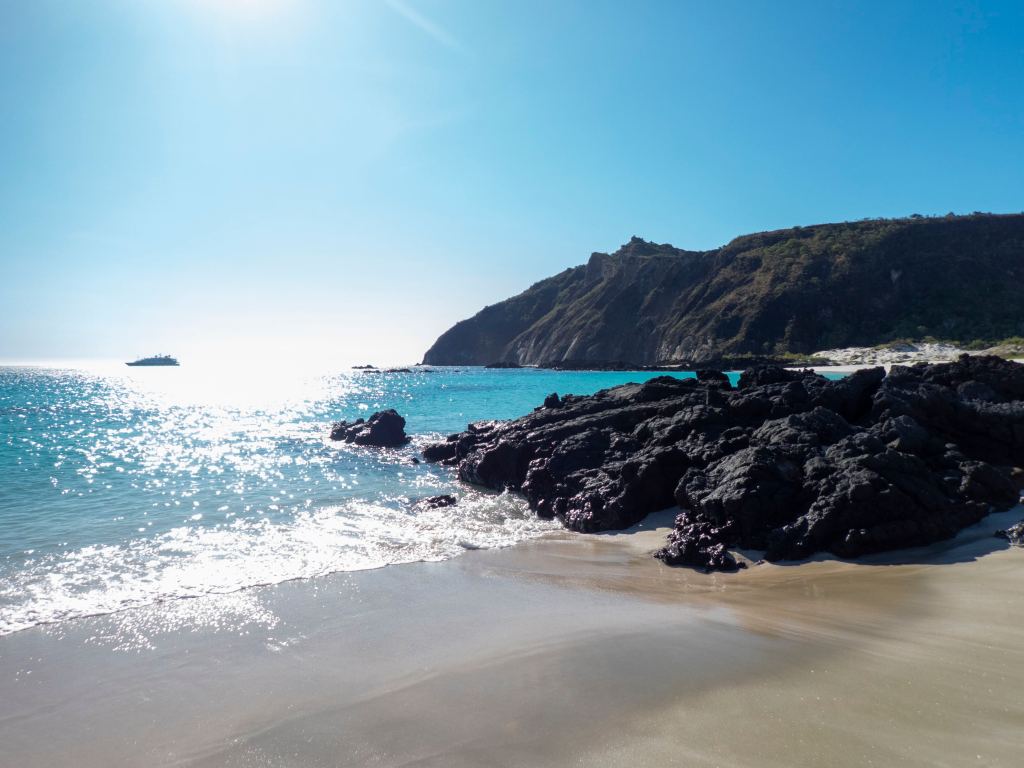
The Galapagos is also situated at the nexus of several important ocean currents, the Humboldt, Panama Flow, and Cromwell Current. The Humboldt and Cromwell in particular arise from the bottom of the ocean, pulling up water rich in nutrients but also exceedingly cold for the region. All three currents interact in unique, seasonal ways, and combined with their recent emergence from the ocean, each island hosts a unique habitat and overall landscape. The water around Darwin Bay on Genovesa Island, for example, is a rich green and relatively warm at 74 – 77 degrees Fahrenheit, but a little over 70 miles further south at San Cristobal, the color is a ridiculous blue and the temperature rarely gets above 60. The wildlife changes accordingly as you travel from island to island. Genovesa is famous for its birds – red footed boobies, frigates, petrels, an owl that blends in so well it’s rarely seen, and more – while Santa Cruz is home to more lizards and sea lions. Neither, however, is home to the famous tortoise, at least not today. The differences extend to the landscapes themselves. Genovesa is centered around an ancient crater that collapsed into the sea, and aside from a small beach area the entire island is surrounded by a cliff of black volcanic rock, rising from the water like a formidable wall preventing humans from easily entering. San Cristobal is also volcanic, but there is a broad beach for landing and practically mountains looming in the distance while much of the rock is a sandy, more familiar color. Overtime, some of these landscapes have been marked and changed by their inhabitants. What once was black volcanic rock turns white after thousands of years of bird droppings. The sea lions also change the color and texture, smoothing them and giving them a unique sheen as though they were coated in a white, oily paste.
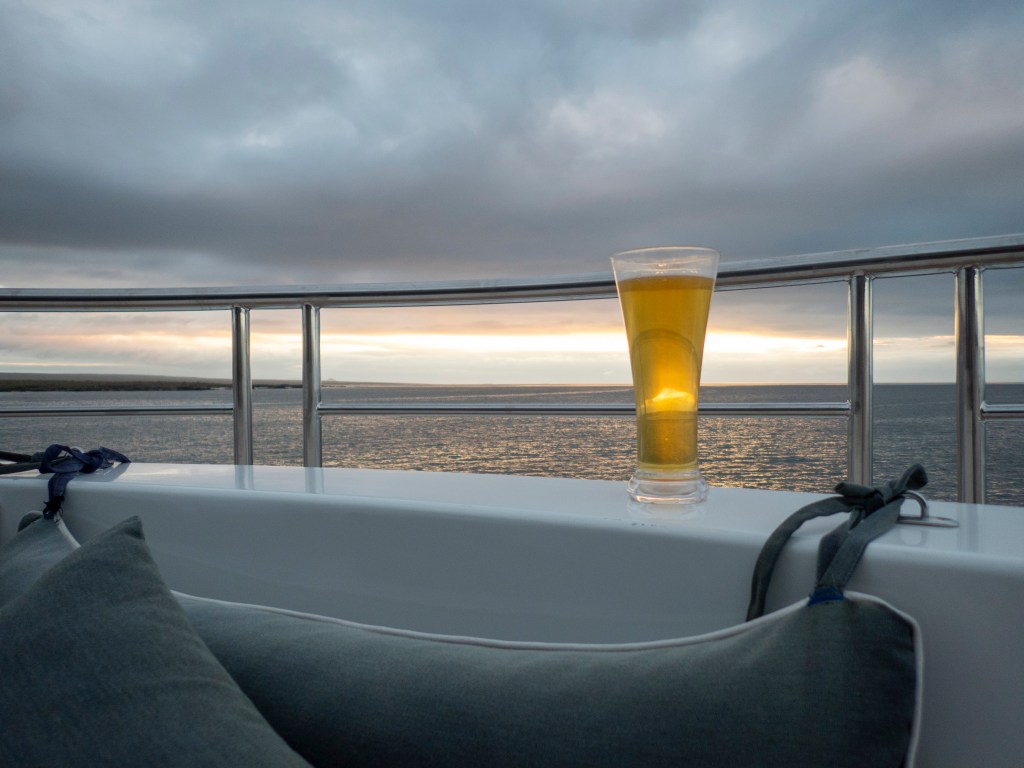
Of course, I knew precious little of this myself when my wife and I decided to join my mother and brother on their long planned trip to Archipelago last December. Back then, I had some vague impression of their remoteness, their importance to Darwin and evolution, and the presence of special finches and tortoises that illustrate Darwin’s principles in action. Otherwise, I had two missions once the details of the trip were confirmed: Drink more beer on the catamaran than the crew had ever seen and take some awesome pictures. The beer was standard practice for me on vacation, but the desire to take pictures was at least somewhat unusual. I hadn’t actually bought a dedicated still photography camera since I began film school at NYU in 1994. Nor am I known for taking many pictures with my cell phone camera either, frequently adhering to Bill Pullman’s great quote from David Lynch’s Lost Highway, “I prefer to remember things my own way.” Thus, most of the documentation of my vacations or other special events in my life is limited to a few shots of me with a beer in various locations – on a hiking trail following a grizzly in Montana, at the Louvre, or beneath the Eiffel Tower in Paris. The Galapagos, however, struck me as different for some reason. If I was going to trek all the way there – traveling from Newark, NJ to Atlanta, GA to Quito, Ecuador and then onto the Galapagos themselves after a brief stop in Guayaquil, Ecuador – and come face to face with a sea lion or a tortoise, I wanted to make sure I got the shot or at least put myself in a position to get the shot. Why I felt this way was admittedly rather vague. After all, if it was that easy to get great shots, most of us would be much better photographers and I likely would have been far more proficient myself. Aside from lugging the equipment around, photography is exceedingly hard because the image you capture either digitally or on traditional film only rarely captures the depth and scope of what you can see with your own eyes, most subjects are too far away to observe properly, and almost anything interesting moves way too fast anyway. By the time you have your camera out and the image properly framed, the moment is lost forever and you’re stuck with some out of focus, unrecognizable blur. Over the past two decades, technology has gone a long way to solving the equipment problem for amateurs at least. A modern point and shoot fits in your pocket, goes underwater, and can take photos fast.
The Galapagos itself solves the other problem: Because of the Islands’ isolation and little exposure to humanity, the animals, generally speaking, do not run from people on sight, allowing you to get much, much closer than you would almost anywhere else on the planet. I became aware of some of these details in the lead up to the trip. The Western world first discovered the Archipelago on March 10, 1535 after currents drove the Dominican Friar Fray Tomas de Berlanga, Bishop of Panama off course. Berlanga himself, didn’t think much of them, claiming God had “rained stones” across the ocean without “even the power of raising a little grass.” Even then, he observed how little interest the wildlife had in people, remarking that there were “many birds like those in Spain, but so silly that they do not know how to flee and many were caught in hand.” Another expedition in 1546 saw Captain Diego de Rivadeneira proclaim them “Las Islas Encantadas,” the “Enchanted or Bewitched Islands,” because they were so difficult to navigate and were prone to frequent fogs. Sailors at the time believed the islands weren’t tethered to the ocean floor and were just floating around freely. For almost three hundred more years, they remained largely uninhabited except for brigands and sailors stopping to harvest tortoises for food in what almost resulted in a mass extinction. In 1832, however, Ecuador formally annexed the Islands and promptly set up a short-lived penal colony that would ultimately serve to both heighten interest in the area – paving the way for Darwin’s visit a few years later – and decimate the local flora and fauna of some of the largest islands because the prisoners didn’t come alone. They brought livestock and other animals with them, from dogs to rats, completely upending the ecosystem. The goats, in particular, wreaked havoc by rapidly devouring anything and everything green, and doing so much faster than any native animal. This meant less food, shelter, and water for the endemic species. Starting in 1997, park rangers initiated an aggressive plan to eradicate the goats, essentially shooting them on sight from helicopters when necessary. Today, there are no longer goats on Pinta, Santiago, northern Isabela, and only a few on southern Isabela, though while we were there you can hear the gunshots in the background still, echoing over the other side of one of the mountains like a sharp thunder from clouds that weren’t there. The 1990’s also saw a more concerted effort to preserve the Galapagos as a whole, ushering in a new era to protect the ecosystems, limit development, and better control the population of the major islands. Today, some 25,000 people live in relatively small towns on three major islands including San Cristobal, Santa Cruz, and Isabella. While the population is kept under tight control, the bay at Santa Cruz, for example, would not seem out of place in any small vacation town. Souvenir shops with clever Galapagos-themed tee shirts and restaurants line the water, looking out on sailboats, catamarans, and other watercraft while tourists – some staying on the island itself, others passing through like we were on and off the boats – walk the promenade.
Darwin himself landed in a different world in September 1835 after having been at sea on the Beagle for four years. The penal colony was still operating, and many of the islands were largely unexplored. Still, the great naturalist’s initial impressions were muted, devoting only a handful of pages to it in his travelogs, available today as The Voyage of the Beagle. He didn’t stumble over a tortoise, bump his head, and suddenly discover the theory of evolution by natural selection, though he did try to ride one of the turtles. Uncharacteristically for him, he made some silly mistakes taking and recording various specimens. He believed the famous finches, for example, were all of one slightly varied species and therefore mixed specimens from different islands in the same storage bags. He described the local lizards, especially the marine iguana, as “stupid and ugly,” and promptly began yanking their tails and chasing them into the water. He did marvel at the birds, but more so because they had no fear of man than anything else, remarking how they landed directly on people and were easily killed even with an ordinary hat. Something about the islands must have haunted him, however. Though the theory of evolution was two decades away, the uniqueness of the landscape, their isolation, and relatively young age prompted him to remark, “Considering the small size of these islands, we feel the more astonished at the number of their aboriginal beings, and at their confined range…Hence, both in space and time, we seem to be brought somewhere near to that great fact, that mystery of mysteries – the appearance of the new beings on this earth.” This “mystery of mysteries” is what he would go about solving for the remainder of his life and reflections on his time in the Galapagos, particularly reexamining the finches and tortoises as they varied from island to island would play a critical role, but even Darwin could not imagine how the Galapagos would continue influencing the study of evolution for almost two centuries and counting.
The Origin of the Species remains one of the most influential books ever written and a seminal entry in the history of science. Much of it, however, was mere speculation and supposition until much more recently. The problem was simple: Darwin observed how organisms are adapted to their environment, studied how we can “evolve” animals ourselves through selective breeding, and correctly assessed how natural selection – that is a process where varied animals within a species compete for resources to reproduce, passing down successful variations to their offspring – could lead to complex adaptations and the creation of new species, but he believed the process happened too slowly to observe in real time. Meaning, we might believe that new species evolved, but could not actually see them under any circumstances and could only propose possible explanations. This left the theory of evolution by natural selection open to widespread criticism, as if Newton’s Laws of Motion and Gravitation couldn’t be studied by simply dropping a ball and measuring the outcome. In 1974, two enterprising scientists from England who happened to be married, Peter and Rosemary Grant, began an experiment on the Galapagos island of Daphne Major that would span more than twenty years and help to prove conclusively that evolution can be studied in the wild if you really look for it. They chose Daphne Major because it was exceedingly small and hard to get to with no natural landings. To arrive on the island, one needs to jump from the boat onto a small ledge in volatile ocean conditions. Once there, they set about naming and labeling all of the finches by species, building out family trees and studying how they changed over time. Though small, Daphne Major is home to the small, medium, and large ground finch, as well as the cactus finch and other species of birds, giving them a large enough sample size to produce real results while still enabling them to become familiar with almost every finch on the island.

Over the course of twenty years, they would catalog every single one of them, thousands and thousands of birds, knowing many by sight, but rather than any static conception of species with immutable traits, the Grants found that all of the finches changed rapidly from generation to generation, growing or shrinking their beaks in particular in response to changes in the food supply. These changes could result in a heritable difference of 10% or more over just a single generation, which was enough to alter the food the species could access. For example, the small ground finches rely on soft berries and plants as their primary food source, but when that becomes scarce, the large ones can eat seeds. They survive under these more difficult conditions, reproduce and pass on the larger beak to their offspring. If conditions changed again and the soft berries were more plentiful, the smaller finches prospered. They also observed that mating between species was far more common than anyone had believed, and grew even more common in times of rapid change from either droughts or floods, enabling the species to take advantage of each other’s genes when necessary. As Dr. Grant put it years later, “Two major results stand out. First, natural selection occurs when the environment changes, and food becomes scarce. Sometimes this is caused by competition for food with members of the same species, and at other times with other species. Second, species evolve through introgressive hybridization; they exchange genes and undergo changes in beak shape as a result. Neither of these discoveries could be made easily in other settings, or studied in such a direct way.” Ultimately, the Grants lead the way to identifying a new species of finch, originally called Big Bird, that had evolved while they were watching. This story dates back to 1981, when a significantly larger finch appeared on the island and inhabited it for thirteen years (originally it was believed the bird flew in from nearby Santa Cruz, but a study in 2015 revealed it as being from Espanola, some 100 kilometers away). Big Bird mated with the local finches, but its descendants only mate with themselves. These descendants are now classified as their own species, bringing the total number of finch species up to fourteen. Over the past twenty years, the Grants’ research has been augmented and validated by studies of the finch’s DNA as the field has exploded with more and more evidence of small changes producing large results, largely as they predicted. At almost 90 years old, they are still at it working from honorary professorships at Princeton University.

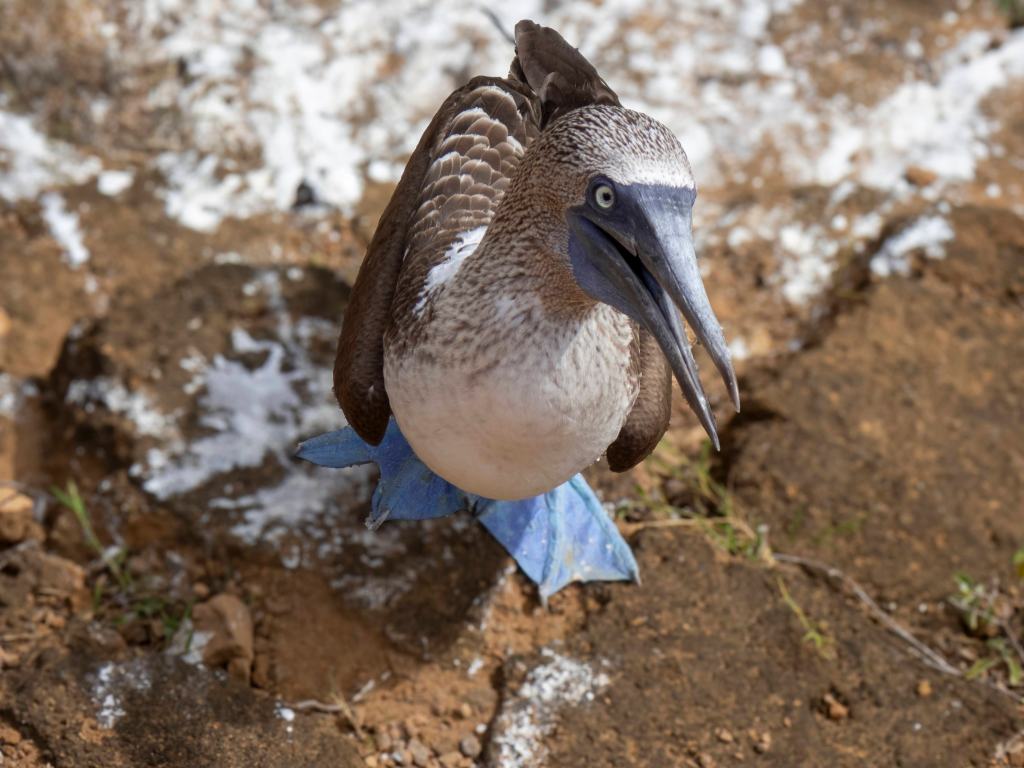
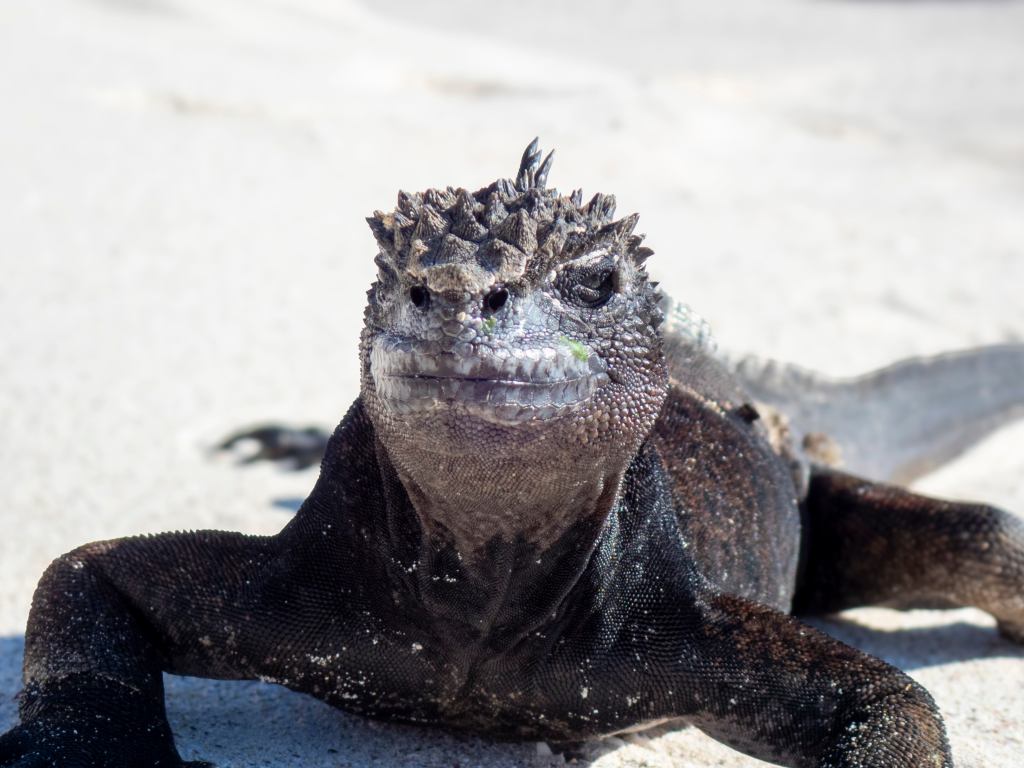
Darwin himself never landed on Daphne Major and might only have seen it as a blot in the distance. We were luckier in that regard. The distinctive volcanic shape was visible from the plane as we arrived at Baltra and our boat was docked for a time with a clear view. Of course, this was far from the only difference in our experiences. Darwin was stuck on a circa 1800s sailing vessel. We were on a luxury catamaran launched only last year with suites larger than most New York City apartments, an open air bar complete with a hot tub on the rear deck, gourmet food, a local guide, and reliable wifi. Still, there was something about the largely rocky, alien, and untamed landscape that made it easy to believe we were following in his footsteps, being whispered to by his ghost. We can imagine him marveling at the red and blue footed boobies and wondering why their feet were such radically different colors. Interestingly, this is an another example of evolution in action that Darwin could only dream of. The color is based on the food they eat in a nice little proof of Richard Dawkins’ theory of the Extended Phenotype. The blue footed boobies eat a fish with a blue pigment that colors their feet, and females choose their mate based on how blue they are because it indicates they are good providers. There are red footed boobies who enjoy a different diet and only mate with their own. Thus, entire species are based on a molecule produced by the DNA of an entirely different species. We can’t imagine what Darwin might have said knowing that, but we can wonder what he thought looking over the jagged cliffs at the sparklingly blue ocean, perhaps spotting a little island offshore and dreaming what might be hidden there. Today, we would not describe the lizards as stupid or ugly. Instead, we would say they were like little dragons dotting the beach and the rocks warning potential trespassers. We do not ride the turtles, either, much less haul them onto the boat and eat them. We live in a radically different era, and yet we still marvel at the natural world around us and consider the same mystery of mysteries.
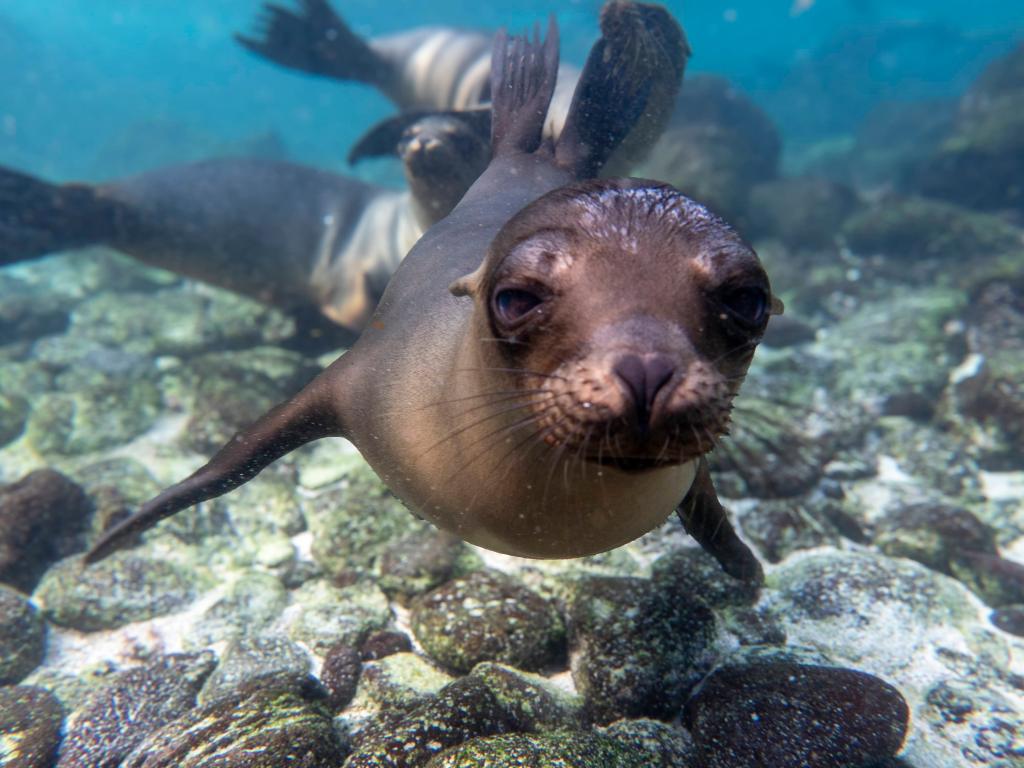
Personally, I cannot say I had any single epiphany while I was there. The sense of experiencing something totally unique was too overpowering to truly think about it all that much, making it more felt than known. A land where birds nest directly on the trail, crowding around it in the thousands. The sea lions play with you in the crystal waters, coming so close they might even kiss your camera. Schools of eagle rays drift by like silent specters in the night while sea turtles make their way closer to the ocean floor, even an occasional shark might swim through a school of tropical fish. Lizards lounge on the beach, daring you to get close and call them stupid or ugly. The sun sets on every day over the waves, promising some new adventure tomorrow. No, I didn’t have any sudden realizations of historic import, but we did drink almost all the beer – and the white wine – on the boat. I hope for the sake of the travelers that came in after us that they resupplied because there were barely three or four left – and hopefully, I got some great shots. That’s mission accomplished in my, admittedly warped mind for an unforgettable trip.

 Confessions of a Conservative Atheist
Nice!
““I prefer to remember things my own way.” As do most people. However, our remembering is a biased story. I’ve always taken pictures [Did so for my HS yearbook and college newspaper. (1968-1970)] Which sparked many an interesting (and fun) conversation this past weekend as we (family and friends) were building, or putting together, the story of my brother’s life. The pictures helped us to recall the 5W’s of his life (and ours).
In Darwin’s day, most folks relied on sketches – rare.
Glad you enjoyed your adventure. Cheers 🙂 and thanks!
LikeLiked by 1 person
Very true! I actually took a few photos for the high school year book myself (1990 to 1994) though, but then I kind of fell out of it during college, largely because I had no skill with film and I didn’t like lugging the thing around. The digital cameras are ridiculous today though. BTW, did you note I read Beak of the Finch? Great book, very interesting. I would love to see him do a part 2 with the more modern genetic learnings.
LikeLike