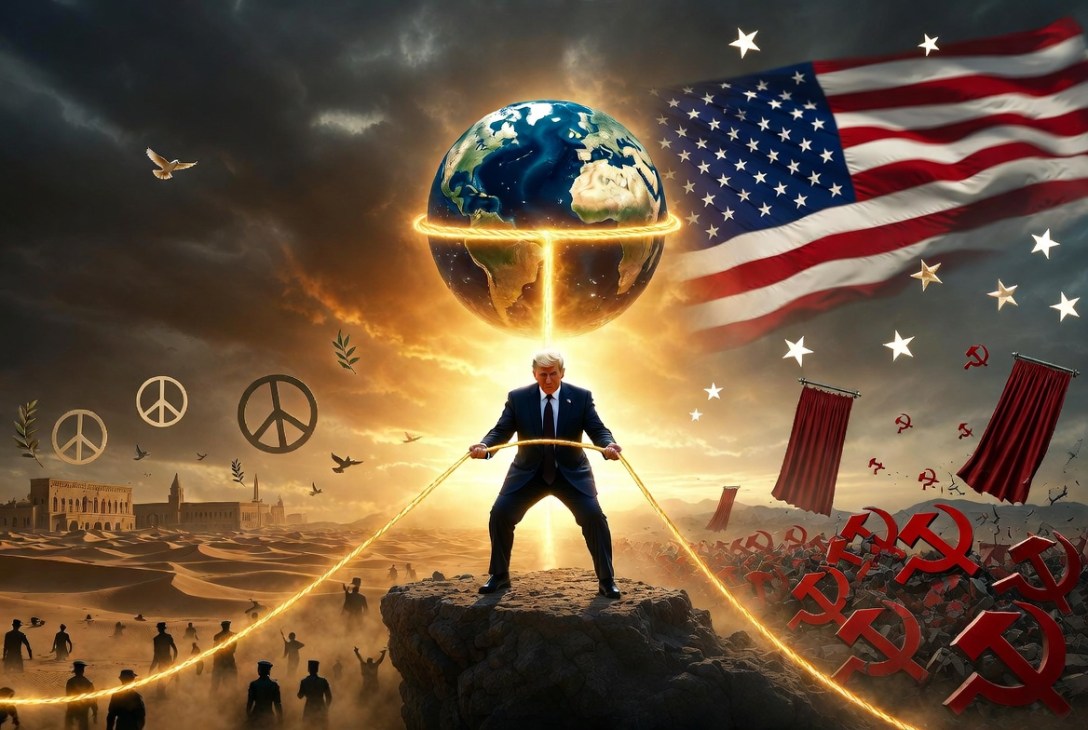
It certainly isn’t pretty at times, but beyond death and taxes, there have been two certainties throughout my life, the Middle East was a strange and scary place from which terrorists launched attacks and communism was a creeping, insidious threat. Trump is finally addressing them both.
At the risk of dating myself, I was born in 1976 and turned 50 earlier this month. Beyond death and taxes, there have been two certainties throughout most of my life: The Middle East was a strange and scary place from which terrorists launched attacks and communism was a creeping, insidious threat. I was too young to remember the Iranian hostage crisis of 1979, when 66 Americans including diplomats and civilian staff were captured and 52 were held for over two months after a French-led rescue operation recovered 16, but I have some vague memories of the bombings in Beirut and Kuwait that occurred a few years later. At less than six years old, I didn’t know the details as I do now or understand what it meant in anymore more than the most simple and direct terms, but on October 23, 1983 two truck bombs were detonated outside barracks housing American and French soldiers in Beirut, Lebanon killing 307. Less than two months later, there were attacks on six installations in Kuwait, killing 25. This, sadly, was only the start of the distant terrors as I grew in age and awareness. In 1988, when I was starting to get old enough to grasp some of the details lurking beneath the devastating headlines, yet still too young to be all that interested in the news, it was Pan Am flight 103 that was blown up by a device secreted onboard over Lockerbie, Scotland killing everyone, some 259 people. In 1990 as I was entering high school, it was an attack on an Israeli embassy in Argentina that killed 29. The Gulf War, which was not directly to either save for the region, followed soon after, positioned at the time as a military triumph, but overtime proved to yield very limited long-term results. We had TVs in school at that point, and I recall being quite bored watching some of the invasion in Mr. McDevitt’s US history class, who was himself an extremely boring but intelligent, nice, and understanding man with a large mustache. The war began on January 17, 1991 and I remember it primarily for occurring in places I knew nothing about beyond the sense that there vast deserts and ancient hatreds, and for introducing me to a classic boogeyman figure of my younger years, complete with a strange and scary name to my white-bred, middle class ears, Saddam Hussein. In 1993, the terror came closer to home with the first World Trade Center attack on February 26, killing six, but even then, it didn’t seem real even though I was born in New York and lived not far away in central New Jersey, more like an event that happened to someone else that I might well have studied in history.
In 2000, it was the USS Cole that was attacked at port in Yemen, killing 17, followed by the worst of all, the Twin Towers getting taken down by our own planes on September 11, 2001 and creating another classic boogeyman, Osama bin Laden. I was 25 years old at the time. The amorphous, vaguely defined in my mind threat from the Middle East had come home. The terror that was far away was officially here, scarier, more real, and yet harder to understand than ever. Beyond the shock and sadness of that time, there was a sense of unity and resolve the country hasn’t experienced since, a belief that we could confront this threat and change the entire world in the process starting with Afghanistan and then Iraq, but as President George W. Bush declared you are either with us or against it, the signs were already there that intractable problems remained and would for the foreseeable future. The Middle East, where the threat originated and had always originated in my mind even if there several distinct countries and issues involved, was hardly with us and can reasonably be said to be against us. Saudi Arabia, for example, beyond being the homeland of the majority of the 9-11 perpetrators condemned our efforts in Iraq. “We do not accept that this war should threaten Iraq’s unity or sovereignty or that its resources or internal security should be subjected to a military occupation, and we have let the United States know about our position on this,” claimed Crown Prince Abdullah on behalf of King Fahd at the time. “The special circumstances surrounding this crisis over the last 12 years demand that we not get involved in any uncalculated adventure that might jeopardize the security and peace of our country and our people,” he added. The United Arab Emirates and others concurred, offering a “complete rejection of any aggression on Iraq.” In my still relatively young opinion, it wasn’t merely the terrorists themselves, it was the entire region that supported them against us or close enough to it, given my ability to make finer distinctions was admittedly limited. President Bush went one step further afterwards and labelled Iran in particular part of an “axis of evil,” insisting that they were “arming to threaten the peace of the world.” Unfortunately, President Bush wasn’t capable of doing anything about this threat, or the other axis state, North Korea, which was and remains under communist control, not as the wars in Afghanistan and Iraq dragged on, costing money and lives, and showing little result. When President Barack Obama took office after, the situation grew so untenable that he pulled out of Iraq, surged back into Afghanistan, and attempted to make a deal with Iran by sending them a lot of money in exchange for promises many believed they wouldn’t possibly keep, I would argue for obvious reasons. While we can debate the wisdom of these decisions, tractable the problem was not. Instead, it seemed perpetual, unsolvable, a threat we simply needed to live with, forever.
The other vague threat of my youth was, of course, the Soviet Union. While I am too young to have hidden under a desk to prepare for a potential missile attack, as I am too old to have done an active shooter drill as they do in schools these days, the Cold War informed more of my experiences growing up than I can state with any surety. Whatever the actual threat at the time, much less my ability to understand it or the history dating back to before Harry Truman was President, the idea that there was a real threat, a potential world-ending danger was everywhere in popular culture and elsewhere. The films of my youth both confirmed it and played upon it. War Games imagined a nuclear war between the US and Russia started by a computer. Red Dawn, an invasion from China and Russia. Sylvester Stallone, one of the premiere action heroes of the day, fought the Russians at least twice, both as Rocky in a boxing ring against Ivan Drago and as Rambo in Afghanistan. While many of these films were and remain wonderfully ridiculous, the sense that two powers might one day collide was inescapable, perhaps inevitable until the Berlin Wall fell and the Soviet Union collapsed, but ironically, rather than ending the threat, it mutated somehow. Cuba remained a communist state close to our shores, another fixture of my life, but rather than the push towards authoritarian socialism receding, Venezuela joined them when Hugo Chavez ascended to the Presidency in 1999, reminding us that the socialist cause might be subdued yet was still on the march. Nor was the threat from Russia eliminated after Vladimir Putin took power. Rather than joining the world’s democracies, he annexed Georgia in 2008 and Crimea in 2013. This period coincided with the rise of communist China, emerging as another shadowy super power on the world stage, as though authoritarian governments were a recurring disease that might be treated for a while, but could never be cured. Sadly, the reality became even more clear as the world’s authoritarian governments began to grow closer and stronger together, forming groups like BRICs and implementing projects like the New Silk Road which were specifically designed to counter Western democratic power. Venezuela, a socialist country in our own hemisphere, might have been tolerable on its own, but by allying with China, Russia, and Iran including sharing nuclear technology, weapons manufacturing capability, and even terrorist training.
As I matured, pursued my life and my career, the threats remained, dangers that never went away, problems that were never solved, leading to recurring themes in world affairs and the news that seemed like they were spun off as ever cheaper sequels to the original. Experts and the establishment class were fond throughout of referring to the post World War II order, NATO, United Nations, and the like, but somehow these bodies never addressed the darker side of that order or were completely incapable of doing so. These strange, dangerous, foreign terrorist states and a Cold War which never really ended, only changed. There’s an old expression that the more things change the more they stay the same, and so the mutation of these various threats was accompanied by a certain kind of stasis, a paralysis, a resignation that this was the way it was and always would be. To be sure, my own perspective changed as I grew older, more worldly, and hopefully more wise. From what I previously described as a white-bred upbringing in New York and New Jersey, about as middle class and middle of the road as one could get, my career took me around the country and to different parts of the world. Working in tech, I became close with many Indian colleagues over the years, ultimately having the chance to visit that special country three times, and learned that despite wildly different histories, cultures, and customs, deeply enshrined values can be shared. That is that we might be from different places. We might revere different historical figures or pop culture icons. We might view things somewhat differently, and yet we can still work closely together for a common goal, learning from and enriching each other with those differences rather than allowing them to divide us. More recently, I was fortunate enough to visit the Middle East for the first time, having traveled to Dubai in the United Arab Emirates for the first time last October and having the opportunity to meet people from around the Middle East including Iran. There, I learned two things. There were shared values. There was the ability to work together, but the underlying philosophies were completely different. The UAE is not a democracy. The people there have no fundamental rights. To an American, such a state might seem intolerable, but to them it is entirely natural. Democracy is messy and disruptive. They believe their way is more stable and direct, or as they put it: We have a few simple rules, if you follow them you will have a good life.
Admittedly, it still seems hard to me to understand, but I am old enough to have learned that the way I see the world isn’t necessarily the right one. I am also old enough to be tired that the intractable problems have remained intractable for the entirety of my life – perhaps until now. The future remains uncertain, but it certainly seems to me that President Donald Trump is at least attempting to drag the entire world past these old divides and threats, running what I have called the Domino Theory in reverse. In the past three months, he has transformed Venezuela into a potential ally, ejected China, Russia, and Iran from the country, and one of the communist specters from our shores. He has also succeeded in getting Panama to eject China from critical ports around the canal. If current reports are accurate, Cuba will be next, ending another long standing stand off, and effectively removing Chinese and Russian influence from the entire hemisphere, ending an unfortunate fact of life for more than a decade before I was born, when President John F. Kennedy stared down Nikita Khrushchev during the Cuban Missile Crisis. As everyone knows, he has waged a war in Iran, though as has been little reported or appreciated the Arab States are on our side now rather than with the terrorists, a huge change. If he can bring this war to a settlement favorable to us, he will have reset the world we have all known for decades. I understand that it might not be pretty. I can’t say with any surety that it’s worth the cost, nor do I think the full costs and benefits will be known for years, perhaps a decade or more in some cases, only that at some point, it had to happen. Threats need to be confronted, problems need to be resolved, and the ghosts of the past simply need to go away. If not President Trump, who? If not now, when?

 Confessions of a Conservative Atheist