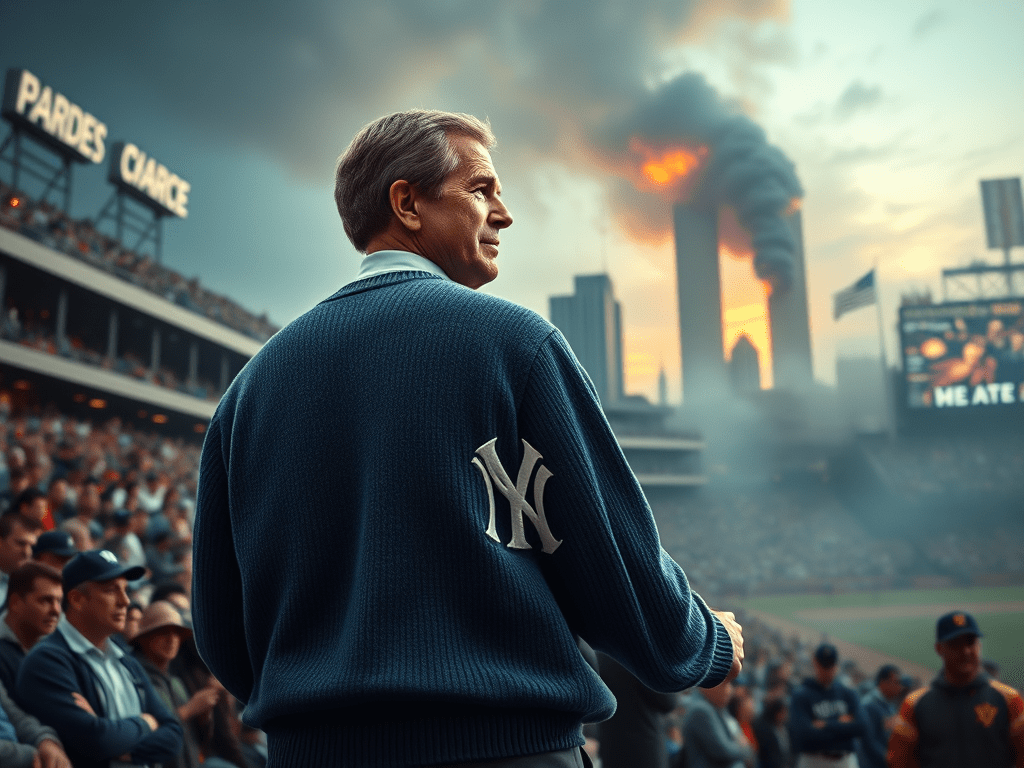
President George W. Bush galvanized the country by throwing out the first pitch at the World Series in 2001. Contrary to the stunning lack of curiosity among the experts and the mainstream media, the visibility of a country’s leaders matter, especially in a time of war.
On October 30, 2001, President George W. Bush galvanized the country and demonstrated American resilience after 9-11 by performing a rather mundane ceremony, throwing out the first pitch at a baseball game. Though politicians, other dignitaries, and celebrities had done so for generations, this particular pitch was of outsize importance. Less than 15 miles away, the Twin Towers remained a smoldering ruin after being destroyed by the worst attack on American soil in United States history less than two months earlier. I was a tender 25 years old at the time and to say the mood of the country was jittery was a massive understatement. In the weeks, even the months or years that followed 9-11, there was the sense that every public gathering was an opportunity for another terror attack, a lingering fear that it would happen again, only worse. In this context, the World Series is a major public event every year. The World Series at Yankees Stadium is more major than most, and the first World Series game in New York following 9-11 made it one of the most major of all time. Immediately after the terror attack, Major League Baseball cancelled all of their games for safety reasons, but ultimately decided that returning to something resembling normal would help unify the country, transforming America’s past time into the renewal of the American spirit and games restarted two weeks or so later. The Bush Administration recognized the importance as well, and initially urged the President to attend the World Series opener in Arizona a few days before reaching New York City. Those responsible for President Bush’s security believed it to be a safer, more easily locked down option than Yankees Stadium in the Bronx for obvious reasons. The President recognized the stakes were higher than that, however, and insisted upon New York, the site of the attack itself.
Earlier in the day, he visited first responders at the World Trade Center site before taking Marine One to the stadium. Wearing a bullet proof vest underneath a deep blue New York Fire Department sweater, the President walked alone to the mound before the start of the game – in plain view of anyone with a gun or any kind of attack – and threw out a perfect strike. Todd Greene, the Yankees catcher at the time, described it this way, “You can use all the words to describe it. It was hair-raising, different. Just an awesome healing moment for our country.” He continued to note the importance in retrospect, “It’s by far my best moment [in baseball] because of the significance for the healing process that our country needed at the time. So, I don’t know what I could have done — from a players’ standpoint — to top what our country needed at the time, which is what President Bush did. It was just a huge moment in time of healing to let the whole world know that we are moving forward, and you are not going to intimidate us.” To those of us watching from home, the importance and power of the moment remain hard to describe even almost 25 years later. In one sense, the sight of a national figure throwing out the first pitch at a baseball came was entirely ordinary. President William Howard Taft was the first President to do so way back in 1910. In another, the entire world had changed dramatically on 9-11. The seeming invulnerability of the United States, protected from horrors of an international war since our Founding by two oceans, was shown to be nothing more than a comforting illusion in the modern world. The reality that thousands of lives could be lost with no warning and our own planes can be used as weapons of war against us was shocking and unsettling to say the least, bringing with it the fear that nothing would ever be the same again and the belief it was only a matter of time before another attack. The President, demonstrating courage and resolve by doing something completely normal took on outsize importance, transcending the event itself and turning it into a symbol. The sight of him approaching the mound by himself from the dugout under the blazing lights of the stadium and countless camera flashes, alone, without the Secret Service surrounding him, knowing he was completely exposed was something all of us watched, practically holding our breath with each step. He took a moment on the mound to gaze around at the crowd, aware of the power of the moment, and though the weight of the world was clearly on his shoulders, he stood tall, strong, and without comment tossed a perfect strike like the scene had been scripted for a movie.
Thus, the ordinary in times of war can become extraordinary. Without words, President Bush communicated to the country and the world that America would not be cowed by the threat of terrorism. Despite the attack, Al Qaeda killing 2,977 people in cold blood at the Twin Towers, the Pentagon, and over the skies of Pennsylvania, life would go on. It might not have felt that way at the time, or even for the foreseeable future, but there was the promise that things would be normal again at some point and no matter what, we would not be defeated.
I was reminded of this in contrast to the complete absence of the Iranian Supreme Leader, Mojtaba Khamenei, the son of the former Ayatollah. Though he was selected to lead the country by the so-called Assembly of Experts approaching ten days ago, he has not been seen in public or even so much as a video or audio recording, leading to various speculations about his whereabouts and whether he remains on this Earth to begin with. Some say he was killed in the same attack that left his father dead. Others that he was seriously injured, having lost a leg and in a medically induced coma. Still others, that he was disfigured, but otherwise healthy. At points, the speculation has been so extreme some outlets reported that he was airlifted to Russia for treatment, but the truth is impossible to say. According to Iran’s Ambassador to Cyprus at least, he was certainly injured. Alireza Salarian told The Guardian shortly after the strikes began, “I have heard that he was injured in his legs and hand and arm… I think he is in the hospital because he is injured.” As of yesterday, the Kuwaiti newspaper, Al-Jarida claimed he was secretly evacuated to Russia for specialized treatment not available in Iran and that he has been offered asylum as well. While it would be interesting to know the truth on its own, this is far more than merely an academic question. Whether dead, alive, or seriously injured, the new Ayatollah is supposed to be able to fill the power vacuum left by the death of his father, a man who ruled the country since 1989 across six US presidents and countless disputes. In many or even most respects, he is the person most responsible for making Iran what it is today, for better or worse, having served as President before being selected as Supreme Leader. He was instrumental in transforming the Iranian Revolutionary Guard Corp into a theocratic force that brooked no dissent and ruthlessly enforced the authoritarian rule of the regime. He exported terror in the form of Hamas, Hezbollah, and other groups that he helped organize and train. He began Iran’s nuclear program. He ensured Iran was able to fund its operation by exporting oil. He tightened Iranian ties with China and Russia. He stood against the United States and Israel, causing the deaths of hundreds of soldiers in Iraq and elsewhere around the world.
According to Vali Nasr of the Johns Hopkins School of Advanced International Studies, he was “an unusual sort of dictator,” who took “many of the powers of the presidency with him and [turned] the office of the supreme leader into the omnipotent overseer of Iran’s political scene.” Officials under Khamenei controlled and influenced, “the parliament, the presidency, the judiciary, the Revolutionary Guards, the military, the intelligence services, the police agencies, the clerical elite, the Friday prayer leaders and much of the media,” as well as various “nongovernmental foundations, organizations, councils, seminaries and business groups.” Karim Sadjadpour of the Carnegie Endowment for International Peace identified several factors that contributed to his near absolute power in recent years. These included, “1) A vast network of commissars stationed in strategic posts throughout government bureaucracies, dedicated to enforcing his authority; 2) the weak, conservative-dominated parliament, headed by Khamenei loyalist Gholam-Ali Haddad-Adel (whose daughter is married to the Leader’s son); 3) the rapidly rising political and economic influence of the Islamic Revolutionary Guards, whose top leaders are directly appointed by Khamenei and have always been publicly obedient to him; 4) the political disengagement of Iran’s young population …; and 5) most significant[ly], the 2005 presidential election, which saw hardliner Mahmoud Ahmadinejad trounce Khamenei’s chief rival … Hashemi Rafsanjani.” While it was easy for Americans to dismiss him as a mad man or label him as an evil, cold blooded killer, the fact remains that he was the equivalent of a force of nature in Iran, the region as a whole, world affairs to some extent, and if nothing else, thwarted American interests for almost four decades, but now he is gone and his replacement appears to be non-existent to the outside world while the country he left behind is an existential war.
When they say power abhors a vacuum, this is exactly what they are referring to especially when there are at least some indications that selecting Mojtaba Khamanei as the replacement was a bad decision from the start, a choice made of desperation rather than strength or the desire to have a figure head for a leader. According to reports from US intelligence, which could admittedly be propaganda of a sort, “Ayatollah Ali Khamenei, had misgivings about his son replacing him, multiple sources familiar with the matter told CBS News. The analysis showed the elder Khamenei was wary of his son, Ayatollah Mojtaba Khamenei, ever taking power because he was perceived as not very bright, and was viewed as unqualified to be leader, according to sources. The information gathered also indicated that the father was aware that his son had issues in his personal life, according to sources within the administration, the intelligence community and people close to the president.” Some have taken the references to “issues in his personal life” to mean that Mojtaba is gay, which of course would be anathema in a Muslim theocracy, making him completely unacceptable. Regardless, there are reasons to wonder at the choice even without wondering about his health. Iran was not intended to be a hereditary dictatorship, choosing the son of the current leader undermines the nature of the regime itself. Mojtaba himself has spent his entire life in his father’s shadow, has no natural constituency, visibility outside Iran, or any sort of name of his own, making it easy to declare him completely unqualified from the start. The questions only get worse if he was selected for the role while being dead or seriously injured. Dead, of course, would mean that the regime attempted to fool the Iranian people and the entire world by choosing a person who does not exist as their leader for their own nefarious purposes, likely for the name alone. In a coma, would essentially mean the same. In both cases, the message that even the regime’s top leadership isn’t safe from US power would be clear, and it’s hard to believe that the fall out among the rank and file and the populace would not be devastating should they learn the truth. Disfigured or seriously injured would be less damaging, though still potentially devastating to the regime’s credibility if he is unable to make public appearances and demonstrate that he is in charge sooner rather than later.
Ultimately, it seems to me at least, that Motjtaba’s status could be one of the most crucial questions of the war so far, and yet the media is either largely uninterested – or actively spinning the failure to appear as a net positive for reasons that defy rational analysis. Perhaps CNN was the most brazen in this regard, declaring that the visibility of the new leader of Iran doesn’t matter in the least based on quotes from officials in the regime itself. Leila Gharagozlou began a supposed “analysis” by claiming, “Almost a week after his appointment as Iran’s supreme leader, Mojtaba Khamenei remains in the shadows…It’s now been six days since he was named the supreme leader, and the Iranian people have not seen him or heard his voice.” Though she spent a single sentence questioning who might be running the country in his absence as if that was of little import, “His absence has done little to dampen the fervor of those faithful to the regime, thousands of whom have taken to the streets to pledge their allegiance.” To prove that was the case even as there are some indications the supposed thousands were generated by Artificial Intelligence and not really there to begin with like the leader himself, Ms. Gharagozlou continued to cite supposed supporters of the new Supreme Leader as evidence this is a perfectly normal and sustainable state of affairs. Instead of a sign of weakness when the country is engulfed in a conflict over whether it will continue to exist, his supporters see his lack of being seen in real life or even a video “not as vulnerability, but as virtue.” So virtuous in fact that the regime itself “have resorted to circulating AI-generated videos of him to drum up support.” While that alone should warrant suspicion about the overall state of the entire Iranian government and how close it might be to collapsing, “The regime can sustain a period of time without public appearances, said Sanam Vakil, director of the Middle East and North Africa program at London’s Chatham House thing tank…Some analysts say what matters most in Tehran right now is not the visibility of the supreme leader, but the cohesion of the institutions beneath him.”
Beyond a stunning lack of curiosity about the underlying truth, there’s little in the way of understanding how power works in the real world. At least a part of the supposed “cohesion of the institutions” stems from the reality that Iran has had someone perceived as a strong leader for almost forty years and the institutions themselves are a reflection of the former Ayatollah’s power. Whether that perception can be transferred to an untested, perhaps unqualified individual is an open question in and of itself, but to suggest that it can be if that person is dead or in a coma, and the transfer of power was based on a lie is its own answer. It cannot. Either way, the media should want to know for sure and in a more rational world, it is the question everybody would be asking. Of course, he will probably appear within an hour of me posting this, but the fact remains, the lack of curiosity beforehand remains astounding

 Confessions of a Conservative Atheist