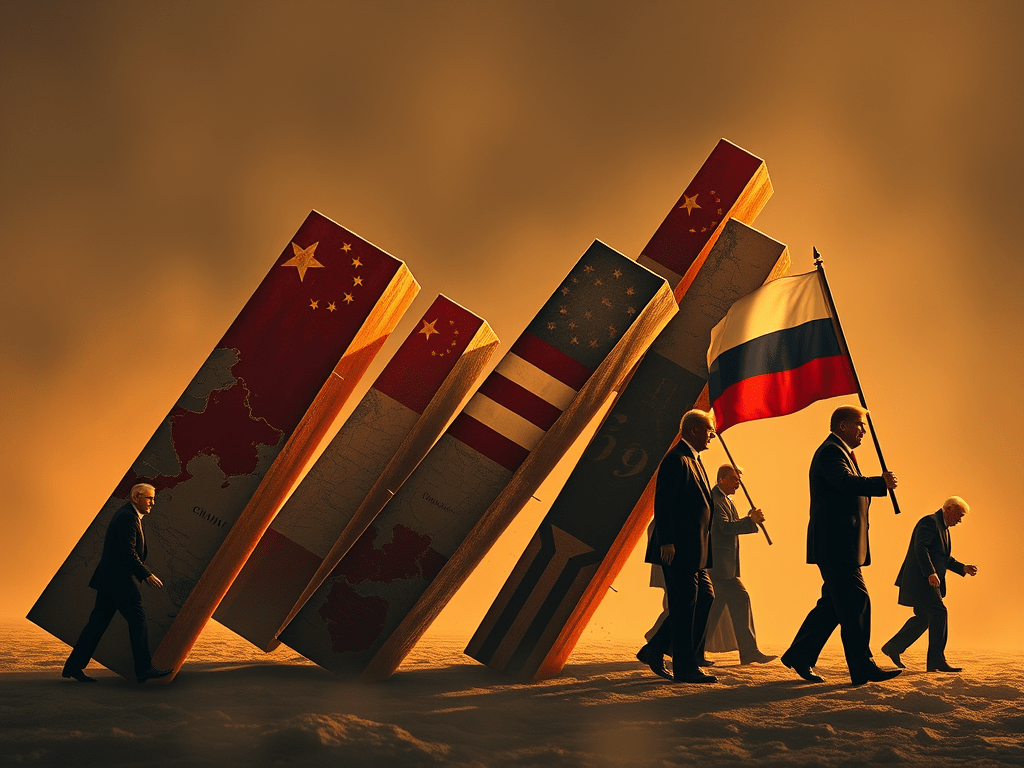
During the Cold War, the theory held that one country falling to communism led to another, but today Trump is toppling states allied with China and Russia in an inverted incarnation.
In the aftermath of World War II, the world was roughly divided into two spheres of influence. Countries either lived under the protective umbrella of the United States, NATO and related alliances, and what are generally considered Western, democratic values, or under the boot of Soviet style communism, behind the Iron Curtain. As early as 1946, Winston Churchill, the former and future Prime Minister of the United Kingdom used this phrasing at a speech at Westminster College in Fulton, Missouri. “From Stettin in the Baltic to Trieste in the Adriatic,” the great speaker declared, “an ‘Iron Curtain’ has descended across the Continent. Behind that line lie all the capitals of the ancient states of Central and Eastern Europe. Warsaw, Prague, Budapest, Belgrade, Bucharest and Sofia; all these famous cities and the populations around them lie in what I must call the Soviet sphere, and all are subject, in one form or another, not only to Soviet influence but to a very high and in some cases increasing measure of control from Moscow.” By 1947, President Harry S. Truman made it a priority to stop the advance of communism beyond this curtain. In what came to be known as the “Truman Doctrine,” the goal was to create a buffer zone around the Soviet Union and contain communism within it. Communism, however, would not be so easily constrained. In 1949, Mao Zedong led a revolution in China, creating the People’s Republic under single party, socialist rule. Korea was divided by North and South, communist and democratic, a situation that persisted even after a war when the North tried to invade South with help from China. Vietnam seemed poised to follow suit, after a communist and nationalist army took control of the northern part of the country by ousting the French at the Battle of Dien Bien Phu. In response to the sense that countries were falling one after the other behind the Iron Curtain, President Dwight D. Eisenhower embraced the Domino Theory at a press conference on April 7, 1954, claiming “Finally, you have broader considerations that might follow what you would call the ‘falling domino’ principle. You have a row of dominoes set up, you knock over the first one, and what will happen to the last one is the certainty that it will go over very quickly. So you could have a beginning of a disintegration that would have the most profound influences.”
Whether purposely or not, the Domino Theory would inform close to the next four decades of foreign policy. President John F. Kennedy feared communism was gaining ground in Laos and encroaching on Southern Vietnam, prompting him to send troops to prevent a full take over of the country. In September 1963, he was asked, “have you had any reason to doubt this so-called ‘domino theory,’ that if South Vietnam falls, the rest of southeast Asia will go behind it?” He replied, “No, I believe it. I believe it. I think that the struggle is close enough. China is so large, looms so high just beyond the frontiers, that if South Vietnam went, it would not only give them an improved geographic position for a guerrilla assault on Malaya, but would also give the impression that the wave of the future in southeast Asia was China and the Communists. So I believe it.” Two years later, his successor, President Lyndon Baines Johnson would say something similar, claiming “If they take South Vietnam, they take Thailand, they take Indonesia, they take Burma, they come right on back to the Philippines.” Undoubtedly, the theory was more than a hypothetical or geographically distant concern when communism was also spreading to the Western Hemisphere, encroaching on the borders of the United States itself. Cuba became communist in 1961, prompting the missile crisis. Chile fell in 1970, Granada in 1979, and Nicaragua in the early 1980s. Argentina, Bolivia, Brazil, Columbia, Ecuador, and Peru weren’t fully communist, but had strong communist parties, placing them under threat. Taken together, it certainly appeared that one country led to another and the free world was at risk. While the theory had its detractors, even those who were sympathetic to the communist and socialist cause like Professor Noam Chomsky believed it was accurate, desirable even. He referred to as a “the threat of a good example,” writing “The weaker and poorer a country is,” he wrote, “the more dangerous it is as an example. If a tiny, poor country like Grenada can succeed in bringing about a better life for its people, some other place that has more resources will ask, ‘Why not us?’”
Following the fall of the Soviet Union in 1991, the Domino Theory no longer seemed necessary and for a time, it was believed that Western style democracy would reign supreme even if China remained communist and a rapidly emerging power. China, however, had other plans and together with a recalcitrant Russia that sought to rebuild the old Soviet Union, they began to expand their own umbrella. The goal was to form alliances around the world with countries opposed to the United States and the West, or countries that attempted to maintain some neutrality between the spheres. Unlike the old Soviet Union, these alliances and the initiatives that support them took various names. In 2009, Brazil, Russia, India, and China formed “BRIC” with the express purpose of counterbalancing Western power, but the idea itself dates back to a decade earlier and to Russia itself when it was initially promoted by Yevgeny Primakov during his term as Minister of Foreign Affairs. By 2010, the alliance was expanded to include South Africa, adding an “S” to make it BRICS. In 2012, they created a new development bank and pledged $75 billion to the International Monetary Fund. During the same period, there was a new National Institute of Statistics that included the Institute of Geography and Statistics (Brazil), Federal State Statistics Service (Russia), the National Bureau of Statistics (China), the Central Statistics Office (India), and Statistics South Africa to help measure and allocate initiates between the members. In 2012, they planned a separate optimal fiber submarine communications system to bypass US intelligence, though that was ultimately abandoned.
As of 2023, BRICS had created some 60 intra-group institutions and a network of think tanks covering more than 30 topics including the BRICS Business Council, BRICS Think Tanks Council, BRICS Women’s Business Alliance, BRICS Business Forum, BRICS Academic Forum, BRICS Deep-Sea Resources International Research Center, and a BRICS Digital Ecosystem Cooperation Network. A year later, the group was expanded to include Egypt, Ethiopia, Iran, and the United Arab Emirates. Argentina and Saudi Arabia were also invited, but have so far declined to participate. Also in 2024, an additional thirteen countries were added as junior partners, including Algeria, Belarus, Bolivia, Cuba, Indonesia, Kazakhstan, Malaysia, Nigeria, Thailand, Turkey, Uganda, Uzbekistan, and Vietnam. Last year, Indonesia officially joined the growing roster and as of today, BRICS+ boasts 46% of the world’s population along with 25% of the landmass and 37% of global GDP. Trade among the countries amounted to almost $615 billion in 2022 alone. Collectively, they have over 1,200 satellites in orbit and about 40% percent of internet users around the world, including offering digital payments to about 87% of Russians, 86% of China, and 81% of South Africa, 77% of Brazil at 77%, and 35% of India.
Four years after BRICS+ was founded, China announced its new “Silk Road” initiative also called the Belt and Road Initiative, previously the One Belt, One Road. Among the most massive infrastructure projects ever conceived, the goal is to connect Asia, Europe, and Africa via land and sea, replacing the current trade corridors with new high-speed rail, ports, and energy pipelines that would cement China’s influence on the world stage and place them at the center of global commerce. The plan calls for physical infrastructure, a digital silk road with 5G networks, data centers, and more, and a polar silk road with routes through the Arctic. More than 140 countries including those in our own hemisphere, as close as the Caribbean, are to be connected. As early as 2017, Time Magazine declared the project a “challenge” for the United States in a massive understatement. After detailing the projects at the time, “a staggeringly ambitious plan to build a network of highways, railways and pipelines linking Asia via the Middle East to Europe and south through Africa. The economic land ‘belt’ takes cargo, in large part via Khorgos, through Eurasia. A maritime ‘road’ links coastal Chinese cities via a series of ports to Africa and the Mediterranean. A total of 900 separate projects have been earmarked at a cost of $900 billion, according to the China Development Bank. There’s the $480 million Lamu deep-sea port in Kenya, which will eventually be connected via road, railway and pipeline to landlocked South Sudan and Ethiopia and right across Africa to Cameroon’s port of Douala. A new $7.3 billion pipeline from Turkmenistan will bring China an extra 15 billion cubic meters of gas annually” and the scale, “some 65 countries, covering 70% of the planet’s population, three-quarters of its energy resources, a quarter of goods and services and 28% of global GDP—some $21 trillion,” they declared “America remains in denial about what Belt and Road really signifies,” the “new Silk Road is the purest illustration of Beijing’s budding influence as Washington is consumed with partisan bickering and fumbles for a coherent foreign policy.” Rather incredibly in retrospect, they concluded “China has wrapped an amorphous group of projects in a tidy package that speaks to inclusiveness, cooperation and altruism. It speaks of China, as an environmental leader, despite being the planet’s worst polluter; as a champion of free trade and investment, despite wreathing its economy in protectionist red tape; as a good guy, despite acting as an authoritarian state that is a serial violator of human rights.”
At this point, it should be clear to everyone that between BRICS+, the new Silk Road, and other initiatives China was actually assembling an alliance of countries that would counterbalance, then oppose American hegemony, creating the modern equivalent of a Soviet Union to encroach on the United States. Beneath the surface, some of the more nefarious countries involved trained terrorists (Venezuela and Iran), shared dangerous technology (Russia, Venezuela, and Cuba, probably Iran as well), sold and traded weapons (Russia, China, Cuba, Venezuela, and Iran), conducted massive amounts of trade in illegal, black market oil and other goods (Russia, China, Cuba, Venezuela, Iran, and probably others), and evaded international sanctions, partnering together to sow global chaos and instability with the goal of making the United States look weak. Equally incredible in retrospect, the United States did very little – some may say nothing – to slow this new alliance in its tracks, much less stop it. On the contrary, we continued to deepen our economic ties with China even as they manipulated their currency and stole our intellectual property. We even went so far as to declare that we would no longer protect our own hemisphere when Secretary of State John Kerry, acting on behalf of President Barack Obama, announced that the era of longstanding Monroe Doctrine was officially over. “In the early days of our republic, the United States made a choice about its relationship with Latin America. President James Monroe, who was also a former Secretary of State, declared that the United States would unilaterally, and as a matter of fact, act as the protector of the region,” he told the United Nations in 2013. “The doctrine that bears his name asserted our authority to step in and oppose the influence of European powers in Latin America. And throughout our nation’s history, successive presidents have reinforced that doctrine and made a similar choice” before claiming the Obama Administration made a different choice. “Today, however, we have made a different choice. The era of the Monroe Doctrine is over. (Applause.) The relationship – that’s worth applauding. That’s not a bad thing. (Applause.) The relationship that we seek and that we have worked hard to foster is not about a United States declaration about how and when it will intervene in the affairs of other American states. It’s about all of our countries viewing one another as equals, sharing responsibilities, cooperating on security issues, and adhering not to doctrine, but to the decisions that we make as partners to advance the values and the interests that we share. As the old proverb says, La union hace la fuerza. The union – in unity, there is strength. Through our shared commitment to democracy, we collectively present a vivid example to the world that diversity is strength, that inclusion works, that justice can reject impunity, and that the rights of individuals must be protected against government overreach and abuse. We also prove that peace is possible. You don’t need force to have fuerza. The vision that we share for our countries is actually within our grasp, but we have to ask ourselves some tough and important questions in order to secure our goal.”
Thankfully in my opinion, President Donald Trump has chosen a radically different course. If the first incarnation of the Domino Theory held that we needed to prevent countries from falling to communism, he has inverted it and chosen to topple the dominos in the opposite direction instead. First, he reinstated the Monroe Doctrine and arrested the sitting President of Venezuela in a stunning raid on his fortress of a palace on January 3, robbing China, Russia, and Iran of a valuable partner in South America. Simultaneously, he pressured Panama to eject China from ports around the Panama Canal. While this has received relatively little coverage, Panama’s Supreme Court voided leases for the terminals of Cristóbal and Balboa on January 29, prompting the Chinese companies that have operated them to declare it unlawful. “The takeover of the two terminals reflects the culmination of a campaign by the Panama State against PPC and the concession contract over the past year,” CK Hutchison said in a statement, adding that Panama ordered the “occupation” of all movable property and removed all employees. “CKHH considers the ruling, the Executive Decree, the purported termination of PPC’s concession, and the takeover of the terminals to be unlawful,” the statement continued. Less than two weeks ago, President Trump moved against Iran, wiping out the existing leadership, destroying their army, airforce, and navy, and halting their ability to produce missiles and drones. While we do not yet know what sort of government will emerge, we can be reasonably confident that its ties to China and Russia will be greatly curtailed, amounting to yet another blow against the alliance. Based on recent reporting, Cuba is likely to enter into a deal with the United States or completely collapse. In addition to the damage to Chinese prestige and the belief they are ascendant, the economic consequences for the would-be superpower are likely to be substantial. Between Iran and Venezuela, China obtained about 20% of its oil, for example. Russia will suffer economically as well, especially if oil prices revert to levels before the strike on Iran. Together, it’s impossible not to conclude that these various moves which might seem disparate on the surface are intentionally designed to limit Chinese influence, curtail Russia, and substantially weaken both of their economies, especially when you consider other deals for rare earth minerals, tariffs, and more. Not content to let this continue any longer, President Trump is actively toppling the dominoes in the opposite direction himself.

 Confessions of a Conservative Atheist