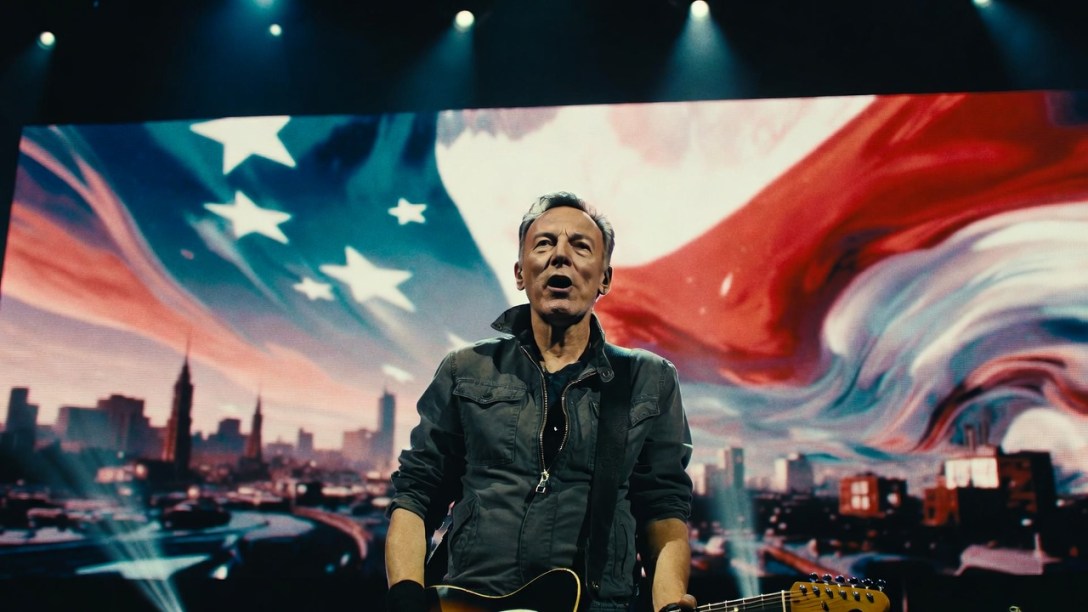
This isn’t the first time Springsteen has turned to music in the wake of an American killed by law enforcement or the first time he’s sung about immigration issues. Sadly, he has done so with far better results than his current effort.
Let me start by saying that I practically worship Bruce Springsteen. I’ve seen him live around forty times, claimed he has no equal or even an apt comparison, and his progressive politics won’t change that whatever he may say or do. At the same time, no one is above criticism and especially after he chose to release a new protest song about events in Minneapolis, aptly titled “Streets of Minneapolis,” it’s worth noting this isn’t the first time he has turned to music in the wake of an American killed by law enforcement. In fact, he did the same almost three decades ago to much better effect, in my opinion. At approximately 12.40 AM on February 4, 1999, a 23 year old immigrant student, Amadou Diallo was gunned down by a New York City Street Crime Unit in the vestibule of an apartment building. The officers on the scene Edward McMellon, Sean Carroll, Kenneth Boss, and Richard Murphy had been tracking a serial rapist when they encountered Mr. Diallo outside the building in the Soundview neighborhood of the Bronx. When they attempted to question him while still in an unmarked squad car, he fled into the vestibule and began reaching into his pocket. The vestibule was dimly lit and in the glare of the streetlamps, one of the officers believed he was reaching for a gun, fired a shot, and then stumbled back onto the sidewalk because of the recoil. The other officers, thinking their comrade had been hit after he fell, opened fire, unleashing a hail of bullets, some 41 in all, 19 of which hit their own mark, killing the young Mr. Diallo where he stood. Though an investigation ruled the shooting a tragic accident and a trial cleared the officers of any wrong doing, the situation was not without controversy for obvious reasons. Between Mr. Diallo being unarmed, the number of shots that were fired, and witnesses reporting that the officers continued shooting after he was down, many, primarily on the left, saw it was an example of how then Mayor Rudy Giuliani’s policing policies had grown increasingly aggressive, trampling on people’s rights and creating the opportunity for violence (does that sound vaguely familiar?). As the CATO institute described it at the time, “The incident has sparked a heated debate over the crime-fighting policies of Mayor Rudolph Giuliani and the New York City Police Department…The killing of Amadou Diallo was neither an act of racist violence nor some fluke accident. It was the worst-case scenario of a dangerous and reckless style of policing. Policymakers should dispense with confrontational stop-and-frisk tactics before more innocent people are injured or killed.” In the aftermath, there were massive street protests, some 1,200 people were arrested, the Department of Justice under President Bill Clinton ultimately ruled that the Street Crime Unit itself had engaged in racist practices, and Mr. Diallo’s family settled a wrongful death lawsuit with the city after the officers were found non-guilty.
A year following the shooting, Springsteen immortalized the incident in “American Skin (41 Shots),” a song that was not without controversy of its own, though in my opinion at least much of that was undeserved, perhaps unlike these days. While the President of the Patrolmen’s Benevolent Association and the Police Commissioner called for a boycott of a planned 10 night stand at Madison Square Garden in the summer of 2000, and the President of New York State’s Fraternal Order of Police got even rougher, publicly denouncing Springsteen as a “dirtbag” and a “faggot,” the song itself is far from a denunciation of the police. Instead, Springsteen imagines several points of view throughout, beginning with the officers themselves. Rather than stone-cold, trigger happy killers, he depicts them “kneeling over his body in the vestibule, Praying for his life” and to at least some extent, sympathizes with the split second decision they were forced to make, asking “Is it a gun? Is it a knife? Is it a wallet? This is your life,” questions that will repeat themselves throughout. Simultaneously, a young minority woman, Liana, is getting her son ready for school. She gives the young man some good advice. Similar to the way my own mother always told me to keep my hands at ten and two on the wheel if I got pulled over, she says, “On these streets, Charles, you’ve got to understand the rules, If an officer stops you, promise me you’ll always be polite And that you’ll never ever run away, Promise Mama you’ll keep your hands in sight.” Ultimately, Springsteen concluded that we are all of us in this together, however awful or violent things might be at times. We “Cross this bloody river to the other side, 41 shots, got my boots caked with this mud, We’re baptized in these waters (baptized in these waters), And in each other’s blood (and in each other’s blood).” The chorus and the entire song close with a haunting statement that is necessarily true in an imperfect world. “It ain’t no secret (it ain’t no secret), No secret my friend, You can get killed just for living in your American skin.” At the time, Springsteen let the song speak for itself, trusting the listener to tease out the complexity while he insisted on performing it in New York City against the insistence of the police associations, frequently with law enforcement people in attendance turning their back to the stage while he urged the crowd to silence (having witness it, it was an odd protest to be sure considering they still went to the show and objected to one song). When asked, he would say that the song was not anti-police, but anti-brutality. “We took a lot of heat from the police for several years after that. There were some police officers giving us the New Jersey state bird, which I always felt was a result of not listening to it.” Years later, he would tell former President Barack Obama that the incident had prompted him to consider the nature of white privilege, not a phrase in wide usage in 1999, saying “this incident occurs and I start to think about it and I go, ‘OK skin, skin is destiny,’ it’s like what a privilege it is to forget that you live in a particular body.”
Fast forward almost twenty six years, and the recent incidents in Minnesota and elsewhere prompted Springsteen to revisit the topic of Americans getting killed by law enforcement, but sadly, the results are far from the same. Even setting aside that “Streets of Minneapolis” is at least partially culled from an earlier classic on a completely different topic, one with no relation whatsoever to immigration, the subtlety and originality of thought is gone, replaced with an outright polemic that merely recycles the various outrages of progressives instead of even attempting to say anything new. Thus, today’s law enforcement officers are no longer complex human beings forced to make decisions that could prove tragic in mere seconds and their lives are no longer on the line if they decide incorrectly. Indeed, they seem to have no agency whatsoever and might not even be people at all, at least in the context of the song. Instead, they are “King Trump’s private army,” “federal thugs,” crushing the city beneath “occupier’s boots,” those who “killed and roamed In the winter of ‘26.” Perhaps even worse, they have no reason to be there in the first place. From the opening verse, Springsteen questions whether there is anything resembling a legitimate motive to enforce immigration law, claiming they “Came to Minneapolis to enforce the law Or so their story goes.” Later, he is even more explicit, singling out Trump Administration officials for their “dirty lies,” “they say they’re here to uphold the law, But they trample on our rights.” Confronted with these atrocities, the good citizens of Minneapolis have no choice except to resist in Springsteen’s telling, a decision that also serves to rob them of their agency by flattening any and all resistance into a single voice. “A city aflame fought fire and ice,” “Against smoke and rubber bullets, In the dawn’s early light, Citizens stood for justice, Their voices ringin’ through the night.” Together, one and all, “We’ll take our stand for this land And the stranger in our midst” and “In our chants of ‘ICE out now,’ Our city’s heart and soul persists Through broken glass and bloody tears On the streets of Minneapolis.” Though he mentions both Renee Good and Alex Pretti, they are simply “two dead” that the good people will “remember,” not actors in their own right who are remotely responsible for their decisions leading up to their respective tragic encounters. At its core, “Streets of Minneapolis” is based on the most simplistic struggle between good and evil imaginable, with the various players on one side or the other, with no real choice in between.
Ironically, Springsteen himself had a far more nuanced and complex take on the complexity of immigration in the 1990s. Rather than a simple good versus evil narrative, The Ghost of Tom Joad explored the darker side on both sides of the border. In “Sinaloa Cowboys,” he told the story of two migrants, Miguel and Louis who entered the United States illegally crossing at the “river levee” despite a warning from their own father, who told them “My sons one thing you will learn, For everything the north gives, it exacts a price in return.” Though they originally set out to work the orchards, legal work despite their legal status, they ended up in the drug trade, “cooking methamphetamine” at a “deserted chicken ranch” because it paid a lot more even with the obvious danger and the abuses of the drug dealers themselves. If “you slipped, the hydriodic acid Could burn right through your skin, They’d leave you spittin’ up blood in the desert If you breathed those fumes in.” Back then, the story ended in tragedy for the migrants. “It was early one winter evening as Miguel stood watch outside, When the shack exploded, lighting up the valley night, Miguel carried Louis’ body over his shoulder down a swale To the creekside and there in the tall grass, Louis Rosales died.” Instead of a brother, Miguel is left with a mere “ten-thousand dollars,” “all that he saved.” In “The Line,” Springsteen told the story of a former military man who joined the Immigration and Naturalization Service (a precursor of ICE before formation of the Department of Homeland Security) in San Diego, charged with preventing border crossings. His partner, Bobby Ramirez, had family in Mexico, and “the job it was different for him,” but even so, Bobby explained why people were willing to risk crossing the border, even paying smugglers to do so, in no uncertain terms. “They risk death in the deserts and mountains, Pay all they got to the smugglers rings, We send ‘em home and they come right back again. Carl, hunger is a powerful thing.” On patrol, Carl encounters “Drug runners, farmers with their families, Young women with little children by their sides,” and tragically falls for one of the young women. “The first time that I saw her, She was in the holdin’ pen. Our eyes met and she looked away, Then she looked back again. Her hair was black as coal, Her eyes reminded me of what I’d lost. She had a young child cryin’ in her arms And I asked, ‘Senora, is there anything I can do.’” Carl agrees to help her brother cross the border, only to learn that her brother is a drug smuggler that he’s (accidently?) let go free. Bobby is aware of this as well, but “He never said nothin’.” Carl, however, can’t live with this choice. He leaves the INS and becomes a drifter, taking “what work I could find” and searching for his love, who it seems has abandoned him and was likely in the drug trade herself.
What accounts for the difference between these songs and eras? Does Springsteen truly believe that every illegal immigrant is now simply a “stranger in our midst” who we should consider our neighbor or are at least some percentage of them human traffickers and drug smugglers, a danger to those they transport and the public at large? Does he no longer believe that law enforcement officers are forced to make impossible choices in a matter of seconds such as when a car is coming right at them or a gun is found on a man who put their hands on a comrade, choices that they have to live with the rest of their lives, or are they now simply occupiers and thugs? Perhaps someone in the media should ask him. If I had to guess, he would probably insist that the situation is somehow so much worse, that any prior work on the matter no longer applies, but that logic goes both ways. Yes, we might agree that President Donald Trump has been more aggressive than his predecessors dealing with illegal immigration, but the illegal immigration system is that much worse. There are far more illegals in the country than in the 1990s; millions crossed the border over the past five years; hundreds of thousands of children went completely missing. There was no fentanyl crisis back then, killing around 100,000 Americans per year until very recently. There were no mass demonstrations and agitations. No progressive cries for war against the administration. This makes it seem pretty clear to me at least, that the only possible answer is the existence of President Trump himself, the Orange Man who is always bad in every possible way. Confronted by him, Springsteen, who has compiled a massive song catalog of almost unrivalled complexity, who has crafted nuanced characters forced to deal with difficult issues, and who has generally explored controversial topics with an unflinching realism, has been reduced to a ChatGPT version of himself, recycling the outrage of the day in the purely performative language of modern progressives in service of a false narrative about the forces of good – his side – battling the forces of evil – the MAGA side. Incredibly, even progressives aren’t all that enthused. Jeff Slate, writing for MSNOW, opined that “Maybe it doesn’t matter that ‘Streets of Minneapolis’ will most likely be forgotten in a few days. Maybe, in fact, that’s exactly what we need right now.” In what can only be described as desperation, even if unconscious, he repeats the sentiment that it’s better Springsteen do something rather than nothing, several times, saying “maybe that’s enough,” “something close to a universal rallying cry,” lamenting that ‘Streets of Minneapolis’ just doesn’t grab me. The lyrics are clunky and the production is unsophisticated,” “it’s hardly Springsteen at his best.” In other words, the quality of the art doesn’t matter in the age of Trump. Politics are all that’s important, and art must therefore be subservient to the cause. Given Springsteen himself has been fond of saying “trust the art, not the artist” throughout his career, it’s a rather sad development that – at least when it comes to “Streets of Philadelphia” – the anti-Trump opinions of the artist are all that mattered and the artist himself has become so Trump-deranged, he ignored his former work, both in terms of immigration and in terms of law of enforcement, in service of the cause. As a result, we are left with the equivalent of AI Springsteen, what some algorithm might come up with if you asked it to recreate a classic in the modern, outrage mode. A sad development indeed.

 Confessions of a Conservative Atheist
Yes, indeed. This world has gone crazy and sucked a lot of people, decent people, into unhinged crazies. We are just overwhelmed, and you’re right on point–that’s a lot to do with AI and the ball and chain. (= the smart phone). My favorite, Neil Young, is abreast with Springsteen. I think, at some point, these icons should retire to the rocking chair. Trump, on the other hand, seems to have aged well.
LikeLiked by 1 person
Hahaha! Didn’t Neil Young give his catalog away or something bizarre? Personally, I don’t want to see Springsteen retire. I just want to see him produce real stuff, not rehashed garbage. 🙂
LikeLiked by 1 person