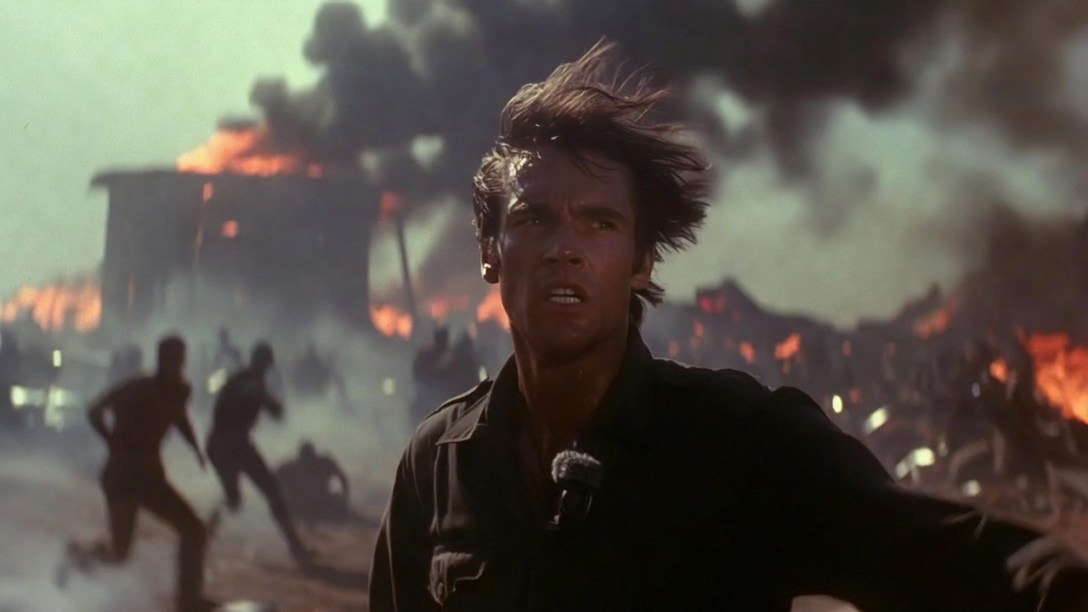
It’s hard to believe we are less than six months from the targeted assassination of Charlie Kirk. Back then, turning down the rhetoric was all the rage, but now everyone loves the smell of napalm in the morning.
“I love the smell of napalm in the morning,” exclaims Lieutenant Bill Kilgore in Apocalypse Now as part of one of the most famous sequences in movie history. The lieutenant and his squad have just landed at the mouth of a river in war torn Vietnam to escort Captain Willard to find the wayward Colonel Kurtz, firing upon those below with abandon, citizens and soldiers alike while “Flight of the Valkyries” blares on the soundtrack. Rather than missiles mounted to some of the helicopters, they have surfboards and immediately upon landing, while people are still dying, bombs are still going off, and the world is in flames around him, a landscape straight out of some orange and yellow smoke filled nightmare, Kilgore struts around without a care in the world, urging his men to hit the beach and start surfing. The combination of the absurdity of the line, delivered in perfect deadpan by Robert Duvall and the hyperealism of the scene prompt a certain nervous laughter in the audience. Is this satire, or real life? How could anyone be so calm, cool, collected, and downright oblivious under these conditions? Is this what war does to certain people and if we were sent to Vietnam or another conflict, could it happen to us? The end result is a unique detachment from the horrors of war, as if we were looking down upon the folly of humanity from afar, which we are in sense watching a film, and a simultaneously immersion, sickened by being embedded in the scene, a helpless witness to humankind’s capacity for death and inhumanity. At the same time, it’s fiction, not real life. Even when the film was initially released, the Vietnam War had ended four years earlier and occurred thousands of miles away. The characters were also fictional, inspired by Joseph Conrad’s classic Heart of Darkness, transforming it into an allegory about the potential for evil in all of us that one can watch with a certain detachment rather than experiencing it in the real world. No one was meant to live it, certainly not on an American street – perhaps until now.
Over the past several weeks, Democrats and their progressive allies appear to have gone all in apocalyptic, battlefield rhetoric as though they were Kilgore themselves marching through a war torn field despite that they’re all safe behind their computer screens. Rather than a dispute over immigration policy that can be resolved in the courts and at the ballot box, ICE and Border Patrol operations in Minnesota are being explicitly framed in terms of a war, complete with “warriors” and “heroes” willing to lay down their lives for the cause. After a second anti-immigration protestor and anti-ICE agitator was shot dead in the street last Saturday, Alex Pretti (who as it turns out, had spat on officers and kicked a federal vehicle while armed with a gun, only to go back for more, making him a clear candidate for the Darwin Awards), the Trump-deranged website, The Bulwark, openly and unironically compared the incident to one of the bloodiest battles in the bloodiest war in American history, Gettysburg. After describing how neither the Union or Confederates truly understood the importance of a conflict that left 7,000 dead and tens of thousands injured, “that the people in the battle could not understand its significance. It would take time for everyone to grasp exactly what the events of Gettysburg meant,” they applied this dynamic to Minneapolis in straight up militaristic terms, outright celebrating and championing the tragic violence that has occurred on American streets during a time of peace. As they put it, “when the regime’s forces occupied the city they were surprised by the resistance they encountered. Not from Democratic politicians, or institutions, or the legal establishment. From ordinary people. The people of Minneapolis organized to protect their neighbors and provide oversight of the regime’s forces that the local government either could not, or would not, perform. Think about this: State and local law enforcement could do nothing to document the crimes being carried out against the residents of Minneapolis by federal forces. But the people were able to do it themselves. This grassroots army used cell phones and whistles to show the world what was happening. In return they were menaced, beaten, and arrested. And Renee Good was murdered by the regime’s masked secret police. Upon encountering this unexpected resistance, the Confederates (Trump) command poured more forces into the city and adopted even more brutal tactics. At which point the people of Minneapolis organized a general strike. After which the regime’s police executed Alex Pretti on the street, in broad daylight.” As if two deaths weren’t enough, and there were no such things as courts, ballot boxes, or even regular protesting and petitioning to begin with, the author, Jonathan V. Last openly called for more, “The people of Minneapolis have given all they have to give. They need reinforcements from other parts of the resistance.”
The Bulwark was not alone. The New Yorker described it as “The Battle for Minneapolis,” The New York Times opined that “State Terror Has Arrived,” and The New Republic claimed that “Dems Have Much To Gain, Nothing To Fear by Attacking ICE.” Even rock legend and one of my personal heroes, Bruce Springsteen felt the need to get involved, once again framing it as an existential struggle by replacing the lyrics from the classic “Streets of Philadelphia” to “Streets of Minneapolis.” In the new version, he imagines “A city aflame fought fire and ice ‘Neath an occupier’s boots,” “Against smoke and rubber bullets, By the dawn’s early light Citizens stood for justice, Their voices ringing through the night And there were bloody footprints Where mercy should have stood And two dead left to die on snow-filled streets Alex Pretti and Renee Good.” He concludes, “We’ll take our stand for this land And the stranger in our midst, We’ll remember the names of those who died On the streets of Minneapolis, We’ll remember the names of those who died On the streets of Minneapolis” In some cases the musings have bordered on the fantastical and bizarre, combining military, historic, and religious imagery. Philadelphia District Attorney Larry Krasner threatened ICE agents, claiming if “If we have to hunt you down the way they hunted down Nazis for decades…we will find your identities!” Perhaps he was inspired by Michael Tomasky of The Daily Beast, who recently fantasized about ICE agents randomly opening fire on a crowd of people under the direct orders of President Trump. As he put it, “what makes what’s happening in this country today different” is “The state is the perp. The government is beyond the law. The United States is now closer to Bashar Al Assad’s Syria, or perhaps even today’s Iran, than to anything we recognize as fitting within the understood norms of American history. That’s a pretty big statement, I realize, but it is not an exaggeration…Until Minneapolis, I would have told you that as bad as Trump is, he’s not capable of ordering ICE agents to shoot people (citizens or not) at random, and that as bad as ICE is, they’d refuse such orders. Now I no longer believe either of those things. This man and his government are clearly capable of mass violence against immigrants and all who support them. It seems only a matter of time now before some of these thuggish ICE agents, under orders from the thug president, shoot some people down.” Norm Eisen, a senior fellow at the Brookings Institute referred to Mr. Pretti’s memorial in Minneapolis as a “holy site,” posting on X, “Good morning from Mineapolis [sic] & the Alex Pretti memorial–a holy site in our fight against autocracy.” At the same time, perhaps the most bizarre framing came from Juliette Kayyem, a professor at Harvard’s Kennedy School of Government and a writer for The Atlantic, who described the situation as some kind of strange, new age self-help episode. “I have begun to think that Minnesota pushback to ICE was successful because it was premised on giving people something to do. It wasn’t just about going into streets. People had purpose and mission: videos, whistles, info and communication flow to communities. People had agency.” Needless to say, she failed to add that some, Ms. Good and Mr. Pretti are dead, having no anything anymore. Attempting to spin this as a positive development, makes little sense outside of the notion that this is indeed some kind of existential struggle, a battle between good and evil, where those with “agency” are on the side of truth and justice, effective and successful despite a couple of deaths and other injuries, such as a woman who lost at least a figure for foolishly picking up a flashbang grenade.
Overall, it’s hard to believe we are less than six months from the targeted assassination of conservative organizer and influencer, Charlie Kirk. Back then, as in last September, turning down the rhetoric was all the rage. “This is on all of us, right?” Democrat Representative Jared Moskowitz told Fox News Digital after the shooting. “I mean, you know, everyone’s been ramping up the rhetoric, right? If the left is going to blame the right, and the right is going to blame the left, and we’re going to continue to say ‘It’s your fault,’ and we’re not collectively going to try to bring it down together, then this cycle is just going to continue to go on.” His Democrat colleague, Glenn Ivey claimed we needed to get back to the spirit of love that bound us together when a series of assassinations–President John F. Kennedy, Dr. Martin Luther King, Jr., Robert F. Kennedy, and more–rocked the nation in the 1960’s. “The message was love and not violence,” he said of the turmoil. “So, you know, returning to a message like that could be good, but it didn’t change the outcome of the assassinations during that era. So, I don’t know that there’s an easy answer.” They were joined by many others in calling for unity, putting side some of our differences, or at least the heated language we use to describe them, for the good of the country. Hakeem Jeffries, Katherine Clark, and Pete Aguilar, three top House Democratic leaders, issued a joint statement calling the assassination “completely incompatible with American values” and warned that the “intense atmosphere of political violence… is not sustainable.” New York Representative Tom Suozzi decried the partisan “punch, counter-punch” reactions, and insisted the divide in the country was “destructive” and a “road to ruin.” California Governor Gavin “Cobra Kai” Newsom said it was “disgusting, vile, and reprehensible” and Americans must reject political violence in every form.
What’s changed? Of course, the killing of a prominent conservative threatened to boomerang back on progressives and therefore there was the risk of backlash against Democrats, but there’s also the reality that President Trump is directly involved. Despite having no evidence at all to this effect, they somehow believe that they’ve got the Orange Man this time and are apparently more than willing to sacrifice more progressive foot soldiers to do so. While they hide safely behind their X accounts, risking absolutely nothing, they will not hesitate to urge others into self-evidently reckless behavior if it furthers the cause, characterizing what is essentially a dispute about the implementation of immigration policy, the sort of disagreement the country has had for decades now, as an existential battle that must be waged with maximum gusto even if it costs lives. They might pretend they love the smell of napalm in the morning, but this is not a war, they are not soldiers, and they are playing with other people’s lives. That they know this and continue to characterize it that way only makes it sicker and more depraved. Sadly, this is how much they hate President Trump and how desperate they are for some kind of win that they believe they can parley into others and if some people have to die to do so, so be it. More meat for the grinder, to quote a radically different war film from another era and one of my own personal favorites, Starship Troopers.

 Confessions of a Conservative Atheist