What do our indictments, proclamations, sanctions, and speeches mean if Venezuelan Presidents Hugo Chavez and Nicolas Maduro were allowed to operate with impunity?
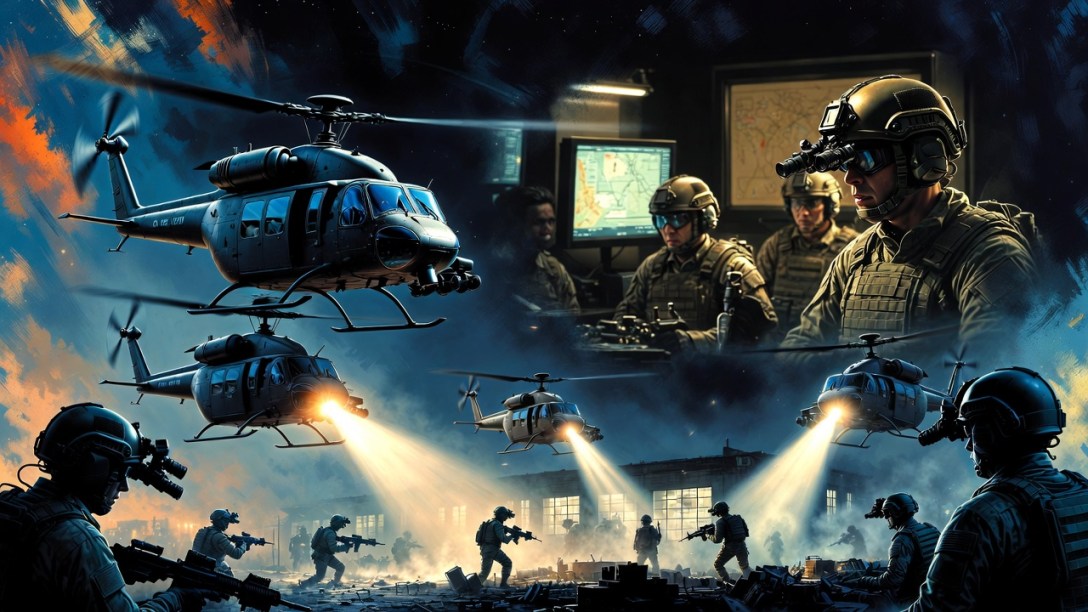
Over the weekend, President Donald Trump stunned the world including many of his own supporters by authorizing a daring military operation to capture Venezuelan President Nicolas Maduro in the capital city of Caracas. Carried out by the United States elite Delta Force in collaboration with law enforcement, President Maduro and his wife, Cilia Flores, were snatched from their bedroom as explosions rocked the broader city in an operation that had been in planning since the middle of December. While a massive air campaign boasting over 150 aircraft launched from 20 plus locations pounded military installations and a cyber attack disabled the power grid, a highly skilled strike force was able to enter the presidential palace via helicopter thanks to information provided by an intelligence asset close to President Maduro himself. The team had trained using a model of the interior complete with the dictator’s bedroom, where they found him and his wife, in grey sweatpants, woken from their slumber, desperate to make it into an adjoining saferoom. Even after they were inside, it proved no deterrence to US operators who had come armed with blowtorches to remove the steel door. Before anyone really knew what was happening beyond the explosions reported throughout the city, the two were arrested and removed from the country to face charges in a United States court. Incredibly, no American was seriously injured and only one piece of equipment sustained minor damage. As President Trump himself put it a few hours after announcing the successful mission, “I’ve done some pretty good ones, but I’ve never seen anything like this.” The raid itself follows a CIA operation on a Venezuelan dock – apparently, intelligence units have been operating in the country since at least August – multiple strikes on Venezuelan drug boats that began in September and the seizure of Venezuelan oil tankers that were operating under sanction. This was all seen at the time as a prelude to some form of broader action, but what form that action would take – how daring and masterfully it would be executed to capture him alive for trial – remained unknown until now.
While there are legitimate concerns about what happens next in the beleaguered country, perhaps especially after President Trump promised we will run it until a peaceful transition can occur, the usual suspects reacted unsurprisingly with the usual outrage, immediately declaring the effort illegal as they have done since the initial campaign to target drug boats – and for just about everything else the President has done since retaking office last year. “Secretaries Rubio and Hegseth looked every Senator in the eye a few weeks ago and said this wasn’t about regime change. I didn’t trust them then and we see now that they blatantly lied to Congress,” Democrat Andy Kim posted on X. “Trump rejected our Constitutionally required approval process for armed conflict because the Administration knows the American people overwhelmingly reject risks pulling our nation into another war. This strike doesn’t represent strength. It’s not sound foreign policy. It puts Americans at risk in Venezuela and the region, and it sends a horrible and disturbing signal to other powerful leaders across the globe that targeting a head of state is an acceptable policy for the U.S. government.” “This will further damage our reputation – already hurt by Trump’s policies around the world — and only isolate us in a time when we need our friends and allies more than ever,” he added. Senator Ruben Gallego claimed it was the “second unjustified war in my lifetime,” noting “This war is illegal, it’s embarrassing that we went from the world cop to the world bully in less than one year,” he wrote. “There is no reason for us to be at war with Venezuela.” “I fought in some of the hardest battles of the Iraq War. Saw my brothers die, saw civilians being caught in the crossfire all for an unjustified war,” he added in a second post. “No matter the outcome we are in the wrong for starting this war in Venezuela.” “Without authorization from Congress, and with the vast majority of Americans opposed to military action, Trump just launched an unjustified, illegal strike on Venezuela,” Representative Jim McGovern wrote before bizarrely shifting to healthcare funding. “He says we don’t have enough money for healthcare for Americans — but somehow we have unlimited funds for war??” “Nicolás Maduro was a thug and an illegitimate leader of Venezuela, terrorizing and oppressing its people for far too long and forcing many to leave the country,” Senator Adam Schiff claimed in a statement. “But starting a war to remove Maduro doesn’t just continue Donald Trump’s trampling of the Constitution, it further erodes America’s standing on the world stage and risks our adversaries mirroring this brazen illegal escalation.” Later, he added, “Acting without Congressional approval or the buy-in of the public, Trump risks plunging a hemisphere into chaos and has broken his promise to end wars instead of starting them.”
To reach these conclusions, however, Democrats need to ignore several critically important things, starting with describing an approximately 4-hour military operation as a war, rather than the execution of an arrest warrant and the fulfillment of long-standing US policy in the region. While it might seem hard to believe given that we have done precisely nothing except blather since, President Maduro was indicted in the Southern District of New York as early as March 2020 at the start of the coronavirus pandemic for various drugs and weapons charges. “For over 25 years, leaders of Venezuela have abused their positions of public trust and corrupted once-legitimate institutions to import tons of cocaine into the United States,” an updated version of the indictment released this weekend read, accusing him, his wife, son, and several others of leading a drug cartel and sitting “atop a corrupt, illegitimate government that, for decades, has leveraged government power to protect and promote illegal activity, including drug trafficking…That drug trafficking has enriched and entrenched Venezuela’s political and military elite, including Minister of the Interior, Justice and Peace Diosado Cabello Rondon, the defendant, and former Minister of the Interior and Justice Ramon Rodriguez Chachin, the defendant.” Similarly, the oil tankers that were seized late last year were under sanction since 2019 in some cases and not legally allowed to operate, even though they were doing so with impunity. Beyond the specific criminal charges and sanctions, the United States has considered President Maduro an illegitimate leader since he rigged an election in 2019. “The Maduro regime is illegitimate,” explained then Secretary of State Mike Pompeo at the time. “The fact that Maduro decided to hold an inauguration after a sham election doesn’t change America’s direction and intent.” During President Trump’s first term, he officially recognized the National Assembly President Juan Guaido as the Interim President of Venezuela following the fraudulent election. “Today,” the President wrote in January 2019, “I am officially recognizing the President of the Venezuelan National Assembly, Juan Guaido, as the Interim President of Venezuela. In its role as the only legitimate branch of government duly elected by the Venezuelan people, the National Assembly invoked the country’s constitution to declare Nicolas Maduro illegitimate, and the office of the presidency therefore vacant. The people of Venezuela have courageously spoken out against Maduro and his regime and demanded freedom and the rule of law.”
For his part, President Joe Biden attempted to make several deals with President Maduro, including a somewhat successful prisoner swap and a far less successful lifting of sanctions in exchange for holding a free and fair election to right the previous stolen one. The so-called “Barbados Agreement” was brokered by European and regional leaders with the goal of holding those elections in 2024. In the lead up, President Biden insisted, “Venezuela thus far is keeping their commitment toward a democratic election — it’s not over yet. They’ve made detailed commitments. We’ll see if they hold them. But we’re going to hold them accountable.” Despite this insistence, President Maduro stole a second consecutive election and still Biden refused to act, doing nothing but placing a $25 million bounty for information leading to his arrest, even going so far as to increase it to that amount from $15 million shortly before leaving office. Nor did the United State’s challenges with Venezuelan dictators begin exclusively with President Maduro. His predecessor, Hugo Chavez, was democratically elected at first and recognized by US leadership at the time, but proceeded to transform the country into a socialist dictatorship. In 2002, a short-lived coup installed Venezuelan Federation of Chambers of Commerce (Fedecámaras) president Pedro Carmona as interim president, a move that was recognized by then President George W. Bush. For the remainder of his time in office, President Bush frequently took aim at President Chavez, tying him to terrorists in the region including the Revolutionary Armed Forces of Columbia. “As it tries to expand its influence in Latin America, the regime claims to promote social justice,” he said in March 2008. “In truth its agenda amounts to little more than empty promises and a thirst for power.” “It has squandered its oil wealth in an effort to promote a hostile, anti-American vision,” he added.” “It has left its own citizens to face food shortages while it threatens its neighbors.”
In addition to committing massive human rights violations, collaborating with terrorists, and likely drug trafficking, President Chavez also began authorizing the state seizure of US oil equipment in the country as early as 2007, robbing American companies of billions of dollars without any repayment and once again with the United States doing nothing across three Presidents. As recently as 2013, CBS News reported “Venezuela has quietly seized control of two oil rigs owned by a unit of Houston-based Superior Energy Services after the company shut them down because the state oil monopoly was months behind on payments. The seizure took place Thursday after a judge in the state of Anzoategui, accompanied by four members of the local police and national guard, entered a Superior depot and ordered it to hand over control of two specialized rigs to an affiliate of PDVSA, the state-owned oil producer. PDVSA justified the equipment’s expropriation, calling it essential to the South American nation’s development and welfare, according to a court order obtained by The Associated Press. Company workers were instructed to load the rigs, known as snubbing units and used to repair damaged casing, onto trucks to be deployed at ‘critical wells’ elsewhere, according to the document.” As if this wasn’t enough, Venezuela has repeatedly embraced the known adversaries of the United States, forging alliances with Iran, Russia, and China, providing bases of operation and inviting them to meddle in our hemisphere in a clear violation of the Monroe Doctrine that will have to serve as the topic for another post. For now, this year alone President Maduro ratified a political, economic, and military agreement with Russian President Vladimir Putin including billions of dollars of air defense equipment designed to be used against the United States. In December, Reuters reported that the two leaders had spoken on the phone about this very thing, “Russian President Vladimir Putin spoke to Venezuelan President Nicolas Maduro by phone on Thursday and reassured him of Moscow’s support for his government’s course in the face of growing external pressure, the Kremlin said.” Ironically, a delegation from China was said to be in Venezuela during the raid itself, purportedly to provide aid against the United States.
Given this history, the real question that Democrats are steadfastly ignoring is: What do our indictments, proclamations, sanctions, and speeches mean if Presidents Chavez and Maduro were allowed to operate with impunity across three Presidencies? If so-called international law is to have any meaning beyond providing a forum for the establishment to engage in government sponsored debates and press junkets, it necessarily needs to be enforced especially when their actions have also resulted in almost 8 million refugees fleeing the country, otherwise it will be ignored as we have unfortunately seen with Russia’s invasion of Ukraine, Hamas’ massacre of Israelis, and more. While this does not make us the world’s police force or mean that we should pursue regime change against every bad actor, there is no point in issuing arrests warrants and bounties that amount to meaningless pieces of paper, especially after those in question have repeatedly violated agreements we insisted were meaningful and such violations would come with consequences. President Biden said he would hold them accountable. What did they and everyone else think when he did not? Further, our refusal to act previously in Venezuela is even more puzzling considering Russian interests in the region. For almost four years now, the establishment has insisted that President Putin is nothing short of a monster who must be stopped at all costs in Ukraine, but it was perfectly acceptable for him to march right into South America and provide them with billions in weapons while we did nothing? What obvious lesson do you think he learned from our failure to act despite our bold words? Whatever comes next, one thing is certain: President Trump clearly believes that action means more than mere words and the rest of the world should certainly have gotten the message at this point.

 Confessions of a Conservative Atheist