
Living in the Emirates is easy, if you follow the rules, you can enjoy all the benefits a thriving country has to offer. These rules are relatively simple, but justice is swift and the consequences are severe. Can an American cut it?
As an American, I have always been proud of my country’s historic role in advancing democratic government and human rights. Few, if any, other nations have been founded on fundamental ideals rather than aristocratic families and the generational ownership of land or resources, choosing instead to embrace three key notions. First, all people are endowed with certain inalienable rights that are independent of the vagaries of who is in power. Second, government must be constrained to certain enumerated powers as detailed in a Constitution to ensure authority remains in its proper sphere and does not encroach upon those fundamental rights. Third, all power rests in the people themselves, rather than divine rights bestowing it upon monarchs, nobles, or some other external entity. While I was keenly aware that the citizens of many countries around the world didn’t enjoy these rights or live under this system of government, I rather naively assumed most if not all would prefer to given the opportunity, making it a question of when and how this form of government could be secured for everyone. After all, why would people not want to be free, have a direct say in their own government, and be protected from its potential abuses? To be sure, this didn’t imply that I believed the United States had always lived up to our ideals or that these rights were perfectly followed and upheld in all instances. Even beyond the atrocities of slavery and the horrors of Jim Crow, there are almost innumerable examples where local, state, and federal governments ran roughshod over the rights of their citizens and exercised power well beyond what was allowed – most recently, the coronavirus pandemic can be seen as a case study on a grand scale, something we all witnessed in our lifetimes unfolding before our very eyes as they say. At the same time, the principles themselves remained a worthy ideal regardless, a perfection to be aspired to and by which our failure to achieve in full could be judged independent of their day to day practical application. Putting this another way, even if we do not and have never fully realized these principles, their existence alone has served as a continuous check on our lapses. Ironically, this belief persisted even after our failure to transform Afghanistan and Iraq into functioning democracies despite tens of thousands of lives and trillions of dollars. When presented with something of an experiment that America’s founding principles were indeed universal, we witnessed two countries with two different histories reject them outright, and yet I still believed, preferring to think that it was a failure of imposition, not a failure of our foundational theory of government. Perhaps, if the citizens of these countries had chosen for themselves rather than as a result of an invasion, their choices would be different and it was still only a matter of time.
For better or worse, this belief could not survive a short visit to the United Arab Emirates last week at least for now. Situated on the eastern end of the Arabian Peninsula, bordered by the desert and jutting out into the sea, the Emirates has a long history. The region was first settled 130,000 years ago, where early inhabitants traded with populations in Mesopotamia, Iran, and the Harrapan culture in the Indus Valley. Around 630 AD, Islam spread to the populace through Oman, then the Portuguese arrived in the 16th century before the British took control in the 19th, when it was known as the Trucial States. Before the discovery of vast oil reserves, the waters of the Arabian Sea were rich with pearls, providing income, employment, and a reasonably high standard of living for the time period, making it an attractive place for both the locals and the imperial powers of the day. If anything, the discovery of oil following World War II only increased investment and interest in the region by the British, but in the early 1960s, they lacked the resources to maintain control of a vast, globe-spanning empire and began to withdraw. For a brief period, the Emirates were vulnerable to incursions from Iran and Saudi Arabia, but on December 6, 1971, six sheikhs banded together to officially form the modern version of the country with another group joining ten days later. The new union swiftly joined the Arab League, the United Nations, and was a founding member of the Gulf Cooperation Council. Unlike many countries in the region, the Emirates has enjoyed mostly positive and positive relationships with Western countries. They were an ally against Saddam Hussain in the first Gulf War, signed protection agreements with the United States in 1994 and France in 1995, even joined us in operations in Libya in 2011. Although not a hereditary monarchy, the country is decidedly authoritarian and is governed by a Federal Supreme Council composed of seven ruling Emirs who pick the President and other officials. Interestingly, the populace is only about 11% citizens while the remaining immigrants have no path to citizenship. Regardless of citizenship status, there are no rights to speech, protest, assembly, religion or anything of the sort. Perhaps not surprisingly, the system of government has not earned praise for those who consider human rights and democracy a priority. None other than The New York Times has described it as “an autocracy with the sheen of a progressive, modern state.” There are believed to be systemic violations of traditional rights including torture, forced disappearances of government critics, and the like. Freedom House ranks it as “Not Free,” The Bertelsmann Transformation Index ranks it 91 out of 137 countries when scored for development towards democracy.

A fine imported beer at a local beach club
While this may be true, one isn’t likely to be aware of any of this when they visit or here much concern about it from the locals, far from it. On the contrary, a traveler from the United States is greeted to a thoroughly modern airport with minimal security presence where you breeze through customs faster than you will upon returning home. Exiting the airport are an array of shops selling high priced goods including wine up to several thousand dollars a bottle. Chances are, this traveler will be whisked away from the there in a Lexus ES300 for a cheaper price than a dingy New York City taxi, marveling at a skyline straight out of the future on their way to being deposited in a hotel with every modern amenity, which they will use as home base for a adventures akin to Disney World or Las Vegas, minus the gambling though a casino offshore is in development. The same as in the United States or any Western democracy, a visitor will plan their entertainments freely and without worry, choosing what to do based on their own unique preferences, not beholden to anyone. In fact, the only difference one might discern in the early part of your stay is that you can’t make calls using WhatsApp and most Messenger services. Whether this is because the mobile phone company is operated by the government and seeks to preserve its dominance, or some more nefarious purpose is debatable, though the messaging features of both work and the internet in general as well with no restrictions. Whatever the case, the beach clubs will be thronged with guests at 11.30 on a Sunday morning, enjoying gazing out at the bay, swimming in several pools, or drinking a beer, an import in a Muslim country, though licenses for local breweries are pending as well, at the bar and relaxing in an upscale environment, surrounded by patrons from all over the world. Within earshot of my little spot at Byron Bathers last Sunday, I could hear European, Australian, Russian, Indian, and other Southeast Asian accents with guests ranging from families with young children, vacationing couples, and young singles. The beach club itself was on par with anything one might find in the United States or anywhere in the world for that matter, significantly nicer than many for anyone familiar with the dives one tends to frequent on my own Jersey shore. After entering through a spacious restaurant, an open air, thatched roof bar was situated next to a large, crystal clear swimming pool with fountains and waterfalls, looking out over the nearly glass-smooth Arabian Sea, the beach itself decked with thatched umbrellas and comfortable chairs while yachts cruise by in the near distance. The police are non-existent, only a couple of staff with security unobtrusively emblazoned on their shirt, something true of almost everywhere I went. Somehow, there is both little crime and little police at the same time.
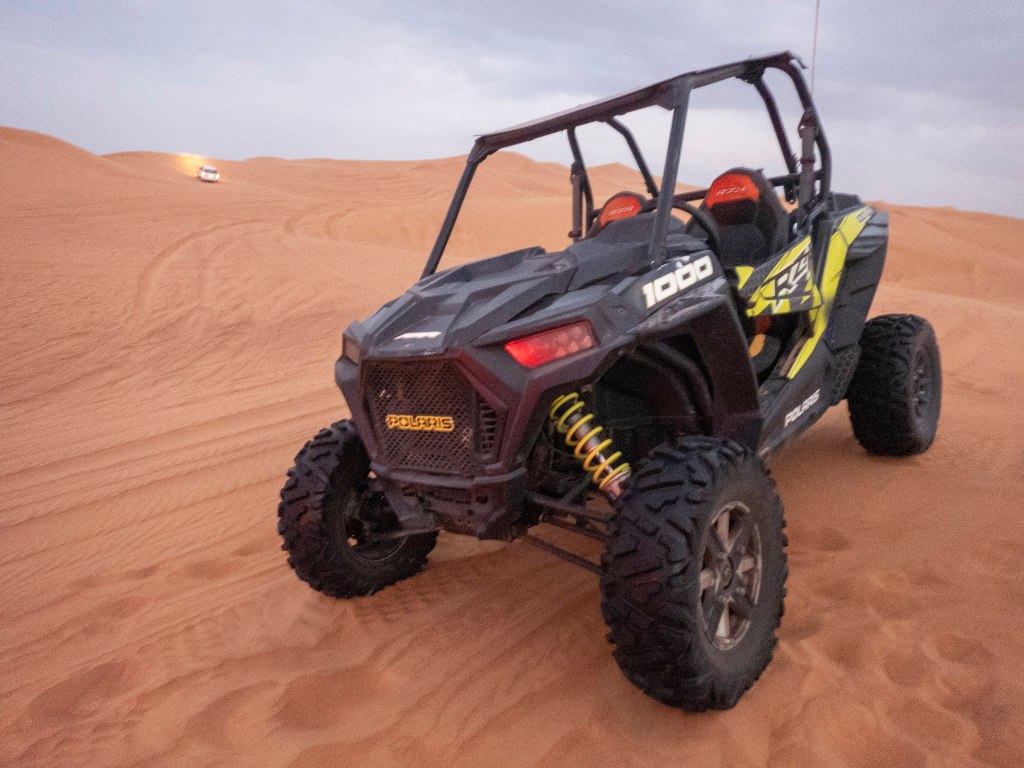
From the beach club, I ventured out into the desert well beyond the city skyline for a chance to drive a dune buggy, what the locals call “dune crushing.” Unlike the rest of my activities, this one was planned in advance, booked on my phone, complete with door to door service from my hotel in new, comfortable minivan. The driver had been in Dubai for twenty years, having emigrated from Pakistan. He noted the massive changes during his time their, complained about the the traffic, but also spoke about the opportunity. When he first arrived, he drove someone else’s taxi. Now, he has his own car, makes more money, and makes his own hours. While the landscape outside city limits was certainly a radical departure from what I’m used to in New Jersey – with nary a tree to be found and huge, sloping, seemingly endless stretches of golden, unshod, untrammeled sand in both directions – the road was well maintained, better than what I am used to throughout most of the United States, though there are periodic circles and speed bumps to slow people down. Perhaps not surprisingly, there is a noticeable decrease in the standard of living the further you get from densely populated areas. The gleaming monuments to advanced architecture give way to more traditional, square buildings, effectively small concrete strip malls that would be familiar to anyone who has traveled to Central or South America. The desert itself quickly becomes alive with machines, however. From the main highway, one can spot SUVs atop the dunes, expensive Mercedes and Land Rovers, thrilling passengers as they descend from the heights on a wave of sand, dozens of them lined up one after the other as we approached our destination. Other than riding dune buggies and quads, I learned this is a key desert attraction, but because you don’t get to drive yourself and I am obsessed with driving myself in anything that has a wheel and a gas pedal, I opted for the buggy and eagerly anticipated our arrival. Though the sun was setting, the rental depot had something of a carnival feel getting ready to close down. A small grocery story and bazaar flanked with rows and rows of vehicles, and everyone was trying to sell something, from a traditional head scarf to posing with a live falcon, both of which I purchased for a few bucks before our guide whisked us to the vehicle after a brief stop posing with a camel. As an American capitalist at heart, one has to give them credit for literally selling the desert before we set out into the unknown. Of the ride itself, I will only say, I wanted to go faster, but that’s not surprising when I always want to go faster. Otherwise, for a grand total of $185 with transportation, you could certainly do a lot worse than riding through the desert at night, the headlights glowing on a small, eerie strip of sand, illuminating the shadows of scrub brush on the sides, the darkness of the dunes like cliffs falling away to the left and the right, the storm of dust kicking out behind you as though you’d recently landed on the moon.
Of course, no trip to Dubai would be complete without a visit to the awe-inspiring downtown, where advanced building design meets classic Arabian style. Dominated by the elegant and majestic Burj Khalifa Tower, the world’s tallest building at 2,722 feet, the downtown mixes office space, hotels, and recreation buildings by a crystal clear waterfront. The Burj itself would be enough on its own, a gleaming spire of glass and steel that rises into the sky with a unique combination of obvious power considering its size and the rare, fragile beauty of the stem of a flower, dominating everything around it or perhaps inspiring everything around it is a more accurate description, especially nestled in a manmade lagoon. The design was derived from Islamic architecture including the Great Mosque of Samarra where a Y-shaped lower portion hosts both residences and a hotel, making it look something like three flower petals in the cross section. The Y-shape tapers and narrows as it extends upwards further and further, keeping the same interlocking petals while staggering them and reducing them in the circumference, resulting in a dynamic overall form that holds the eye from every angle before ending in a slender antenna that seems sharp enough to cut the very heavens. When it catches the sun, the glass and metal shine with an almost inner light, casting their radiance on everything around as though it was a tower out of a fantasy story or something pulled straight from science fiction. Though they offer tours of the tower and have amenities at the top, I opted for something a little more adventurous, some may say insane. Directly across from the Burj, sits the Sky Views Observatory, another massive complex of residences and hotels, this one rising over 720 feet, more than half as tall as the original World Trade Centers. At the top, they offer the Edge Walk, where those who aren’t afraid of heights can get suited up, strap themselves to a cable, and walk around outside while dangling themselves over the edge of the building in a few key places, both backwards and forwards. Given this is Dubai and they’ve thought of everything, there’s even a pouch for your phone to take photos. Immediately upon exiting the building and walking onto the platform, the Burj rises directly across from you, high enough you still need to crane your neck, dominating all around, but as you walk the edge, you can take in the rest of the city in the open air and because you are cabled to the roof there is no barrier, glass, or anything of the sort, only the wind, as you dangle over the edge thinking to yourself, they do this dozens of times a day, the cable has to hold, right?

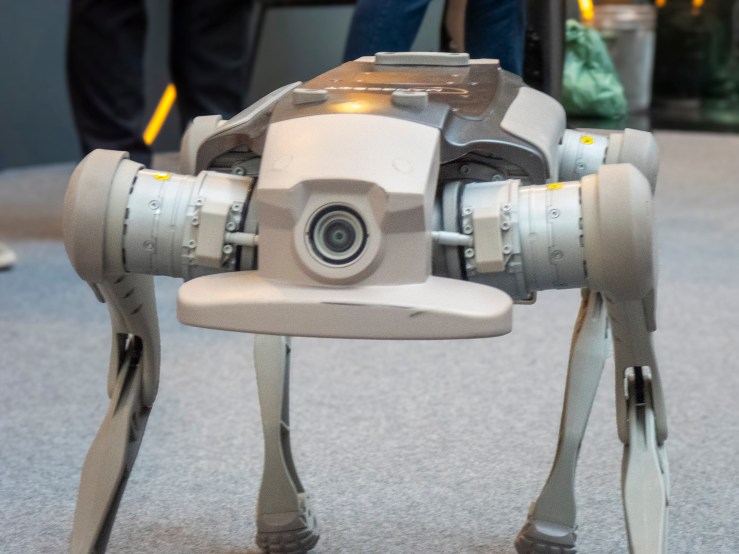
Ostensibly, I was in Dubai for work to attend and deliver some remarks to the GiTex Artificial Intelligence conference, a huge worldwide gathering of some 250,000 technology people representing every major industry area, from robotics to marketing software with companies of all sizes, from global behemoths like Microsoft to my own relatively small group. While the majority of attendees were from the Middle East including those from countries I do not normally associate with much such as Iran, many were from throughout Europe, Russia, Asia, and Australia, making it much more international affair than similar gatherings in the United States. Otherwise, after running your bag through security, the overall feeling was the same with perhaps even less security inside the actual conference. The attendees marched through halls lined with booths and listened to presentations while the vendors hawked their wares. In these situations, I tend to play the politician, hawking our wares by marching up to people and introducing myself. I position myself in a well trafficked area, and just start shaking hands and scanning badges to follow up with later. Given the size of the event, I must’ve shaken a thousand hands over three days and gotten the chance to chat with at least a hundred (my final count of scanned badges alone was 203). Two things were apparent. First, many if not most of the attendees were friendlier than their American counterparts, happier than I am used to to let me give my little pitch and get their contact information. Second, technology has certainly made the world smaller and flatter in a sense. If you were to ignore those in traditional Arab attire and the accents, the topics of conversation and the various technology platforms underlying those topics are the same as they would be anywhere in the world. There is no American tech or European tech or Asian tech. There is only tech and the world as a whole is hungry for it – bring me back to the original topic, apparently hungrier than they are for democracy in its American form and at least somewhat giving the lie to the old idea that technology can be a tool for the democratization of the world.
Being a curious creature, I was compelled to ask two people about this, one a colleague who had emigrated from India to the UAE and another who was born and raised there by Indian parents that I chatted with at a bar (interestingly the gentleman in question works in fashion and is a recording artist on the side and counts himself a recovering metal-head, huge fan Metallica and some of my personal favorites). Both of them said pretty much the same thing: Living in the Emirates is easy, if you follow the rules, you will have a good quality of life and get to enjoy all the benefits this economically thriving country has to offer. These rules are relatively simple. Do not criticize the government, do not touch children, do not do drugs, do not drink and drive, and do not commit crimes because justice is swift and the consequences are severe. Both also noted that they like life better without the politics they see as plaguing democracies, leading to unnecessary arguments, protests, and overall angst. As one person put it, because there is no debate about the future of the government everyone gets along, pointing out to the large Indian and Pakistani populations being far more in accord and far more willing to work together than in their home countries. When I asked directly if they were concerned about not having any fundamental rights, both replied no, not in the least, and they might even prefer it that way, then repeated the simple notion about following the rules. While I could certainly have shot back something about what happens when those rules change, if a new group of Emirs comes into power, and decides to take the country backwards rather than forward, getting more oppressive rather than more open and free, but who was I to argue? Beyond being a guest in their country, perhaps the only strange thing I experienced the entire time I was there was an hour-long line at the liquor store on a Saturday night and the need to download an app to buy beer. Otherwise, I could’ve been anywhere in the world under any system of government in the world, free to do what I wished when I wished within the confines of the law, and wouldn’t have been the wiser. While I am certainly not ready to give up my cherished freedoms as a person with a life-long penchant for breaking every possible rule at some point, it did make me think.

 Confessions of a Conservative Atheist
Wow! Thanks for this. Not for me, though. They make a good argument. What makes America great, AND unique is its history of the frontier and Wild West–where you were free to do whatever you wanted – even rob, steal, rape and kill. Heroes and villains. AND women and children in need of the tall, dark, stranger to protect them. Also, America the beautiful – nothing like it – wild and free. 🙂
Btw, you never mentioned women or children.
LikeLike