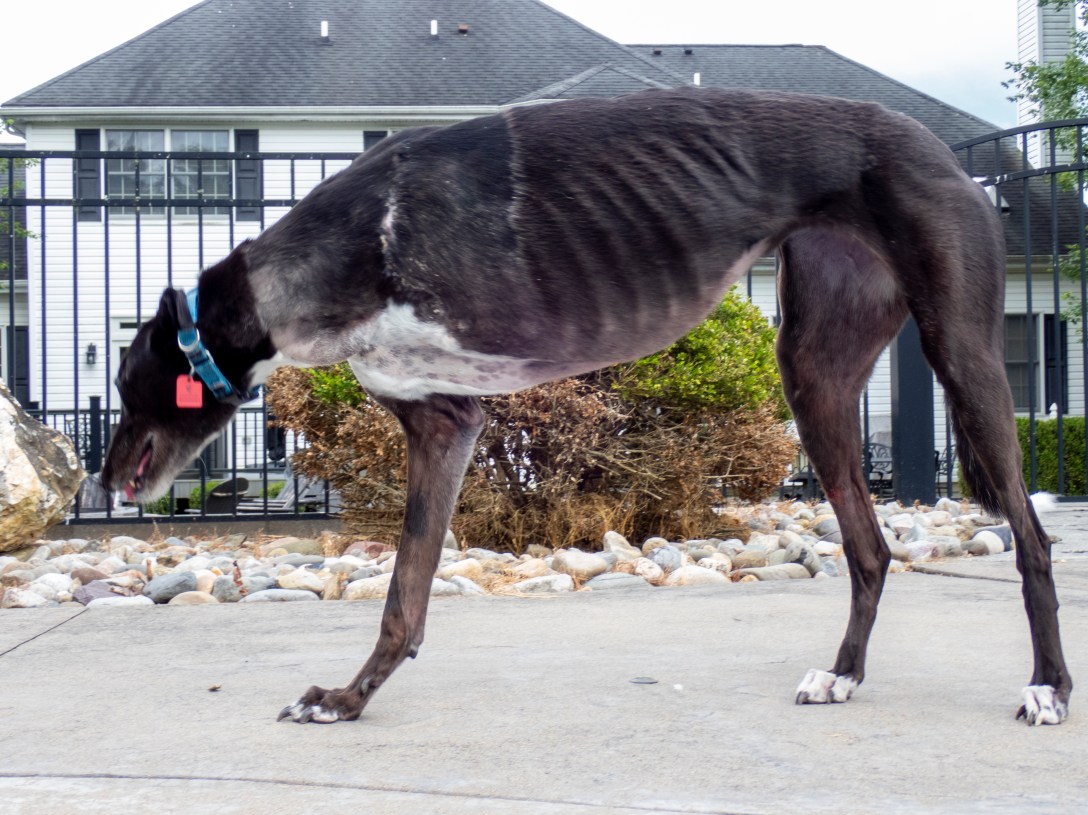
For a distance of over fifty yards on reasonably flat ground, our greyhound and our whippet tore across the lawn at well over forty miles per hour in a full-fledged race, almost neck and neck until the greyhound pulled ahead towards the end, despite having only three legs. That’s the heart of a champion.
We don’t normally let our dogs outside off leash, but neither are runners. They, a six and half year old greyhound, Rosie, and a five year old whippet, Carlitos, might disappear for a few minutes in the neighbor’s yard or in the trees between, but they never go far as we’re pretty sure they like it here and love their family. Both are rescues, with the whippet coming all the way from China. One would think this would be doubly true after our Rosie had her left front leg amputated in April as part of her treatment for aggressive bone cancer. How far can she possibly bounce around on three legs? Last Saturday evening, we learned that it was quite far and quite fast when, much to my wife’s dismay, I let them slip out the back door while we were cleaning up after dinner on the patio believing what could possibly go wrong? Rather than hanging around as they usually do, the pair took off towards the neighbor’s yard on our left, but in northwest New Jersey, essentially farm country, yards in general tend to be large, each plot measuring about three acres in our neighborhood. Once they got around the house itself, we could barely see them in the distance, only their little heads and necks popping out over the gentle upward slope the home rests upon, and it would have been impossible for two slow moving humans to catch up with them, but rather than making a break for it and heading for the hills about a mile away, they came around the house from their front yard into the back, and started racing towards us at full speed. For a distance of over fifty yards on reasonably flat ground, the two tore across the lawn at well over forty miles per hour, almost neck and neck until the greyhound pulled ahead towards the end, despite having only three legs. If you have never seen two different breeds that were born to race hit full stride on a lawn, it’s certainly a sight. Whippets are known for both their speed and their super fast acceleration; their little legs and short bodies move in a blur, almost too fast to believe as they propel themselves forward, as though they were flying a few inches above the ground. Greyhounds, however, have much longer strides and tend to be more graceful, covering close to ten feet per leap, and seeming as if they don’t touch the ground at all for any reason. Both have the appearance of barely moving relative to the ground, as if their bodies were perfectly level and they only shot straight ahead like an arrow in flight. Rosie, however, is down a leg and has been for almost three months. Before the surgery, we understood that she would be able to get around reasonably well, but never dreamed she would run again, nor do I quite understand how she does it, except the rear legs must generate all of the momentum while the front merely functions as a kind of pogo stick; as she runs, you can barely even tell anything is missing, she moves so fast and free. Run and do so much more, that as my mother claims, she’s living her best life again.

At the same time, I’m not going to sugarcoat the surgery and at least the first two weeks of recovery. While our friends and family on social media and in real life have generally applauded our decision to attempt to save her life, I can understand why others don’t follow this path and choose to put the poor animal to sleep instead. First, there are the costs. Even with pet insurance, an amputation for cancer followed by six chemotherapy treatments costs somewhere close to $10,000 and there are no guarantees she will live long. Half don’t make it to six months. Only twenty five percent make it more than two years. To be sure, osteosarcoma tends to affect either young or old dogs, making the numbers potentially deceiving given a canine’s short lifespan and the overall lack of data. Also, before the surgery, we had a three dimensional lung scan to ensure the cancer hadn’t spread and after, prior to chemotherapy, we double checked that there was none in the lymph nodes to give her an optimal chance of success. Regardless, there are no guarantees; we agonized over that, but after having put down another dog six months earlier, we simply couldn’t bring ourselves to do it again. Second, even if you are fortunate enough to have the resources like we are, you also need to have the time. Rosie only spent a single night at the vet before she came home, emerging from the car looking something like the bride of Frankenstein. There was no cast or bandage of any kind. She was shaved from her shoulder to her belly, plus two places on her legs for the IVs. The scar itself was absolutely massive, well over a foot long with the stitches, thick black ones, the skin all red and mottled around it, fully exposed. Still, she was able to get out of the car and slowly hop her way into the house. For the next few days, she existed in a strange state, exhibiting some normal behavior like eating, walking, or rather hopping, and even trying to get on the counter to steal some food, but others that were obviously a result of the recovery from major surgery. At times, she would seem to scream or squeal for no reason, sometimes for an extended period of twenty or even thirty ear-splitting, gut-wrenching seconds, whether this was the pain of the incision, phantom pain from the missing leg, or something else, we couldn’t say, which only made it all the more heartbreaking and awful, especially when it could come at anytime. Sometimes in the middle of the night, and we could do nothing about it, as though we were haunted by some kind of ghost in agony. Perhaps needless to say, she was otherwise uncomfortable, having a hard time getting in and out of her crate, and finding a position to lie in that didn’t aggravate the wound; sometimes she would just stand there and pant, others wriggle around until she laid herself flat enough on her right side, but of course, being a dog, she had no conscious awareness of her condition. She’d get up on the couch with no easy way down, or attempt to curl up like she used to, only to find it didn’t quite work anymore. There was also a battery of medicine to be administered practically on an hourly basis. The result was not being able to leave her alone for more than a few minutes at a time for two full weeks. As my wife and I both work from home, we were able to take care of her, or rather I should say she was able to take most of the care of her, but for many others it would be impossible.

By two weeks, however, Rosie was starting to get back to normal. The area was still sensitive and her energy level was low, but when I returned from India on May 10, she followed me up the stairs for the first time – once again, much to my wife’s chagrin. At the time, I had just gotten off of a flight after over 30 hours of travel and could barely keep my eyes open, desperately in need of some real sleep and bogged down by a little bit of a cold. I asked my stepdaughter to check on her if she had trouble getting down the stairs and was a little worried she might hurt herself, but at some point while I was napping, she bounded down on her own – only to not come back up for several weeks, as if somehow she knew she wasn’t really ready for it and might never be. By the first week of July, Rosie had been sleeping downstairs for almost three months with Carlitos as her constant companion; he used to sleep up with us as well, but had been standing guard like a good brother ever since the surgery, the two almost inseparable. I figured that was just the way it was going to be from now on, but as you might have guessed I figured wrong. For reasons only she can know, Rosie started following us upstairs at night early in July, then resumed her usual routine of running up in advance and plopping herself in the middle of the bed while Carlitos prefers to follow a little later. Nor was this the only routine she picked back up on as if she’d been doing it along and had never stopped for surgery or anything else. Frequently, before she actually lies down to go to sleep for the night, she nuzzles herself up to my side of the bed in a doggie attempt to say good night, getting a last bit of petting in while I drape my arm over the side and rub her neck. She also runs what we like to call her little scam, a remnant of when she had an older sister, Lilly, who would try to take over the bed. Once we were comfortable under the covers and believed all would be quiet for the evening, Rosie would start barking at nothing, except it would cause Lilly to spring into action, at which point she would circle back and jump on the bed herself. She also resumed her routine of taking over the bed, gradually pushing us both to one side, or climbing in between us. Strangely, she rarely remains in the bed all night. She’ll either start there and switch at some point to a comfy chair, something she has rediscovered since she began venturing upstairs again, or her doggie bed, assuming Carlitos isn’t in either, or she’ll start in the chair and then head over the bed. After merely a couple of weeks of her resuming this “normal” routine, it’s as if nothing ever happened in the first place and to her at least, it didn’t. One of the benefits of being a canine is they just are what they are and don’t question it, or as the legendary George Carlin put it, they don’t know and they don’t care. While it took her some time to adjust to life without her left front leg, once her brain rewired, it was as if she never had a leg in the first place. To her, she’s just living her best life as my mom says including bounding down the stairs to greet us every time we walk in the door.

At this point, she has recovered so well and so completely that I sometimes joke that she likes it better with three legs than four. For example, she has figured out that she can get much further onto the counter and into the sink if she approaches from her left side without that pesky leg in the way. My wife and I are now busy scrambling figuring out where to put stuff where she can’t reach. Overall, Rosie seems to have more energy than perhaps ever. She’s not more aggressive in the sense of being snappy or growling, but she is more in your face when she wants something and if she sees something within reach, seems far more likely to go for it and far less likely to listen to me and her mother telling her not to. It’s almost as if she knows that we promised to spoil her after the surgery, and is taking full advantage of the opportunity as a now officially crowned princess of the household rather than merely an honorary one as all dogs are. It also makes us wonder how much pain she might have been even before she started exhibiting a limp in February. As anyone who has owned dogs knows, they tend to hide their pain until it becomes excruciating. Before then, it manifests as a loss of energy or lethargy, and while it wasn’t pronounced in Rosie, maybe, just maybe it was there, and we missed it somehow, or maybe we’re just so excited at her rebound that we’re reading more into it than was warranted. We don’t know and we’ll never know, nor can we say how long her rebound will last, if and when the cancer returns and no further treatment options are available. My stepdaughter is on the autism spectrum and as she says, “Do I need still need to prepare myself to lose Rosie?” Unfortunately, the answer is yes. The odds are she will not make it another two years. She might not make it another three months, however hard that might be to believe at the moment. We don’t know and can’t know until it happens. We can hope, but hope isn’t a strategy as they say. What we can do, however, is enjoy every minute with her as she enjoys every minute with us, marveling at her spirit and resiliency, the true heart of a champion while we have her. It’s not ideal, but in a world where anything and everything can be gone in a minute through no fault of your own, it’s life in general. I don’t think either my wife or I thought getting a greyhound would be a life lesson in and of herself, but that’s how it turned out.

 Confessions of a Conservative Atheist