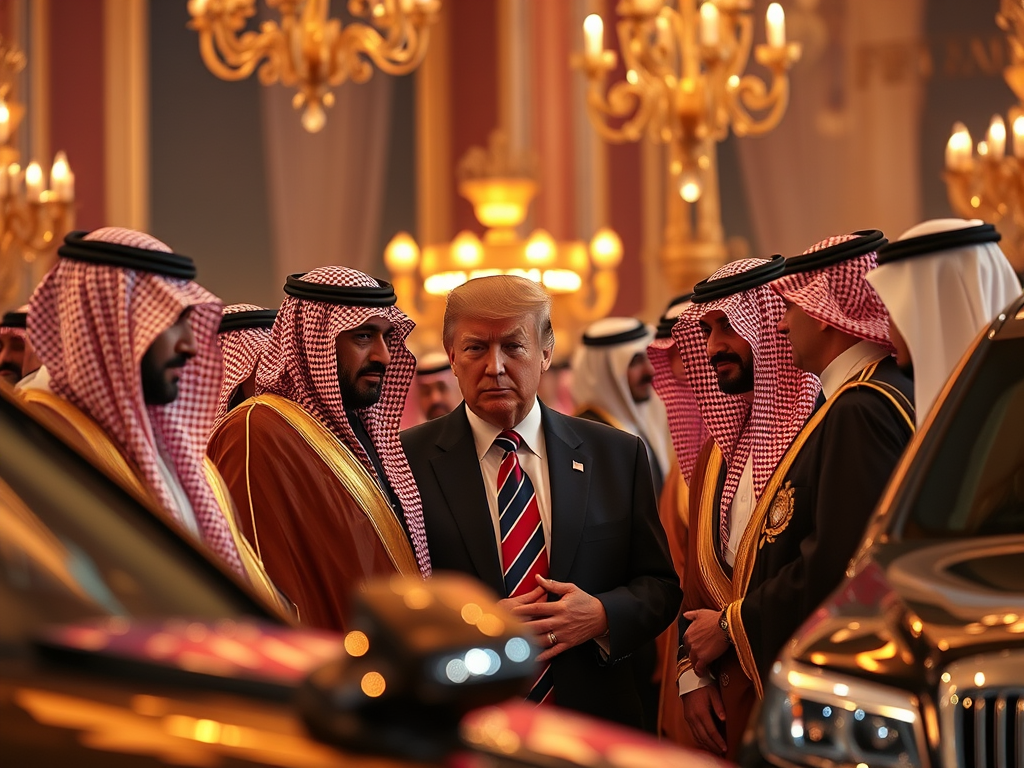
“In recent years, far too many American presidents have been afflicted with the notion that it’s our job to look into the souls of foreign leaders and use US policy to dispense justice for their sins…I believe it is God’s job to sit in judgment; my job, to defend America and to promote the fundamental interest of stability, prosperity, and peace,” President Trump makes one of the boldest foreign policy statements in decades.
“Gosh, I wish I could work for an administration that could move that quickly,” a former Biden official, who asked to remain anonymous, told Axios last week after observing President Donald Trump on a triumphant four day tour of the Middle East. “He does all this, and it’s kind of silence, it’s met with a shrug,” explained Ned Price, a former senior State Department official, also under President Biden who went on the record. “He has the ability to do things politically that previous presidents did not, because he has complete unquestioned authority over the Republican caucus.” “It’s hard not to be simultaneously terrified at the thought of the damage he can cause with such power, and awed by his willingness to brazenly shatter so many harmful taboos,” added Rob Malley, who held senior posts in three Democratic administrations, including handling Iran talks under both President Obama and Biden. “It’s so clearly the right decision,” noted Ben Rhodes, a national security aide to President Obama, remarking on a potential deal to provide sanctions relief in Syria following President Trump unexpectedly meeting with newly minted Syrian leader Ahmed al-Sharaa, a former militant who now positions himself as a reformer in general . “I don’t know why Joe Biden didn’t do this,” Mr. Rhodes continued. “I don’t like Trump’s motivations for lots of things he does, but one thing you will say is he’s not tied to this constant fear of some bad faith right-wing attacks or stupid Blob-type, ‘we don’t do this, we must leverage the sanctions for blah blah blah.’ No! Sometimes you just have to try something different.” While it would be naive and foolish to believe these statements and others mark the beginning of a trend of renewed respect if not affection from some President Trump’s most ardent detractors, even the media was more enthused than usual. As CNBC reported on Friday, “Qatari Cyber Trucks, elite camels and trillion-dollar vows: Why Gulf countries are going all out for Trump’s visit.” “President Donald Trump was greeted with spectacular fanfare in Saudi Arabia, Qatar and the United Arab Emirates during his 4-day visit,” they continued. “The optics of the U.S. leader’s Middle East visit were strong, showcasing the larger-than-life opulence of the region’s richest petrostates — and how much of that wealth they are willing to spend to deepen their ties with the U.S.” In their view, the “bromance vibes were real in Saudi Arabia, where Trump and Mohammed bin Salman heaped praise on each other in remarks made during the U.S.-Saudi Investment Summit. The event, held in the opulent Ritz-Carlton Riyadh, was attended by scores of top American CEOs including the likes of Tesla’s Elon Musk, Nvidia’s Jensen Huang and BlackRock’s Larry Fink, to name a few. In the UAE, meanwhile, Trump and Emirati leader Mohammed bin Zayed lauded their personal friendship and the more than 50-year alliance between their countries. The visit was the first by an American president to the UAE since George W. Bush visited the sheikhdom in 2008. The warm body language and free-flowing mutual compliments signified a stark difference in tone from visits to the country by officials from the Biden administration, which were peppered with tension.” How to explain the sudden shift? “Trump’s trip to the Gulf reflects the increasing personalization of geopolitics,” claimed Taufiq Rahim, principal at 2040 Advisory and author of Trump 2.5: A Primer. “The region’s leaders have responded accordingly, putting on an ornate display for the visiting president. Flattery and compliments become as important to the announcement and substance of deals.”
Substantively, however, the tour was also a success by any reasonable standard with President Trump securing important deals in every country he visited. Saudi Arabia promised to invest some $600 billion in the US; Qatar and the US agreed to a $1.2 trillion economic exchange and the purchase of some $200 billion in passenger aircraft from Boeing in the largest deal in the country’s history; the United Arab Emirates signed several large agreements including for a large AI Data Center, also agreeing to import 500,000 Nvidia H100 chips per year; and even before the trip, Abu Dhabi had already committed to a $1.4 trillion investment over 10 years. As even CNBC admitted, the “numbers are historic,” even if there “remains some doubt as to whether those numbers are realistic, especially during a period of low oil prices and weaker revenue for crude-producing countries.” At the same time, publicly announced promises with such fanfare are undoubtedly achievements in their own right even if the full monetary gain is only partially realized or takes longer to realize than expected. “Sure, a lot of it is theater,” explained Tarik Solomon, board member and former chairman of the American Chamber of Commerce in Saudi Arabia. “But in this region, signaling ambition is half the game. Even if only 50% sticks, it’s still an impactful play.” For its part, CNBC summed up the dealmaking frenzy this way, noting, “the message was clear: the Gulf states want to be first in line when it comes to partnering with the U.S., whether it be for business, military, or tech.” “The Gulf has always gotten along better with business-first presidents, and President Trump fits that mold perfectly,” Mr. Solomon continued. “He still symbolizes fast money, big defense, and access to American tech. So, if cozying up to him helps secure a seat at the table of the next world order, the Gulf is bringing the gold-plated chair.” While some have suggested the President benefited from friendly, or perhaps not so friendly competition between countries, “many,” CNBC’s description, believe we are witnessing a “long-term, strategic alignment,” one which began under President Trump’s first term. “I do not view the big economic announcements as a competition among the three countries; rather, they reflect a competition with other regions — Europe for example — for a closer relation with the U.S. administration,” explained Ahmed Rashad, an Abu Dhabi-based assistant professor of economics at the Economic Research Forum. “The economic deals appear vital to increase the attractiveness of the Middle East visit. On the other hand, the primary motive of the GCC [Gulf Cooperation Council] countries appears to be strengthening relations with the U.S. and securing access to advanced technologies,” he added.
President Trump seemed to agree in both principle and practice, explaining how he plans to reorient the American role in world affairs during a speech in Saudi Arabia, precisely along these lines. “Exactly eight years ago this month I stood in this very room and looked forward to a future in which the nations of this region would drive the forces of terrorism and extremism, drive them right out of existence, and take your place among the proudest, most prosperous, most successful nations anywhere in the world as leaders of a modern and rising Middle East.” After describing his vision during his first term, he remarked on the progress he has witnessed “over the past eight years, Saudi Arabia has proved the critics totally wrong. The transformation that has occurred — even by these incredible business leaders, I mean you have the biggest leaders in business anywhere in the world standing right before us — but the transformation that has occurred under the leadership of King Salman and Crown Prince Mohammed has been truly extraordinary. Such a thing has I don’t think ever happened before. I’ve never seen anything at that scale happen before. And I guess maybe you could say the United States is doing pretty well too, but I don’t think too many people have seen that happen before. Majestic skyscrapers, the towers that I see, the difference between now and eight years ago. And eight years ago, it was very impressive. But the towers that I see rising, some of the exhibits that I was shown by Mohammed, what I’ve seen there is just an amazing, amazing process, amazing genius of so many people, architecture. But I have a feeling I know where many of those ideas came from, happens to be sitting right in this room, right before me.” Nor was this progress limited to Saudi Arabia in his view, “In other cities throughout the peninsula, places like Dubai and Abu Dhabi, Doha, Muscat, the transformations have been unbelievably remarkable. Before our eyes a new generation of leaders is transcending the ancient conflicts of tired divisions of the past and forging a future where the Middle East is defined by commerce, not chaos; where it exports technology, not terrorism; and where people of different nations, religions, and creeds are building cities together, not bombing each other out of existence.” Rather than believing this progress has occurred because of American attempts to export democracy and dollars abroad as has been the foreign policy consensus since 9-11, President Trump credited the exact opposite, claiming “it’s crucial for the wider world to note this great transformation has not come from Western interventionalists or flying people in beautiful planes giving you lectures on how to live and how to govern your own affairs. No, the gleaming marvels of Riyadh and Abu Dhabi were not created by the so-called nation-builders, neocons or liberal nonprofits like those who spent trillions and trillions of dollars failing to develop Kabul, Baghdad, so many other cities. Instead, the birth of a modern Middle East has been brought by the people of the region themselves, the people that are right here, the people that have lived here all their lives — developing your own sovereign countries, pursuing your own unique visions, and charting your own destinies in your own way. It’s really incredible what you’ve done. In the end the so-called nation-builders wrecked far more nations than they built, and the interventionalists were intervening in complex societies that they did not even understand themselves. They told you how to do it, but they had no idea how to do it themselves.”
As he saw it, “Peace, prosperity and progress ultimately came not from a radical rejection of your heritage, but rather from embracing your national traditions and embracing that same heritage that you love so dearly, and it’s something only you could do. You achieved a modern miracle the Arabian way. That’s a good way. Today, the Gulf Nations have shown this entire region a path towards safe and orderly societies with improving quality of life, flourishing economic growth, expanding personal freedoms, and increasing responsibilities on the world stage. After so many decades of conflict, finally it is within our grasp to reach the future that generations before us could only dream about — a land of peace, safety, harmony, opportunity, innovation and achievement, right here in the Middle East.” Iran, meanwhile, has taken a starkly different path with rather unfortunate results according to President Trump. “While you have been constructing the world’s tallest skyscrapers in Jeddah and Dubai, Tehran’s 1979 landmarks are collapsing into rubble and dust. They had it going for a little while under a much different system, but those buildings are largely falling apart, falling down, while you’re building some of the world’s biggest and most incredible infrastructure projects, buildings, all sorts of things you’re building that nobody’s ever even seen before. Iran’s decades of neglect and mismanagement have left the country plagued by rolling blackouts, lasting for hours a day. All the time, you hear about it. While your skill has turned dry deserts into fertile farmland, Iran’s leaders have managed to turn green farmland into dry deserts, as their corrupt water mafia, let’s call it the water mafia, causes droughts and empty riverbeds. They get rich, but they don’t let the people have any of it. And then of course there’s the key difference at the root of it all: While the Arab states are focused on becoming pillars of regional stability and world commerce, Iran’s leaders have focused on stealing their people’s wealth to fund terror and bloodshed abroad. The most tragic of all, they have dragged down an entire region with them.”
Ultimately, the President concluded with one of the boldest foreign policy statements in recent decades, whatever it may lack in soaring rhetoric, it possesses in practical application. “As President of the United States, my preference will always be for peace and partnership, whenever those outcomes can be achieved. Always, it’s always going to be that way. Only a fool would think otherwise. In recent years, far too many American presidents have been afflicted with the notion that it’s our job to look into the souls of foreign leaders and use US policy to dispense justice for their sins…I believe it is God’s job to sit in judgment; my job, to defend America and to promote the fundamental interest of stability, prosperity, and peace. That’s what I really want to do.” Of course, whether or not he can achieve all of these goals remains to be seen, but as ever the practical audacity of his vision and his unique ability to break with the past offer at least some hope the trend can continue. Whether you agree with him or not, whether you trust him to implement this vision or not, there is no doubt that the policies of the past have failed. Democracy cannot be rained down from above, either in bullets or cash. Reform can only come from within, and hopefully we can capitalize on that as President Trump already appears to be doing.

 Confessions of a Conservative Atheist
Thanks for that. Great summary! I wish more people would read it.
Regarding Syria- Trump’s “deal” was: if Syria would accept one million Palestinians. Brilliant! Yet not talked about. Because of your pal Springsteen and folks like him.
I’m still waiting for your take on The Boss and his TDS.🍻
LikeLiked by 1 person
Hahaha! Great to hear from you – regarding Bruce, I am working on an article right now, to be posted tomorrow. Thanks for your kind words in the meantime.
LikeLike