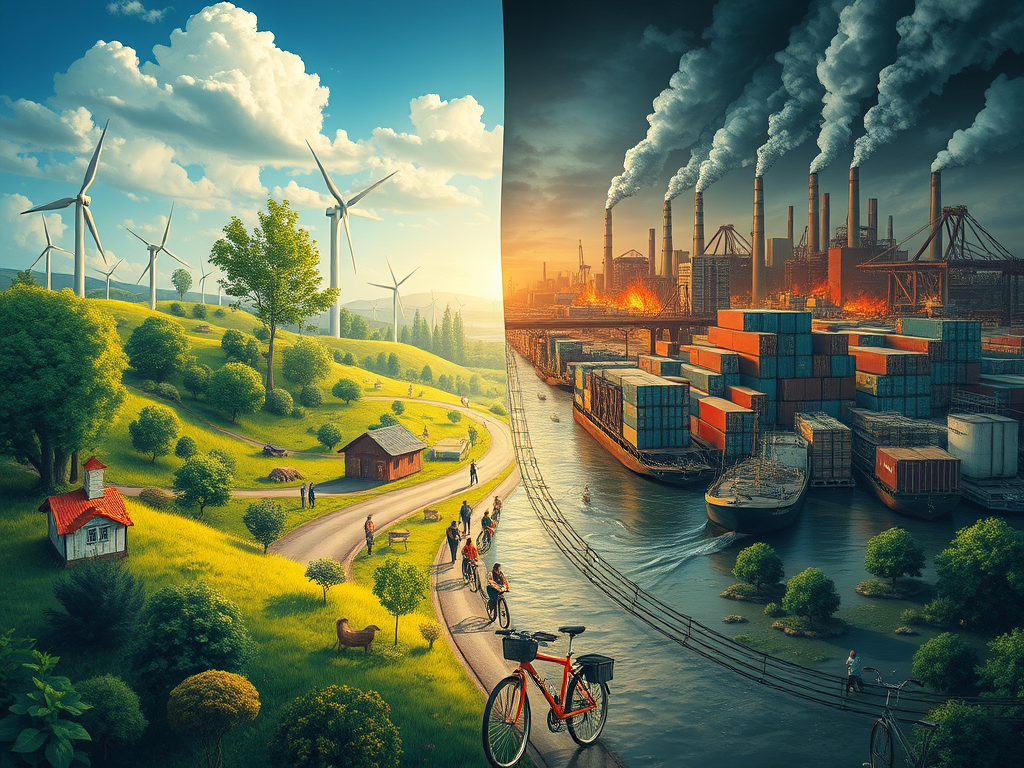
To combat climate change, there was almost no part of your life Democrats and their progressives allies didn’t want to disrupt, from the car you drive to the house you live in to the food you eat, but somehow, this was all good and great, the height of enlightened thinking and if you weren’t completely onboard, bad marketing is to blame.
As President Donald Trump continues revising and implementing a (partially) tariff driven strategy to increase domestic manufacturing, Democrats and their progressive allies have increasingly described the effort as unnecessarily disruptive. For example, The New York Times recently claimed it was nothing more than “An Experiment in Recklessness: Trump as Global Disrupter,” citing the “global trading system” as only one example of “the administration tearing something apart.” NBC News similarly insisted that “Trump’s sweeping global tariffs snap into effect, ushering in a new era of disruption.” As Robe Wile described it, “President Donald Trump’s unprecedented tariffs on global imports into the United States took effect Wednesday, reshuffling a global economic order that has largely stood for generations and prompting new retaliations from China and Europe. Now, consumers and investors alike will begin to gauge the actual impact on the U.S. economy as the cost of the import taxes starts to flow through supply chains and into businesses and household budgets.” “Tariffs are nothing new,” he continued, “and many business leaders have long argued that the United States must do more to prevent some low-cost goods, especially from China, from flooding its markets. But Trump shocked the world with his attempt to bring to the United States the production of a vast array of goods that are, in most cases, produced more affordably overseas.” “It’s too much too fast,” they quoted Craig Fuller, founder and CEO of the logistics consultancy, FreightWaves. “It’s not realistic,” he added. The Economic Times, meanwhile, claimed the tariffs are much worse than mere disruption. They are, instead, “chaos” incarnate. Clive Crook opined, somewhat sarcastically, “Apparently it might take a recession to detoxify the economy. If so, this will be a beautiful recession, the prelude to a new golden age for American workers — apart from those who lose their jobs, see their savings destroyed or otherwise must grapple with much lower living standards. A few setbacks are only to be expected as the Trump administration builds a backward-looking, tariff-protected, uncompetitive, labor-intensive manufacturing economy to make America great again.” He too continued, “Disruption is often the price one must pay for economic success. But what’s dawning on investors as Trump’s approach to trade and foreign relations unfolds is that he’s inverting this logic. For political purposes, and to serve his boundless vanity, he sees disruption as a goal in its own right…If Trump keeps this up, the economy will indeed tank.”
While the outcome of President Trump’s tariff policy remains unknown, save that at least as of today, it has not resulted in the continued stock market meltdown anticipated just last week, it’s worth considering that tariff-related disruptions appear to be the only kind Democrats and their progressive allies don’t like (this being on top of tariffs in general being the only tax the establishment doesn’t like). Contrary to the recent hyperventilating, massive disruption has been on the Democrat agenda for decades now, complete with calls for significant changes to almost every aspect of American life up to and including eating bugs to save the planet. Indeed, the entire agenda to “fight” climate change is perhaps best seen as a series of radical disruptions from the homes we live in to the cars we drive with the freedoms we enjoy in between. As the world was still recovering from the disruption let loose by the coronavirus pandemic, disruption Democrats generally cheered on despite being among the most authoritarian in modern Western history, progressives weren’t calling for a return to normalcy. Instead, they were demanding even more disruption, believing the restrictions on travel, gatherings, and other measures could be repurposed for their purposes, insisting that business as usual wasn’t good enough. “Capitalism is facing three major crises,” explained Mariana Mazzucato writing for The New Republic in March 2021, “A pandemic-induced health crisis has rapidly ignited an economic crisis with yet unknown consequences for financial stability, and all of this is playing out against the backdrop of a climate crisis that cannot be addressed under the rubric of business as usual.” She continued to demand radical change, “This triple crisis has revealed just how unprepared we continue to be—and how our model for sustainable capitalism must change. Critically, the health crisis, the climate crisis, and the economic crisis must be viewed together. Otherwise, we will simply be solving problems in one place while creating others elsewhere.” At the time, Ms. Mazzucato equated “the signal failures of the social response to the Covid emergency as a kind of dry-run illustration of the weakened institutional and social commitments that we are seeking to deploy to roll back climate change at the eleventh hour.” To address this, she envisioned a “broad ethos of shared sacrifice” and a “dramatic shift in familiar routines of work and leisure” that would ultimately “repair the deep-seated flaws in our economic structures.”
Democrat politicians might not have gone quite that far, but they certainly got close enough to make it clear disruption was an acceptable means to an end – and they began doing so long before the pandemic. As early as 2007, The New York Times’ Thomas Friedman has been advocating for a Green New Deal as a “huge industrial project” to replace fossil fuels, writing “If you have put a windmill in your yard or some solar panels on your roof, bless your heart. But we will only green the world when we change the very nature of the electricity grid – moving it away from dirty coal or oil to clean coal and renewables. And that is a huge industrial project – much bigger than anyone has told you. Finally, like the New Deal, if we undertake the green version, it has the potential to create a whole new clean power industry to spur our economy into the 21st century.” By 2019, progressive firebrand Alexandria Ocasio-Cortez and her Democrat colleague Ed Markey introduced legislation to recognize “the duty of the Federal Government to create a Green New Deal.” Their plans, estimated to cost trillions of dollars, if not a hundred trillion, included eliminating greenhouse gas emissions and other pollution from transportation and agriculture, replacing all current power grids, upgrading all existing buildings or building new ones to make them more water and energy efficient, and providing free access to college, healthcare, and affordable housing. While the vagary of the language makes it difficult to determine precisely the means to achieve these ends, we can glean some sense of what this might look like from other ideas percolating throughout the progressive chattering classes at the time, some of which were ultimately been implemented at the federal under President Joe Biden or the state level under various Democrat governors. This included something close to the outright ban of gas-powered cars by increasing mileage standards beyond what is technically possible as soon as 2032 and providing massive subsidies for electric vehicles. “With transportation as the largest source of U.S. climate emissions, these strongest-ever pollution standards for cars solidify America’s leadership in building a clean transportation future and creating good-paying American jobs, all while advancing President Biden’s historic climate agenda,” explained EPA director Michael Regan as recently as last March. While politicians in the United States didn’t address other modes of transportation, their counterparts in Europe pushed what would effectively be a ban on air travel for the average person. Between the two, it is hard to overstate the disruptions to our mobility, from being limited in range, to the government actually controlling when we can charge our cars, to not being able to travel freely on a plane or perhaps even a train, and this was before they moved on to banning natural gas stoves, heating, and other popular appliances.
Meanwhile, others took the lead on efforts to reduce greenhouse emissions in agriculture. This generally took a two pronged approach, primarily targeted at the meat industry. First, Bill Gates and others began promoting meat substitutes, as in fake meats, declaring that “I do think all rich countries should move to 100% synthetic beef.” “You can get used to the taste difference, and the claim is they’re going to make it taste even better over time,” he continued. If people objected, “Eventually, that green premium is modest enough that you can sort of change the [behavior of] people or use regulation to totally shift the demand,” he threatened. In an interview to showcase the benefits of fake meat, Mr. Gates was asked about the connection between measures taken during the pandemic and those to combat climate change. “The COVID-19 pandemic not only highlighted the costs of ignoring science, but also proved that rapid, large-scale behavioral change is possible, and showed that leaders who take responsibility for addressing problems can gain respect,” Project Syndicate’s Connie Hedegaard prompted him while discussing “innovation in policy.” Mr. Gates agreed that, “we all have to do our parts by wearing masks and distancing, individuals also need to play a role in reducing emissions,” then called for government action that was “targeted, robust, and predictable.” How robust? They don’t say for sure, but Mr. Gates managed to note, “One lesson is the flip side of the idea that flying or driving less isn’t enough,” a point to which Ms. Hedegaard readily agreed, claiming that pandemic restrictions “also carried another crucial lesson: the relatively small (10%) reduction in greenhouse-gas emissions that global lockdowns produced showed that behavioral changes like flying or driving less are nowhere near enough.” Nor was Mr. Gates only concerned about people’s diet. In his book, claimed that “Beyond finding ways to make materials with zero emissions, we can simply use less stuff,” a rule which presumably wouldn’t apply to him given he owns more houses than most people own shoes.
Simultaneously, even supposedly mainstream publications like Time Magazine were promoting the idea that we should begin eating insects to save the planet. As they put it, eating insects will unleash a trifecta of never-before-seen benefits, “There is a sustainable alternative to going meat-free, the FAO [The United Nation’s Food and Agriculture Organization] says: edible insects. Grasshoppers, crickets and mealworms are rich in protein, and contain significantly higher sources of minerals such as iron, zinc, copper, and magnesium than beef. Yet pound for pound they require less land, water and feed than traditional livestock. Insect farming and processing produces significantly lower greenhouse gas emissions. Not only do insects produce less waste, their excrement, called frass, is an excellent fertilizer and soil amender.” “Insects are 60% dry weight protein. I mean, honestly, why wouldn’t we use them?” wondered Agnes Kalibata, the UN Secretary-General António Guterres’ special envoy for the 2021 Food Systems Summit, “But we have to be able to put them in a form that is acceptable to different cultures and different societies.” In Time’s view, marketing and marketing alone was the chief hurdle to worldwide insect eating. “In order to compete, manufacturers will have to figure out how to successfully market bugs to consumers. The sustainability halo and health aspects may be enough for some, but are unlikely to work on a wider scale, says Cortni Borgerson, an anthropology professor at Montclair State University in New Jersey.” Perhaps needless to say, they recruited those who claimed with a straight face that the insect-eating trend had already begun, “a cultural shift is already in the works, particularly among the young and adventurous urbanites who will be setting food trends for generations to come.” “It’s not going to happen overnight, and it’s never going to 100% replace meat, but those of us who are health conscious and environmentally aware have already started making that transition,” explained Jenna Jadin, a biologist who wrote Cicada-licious, “a cookbook featuring cicada dumplings and other treats, just in time for the 2004 hatching of Washington D.C.’s 17-year cicada cycle (the next hatching is this summer. Get your skillets ready).” If there was any doubt we could change to suit their disruptive demands, Time was certain to assure us, “Food culture does change. Five hundred years ago, Italians thought tomatoes were poisonous. In the 1800s, Americans considered lobsters to be trash food and fed them to prisoners. Few cultures ate raw fish 50 years ago; now sushi is ubiquitous. Insects are likely to follow the same trajectory, says Fisher, who suggests salt-roasted crickets served with beer as the ideal ‘gateway bug.’ The sustainability factor, the health aspects, those are the angles that will make people want to try edible insects, he says. The rest is easy.” “If it’s done right, they will keep coming back for more, because it tastes really good,” he added.
While other aspects of the Green New Deal might be less dramatic, they were no less absurd, radical, or insidious. Replacing power grids would have required an update to every electric line across the continental United States and beyond, presumably under an entirely new as yet unseen regulatory regime which would undoubtedly have offered the government greater power of how we use electricity, perhaps down to controlling our thermostats. Either refurbishing or rebuilding for energy efficiency, would have required massive new regulations for every house, apartment complex, commercial building, warehouse, factory, or other structure in the United States, and because they wanted these initiatives to apply retroactively, almost every current building would have to be reviewed by the government and updated accordingly, or destroyed entirely if it could not be made to conform. While free access to college, healthcare, and affordable housing, might sound less disruptive in principle, accomplishing all three would require a complete upheaval of our relationship with the government and private businesses. Conceivably, college could be achieved with a subsidy, though given the government’s track record with student loans we have reason to be skeptical, but free healthcare proponents have repeatedly claimed for the abolishment of private insurance and government take over of healthcare under the banner “Medicare for All.” Affordable housing might be more murky, but given the ban on evictions long after the pandemic was over and the mess that existing policies have made in both the rental and purchase market almost wherever they have been applied, it seems clear to me at least that they had something radical in mind, even as they refused to come out and say it. Whatever the case, the track record is clear: There was almost no part of your life Democrats and their progressives allies didn’t want to disrupt down to your diet, but somehow, this was all good and great, the height of enlightened thinking and if you weren’t completely onboard, bad marketing is to blame. While we cannot directly equate their proposed disruptions, some of which have been enacted to our detriment, see electric cars and car prices in general, we can conclude two things. First, it’s very difficult to take anyone currently carping about potential price increases on certain products seriously when they called for disruption on a scale much greater than any we are facing now complete with even more massive price increases. Second, while we might doubt whether President Trump’s tariff policy will be effective, we should not doubt the long-standing goal, shared by both parties, of revitalizing our manufacturing sector. Experiencing a little short term disruption as President Trump himself has admitted to achieve that objective should, at least in principle, be considered a possibly worthy the trade off, worth some discussion if nothing else, but for some reason, Democrats and their progressive allies refuse to endorse practically anything that would be good for America, especially if they perceive it as coming a the expense of the rest of the world.

 Confessions of a Conservative Atheist