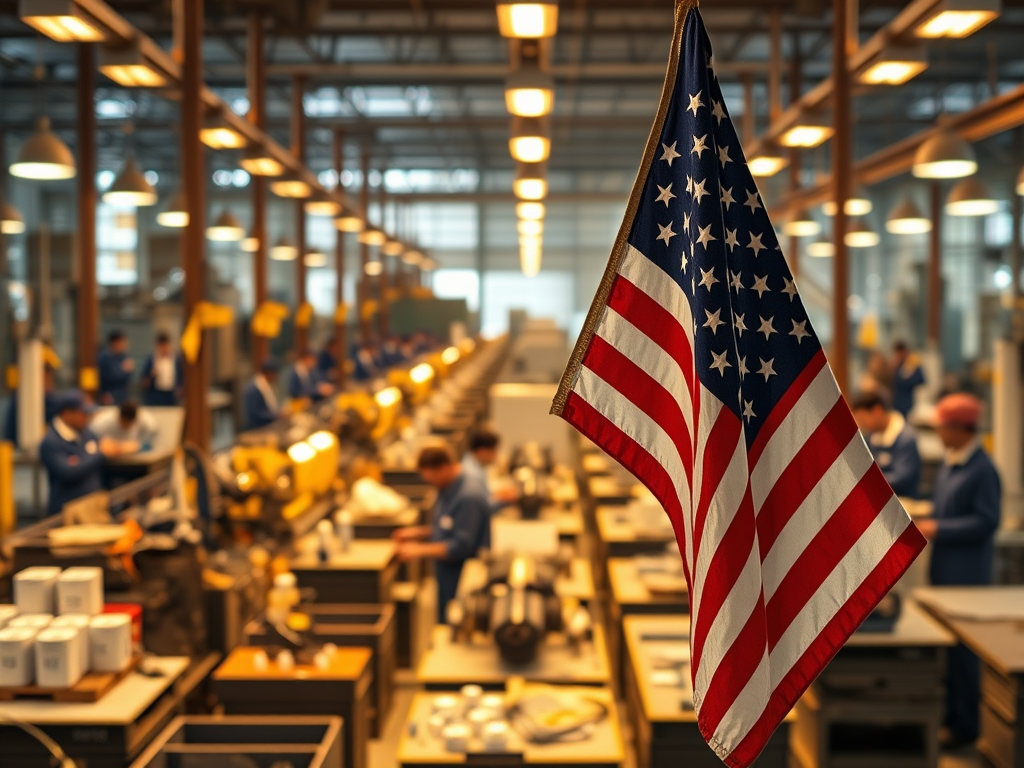
Those who are convinced we cannot make things in America anymore have conveniently forgotten the recent history of the pandemic, where we invented a new vaccine, produced hundreds of millions of doses along with hundreds of thousands of ventilators and millions of other medical devices in a few months.
There are plenty of reasons to be concerned about President Donald Trump’s tariff policy. Even if, like me, you generally support the notion that globalism has hollowed out of American manufacturing, transitioning millions of jobs overseas, and consigning those without a college degree to subsistent existences, living paycheck to paycheck, and that tariffs are a potential tool to reverse this slide, the Administration is pursuing one of the most radical changes from the prevailing orthodoxy in generations. While a part of me believes the President is correct and the tariffs will ultimately change this trajectory, either by bringing jobs back to the United States or by making it easier for American products to compete in foreign markets, the law of unintended consequences is inescapable. In the short and perhaps even medium turn, there will be price increases on some or even most products, and some of these increases might be both unexpected and dramatic. Even for American made products, the global supply chain is more of a tangled ball of yarn than it’s named for, and the same as the old adage about no one knowing how to make a pencil, no one has any clue how new tariffs on raw materials will impact downstream prices. I say this even believing that the experts are exaggerating the scale of the impact, given the total value of the tariffs is somewhere around 1.4% of the total size of the economy, but all the same, we can likely expect some oddly shocking results, even outside the auto industry where imported cars might well rise in price close to 25%. I am also willing to forgive the politicking, necessarily hyperbolic in the Trump Era, that accompanies any major policy change, wherein those who have argued for similar things in the past are suddenly against them in their entirety.
For more than a decade, Democrats and progressives have argued that taxes were too low and at times large increases were required to address the deficit, debt, and other issues. For example, President Barack Obama’s vaunted Commission on Fiscal Responsibility recommended an almost $1 trillion increase as recently as 2010, including the elimination of deductions and a tax on gasoline that would impact low and middle income Americans far more so than tariffs. In the intervening fifteen years, Democrats have broadly embraced increased taxes to solve the supposed climate crisis, including brand new schemes for carbon trading and other initiatives. Simultaneously, Democrats and their progressive allies have advocated for major disruptions in American life, from banning gasoline cars to natural gas stoves, to cope with the same supposed crisis. Putting this another way, significantly higher taxes accompanied by massive disruption were considered the bare necessities to deal with their imagined crises, and yet suddenly neither are acceptable under any circumstances, for any reason. Similarly yet even more broadly, there has been no one on either the right or the left who hasn’t argued at times that the loss of US manufacturing jobs has been anything short of a disaster for the middle class. For decades, presidents of both parties have been putting forth plans and claiming credit for reversing that trend. In 2012, President Barack Obama himself created a “Blueprint for an America Built to Last” that aimed to “Support US Manufacturing Jobs, Discourage Outsourcing, and Encourage Insourcing.” The press release read, “In his State of the Union address, President Obama laid out a Blueprint for an America Built to Last, encouraging companies to create manufacturing jobs in the United States while removing deductions for shipping jobs overseas and encouraging insourcing. During the past two years, we have begun to see positive signs in American manufacturing – with the manufacturing sector adding more than 300,000 jobs since December 2009, with companies engaging in the emerging trend of ‘insourcing’ by bringing jobs back and making additional investments in the United States. Manufacturing jobs are growing for the first time since the late 1990s.” Just as suddenly, however, the US economy is now perfect, the greatest in the world, delivering prosperity for everyone, and President Trump’s tariffs are a solution in search of a problem. Regardless, we still might forgive these sudden changes in position purely as a result of politics, where hypocrisy is rampant and neither party is above arguing the opposite if they feel it’s advantageous, but lurking beneath the surface of many of these arguments is something we simply cannot forgive and should reject outright: The lack of imagination and vision to conceive of a future where American regains her manufacturing strength, reclaiming the industry and innovation we were primarily responsible for bringing into the world in the first place.
To many, it seems impossible to believe this challenge, agreed to by both parties for decades, can be solved by any means, tariffs or otherwise, as though we were living in Bruce Springsteen’s “My Hometown,” when the foreman says these jobs are going boys and they ain’t coming back. Since President Trump’s “Liberation Day” announcement last week there have been a flurry of examples, from the specific to the general, detailing how we cannot possibly succeed. On the specific side, there are those claiming that a major company like Nike simply can’t manufacture shoes in the United States at a competitive price point. In fact, they have already tried and failed to do so. On the general side, there are complaints that the majority of our clothing comes from China, and we cannot possibly produce it here at a similar cost. Even setting aside how both positions ignore the fact that there are already American shoe and clothing companies producing products in the country as we speak, what could possibly convince someone that American ingenuity cannot solve the sweatshop labor problem underlying these sensibilities by producing quality goods here at home at competitive prices? While it is generally true that American products are currently more expensive than some of their foreign counterparts, much of this appears to me to be a problem of scale. US shoemakers and clothing manufacturers tend to be family owned companies producing niche products, but why does it have to be that way? As everyone knows, prices tend to decline as production increases, and we should expect that expanding the already existing manufacturing capacity will have the same result here, making them competitive with cheaper imports. Equally obvious should be the reality that the cost of labor isn’t the only deciding factor in the final price of a product. American labor will be more expensive than Chinese for the foreseeable future, but the difference should not be insurmountable once you consider productivity, meaning labor can be more expensive and yet produce an equivalent output, quality, reliability, access to shipping, access to skilled employees, access to supporting infrastructure, automation, and more. Of course, manufacturing in China and other countries comes with costs of its own. The company is taxed in the foreign country as well as the US. The company is charged for the use of ports, the shipping necessary across oceans, and in many cases, distribution networks which add their own fees throughout these steps. How can anyone look at this and not see any opportunity for imagination and innovation?
This should be doubly true when you consider two things. First, those who are convinced we cannot make things in America anymore have conveniently forgotten the recent history of the pandemic. Not only did we research and develop a never-before-seen vaccine in less than nine months, we created the manufacturing infrastructure to develop and distribute billions of doses within a year, over 500 million in the United States alone for a product that didn’t exist and nothing like it had ever been produced at scale. By any rational standard, this would be considered an Earth-shattering achievement on its own, indicative of what Americans can do when we put our minds to it, but the vaccine was only one part of the coronavirus story. Before the vaccine, there was an effort to produce ventilators on an unprecedented scale, involving eleven different manufacturers who produced some 200,000 extremely complex pieces of medical equipment in a matter of months. Simultaneously, we crafted the most advanced and robust medical testing apparatus in the history of the known universe, producing and reporting on millions of individual tests every single day. These were accompanied by a concerted effort to produce personal protective equipment. In just a few months, 3M was manufacturing twice the amount of N95 respirators as they had previously, some 35 million per month in the US, which was further increased by tens of millions more by the end of the year. Utica New York’s Environmental Composites produced industrial textiles for filtration and insulation across industries prior to the pandemic, but quickly developed an alternative N95 manufacturing method and began producing six million per month. Shatkin F.I.R.S.T, also based in New York, managed to manufacture 20,000 masks in a couple of months with just 30 workers. Ford started producing surgical gowns in addition to ventilators, cranking out 200,000 per week in partnership with 3M. Sterlingwear of Boston, a small family owned company, switched from making pea coats for the Navy to producing 150,000 surgical gowns in August 2020 alone. National Safety Apparel transitioned from making protective gear for welding and factoring work to surgical gowns, producing 2,000 per day, also by August. Unique Fabricating in Michigan repurposed their heat sealing and sonic welding capabilities to make face shields and respirators, churning out 30,000 shields daily by March. Akervall Technologies, also in Michigan, was likewise producing up to 16,000 shields per day, as was Starline, USA, which produced one million units, ZVERSE, 115,000 per day, and Battery Watering Technologies, 6,000.
There are many other, similarly inspiring stories of capacity going from essentially zero to millions upon millions of units in a matter of months. At least part of this is due to the second point: There are vast amounts of unrealized manufacturing infrastructure already in the United States. The companies above and others didn’t build new plants in their entirety. They took advantage of either unused capacity or they repurposed existing capacity. This is entirely different from having to build new plants from scratch, and can be done in a matter of months as it was during the pandemic rather than years. For those who might believe in President Trump’s vision, but are concerned it will take years to increase US production, there’s no reason to believe that unless you succumb to the lack of faith in the American experiment. Instead, existing manufacturers can easily tap into this latent capacity, either expanding existing production or creating all new products in an incredibly short period, or at least they should be able to – if they have the will, the vision, and the imagination to see it. Sadly, many obviously do not, and even more sadly, that continues to be one of our biggest challenges and the biggest possible threat to our future regardless of your opinion on a specific policy.

 Confessions of a Conservative Atheist