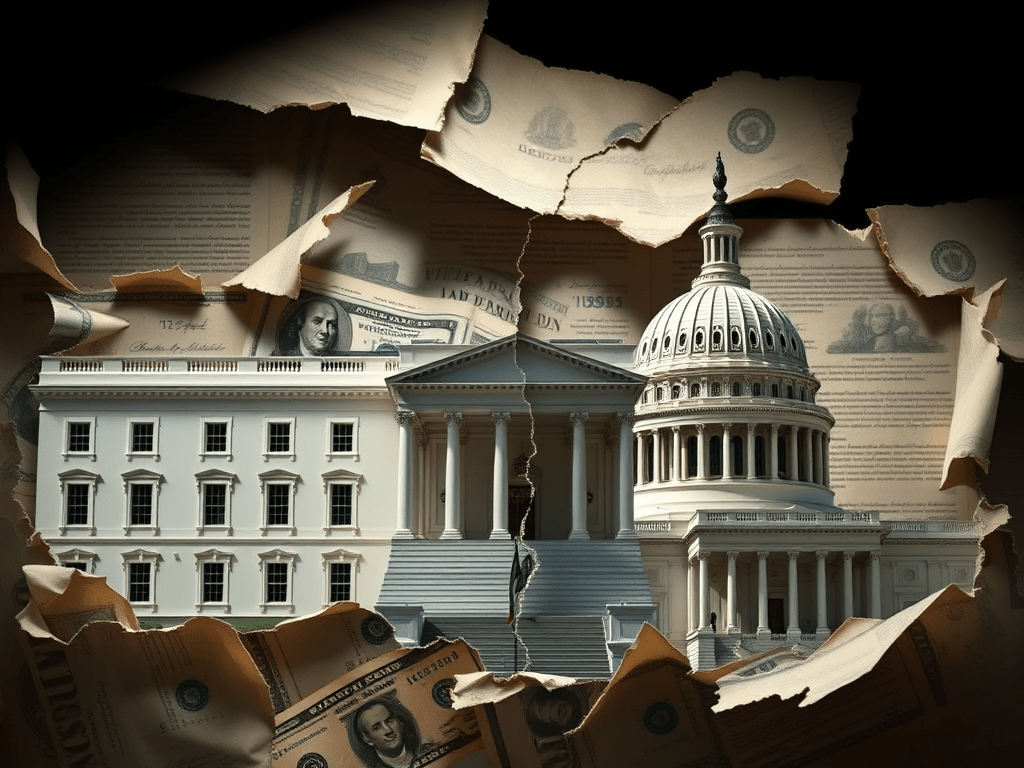
We have two alternatives. The first is to assume the President has some power and discretion when it comes to disbursing government funds. The second is to adopt the new theory that the President must spend every dollar or be in violation of the law and the Constitution itself.
As of January 20, 2025, coincidentally the date of President Donald Trump’s second inauguration, Democrats and their progressive allies have adopted a new theory of Congressional appropriations holding that every dollar Congress allocates to the federal government must be spent or the Chief Executive is breaking the law, if not shredding the Constitution or mounting a coup against his entire government. Seriously, here’s how The Guardian’s Peter Stone recently described it, “‘This is a coup’: Trump and Musk’s purge is cutting more than costs, say experts.” “Donald Trump and Elon Musk’s radical drive to slash billions of dollars in annual federal spending with huge job and regulatory cuts is spurring charges that they have made illegal moves while undercutting congressional and judicial powers, say legal experts, Democrats and state attorneys general,” they claimed while citing Arizona Attorney General, Kris Mayes. “The president is openly violating the US constitution by taking power from Congress and handing it to an unelected billionaire – while Elon Musk goes after judges who uphold the law and rule against them,” he explained. The underlying theory as to how this could possibly be illegal can best be seen as a novel extension of what is colloquially known as Congress’ “power of the purse.” According to the Constitution itself, all spending bills must originate in the House of Representatives, as detailed in Article I, Section 7, where it states “All Bills for raising Revenue shall originate in the House of Representatives; but the Senate may propose or concur with Amendments as on other Bills.” These powers are further clarified in the following section, which begins to detail the role of the executive branch under the President. Congress has the power to “To make all Laws which shall be necessary and proper for carrying into Execution the foregoing Powers, and all other Powers vested by this Constitution in the Government of the United States, or in any Department or Officer thereof.” In Article II, the President’s power and role in the government is defined in a single sentence, “The executive Power shall be vested in a President of the United States of America.”
Generally speaking this has been taken to mean that Congress controls the budget, detailing what departments, services, and other initiatives are to be funded in a given fiscal year, along with the amount of money appropriated for each, while the President executes the delivery, organizing and leading the various departments and initiatives, and doling out the funding as defined by Congress. Crucially, the plain text of the Constitution doesn’t detail what discretion the President has in dispensing the allocated funds, whether or not all funds allocated need to be spent, or what might happen to any funds that remain unspent. Like much of our constitutional order in general, the details were left intentionally vague to be determined by the necessary push and pull between two co-equal branches of government, three if you count the judiciary, and even in the earliest days the limits of each were tested. In 1791, Congress established the First Bank of the United States and although the idea of a Federal Reserve is well established today, even if perhaps it shouldn’t be, the decision to give power to a national bank was almost immediately controversial, dividing much of the country as to both the wisdom and the Constitutionality. Regardless, Congress managed to extend the bank’s charter for a second time in 1816, which should have kept it in operation until at least another two decades, but then President Andrew Jackson came into power. While he was unable to convince Congress to repeal the law, he vetoed a second recharter that would have extended the bank even further into the future, claiming it was “unauthorized by the Constitution, subversive to the rights of States, and dangerous to the liberties of the people,” and after winning re-election a landslide, used his executive authority to cease making deposits in the national bank entirely. This had the effect of unilaterally defunding it by transferring the money to the states, effectively killing the bank even though it continued to be authorized by law. Congress was outraged, censuring him for the effort, but the bank’s charter was never renewed and therefore, Jackson effectively destroyed the institution with executive authority alone, against the will of Congress.
While this is certainly an extreme example, the extremity itself nicely illustrates that Congress’ power of the purse, which might seem an easy shorthand to describe how our government works, does not fully capture the dynamic interplay and competition between the branches the Founders envisaged. Though the relative power between the two branches over the budget has ebbed and flowed over the almost two centuries since, Congress itself can be said to have officially recognized this separation of powers in at least two ways. First, starting in the mid-20th century, they began dividing budgets and passing laws based on discretionary and non-discretionary spending. Non-discretionary spending, which today includes programs like Social Security, Medicare, Medicaid, tax payments on the debt, etc. accounts for about two thirds of the total budget, is pre-determined by existing budgetary law, does not need to be debated or negotiated in Congress every year, and is assumed to be delivered promptly by the executive unless existing law is changed. In other words, the law itself demands the money must be spent, on who it must be spent or how it must be spent, and neither Congress nor the President can change that without changing the underlying law. In contrast, discretionary spending, accounting for the remaining third with the largest expenditure being defense, is negotiated and appropriated on an annual basis, as new spending bills are passed. Based on that distinction alone, one can reasonably assume that even Congress has acknowledged the role of executive discretion in spending the money, but they have actually gone one step further to make that even more explicit. In 1974, Congress passed the Impoundment Control Act, which specifically details a process should the President refuse to dispense funds allocated by law. Under its terms, the President must promptly report all withholdings of its budget authority and if Congress so chooses, they can initiate an impoundment review process. “Whenever the President determines that all or part of any budget authority will not be required to carry out the full objectives or scope of programs for which it is provided or that such budget authority should be rescinded for fiscal policy or other reasons (including the termination of authorized projects or activities for which budget authority has been provided), or whenever all or part of budget authority provided for only one fiscal year is to be reserved from obligation for such fiscal year, the President shall transmit to both Houses of Congress a special message specifying (1) the amount of budget authority which he proposes to be rescinded or which is to be so reserved; (2) any account, department, or establishment of the Government to which such budget authority is available for obligation, and the specific project or governmental functions involved; (3) the reasons why the budget authority should be rescinded or is to be so reserved; (4) to the maximum extent practicable, the estimated fiscal, economic, and budgetary effect of the proposed rescission or of the reservation; and (5) all facts, circumstances, and considerations relating to or bearing upon the proposed rescission or the reservation and the decision to effect the proposed rescission or the reservation, and to the maximum extent practicable, the estimated effect of the proposed rescission or the reservation upon the objects, purposes, and programs for which the budget authority is provided.”
While this law has never been tested at the Supreme Court and indeed might well have expired in 2005 (according to the text of the bill online it did; despite multiple searches, I could find no indication it was actually renewed, making the matter unclear), the executive has generally agreed to follow it, potentially up until President Trump. As Just Security recently reported, “In 1985, lawyers in the Office of White House counsel wrote a memo on impoundment authority during the Ronald Reagan administration advising that ‘no area seems more clearly the province of Congress than the power of the purse.’ A 1988 Department of Justice Office of Legal Counsel memo on the presidential veto power states there is ‘no textual source in the Constitution for any inherent authority [of the president] to impound.’ And more recently, the Government Accountability Office (GAO), a government agency within the legislative branch that audits the federal government, made clear in a 2018 memo that an appropriation is like any other law and the president ‘must take care to ensure appropriations are prudently obligated during their period of availability.’” (Note that even in this framing, which generally agrees with the powers of the purse approach, there is the caveat ‘prudently obligated,’ meaning the President exercises some judgement in that regard.) According to the law itself, the President has a 45 day period to notify Congress of its desire to impound certain funds, upon which the House and the Senate are empowered to convene respective committees, floor votes, etc., and the President is obligated to comply with their final decision. At the time of this writing, however, Congress has not convened any impoundment panels, though they have chosen to exercise their oversight power through committee hearings, however ineffective those have proven to be in recent years. Indeed, the House of Representatives has already created a subcommittee specifically for the DOGE effort and held their first public hearing last week, where, perhaps not surprisingly, Republicans were generally supportive of the effort and Democrats were not. “If we want to be serious about it,” explained Representative Gerald E. Connelly, the “it” being waste fraud, and abuse, “let’s be serious about it. But the way not to do it is to fire the people in charge of ferreting out waste, fraud and abuse,” he claimed, referring to the firing of several inspectors general who had failed to ferret out any actual waste, fraud, and abuse, and who are powerless to enact their plans even if they should. Conservative firebrand Marjorie Taylor Greene shot back by noting, “The president of the United States has the prerogative to fire anyone that has overseen $36 trillion in debt enslaving the American people, and rightfully so,” and so the battle continues as it should, perhaps all the way to the Supreme Court.
In the meantime, we are left with two alternatives. The first is to use the historical precedent and assume that the President has some power and discretion when it comes to disbursing government funds. While this power is limited in ways both defined and undefined, it clearly exists in some form and has been acknowledged for centuries. Personally, I would suggest it exists even more clearly in the modern era, where much of the funding for programs like USAID is to third parties that are presumably vetted and approved by the executive branch, rather than Congress directly, but that is admittedly a speculation on my part and I have no idea how the courts will see that distinction. The second is to adopt the new theory that the President must spend every dollar or be in violation of the law and the Constitution itself. This I am politely calling the Drunken Sailor Theory of Congressional Appropriations because, taken to an extreme it would mean that the President himself must take the streets handing out cash if so much as a dollar remains in federal coffers at the end of the fiscal year or be breaking the law at best, potentially conducting a coup against his or her own government at worst. This, of course, is absurd on its face. No one honestly believes the President’s only fiscal obligation is to shovel money out the door above and beyond all other concerns, nor has anyone ever taken it to this extreme until President Donald Trump came back into office less than a month ago.

 Confessions of a Conservative Atheist