If you believe our obsession with racial identity is a threat to the future, a poison in our discourse, and a majority of Americans are increasingly tired of being labeled purely by ethnicity, you need to confront the issue head on, especially when your opponent is exploiting the accidents of her race for political gain.
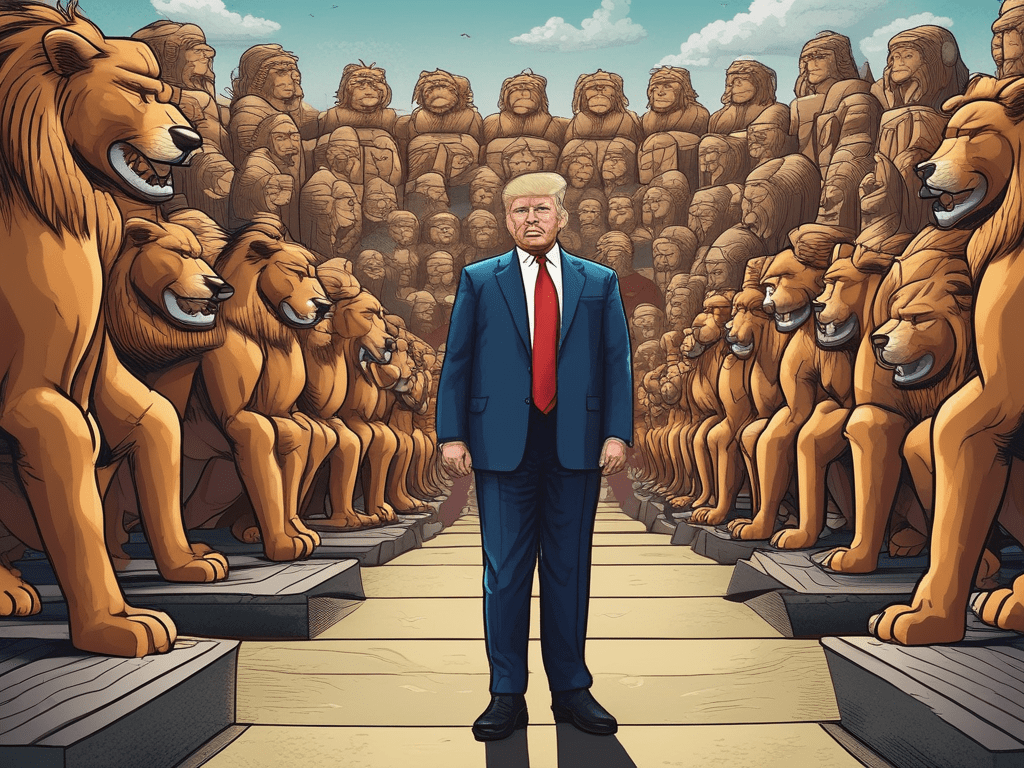
Love him or hate him, there is no white politician in modern history who would dare to question the blackness of the opposing party’s self-proclaimed first black woman presidential candidate at a conference of black journalists no less. Former President Donald Trump, however, did just that – and more when he participated in the National Association of Black Journalists annual conference in Chicago on Wednesday, a gathering that has been described as “the lion’s den” for a conservative politician for self-evident reasons. If there was any doubt that was an apt description, the question and answer portion of the event began without so much as a hello before ABC News Reporter, Rachel Scott, accused the former President of being a racist, citing everything from birthers to referring to progressive District Attorney’s that allow violent felons to walk the streets as “animals” and “scum” before wondering how black people could possibly trust him. “I don’t think I’ve ever been asked a question in such a horrible manner. A first question. You don’t even say hello, how are you,” the former President responded, stating the overwhelmingly obvious. “Are you with ABC, because I think they’re a fake news network, a terrible network. I think it’s disgraceful that I came here in good spirit. I love the Black population of this country, I’ve done so much for the Black population of this country,” ultimately claiming that he has done more for black people than any President since Abraham Lincoln. From there, he questioned why his newly coronated opponent, Vice President Kamala Harris, wasn’t in attendance as planned, claiming he was “invited under false pretenses” and told he could not join virtually, but apparently those rules do not apply to the Democrat candidate, along with many other rules as we will see. He also noted, repeatedly, that they were unable to even start the conference on time, forcing a former President and current candidate to wait for more than a half hour because of technical issues, despite that he was scheduled to appear in Pennsylvania later that same day. “I think it’s a very nasty question,” he said. “For you to start off a question and answer period especially when you’re 35 minutes late…in such a hostile manner, I think it’s a disgrace.” This set the tone for what can only be described as a combative session, but perhaps no remarks generated more controversy than when President Trump was asked whether or not Vice President Harris was a “DEI hire” and whether he would condemn Republicans who said as much – even after President Biden clearly stated he sought only a woman as a potential running mate in 2020, meaning men need not apply, the definition of DEI itself, and even after he bragged about how his administration embraced this ideology. After questioning what the letters even means in this context, a question Ms. Scott refused to answer, President Trump said the unthinkable, “I’ve known [Kamala] a long time indirectly. She was always of Indian heritage and she was only promoting Indian heritage. I didn’t know she was black until a number of years ago when she happened to turn black. I respect either one.”
Needless to say, Harris-friendly outlets including most of the mainstream media responded with immediate outrage that President Trump dared question her racial identity, a racial identity that she, of course, plans to use to her benefit in the campaign. Democrat Senator Mark Kelly claimed the suggestion was “overtly racist.” Democrat Governor J.B. Prizker insisted that there was “racism coming through him.” Al Sharpton claimed the former President did everything except call Ms. Harris the N-word. On MSNBC, there were heads practically exploding like fireworks on the Fourth of July. Equally needless to say, these individuals and others continued the recent trend of studiously avoiding a few highly relevant points. First, President Trump is almost certainly correct, as he and his Republican supporters, or at least those with a spine, published a barrage of headlines prior to President Biden selecting Kamala Harris as his running mate in 2020. On November 8, 2016, the Associated Press covered her victorious Senate campaign with the headline, “California’s Kamala Harris becomes first Indian-American US senator.” The article noted specifically, “The victory for 51-year old Harris makes her the first Indian-American Senator.” In an interview after she was sworn in, then-Senator Harris said herself, “I’m proud to be the first Indian Senator in US history.” On a cooking segment with Indian actress Mindy Kaling, Ms. Kaling noted, “We’re going to cook an Indian recipe today because you are an Indian.” Vice President Harris nodded approvingly and said, “Yes.” Ms. Kaling further clarified, “Actually, we’re both South Indian,” and Vice President Harris agreed again. Back in 2003, a local newspaper covered her initial run for San Francisco District Attorney, “If she’s successful in defeating incumbent District Attorney Terrence Hallinan and defense attorney bill Fazio – who is in his third run for office – Harris would become not only the first female district attorney in the City’s history but also the first DA of Asian-Pacific American descent.” Of course, Vice President Harris’ father has always been of Jamaican descent, making her of mixed racial background, but at a minimum, it’s clear that she was content to leverage whatever side of her heritage offered her the most political opportunity at the time. She wouldn’t have been the first black Senator, so she chose to trumpet being the first Indian Senator. The increasingly intense focus on the black community, especially in the wake of the killing of George Floyd, likely prompted her to play up that portion of her heritage. If you doubt this, then why isn’t she running to the first Indian President? Vice President Harris is, of course, free to position herself as she likes, but at the same time, her opponents and detractors, who see this as part of an overall trend of her taking positions (and faking accents) for political purposes, are equally free to point it out.
The second point is far more fundamental, however. Progressives have a long, sordid history of questioning the racial identity of their political opponents based purely on disagreements with their ideology and policy positions. It was President Joe Biden, then a candidate, who infamously said that if you vote for Donald Trump, “you ain’t black” suggesting that you cannot call yourself black and be a Trump supporter at the same time and implicitly questioning the racial identity of anyone who failed to agree with what a white person said about the matter. Black conservatives are continually subjected to the criticism that they simply aren’t authentically black enough, frequently using pejorative terms like “Uncle Tom.” Supreme Court Justice Clarence Thomas is perhaps the most famous victim of these attacks to the point where CNN felt the need to explain “why many Black people despise Clarence Thomas” just last year. According to them, Justice Thomas has been rejected by the black community because he is a “traitor” and a “hypocrite.” “When the National Museum of African American History and Culture opened in Washington in 2016, its organizers excluded any direct mention of Thomas in the exhibits. Various Black leaders have called Thomas an ‘Uncle Tom,’ and the NAACP’s current president recently called Thomas ‘the worst thing’ affirmative action created,” meaning he is the equivalent of a DEI hire. One of those black leaders is Democrat House Member Bennie Thomas. Rather than apologizing for using the racially charged phrase “Uncle Tom” in 2014, he defended it as accurate for purely political reasons. “Well if you look at his decisions on the court, they have been adverse to the minority community, and the people I represent have a real issue with an African-American not being sensible to those issues,” Representative Thompson explained to CNN after making the initial comment, doubling down on the idea that you cannot be black and conservative. Though the term might be racially charged to some people, “It’s the truth,” he declared. When reporter Dana Bash noted that he wouldn’t accept a white person saying the same, he defended himself with his blackness, “But I’m black. You’re asking me the question, and I’m giving you a response. The people that I represent, for the most part, have a real issue with those decisions-voter ID, affirmative action, Affordable Care Act-all those issues are very important and for someone in the court who’s African American and not sensitive to that is a real problem.” Representative Thomas is, of course, entitled to his opinion, but clearly he – and his fellow progressives – have long equated racial identity with political positions and have declared anyone not sufficiently progressive, not sufficiently black. Justice Thomas is not alone, either. Almost every conservative of color has had their racial identity questioned by the very same people expressing outrage now, and inevitably they are deemed not black enough purely because of politics. Senator Tim Scott, a prominent black conservative and close ally of President Trump, has even been given the nickname “Uncle Tim,” more on him in a moment.
There is a third, related point: As Representative Thomas did when confronted by the obvious fact that he wouldn’t tolerate a white person using the phrase “Uncle Tom,” he donned his racial identity as a suit of armor that put him beyond criticism. This is another frequent tactic among progressives who use their race, one they define in others in political terms, to shut down the conversation by declaring their opponent a racist. Thus, the response to President Trump’s comments about Vice President Harris have been no surprise, but the same benefit of the doubt is never extended to black Republicans. Senator Scott, for example, clearly typifies the experience of an unfortunately large number of black Americans. Born in South Carolina at the tail end of segregation, his parents divorced when he was only seven years’ old, forcing his mother to move him and his older brother into his maternal grandfather’s house. He grew up in extreme poverty despite his mother working two jobs, and in the 1960s and 70s especially, South likely faced equally extreme racism. When we talk about the legacy of slavery and Jim Crow in America, Senator Scott and his family are the inheritors, the ones who have been impacted the most given that he is directly descended from slaves in a place hostile to black people to the point of lynching them. In other words, he’s exactly the sort of person who has suffered from any systemic racism in the country, but when he dared to share stories of his grandfather, who he claimed “left school after 3rd grade to pick cotton. He never learned to read, but he taught us so much about what’s really important,” the media didn’t choose to exhibit racial sensitivity of any kind. Instead, they promptly fact checked him because apparently his great grandfather owned land or something. “Scott tells a tidy story packaged for political consumption, but a close look shows how some of his family’s early and improbable success gets flattened and written out of his biography. Against heavy odds, Scott’s ancestors amassed relatively large areas of farmland, a mark of distinction in the Black community at the time,” wrote The Washington Posts’ Glenn Kessler. “Scott, moreover, does not mention that his grandfather worked on his father’s farm — a farm that was expanded through land acquisitions even during the Great Depression, when many other Black farmers were forced out of business.” In other words, Senator Scott isn’t who he claims to be. The same scrutiny is, needless to say, never given to progressive politicians. Vice President Harris, for example, is the daughter of a biologist and a Stanford University professor, both of whom emigrated to the United States shortly before the passage of the Civil Rights Act. She, by all accounts, had an upper middle class upbringing and came of age after the civil rights movement. She is not descended from slaves, and her parents didn’t grow up under Jim Crow. This doesn’t mean she isn’t a person of color of mixed race descent, free to define herself as she likes, but it does point out the reality that only progressives are free to do so because of their policy positions.
Sadly, some who are supposed to be conservatives and supporters of President Trump immediately accepted the framing of his comments by the mainstream media despite the incontrovertible truth of what he said and how racial identity in general is framed by what passes for conventional wisdom. Rather than acknowledging how race is used as a one sided weapon purely to advance progressive causes, they retired to the proverbial fainting couches that President Trump would dare to bring it up in the first place along with their progressive counterparts. Of course, this is not the way to win an argument – or an election. If you believe, as conservatives claim to, that our obsession with racial identity is a fundamental threat to the future of the country, a poison in our political discourse, and that a majority of Americans of all backgrounds are increasingly tired of being labeled purely because of those backgrounds, you need to confront the issue head on, not hide away from it and allow your opponents to continue using it as a political sword, especially when your opponent is exploiting the accidents of her race for political gain. There’s a reason why a significant percentage of the largely black audience when President Trump made these remarks clapped and cheered: People, whether black, brown, white, or whatever, aren’t stupid. Whatever she or the media may say, they know that Vice President Harris didn’t grow up on the southside of Chicago and that she is only promoting her racial identity for political purposes. There were undoubtedly no small number of them in attendance on Wednesday who are tired of it, at least in my opinion. President Trump’s willingness to say so, out loud, in a hostile environment will ultimately earn him votes if only out of respect. How do I know this? Primarily because the exact same thing played out when he took an aggressive stance against illegal immigration while announcing his candidacy in June 2015. The same people fainted, as they have today. The voters, however, responded, with the former President earning a higher share of the Latino vote than Republicans before him who preferred to pander on the issue, and I believe they will do so again.

 Confessions of a Conservative Atheist