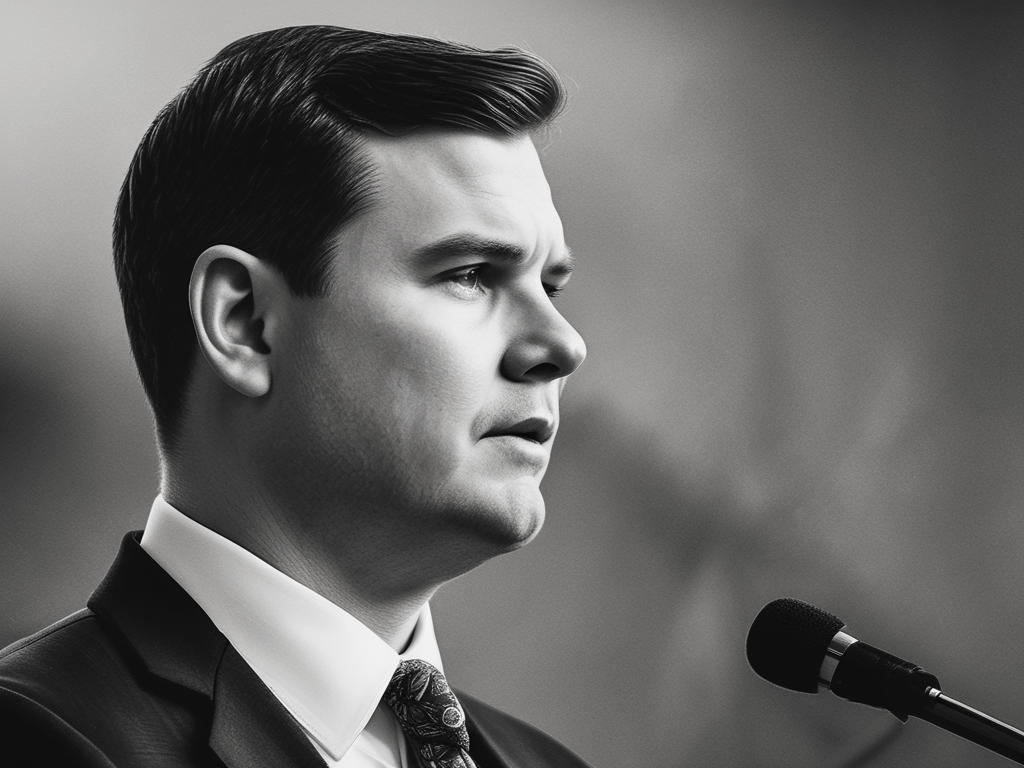
The new Republican Party seeks to shift the balance of our interests shifts from abstract American ideals to the practical impact on every day Americans, America as a country like any other, with her own interests, rather than as some easily manipulated metaphor for democracy or human progress.
The same way we can rarely tell when someone is losing (or gaining) weight in real time until it hits us suddenly one moment, the radical changes to the Republican Party over the past eight years have not always been easy to observe, lost in the course of events and the constant give and take of politics. On Wednesday evening, however, Senator JD Vance, delivering his acceptance speech for Vice President in Milwaukee, WI, was the political equivalent of seeing an old friend who’d just lost a hundred pounds for the first time in a few years, forcing you to wonder, is this really the same person? The word “populism” has been frequently used to describe this transition, sometimes positively and sometimes negatively, given the inherent connotation of pitting the average person against an elite establishment. The word, however, while not entirely inaccurate, has little actual utility because it can apply equally to either the left and the right. As the Organization of American Historians noted a few years ago, “If Trump and Sanders are both populists, what does it mean?” “The headlines tell us that the political campaigns of Donald Trump and Bernie Sanders have opened a new chapter of populist politics. A reporter at the Los Angeles Times writes on ‘the populist sentiment fueling both the Bernie Sanders and Donald Trump campaigns.’ A pundit at the National Review asks if Sanders and Trump are ‘two populist peas in a pod?’ and answers in the affirmative.” Of course, you are unlikely to find two political figures as ideologically opposed as former President Trump, an unabashed conservative, and Senator Sanders, a committed Democratic Socialist. The two rarely, if ever, have agreed on any policy, from tax rates to welfare to energy to overall government regulation with most foreign affairs in between. As the Organization’s Charles Postel put it, “Whether it is policy, style, or temperament, these two candidates make for strange peas in a pod. Pairing Sanders and Trump indicates just how flexible the term populist has become and poses the question as to whether populist has any useful meaning and if so, what it might be.” Mr, Postel continued to detail the history behind the term and what that means for our current politics, but for our purposes here, it captures the overall positioning, not the substance. Putting this another way, it says more about how each man appeals to voters than it does about what they would do for voters, failing to capture what is truly happening in the Republican Party, which nothing short of a shift not seen in over 40 years or more.
Senator Vance captured the extent of this revolution, and the underlying boldness of the vision in a few simple sentences on Wednesday that redefined the nature of the country itself, when he claimed that America was more than an idea. It’s a place. It’s a home, and one needs to be protected above all else. While this might sound like common sense to many, it completely upends the context of much of what passes for political debate in recent years if you look below the surface. In June 2018, President Biden invoked the notion that the American ideal transcends what is best for Americans even before he was in office. “This is not who we are. America is better than this,” he declared in reaction to then President Trump’s border policies, which were said to put kids in cages, though photos broadcast in the media were largely from the Obama Era and we have seen much the same under the current President. “I know how difficult this problem is. As Vice President, I was charged with leading our response when we saw a surge of unaccompanied minors on our border. And I can tell you the answer is not to toss aside our values, our principles, and our humanity.” He continued, “No one, not even a President, can change who we are as America and what we stand for — if we the people stand united and unleash all that power that is in our hands. We must remind this Administration of the core values that beat in the heart of this country. We must send the clearest possible signal to the rest of the world that America still represents the best of humanity — not the worst.” Beneath the political hyperbole, the argument rested on the assumption that our principles are more important than our people, that we must, as Americans, shoulder a burden we didn’t ask for, if not suffer for it. The moral duty of the American ideal outweighs practical considerations, or the impact on the American people, and in a contest between the two, the American principle, such as they define it of course, must prevail. Even if it’s never said so bluntly, the same thinking underlies the President’s framing of the war in Ukraine as a war for democracy itself. Last year, he spoke at Vilnius University in Lithuania, declaring “Faced with a threat — faced with a threat to the peace and stability of the world, to democratic values we hold dear, to freedom itself, we did what we always do: The United States stepped up.” He continued, “Our commitment to Ukraine will not weaken. We will stand for liberty and freedom today, tomorrow, and for as long as it takes.” Comparing the American ideal to Russian President Vladimir Putin, he claimed, “[President Putin] still doesn’t understand that our commitment to our values, our freedom is something [we] can never, never, ever, ever walk away from. It’s who we are. I mean it — it’s who we are. It’s who we are.” The calculus here was the same as immigration repackaged for international relations: The American moral imperative to protect democracy, as the world’s first modern democracy, impels us to protect Ukraine above and beyond all other concerns. We do it not because it benefits the average American, but because their conception of the American principle compels us.
Of course, none of this is to suggest that America doesn’t have a vested interest in ensuring peace and stability in the world, or that our immigration policy should not be reasonable, fair, and humane, if not generous, but it does radically change the terms of the debate. Rather than giving primacy to America as an ideal, we should give primacy to America as a country, a people, a place at a specific point in time. Former President Trump, who has largely been responsible for the revolution in his party despite the endless criticism, has used the phrase “America First” to describe this perspective, implicitly suggesting the establishment, of which President Biden is most certainly a part, has prioritized other interests above our own, but Senator Vance expanded the notion into a broader ideology, creating even more contrasts with that same establishment – and their likely opponent. “I grew up in a place that the ruling class in Washington had cast aside,” he told attendees, “but in these forgotten corners of our nation, people don’t ask for much—they just want a fair shot and a government that works for them.” He continued, “When I was in the fourth grade, a career politician by the name of Joe Biden supported NAFTA, a bad trade deal that sent countless good jobs to Mexico. When I was a sophomore in high school, that same career politician named Joe Biden gave China a sweetheart trade deal that destroyed even more good American middle class manufacturing jobs. When I was a senior in high school, that same Joe Biden supported the disastrous invasion of Iraq. At each step of the way, in small towns like mine in Ohio or next door in Pennsylvania or Michigan and states all across our country, jobs were sent overseas and our children were sent to war.” Former President Trump, however, “was right on all of these issues.” “President Trump’s vision is clear and powerful—we’re putting America first, not catering to Wall Street or globalist interests,” Senator Vance concluded. Needless to say, there are many, especially in the establishment and among critics of President Trump who would dispute he’s done any such thing, and – in some cases, more on that below – they may even be right, but this doesn’t alter the revolution in the discussion or the party having it, especially for a party that has long been associated with both Wall Street, unfettered free trade, and globalist intervention.
Equally needless to say, the impact on policy is not entirely clear at this point, but we can glean some insight from the former President’s first term, even though much of it was mischaracterized at the time, frequently intentionally so. First, even before entering office, then-candidate Trump rejected the neoconservative consensus on interventionist foreign policy, stating clearly that Afghanistan and Iraq were tremendous blunders, costing trillions and producing nothing of value. While President, Trump didn’t hesitate to use American force when necessary, destroying ISIS quickly and assassinating key terrorist leaders, but he refused to commit any American troops or funding on a long term basis. He also sought to defuse internationally tensions by reimagining the dynamics, adopting a Rooseveltian approach to Russia by praising President Vladimir Put in public, insisting he was willing to work with him, and welcoming him into the international fold while also making strong defensive moves including supplying Poland and Ukraine with advanced weaponry, and blocking oil pipelines that would enrich the former communist state. Similarly, he cajoled the NATO alliance constantly, both for failing to fund their own militaries and for falling under Russia’s sway by relying on their oil and natural gas. China, however, was treated rather differently for economic reasons as part of the overall rejection of globalism, starting what many characterized as a trade war by implementing tariffs on Chinese imports and designating them as a currency manipulator. In the Middle East, he rejected the consensus that there could be no peace without a Palestinian state, and forged the Abraham Accords to normalize relations with Israel and Sunni Arab countries while decimating Iran’s economy with sanctions independent of what happened between the Jewish state and the Palestinians. In North America, he continued his economic crusade against globalism by renegotiating NAFTA and leveraging our economic might to stem the tide of immigration. On energy, he unleashed it despite cries that we should sacrifice our growth to save the planet from global warming, even as the two largest carbon emitters, India and China, made no such promises. On taxes, he reformed the code to benefit both average Americans and the companies they worked for. What has regularly been described as a tax cut for the rich, was really a reduction in corporate tax rates to encourage more investment in America and to prevent companies from relocating their offices overseas. The “rich” necessarily benefited from this to some extent, but so did workers by keeping jobs here and bringing investment back. The reduction in individual tax rates, however, was greatly biased towards the middle class, both because rates were cut more on the lower end of the income scale and because of the elimination of the state and local tax deduction, which meant that families making $200,000 or more per year in wealthy, high tax states like the Northeast and California saw little reduction at all.
In all of these – and other accomplishments like prison reform – we can see both a shift in the Republican Party and the seeds of this new conservative ideology, where the balance of our interests shifts from abstract American ideals to the practical impact on every day Americans, America as a country like any other, with her own interests, rather than as some easily manipulated metaphor for human progress. Unfortunately, President Trump wasn’t given the opportunity to finish what he started in many cases, and we will never be able to say definitively what the result of some of these policies might have been after President Biden came into office and reversed as many as he could. Nor is President Trump an ideologue or a natural philosophical thinker. He’s a man of action, a practical “doer,” “pure act” as Henry Brooks Adams described Teddy Roosevelt, who undoubtedly pursued many of these policies because he thought they were right at the time in isolation, based more on instinct than an overarching vision. Four years later, however, we can begin to see and understand how all of these individual ideas fit into a more coherent framework, transforming America First from a slogan to a political ideology perhaps not seen in America since Teddy Roosevelt. Senator Vance has taken an admirable first step at laying this new foundation while promising a large tent and vigorous debate. Others will necessarily contribute and the real results will be measured in years and decades whether or note former President Trump prevails in November, but in the meantime, the party of George W. Bush and Mitt Romney is no more, and I am not the only one who says “good riddance.” The tired ideologies of the past, which prioritize ideas rather than actions, will not secure another American century. As I put it a couple of years ago, we need a new Americanism and we need it now. Senator Vance might well be the one to truly forge it.
PS Former President Trump’s acceptance speech ended way too late for me to properly comment. My initial reaction: It was good, but too long. The opening was impactful and humanized him. The middle meandered. The end was incredibly strong, but one thing was true and impressive throughout: Trump is gonna be Trump. Less than a week after someone tried to assassinate him, he appeared more human and a little more somber, but the unique combination of ad libs for laughs and more traditional political rhetoric remained the same, and seeing someone so comfortable in their own skin, remains refreshing even nine years later.

 Confessions of a Conservative Atheist