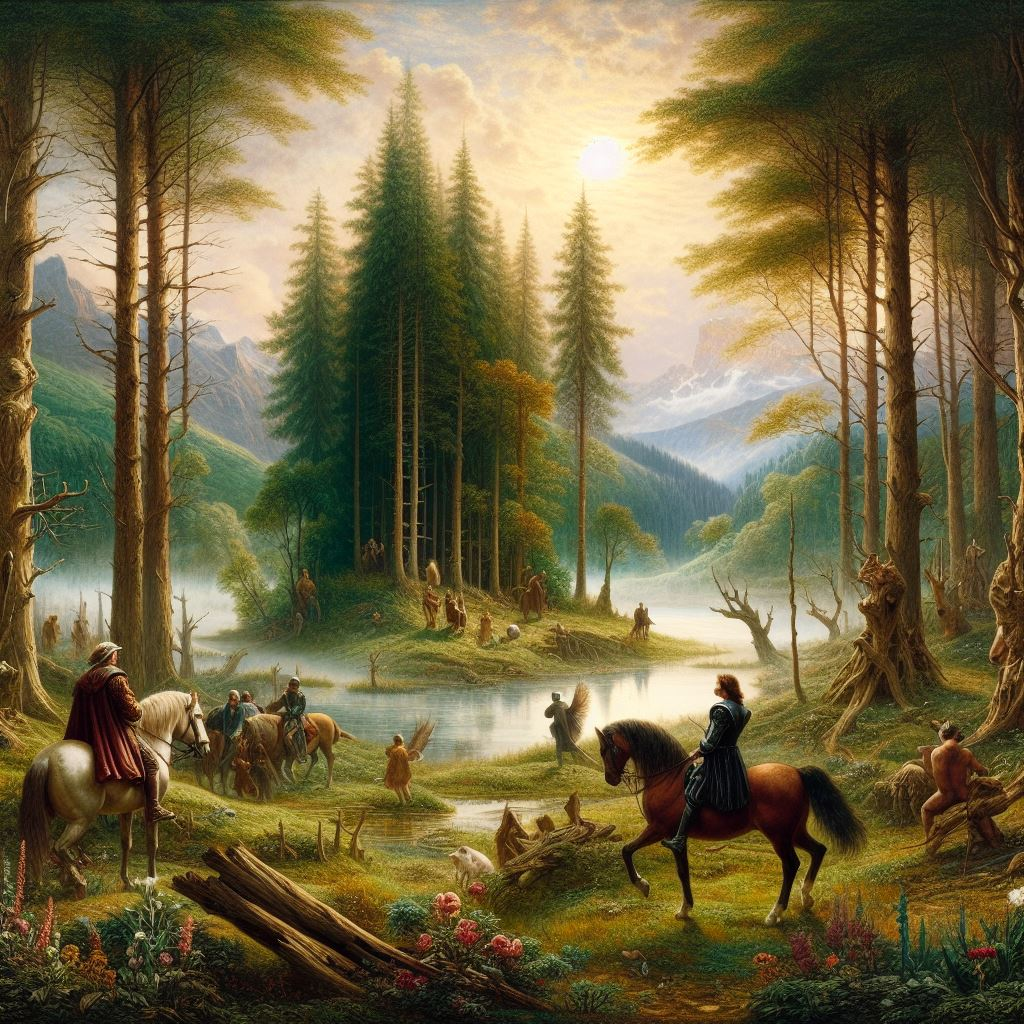
Jaques, As You Like It’s “melancholy fellow,” is not likely to appear on any list of Shakespeare’s greatest characters, nor is his speech on the nature of his melancholy, but we see in him a sort of proto-Hamlet without the need to wound, opinion unrestrained, as he fancies himself said, claims it is better to say nothing, but does nothing of the sort.
Hamlet, Macbeth, Romeo, Juliet, Othello, and more are Shakespearean characters that have become household names, recognizable and referenceable even by those who have not read or seen the original works. Shakespeare aficionados would likely add Falstaff, Lady Macbeth, the Nurse, Iago, Edward, and others to a list of the Bard’s greatest creations, where his combination of characterization and dialogue touches on a universal truth in human nature, showing us something of ourselves reflected back from a fictional figure. Jaques, As You Like It’s “melancholy fellow,” is not likely to appear on any of these lists, however. Even the play itself remains somewhat controversial in Shakespeare’s canon, still widely performed while critics have debated its overall merit for centuries. George Bernard Shaw, for example, believed it didn’t represent the high artistry Shakespeare was capable of, believing the title itself suggested the play was written simply as a crowd pleaser, as in the way the audience wants it, not how the artist should have created it. “Shakespeare found that the only thing that paid in the theater was romantic nonsense,” he wrote. “When he was forced by this to produce one of the most effective samples of romantic nonsense in existence — a feat which he performed easily and well — he publicly disclaimed any responsibility for its pleasant and cheap falsehood by borrowing the story and throwing it in the face of the public with the phrase As You Like It.” Others, however, have been far more impressed. The late, great literary critic Harold Bloom believed it a superior work and claimed the gender-bending female heroine, Rosalind, is one of Shakespeare’s best overall characters, saying if she “cannot please us, then no one in Shakespeare or elsewhere in literature ever will.” In his view, the play exists between inherent human extremes and dualities, romance and realism, noble and commoner, male and female, etc., commenting on all, but refusing to choose one side or the other. Bloom was not alone in this belief, seeing the Forest of Arden, where most of the action takes place, as an almost magical realm unconstrained by the traditional notions of time, space, and human experience. William Hazlitt, for example, remarked that “The very air of the place seems to breathe a spirit of philosophical poetry; to stir the thoughts, to touch the heart with pity, as the drowsy forest rustles to the sighing gale.” August W. von Schlegel claimed the forest represented “unlimited freedom,” a place where “nothing is wanted to call forth the poetry which has its dwelling in nature and the human mind but to throw off all artificial constraint and restore both to their native liberty.”
Shakespeare himself appeared to trust that the audience would be willing to suspend their disbelief at a minimum while the action takes place in Arden. Whatever it represents symbolically, the master playwright certainly would not have expected anyone to accept some of the play’s central conceits at face value or in purely realistic terms, so remarkable and figurative are they. After all, young nobles fleeing from their brother do not frequently proclaim their love for those they’ve barely met by inscribing it in trees, nor are they so easily tricked that they can converse with the object of their affections disguised as a man for what appear to be days on end and have no idea who they are talking to. These sequences, in fact, appear to take place in a netherworld of their own, one where from certain angles we are supposed to assume Orlando knows its Rosalind beneath the disguise but simply refuses to directly address her real identity for some reason. Even after Orlando begins calling her Rosalind at her own request, Rosalind herself insists on continuing the charade. She asks him, seemingly without irony and yet full of it, “Am not I your Rosalind?” He replies in the same interim state, “I take some joy to say you are because I would be talking of her.” She proceeds to reject him, “Well, in her person I say I will not have you.” He claims he will die if he cannot have the woman right in front of him, who is obviously flirting with him, “Then, in mine own person I die.” She, in turn, dismisses his concerns, and insists no one has ever died from love. “No, faith, die by attorney. The poor world is almost six thousand years old, and in all this time there was not any man died in his own person, videlicet, in a love cause.” Anyone who claims otherwise, “these are all lies. Men have died from time to time and worms have eaten them, but not for love.” The two continue into a mock marriage ceremony, officiated by Rosalind’s friend, who is also in disguise and also about to find love. Orlando asks, “But will my Rosalind do so?” “By my life, she will do as I do,” Rosalind insists. The conceit is not broken until later, but clearly, this would be a rather bizarre, if not outright disturbing sequence if Orlando wasn’t aware of Ganymede’s real identity on some level. Men smitten with a particular woman, do not normally meet other men and roleplay their relationships down to getting married, and women, at least to my knowledge, don’t often seek to marry fools who can’t recognize them with their tied in a bun. Practically speaking, the scene is normally staged as an outright flirtation, with Rosalind’s real identity lurking just beneath the surface, caught in that netherworld of truth and fiction. This “magic” unique to Arden can also be seen in the existence of Duke Senior and his retinue, exiled by his brother, but somehow managing to live a near idyllic existence in the wood until that same brother has a miraculous change of heart and decides to be a hermit in the same wood. In any other Shakespeare play, the plot might easily be dominated by Senior’s revenge, or Frederick’s attempt to execute his brother in exile, or Orlando and his relationship with his own estranged brother, Oliver, but here we are supposed to assume that (almost) all things are possible between the usual extremes of human action.
We find some proof of this in two characters Shakespeare invented that are not present in the source material, Touchstone and Jaques himself. Here, the Bard appears to have intentionally added two distinct magnetic poles to watch over the proceedings, comment on the developments, and further heighten the ironic dualities that underly the entire play. Touchstone, the happy, go lucky fool, who laughs at everything and Jaques the melancholy observer who finds no pleasure in anything – perhaps save for the act of finding no pleasure in it. Touchstone, however, takes an active part in the events, falls in love with Audrey and is married at the end while Jaques refuses to leave Arden, taking up the company of Senior’s now hermit brother Frederick. For this and other reasons, Jaques stands alone, a character who is not really a factor in the plot, whom Hazlitt described as “the only purely contemplative character in Shakespeare,” “His only passion is thought; he sets no value upon anything but as it serves as food for reflection.” Given the magical nature of the forest, we might wonder why Jaques, though he has been there a long time himself, has not fallen under its spell, remaining a “melancholy fellow” by his own description, no matter what life brings him. Melancholy itself is an almost magical world, defined as a “feeling of pensive sadness, typically with no obvious cause,” but in As You Like It and otherwise, it means something more than simply a feeling, either the regular sadness we all feel at times of loss or even a deep depression. Melancholy is, instead, a state of mind, a way of perceiving the world and either finding it missing something or, equally troubling, too full of the wrong things. Shakespeare first introduces Jaques via a story told to Duke Senior by one of his exiled lords, describing how he reacted to the killing of a deer. The lord, in this case, spied Jaques watching the poor animal’s death throes, “indeed, my lord, The wretched animal heaved forth such groans That their discharge did stretch his leathern coat Almost to bursting, and the big round tears Coursed one another down his innocent nose In piteous chase.” The Duke asks if Jaques “moralize[d] the spectacle?” “Oh yes into a thousand similes,” the lord answers. First, Jaques commented on his own tears, of which he said the deer brought forth more from someone who already had “too much.” Next, he commented on the loneliness of death and the fact that the deer has been abandoned by his “velvet friends” and that the same happens in human societies, where no one looks upon “that poor and broken bankrupt there.” The lord sees something deeper in these remarks than mere prattle, “Thus most invectively he pierceth through The body of country, city, court, Yea, and of this our life, swearing that we Are mere usurpers, tyrants, and what’s worse, To fright the animals and to kill them up In their assigned and native dwelling place.” The Duke, apparently agrees, and asks to be taken to the location, for “I love to cope him in these sullen fits, For then he’s full of matter.”
When we first meet Jaques, however, he doesn’t seem nearly so sullen. One of Senior’s lords from earlier is singing about the joys of life in the forest, and Jaques encourages him to keep going. The lord, Amiens, protests that it only makes Jaques melancholy, a fact that Jaques himself admits, saying he “can suck melancholy out of a song as a weasel sucks eggs,” but still he wants more. Amiens persists in his protestations, claiming “My voice is ragged. I know I cannot please you.” Jaques responds by noting, “I do not desire you to please me. I do desire you to sing” and asking for another “stanzo. Call you ’em ‘stanzos’?” When Amiens agrees this is the proper terminology, Jaques insists he cares “not for their names. They owe him nothing.” Amiens finally relents at that point, saying he will sing “More at your request than to please myself.” Jaques continues jesting with him even then, saying “Well then, if ever I thank any man, I’ll thank you. But that they call ‘compliment’ is like th’ encounter of two dog-apes. And when a man thanks me heartily, methinks I have given him a penny and he renders me the beggarly thanks.” Before Amiens strikes up again, he informs Jaques that the Duke has been looking for him. “And I have been all this day to avoid him,” he replies. “He is too disputable for my company. I think of as many matters as he, but I give heaven thanks and make no boast of them.” Amiens begins singing, only to have Jaques provide a parody counterpart, centered on “ducdame,” “a Greek invocation to call fools into a circle. I’ll go sleep if I can. If I cannot, I’ll rail against all the first-born of Egypt.” Overall, it’s hard not to see Jaques jesting as a sort of proto-Hamlet, who never met anyone or encountered anything he refused to comment on, trading barbs as if they were coin, riding on the fact that, as Bloom once put it, he “thinks too well.” Jaques, for all his self-proclaimed melancholy, however, is much gentler practitioner. Hamlet frequently jokes with the obvious intent to wound, as when he mocks Polonius as old or insinuates his daughter is a slut. Jacques, meanwhile, seems to enjoy bantering for bantering’s sake, as a way to pass the time with a smile, distracting himself and others from the cares of the world, which of itself seems an odd occupation for a self-professed sad fool.
Whatever the case, Jaques is transformed once again the next time we meet him, after actually encountering Touchstone in the forest. Duke Senior remarks that he looks “merrily,” prompting Jaques to recount how he met, “A fool, a fool, I met a fool i’ th’ forest, A motley fool. A miserable world! As I do live by food, I met a fool, Who laid him down and basked him in the sun And railed on Lady Fortune in good terms, In good set terms, and yet a motley fool.” Jacques continues to explain that he found it strange the fool chose to comment on the passing of time (a recurring theme in the play in general, suggesting that time flows differently in Arden), noting that “from hour to hour we ripe and ripe, And then from hour to hour we rot and rot, And thereby hangs a tale.” To Jaques, “When I did hear The motley fool thus moral on the time, My lungs began to crow like chanticleer That fools should be so deep-contemplative, And I did laugh sans intermission An hour by his dial. O noble fool! A worthy fool! Motley’s the only wear.” He informs the Duke that he is “ambitious” for a motley coat of his own, which the Duke promises him he will have. Jaques proceeds from there in the jesting mode, noting how he is “wise,” “must have liberty,” “as large a charter as the wind,” to mock whoever he pleases because if he is given “leave To speak [his] mind, and [he] will through and through Cleanse the foul body of th’ infected world, If they will patiently receive [his] medicine.” The Duke chides him gently in return, saying he knows what Jaques will do, cast his own sins back on others. After all, “For thou thyself hast been a libertine, As sensual as the brutish sting itself” and as a fool, he would “disgorge” all this into the general world. The good natured banter continues, but one thing is apparent: Why does Jaques insist he wants to be a fool, when everything we have seen so far makes it clear he already plays the role of the fool without the motley? He mocks lords and dukes, comments on everything and anything, and is sought after for his wit. Putting this another way, what makes Jaques melancholy except that he has chosen to brand himself that way in the first place like a stand up comedian with a dry sense of humor? We cannot say for sure, but given the other characters in the play generally don disguises of their own, or find ways to aspire to be what they weren’t before arriving in Arden, there is certain the possibility that Jaques has chosen this course on purpose.
He hints at this himself shortly after. In the most well known monologue of the play, Jaques declares that “All the world’s a stage, and all the men and women merely players,” before recounting the stages of life, from infant to infirm. Interestingly, for a self proclaimed melancholic, he deploys a gentle humor throughout, poking fun at the reluctant schoolboy, the love-struck youth, the bragging soldier, the well-fed middle aged, and the descent into another infancy. Listening to the speech, one doesn’t get the sense Jaques is anything other than an astute, perceptive observer of the human condition, repeatedly finding what most of us do in the span of a human life, that unique combination of comedy, tragedy, triumph, and loss that defines us all as we play our parts in this world. Throughout the remainder of the play, Jaques appears sporadically to jest with various players. He meets Orlando carving Rosalind’s name into the trees and informs him, rather drolly, “I thank you for your company, but, good faith, I had as lief have been myself alone.” Orlando responds in kind, “I do desire we may be better strangers,” and Jaques implores him not to mar “more trees with writing love songs in their barks,” but similar to his previous verbal jousting, it’s difficult to find much actual enmity in it and both characters seem inclined to play along as the play dictates. Even when Jaques pokes fun at Rosalind herself, saying he doesn’t like her name, the worst fault in all the world is to be in love, and he was looking for a fool when he found Orlando, there is far more mirth than venom in it. After railing against love, he meets Touchstone again, who is planning to marry “under a bush,” but instead of telling him not to marry as he previously cast doubt upon Rosalind, he urges him to marry in the proper fashion. “And will you, being a man of your breeding, be married under a bush like a beggar? Get you to church, and have a good priest that can tell you what marriage is. This fellow will but join you together as they join wainscot. Then one of you will prove a shrunk panel and, like green timber, warp, warp.” The conversation he has with Rosalind shortly thereafter is unique, however, and stands out among the rest as helping to illuminate Jaques character, prompting what is a highly underrated speech and should be far more widely quoted. The two have not met, but Rosalind, in her inquisitive way, has heard of him and notes that “They say you are a melancholy fellow.” He replies, “I am so. I do love it better than laughing.” Rosalind, getting to the heart of the irony underlying the play, notes “Those that are in extremity of either are abominable fellows and betray themselves to every modern censure worse than drunkards.” Jaques continues the sense of irony by claiming against all of the evidence we have seen in the play, that “’tis good to be sad and say nothing.” Then, he explains the unique nature of his melancholy:
I have neither the scholar’s melancholy, which
is emulation; nor the musician’s, which is fantastical;
nor the courtier’s, which is proud; nor the
soldier’s, which is ambitious; nor the lawyer’s,
which is politic; nor the lady’s, which is nice; nor
the lover’s, which is all these; but it is a melancholy
of mine own, compounded of many simples, extracted
from many objects, and indeed the sundry
contemplation of my travels, in which my often
rumination wraps me in a most humorous sadness.
I am reminded of something I read years ago, while planning to direct my first independent film: People don’t always say what they mean or mean what they say. To the extent that Jaques is consistent, it’s in his inconsistency down to describing his sadness as humorous. This might seem a flaw to some, but humans have ever been bundles of contradictions and in the context of a play that exists in a netherworld of extremes of emotion, we should not be surprised that Shakespeare has brought this aspect of our characters to the forefront, literally building a character around it. Melancholy, to Jaques, is a frame of mind, a certain detachment with which he views events, but not borne of any underlying emotional wound or scar that we can see. We know little of his history except that he was in the Duke’s court and had a reputation for being a little wild, nothing that would suggest a sudden change of character except what he might choose for himself. Like others in the play, he chooses to wear this melancholy, making of it something he describes as his own, but by doing so does not limit himself to any particular line of thought. Indeed, you might say he calls himself melancholy while acting anything but. He encourages some to marry, others to not, some to leave, while he stays in the netherworld forever where he is free to be himself. He mocks as well as he takes, jibes with dukes and fools, and everyone else he encounters. Perhaps the only thing he doesn’t do, despite his own proscription, is “say nothing.” He is opinion unrestrained, dictated by the circumstances, but not cruel or hurtful. Melancholy, to him, is a means to cope with the obvious evil in the world while still enjoying its beauty and grace, and testing some of its pleasures. This to me is a lesson we can all benefit from.

 Confessions of a Conservative Atheist
[…] Shakespeare’s most underrated character and speech, perhaps — Confessions of a Conservative Athe… […]
LikeLike