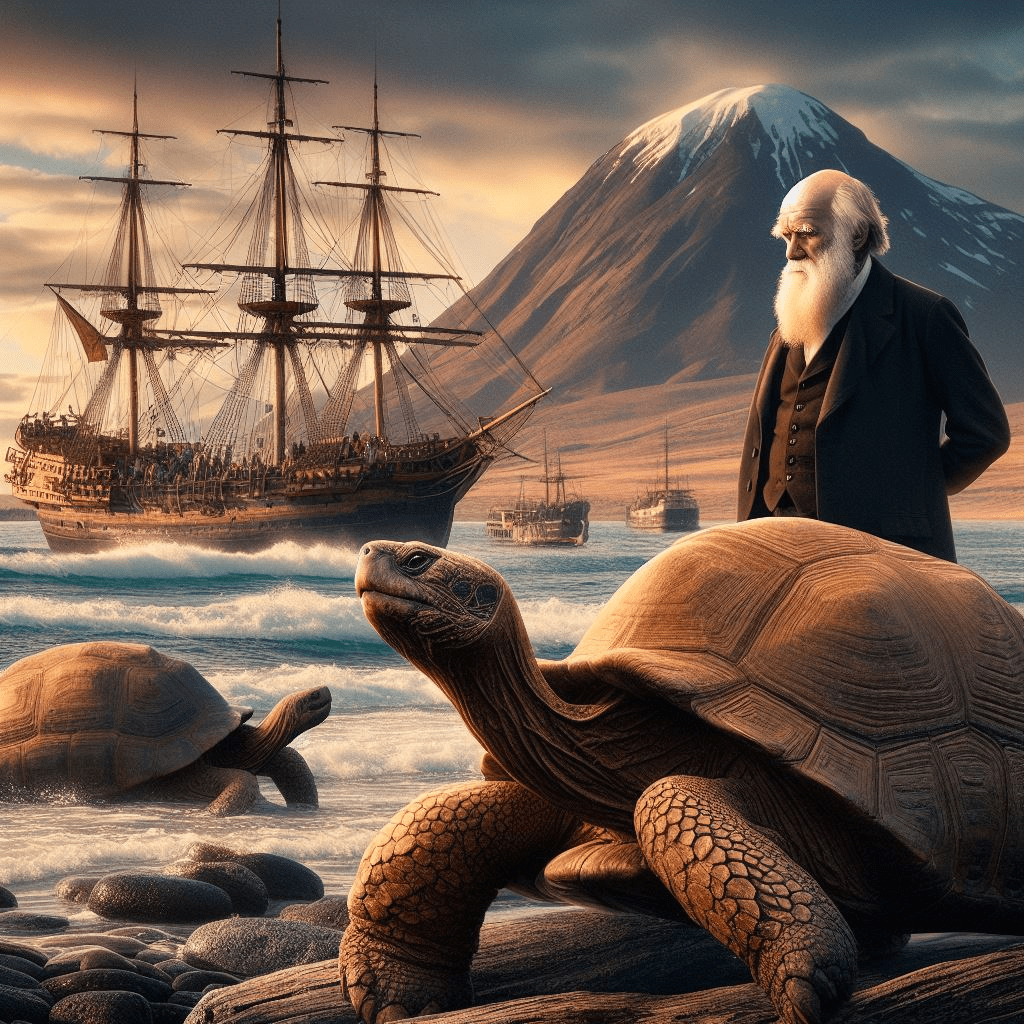
When Charles Darwin set off on a five year journey around the world in the Beagle, he was not yet the thinker he would become. Instead, he was merely a product of his time on his way to becoming a man for all time, as all world-changing geniuses are.
Charles Darwin is among the most brilliant people to have ever lived, one of those exceedingly rare individuals who changed the way we think about the world and our place in it. The publication of On the Origin of Species in 1859, where he introduced the concept of evolution via natural selection, is a watershed moment in history, creating an entirely new paradigm from which to view the natural world that holds true to this day. Darwin, like all of us, was also a product of his own time. The son of a wealthy doctor and financier, he was born an aristocrat in England on February 12, 1809 inheriting a cultural belief in the superiority of the English way of life and the British system of government, which at the time was among the most powerful empires the world had ever known, ruling colonial territory across the entire globe and still a peripheral participant in the slave trade. Darwin was also an ordinary man with faults and weaknesses all his own. He did not spring into existence with the theory of evolution fully formed in his mind, ready to change the world with his wisdom. He was a baby, a child, and then a young man with something to prove, the same as everyone else who aspires to greatness. Like many influential thinkers, he had to work for it over the course of decades, sacrificing much of himself and grappling with the big ideas bequeathed to him by other naturalists and geologists before coming up with his own at 50 years old. To do so, Darwin had to take advantage of the opportunities presented to him, an enterprising person seizing the moment to make his mark, knowing another might not come again. The first real chance to do so came when he was only 22 years old and through a lengthy, rather improbable network of connections, he was able to enlist on a British ship that would sail around the world in service to the crown, the Beagle. There is no doubt that this journey, which included the Galapagos Islands that have since become almost synonymous with the theory of evolution, was essential to Darwin’s thinking and the formation of his ideas. It was also essential to his career, transforming an unknown, aspiring naturalist into a quasi-celebrity as reports of his travels and samples he collected were published widely even before he returned home.
Darwin, however, was not the first choice, the second, or even the third, nor was he officially hired as the mission’s naturalist in the first place, leaving the history of science to chance itself. In this case, Captain Robert FitzRoy was also a young man with something to prove, but he was wise enough to realize he couldn’t take on such a long journey alone in his cabin without another gentleman for company given his unique history. The previous captain of the Beagle, Pringle Stokes had committed suicide onboard in that very cabin, casting a shadow over FitzRoy’s own ascension and future career. FitzRoy’s family also had a history of mental illness; his uncle committed suicide by slitting his own throat a few years earlier. As a result, he sought a suitable companion for the voyage, someone who was also a product of British society and education, first contacting Henry Chester and then Francis Beaufort, Hydrographer for the Navy. Beaufort contacted Charles Peacock in turn, a fellow at Trinity College, who thought of John Stevens Henslow, a professor of botany. Henslow had recently had a child, however, and recommended his brother in law Leonard Jenyns. It was only after Jenyns refused that he recommended Darwin himself, writing him in Shrewsbury about a proposed trip to “Terra del Fuego [sic] & home by the East Indies” that was expected to take two years. If you “take plenty of Books with you, anything you please may be done – You will have ample opportunities at command – In short I suppose there never was a finer chance for a man of zeal & spirit.” Henslow did, however, caution Darwin about his role, which he described as “more of a companion than a mere collector.” Darwin was being recommended “not on the supposition of…being a finished Naturalist, but was amply qualified for collecting, observing, & noting any thing worthy to be noted in Natural history…Don’t put on any modest doubts or fears about your disqualifications for I assure you I think you are the very man they are in search of.” Henslow’s invitation was seconded by Peacock, but Darwin had a problem: His father didn’t want him to go, and he was the one that would be responsible for funding the voyage in the first place. Darwin’s uncle, Josiah Wedgewood ultimately interceded and convinced his father to support him, setting in motion the future path of Darwin’s career and the history of science itself.
The Beagle set sail from Plymouth on December 27, 1831 with a primary mission of improving maps of South America. No one had any inkling it would change the world almost 30 decades later, or the man they were carrying as a gentleman companion in an unofficial position would become one of the most famous in all of history. Darwin’s unofficial role did offer a key advantage: The specimens he collected and his writings were considered private property, to be disposed of as he wished. This allowed him the freedom to think and observe as he wanted – when he wasn’t suffering from acute sea sickness. Darwin chronicled his voyage in a book published as Journal of Researches in his era, The Voyage of the Beagle in ours, revealing an obvious genius in infancy, both a man of his time and a man for all time. Considering Darwin is known today as a famous biologist, it might seem surprising that much of the journey was spent considering the nature and origins of various rock formations. Darwin was enamored of the early geologist, Charles Lyell, whose Principles of Geology was published in part shortly before the Beagle set sail. In another moment of serendipity, Darwin received volume one from FitzRoy in Plymouth. He would not receive volume two until he reached South America, but by then, it had already begun to change how he viewed natural phenomenon, describing a world that was much, much older than previously believed and subject to constant, albeit slow change. Critical to this thinking was the idea that the future could be explained by the past. That is by studying rock formations today, we can understand how they came to be and anticipate what comes next. The philosopher David Hume put it this way, “all inferences from experience suppose…that the future will resemble the past.” As Darwin traveled, he sought to put this principle to the test, attempting to see the world “through Lyell’s eyes.”
South America presented a unique opportunity in this regard. The cliffs that mark the southern edge of the continent on both the east and west coasts are the result of ancient sea beds literally being pushed out of the ocean to higher and higher elevations. Thus, what was once completely submerged is now hundreds or even thousands of feet above sea level, revealing the history of the region and surfacing fossils of earlier life forms. On the coast of Patagonia, Darwin remarked that “At first I could only understand the grand covering of gravel [he discovered], by the supposition of some epoch of extreme violence,” but that would run afoul of the principle of gradual change, requiring him to believe that the past was very different than the present. Instead, he concluded that the process to produce these beds had to have been gradual, imagining that the “same number of feet should be converted to dry land in each succeeding century. Every part of the surface would then have been exposed for an equal length of time to the action of the beach-line, and the whole in consequence equally modified. The shoaling bed of the ocean would thus be changed into a sloping land, with no marked line on it. If, however, there should occur a long period of repose in the elevations, and the currents of the sea should tend to wear away the land…, then there would be formed a line of cliff.” He surmised that this process could be repeated in cycles, “this is the structure of the plains of Patagonia…I must here observe, that I am far from supposing that the entire coast of this part of the continent has ever been lifted up, to the height of even a foot, at any one moment of time; but drawing our analogies from the shores of the Pacific, that the whole may have been insensibly rising. With every now and then a paroxysmal or accelerated movement in certain spots.”
Darwin made similar observations throughout his travels, considering the impact of earthquakes, volcanoes, and other more destructive forces that occur from time to time. He would personally observe the after effects of a major quake and tsunami in Concepcion in March 1835. “Both towns [he visited] presented the most awful yet interesting spectacle I ever beheld. To a person who had formerly known the places, it possibly might have been still more impressive; for the ruins were so mingled together, and the whole scene possessed so little the air of a habitable place, that it was scarcely possible to imagine its former appearance or condition.” He described the experience of the English consul with his typical precision and flair for capturing momentous events. The man “was at breakfast when the first movement warned him to run out. He had scarcely reached the middle of the courtyard, when one side of his house came thundering down. He retained presence of mind to remember, that if he once got on the top of that part which had already fallen, he should be safe. Not being able, from the motion of the ground, to stand, he crawled up on his hands and knees; and no sooner had he ascended this little eminence, then the other side of the house fell in, the great beams sweeping close in front of his head. With his eyes blinded, and his mouth choked with the cloud of dust which darkened the sky, at last he gained the street. As shock succeeded shock, at the interval of a few minutes, no one dared approach the shattered ruins; and no one knew whether his dearest friends and relations might not be perishing from the want of help. The thatched roofs fell over the fires, and flames burst forth in all parts. Hundreds knew themselves to be ruined, and few had the means of providing food for the day. Can a more miserable and fearful scene be imagined?” Darwin proceeded to recount an earthquake that had happened in the same area 13 years before, and then analyze the way the destruction appeared to follow certain lines of the vibrations of the earth. He moved onto the formation of the tsunami, and how that too followed a certain pattern, before he noted the impact on the elevation of the land, attempting to calculate how these massive forces caused sudden shifts.
This keen interest in changes of the landscape overtime necessarily lead Darwin to consider the changes to animals. Though the theory of evolution by natural selection was still decades away, he made a couple of key observations on the voyage that served as seeds in his mind. First, he reasoned that the extinct animals he observed as fossils lived alongside some of the species that still roamed the Earth, remarking that much of the life in the sea appears to have remained the same over the eons. This led him to ponder the “law of the succession of types” and how it must have some relation to the geological changes to the landscape. Also in Patagonia, he remarked that “The greater number, if not all, of these extinct quadrupeds lived at a very recent periods; and many of them were contemporaries of the existing molluscs [sic]. Since their loss, no very great physical changes can have taken place in the nature of the country. What then has exterminated so many living creatures?” He continued, “One is tempted to believe in such simple relations, as variation of climate and food, or introduction of enemies, or the increased numbers of other species, as the cause of the succession of races. But it may be asked whether it is probable any such cause should have been in action during the same epoch over the whole northern hemisphere” so as to wipe out the wooly mammoth in Spain, Siberia, and North America for example. Further, these same regions today had wildly different climates, making any potential explanation even more challenging. At the time, Darwin could reach no definitive conclusion, and yet he was full of ideas that would prove critical in the future. “We see that the whole series of animals, which have been created with peculiar kinds of organization, are confined to certain areas; and we can hardly suppose these structures are only adaptations to peculiarities if climate or country; for otherwise, animals belong to a distinct type, and introduced by man, would not succeed so admirably, even to the extermination of the aborigines. On such grounds it does not seem a necessary conclusion, that the extinction of a species, more than their creation, should exclusively depend on the nature (altered by physical changes) of their country. All that at present can be said with certainty is that, as with the individual, so with species, the hour of life has run its course, and is spent.”
In retrospect, these few sentences lay out the rest of his life’s work. Darwin would ultimately recognize that small changes in the environment and within animals themselves can produce huge results, leading both to complex adaptations and accounting for why organisms continually change in the first place. He would also realize that organisms change for reasons beyond their environment, namely because of their lifestyle and means of reproduction, what today we refer to as niche selection theory and sexual selection. Lastly, he would place all of these observations and more under the overarching idea that organisms are competing both within their species and between species for the resources to reproduce. Thus, an environment need not change dramatically or even at all, and yet species will still continue to evolve regardless and whatever adaptations they happen to evolve can be applied anywhere they find a niche to reproduce themselves. He certainly didn’t realize it at the time, but the very questions he was asking, he himself would ultimately answer.
There is, however, what modern sensibilities would consider a darker side to Darwin’s observations during the voyage of the Beagle. He was not a naturalist in the way we would consider the field today, someone who observes and chronicles without interfering. Instead, he was an active hunter and outdoorsman, a precursor to Teddy Roosevelt if you will. Frequently, he described how easily animals were to kill, at one point remarking on a small group of deer where he was able to shoot four out of five of them before they wised up and stayed away. While he loved the natural world, animals were not sacred in his mind, far from it. Upon encountering a tortoise in Galapagos itself, he promptly tried to ride it, noting “upon giving a few raps on the hinder part of the shell, they would rise up and walk away; but I found it very difficult to keep my balance.” Perhaps his most disturbing comments, however, are reserved for the indigenous peoples he encountered around the world, when we can mostly clearly see the British sense of superiority at work. Darwin was not without compassion and understanding, merely convinced that all other races were inferior. When he was part of a party capturing runaway slaves, an elderly black woman threw herself off a cliff rather than being taken. Darwin remarked, “In a noble Roman matron this would have been called the noble love of freedom; in a poor negress it is mere brutal obstinacy.” The natives in Tierra del Fuego earned his most hardened scorn, referring to them as “stunted miserable wretches,” questioning whether they were even human like him. “These poor wretches were stunted in their growth, their hideous faces bedaubed with white paint, their skins filthy and greasy, their hair entangled, their voices discordant, their gestures violent and without dignity. Viewing such men, one can hardly make oneself believe they are fellow-creatures, and inhabitants of the same world.” Elsewhere, however, his inner compassion shines through, at least a little. After recounting how a former slave was frightened over a simple motion of his hands, he claimed “I shall never forget my feelings of surprise, disgust, and shame, at seeing a great powerful man afraid even to ward off a blow, directed, as he thought, at his face. This man had been trained to a degradation lower than the slavery of the most helpless animal.” Later, he recounted how the local residents removed their hats and bowed their heads even to a poor, overweight black woman, and wondered if it would be the same in England. “We met near Mendoza a little and very fat negress, riding astride on a mule. She had a goiter so enormous, that it was scarcely possible to avoid gazing at her for a moment; but my two companions almost instantly, by way of apology, made the common salute of the country, by taking off their hats. Where would one of the lower classes in Europe have shown such feeling politeness to a poor and miserable object of a degraded race?”
To my knowledge, no one has recommended canceling Charles Darwin even so, likely because his contribution to the world was so profound, it’s hard to overstate the significance and almost impossible to erase every vestige of the impact given his name is also its own “ism.” He wasn’t yet the thinker he would one day become when he set off for on the five year journey on the Beagle (yes, the trip took more than double the expected time, though believe it or not, poor seasick Darwin actually spent more time on land than in the boat), but still we can see the clear signs of a singular mind in its early stages of revealing itself like a newborn star winking in some distance nebula, the talent and perceptiveness that would come to fruition decades later shining through even amid the colonialist worldview. On a final note, my lovely wife, mom, and brother will be following in Darwin’s footsteps and taking our own tour of the Galapagos in May. Given Darwin had no epiphanies there, it is highly unlikely a man of much humbler means than myself will discover anything new, but hopefully I can bring back a few good pictures, a few more great memories, and perhaps a little share of the awe he felt almost two hundred years ago.

 Confessions of a Conservative Atheist
Thanks for the history/bio take. Good stuff that I didn’t know. How exciting that you’re going! “The Beak of the Finch” (1995) is a good book to read as prep. Also, my book “Election 2016”, to pass the time on the long journey there & back 🙂
LikeLiked by 1 person
Hahaha! Thank you, I will check out Beak of the Finch. I was looking for another read on the subject. Where can I get your book as well?
LikeLiked by 1 person
Available at Xlibris and Amazon, the ebook immediately. And any bookseller can order it. I’ve a link on my homepage to Xlibris. Thanks, please consider writing a review.
Have a great trip!
LikeLiked by 1 person
[…] Charles Darwin, colonialism, cancel culture, and the irrepressible nature of genius — Confessions … […]
LikeLike