Globally, 828 million people go to bed hungry. Some 700 million live in poverty. 72% of the population, lives under authoritarian rule while some 5 billion do not have access to adequate medical care. Why do a relative handful on a small strip of land matter so much?
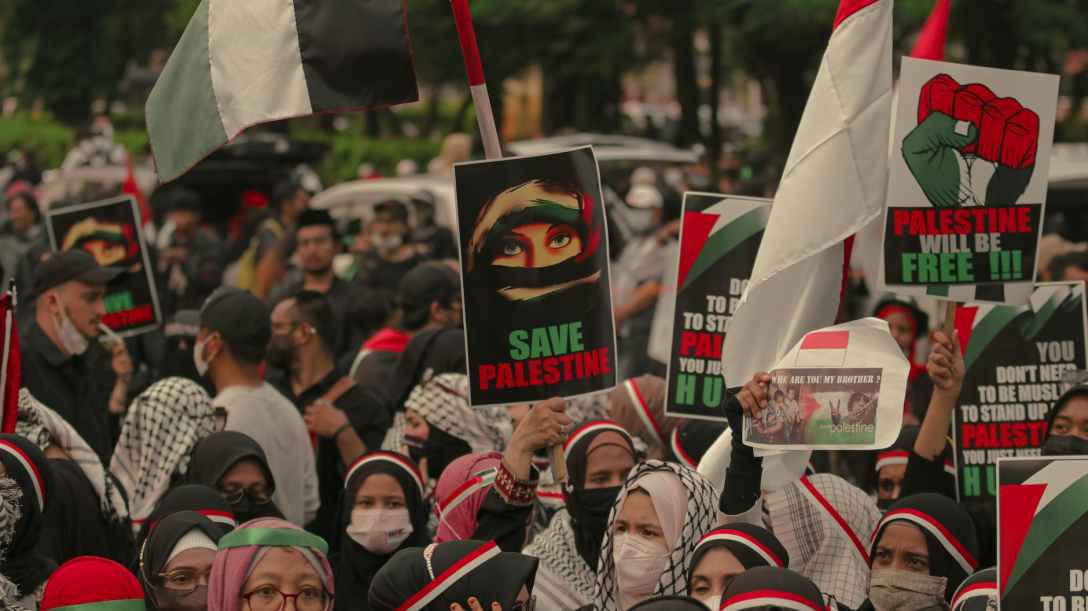
To many progressives, the fate of Palestine seems to contain the fate of the entire world, a microcosm of all the problems that plague humanity crammed into a relatively tiny strip of land. Over the past two months, major cities and universities in both the United States and Europe have been teeming with protests over Israel’s invasion of the Gaza Strip and plans to eradicate Hamas. The word “genocide” is routinely used to describe Israeli’s objectives and tactics, even though the country is the one responding to an unprovoked massacre. If not an actual, text book “genocide,” the commission of unconscionable atrocities are underway according to this group of largely progressive individuals, violating almost every known international law or rules of war. “Collective punishment,” for example, that is the notion that Israel is intentionally killing as many civilians as possible in revenge for the attack on October 7, rather than strictly targeting Hamas. The waging of the war itself isn’t the only potential atrocity on their minds either – the longstanding embargo enforced along with Egypt, the lack of water and food, the limited medical supplies, all of it are seen by some not insignificant percentage of the Western world as a global crisis, a conflagration of epic proportions, the likes of which humanity can scarce bare to witness. In support of these conclusions, the demonstrators and friendly commentators frequently cite the civilian death toll, which according to Hamas currently stands at around 17,500, along with other information provided by the terrorist group describing the deplorable conditions in the Strip and the displacement of tens of thousands of people seeking shelter from the invasion. The Palestinians themselves, meanwhile, are extended the benefit of every possible doubt. Their claim to the land is considered sacrosanct, beyond any and all debate, regardless of how long Jewish people have been in the region. They have no responsibility at all for decades of conflict and the failure to reach a peace agreement with Israel. They bear no blame for voting a terrorist group like Hamas into power in the first place, and are not expected to share the burden of destroying them. Instead, they are always the victim, as innocent and powerless to affect their fate as children, and they must be protected above all others, or at least the voices calling for their protection must be louder than all others.
Meanwhile, the Gaza Strip exists in a region that is no stranger to strife or atrocity, where no one’s claim on anything has been readily accepted by anyone for decades if not far longer, regardless of whether or not Israel or any Western countries are directly involved. In truth, territorial and religious disputes between even majority Muslim countries have been the norm in the modern era – or earlier if you consider the fall of the Ottoman Empire during World War I. For our purposes, we can consider the wars that have occurred since Iraq invaded Iran in 1980, a conflict that ostensibly began over fears Iran’s brand of political Islam would sweep into Iraq and lasted for a full eight years, a common refrain in a region torn by irreconcilable conflict between the two most populous sects of the Muslim religion, Sunni and Shia. At the time, Saddam Hussain believed Iran’s theocratic government would exploit religious and sectarian tensions between Iraq’s Sunni ruling class and majority Shia population. Iraq invaded Iran preemptively to prevent the overthrow of the government. Iran invaded Iraq in response. They fought over oil tankers in the sea. Attacks were carried out as far away as Paris as the war raged for close to a decade of stalemate. Weapons of mass destruction were unleashed, cities were bombed, ships were targeted, and hundreds of thousands were killed. Total casualties are estimated at between 1,000,000 and 2,000,000 soldiers and civilians, and all of it was for nothing. The war ended with a ceasefire that preserved the status quo as if it didn’t happen in the first place. More recently, Yemen has been engulfed by civil war for almost 10 years as the Rashad al-Alimi-led Presidential Leadership Council and the Mahdi al-Mashat-led Supreme Political Council both claim to be the official government of the country. The conflict is believed to be driven by the same Sunni-Shia rift, this time between Iran and Saudi Arabia, but whatever the case, devastating doesn’t begin to describe it. Close to 400,000 people have been killed, some 85,000 of them children from starvation alone, along with 4,000,000 people displaced. An outbreak of cholera was said to have killed around 4,000 alone. Attacks in Saudi Arabia, outside the warzone, have killed some 500. Nearby Syria has been mired in a civil war for even longer with between 503,064 and 613,407 total dead, 217,390 to 306,887 of them civilians. 6.7 million have been displaced internally, while 6.6 million have fled the country entirely.
Once again, the civil war itself is supported by outside parties, with Iran as a major backer, but somehow when it comes to Palestine – and Palestine only – none of this long history of disputed claims, outright war, and millions dead in the very same region applies. Instead, we’re simply supposed to accept that Israel is the evil colonizer and the Palestinians are the subjugated colonized even though the same logic would apply nowhere else in the Middle East, as warring factions kill and displace far greater numbers of people over far greater periods of time. There are few if any protests over Yemen or Syria, no mass marches against Iran for fomenting the violence. Barely a word to be heard anywhere about destruction on a scale that dwarfs anything happening in the Gaza Strip right now, or indeed anything that has happened there in generations. Of course, I am not trying to single out the Middle East as the only region of the world that suffers from ongoing strife. In Africa, Sudan has been in the midst of a civil war that has displaced some 3.4 million people as 1 million fled. In China, Human Rights Watch estimates that 1.3 million Uighurs are held by the Chinese Communist Party in concentration camps, where they perform slave labor and are forcibly sterilized. In South America, conditions are so bad that tens of thousands of people risk their lives traveling thousands of miles, often on foot to America. Globally, it’s estimated that 828 million people in the world are at risk of starvation, going to bed hungry each and every night. Some 700 million live in poverty, about half in sub-Saharan Africa, surviving on $2.15 per day. Further, about 5.7 billion people, 72% of the total population, currently live under authoritarian rule, enjoying none of the freedoms or autonomy we take for granted in the West. Some 5 billion do not have access to adequate medical care. I do not recite these facts to suggest that we should have no care for the Palestinians or that those who yearn for freedom in Gaza should not have our sympathy, but merely to ask why tens of thousands of people in the Western World are obsessed with the fate of Palestine, seemingly above all other things, to the point where they hold effectively the same position as Iran. Why, when you can point almost anywhere on the map and in many cases find even greater suffering and atrocity that goes without even a passing mention most of the time?
The situation is even more perplexing given that the average Palestinian’s political views and preferences are almost diametrically opposed to the typical progressive supporter. The Palestinians are not liberal freedom fighters striking a blow for liberty by any rational definition. Instead, they are extreme for their even their region of the world which isn’t exactly known for progressive values; so extreme the King of Jordan claims they would not be a fit for even his regressive country by Western standards. Generally speaking, there is no respect for women’s rights, the LGBTQ community is literally outlawed, and diversity isn’t the goal. According to the United Nations in a report issued last year, “Palestinian women and girls continued to suffer the adverse effects of occupation, political violence, and human rights violations,” including “entrenched discrimination…within their own society in the context of traditional patriarchal norms” and “inequitable power dynamics.” Moreover, actual “violence against women and girls remains prevalent and women’s political and economic participation curtailed.” This aggression includes “intimate partner violence, rape, sexual exploitation, physical abuse, harassment, and verbal and psychological abuse,” even “femicide.” These challenges are compounded by “low female labour force participation, [where] women’s economic dependence on their husbands or other male family members is a risk factor for psychological, physical and sexual violence. This is especially the case for women and girls with disabilities, Bedouin women, and internally displaced women, who are left with few options for supporting themselves financially, and therefore are more likely to not report intimate partner violence if it means losing their only source of financial support.” Women who are abused or even killed “continue to encounter challenges in accessing justice” and “many femicide cases are not pursued: they are either registered as ‘suicide cases’ or ‘deaths for unknown reasons’, or closed immediately without proper investigation, especially in Gaza, under the pretext that the perpetrator was ‘insane or mentally unstable’. This contributes to…a culture of impunity and allows perpetrators to escape deterrent penal measures.” Tragically, the United Nations also believes that many Palestinian women think they deserve it. A survey found at least one in four women from Gaza believes “husbands are justified in beating their wives.” Young women are more likely to endorse this than older women, suggesting the problem is getting worse.
Barbaric practices like honor killings are also frighteningly common. As recently as 2021, the world was stunned when, in the words of Human Rights Watch, “Israa Ghrayeb, a 21-year-old Palestinian make-up artist from the village of Beit Sahour in the southern West Bank who had been hospitalized on 10 August after being beaten by her family. The videos suggested she may have been subject to further beating while in hospital.” The Palestinian authority admitted that she died of injuries as a result of domestic violence – though they refused to call it an honor killing – and “the police had not initially conducted an investigation because when they spoke to her, she had apparently said she had been injured in a fall and had no visible marks on her body. He acknowledged that the videos of her screams at the hospital were authentic but gave no further information about these incidents.” Currently, there are no domestic violence laws, a situation Ikhlas Sufan, who runs a shelter for victims in Nablus, described as “there are no legal or social deterrents” and the abuser “knows he can get away with it.” Estimates also put the number of women married before age 18 at 13%, some figures put it as high as 20%. A United Nations report noted, “Cases have been detected where girls and boys were as young as 12 years when entering into marriage. When comparing the 2014 data with the 2013, a decrease can be identified for Palestine as a whole, but also when looking separately at West Bank and Gaza Strip. This decrease is however misleading as pockets within both the West Bank as well as Gaza Strip have experienced an increase thereby leaving communities behind the national trend.” Not surprisingly, there are no reproductive rights either. Nor does the LGBTQ community doesn’t fare any better. Homosexuality as a whole remains outlawed in the region. According to EqualDex.com, the Arab world in general is not favorable to those with alternative sexual preferences and lifestyles. Only 4% said the entire region was a “good place” for gay and lesbian people. A whopping 95% of people don’t accept them, period. “In 2022, the brutal killing of Ahmad Abu Murkhiyeh, a gay Palestinian man who had sought asylum in Israel, ignited shock and sparked discussions about LGBTQ+ safety and rights within Palestinian territories. In August 2019, the Palestinian Authority police banned the LGBTQ+ rights group Al Qaws from holding events in the West Bank, sparking debate on Palestinian social media and drawing attention in Israel. Al Qaws, which advocates for sexual and gender diversity in a largely conservative society, condemned the intimidation and called for a focus on addressing broader issues like occupation.”
If any of these positions – or others – were held by a citizen in the United States, progressives would not consider them worthy of polite – or any society. (These are many of the same people who regularly rail about the patriarchy here.) Republicans who hold far more mild versions of these positions regarding abortion and gay marriage, and who embrace a generalized traditional morality are regularly slandered, attacked, and demonized, but somehow none of this applies to the Palestineans. It is not an exaggeration to suggest that a significant percentage of progressive supporters of Palestine would be exiled or beaten should they ever voice their opinions in the Gaza Strip or even the West Bank, and yet their support apparently trumps all other concerns and any other world atrocity. What could possibly account for this? Many might claim antisemitism and certainly that’s a factor, but it’s equally hard to believe that most of these pro-Palestinian protestors actually harbor some deep seated hatred of Jews. Instead, I would suggest that the majority are a unique combination of brainwashed and ignorant. (This should not imply that no one can hold a reasoned position on the matter and one cannot find an honest, intelligent supporter of Palestine, only that most of them are both unaware of what they are supporting amidst the other calamities the world is facing.) Brainwashed in the sense that their worldview has been molded to view humanity in terms of oppressor and oppressed, and there is little doubt Palestinians are oppressed. We can debate whether or not Israel is the oppressor or a leadership that uses their lives and pawns and has gotten rich while stealing aid and funding ideological battles, but the poverty, the unemployment, the limited food and supplies, and more are all real. This might be just as true – or even more true – in other areas of the world, but it’s hard not to have at least some sympathy for the women and children especially.
Ignorance tends to go hand in glove with brainwashing, but a couple of recent studies reveal just how deep seated the problem truly is. First, Newsweek found that a truly incredible over 40% of people aged 18-29 believe the Holocaust is a myth or over exaggerated, with a full 20% believe it is a myth entirely. Second, political scientist Ron Hassner conducted a survey of students to determine what they actually knew about the popular slogan “from the river to the sea,” which is generally interpreted as the elimination of Israel. According to Mr. Hassner, writing for The Wall Street Journal, “I hired a survey firm to poll 250 students from a variety of backgrounds across the U.S. Most said they supported the chant, some enthusiastically so (32.8%) and others to a lesser extent (53.2%). But only 47% of the students who embrace the slogan were able to name the river and the sea. Some of the alternative answers were the Nile and the Euphrates, the Caribbean, the Dead Sea (which is a lake) and the Atlantic. Less than a quarter of these students knew who Yasser Arafat was (12 of them, or more than 10%, thought he was the first prime minister of Israel). Asked in what decade Israelis and Palestinians had signed the Oslo Accords, more than a quarter of the chant’s supporters claimed that no such peace agreements had ever been signed. There’s no shame in being ignorant, unless one is screaming for the extermination of millions” he noted in a classic understatement. Mr. Hassner continued, “In all, after learning a handful of basic facts about the Middle East, 67.8% of students went from supporting ‘from the river to sea’ to rejecting the mantra. These students had never seen a map of the Mideast and knew little about the region’s geography, history or demography. Those who hope to encourage extremism depend on the political ignorance of their audiences. It is time for good teachers to join the fray and combat bias with education.” Alas, academia, as we know all to well, is morally bankrupt and cannot be counted on simply to assert that it violates campus policy to openly call for genocide. Sadly, this suggests the sane among us will be forced to live with this phenomena for the foreseeable future, wondering how it is a tiny strip of land that launched the worst attack on Jews since the Holocaust is treated so differently than everyone, anywhere else.
To some extent, this post is intended to be intentionally provocative. I do not have a monopoly on the truth or morality, far from it, but the point is to question, closely, why we are focused on one thing when there are much worse things right next door. I’ve already put together a list of honest questions for supporters of Palestine. This is one more that is crucially important.

 Confessions of a Conservative Atheist