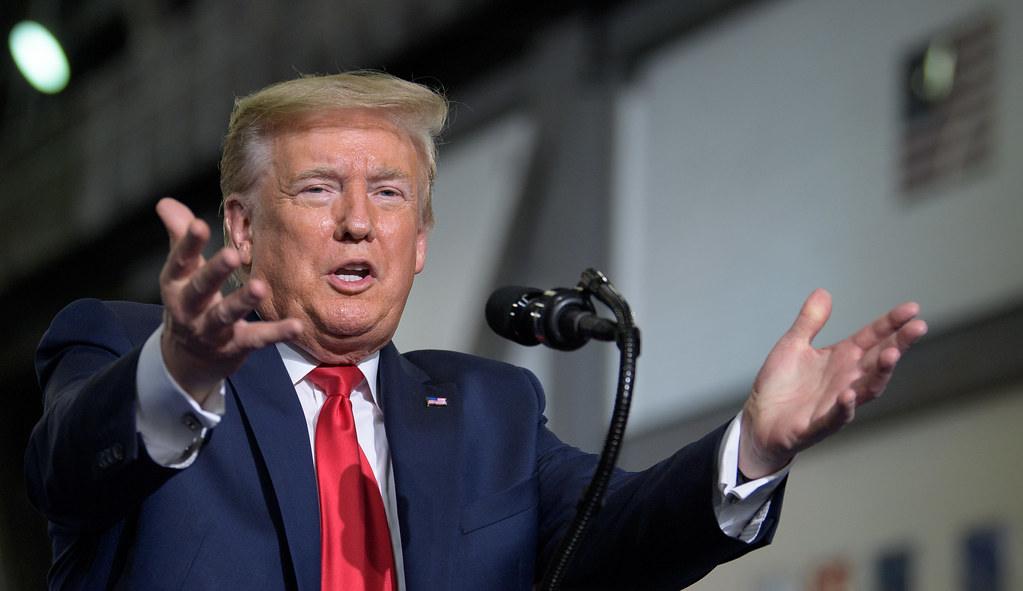
According to conventional wisdom in much of the media and other Democrat-heavy groups, President Trump shouldn’t even be allowed to run again, and yet the makings of one of the most – if not the most – triumphant political comeback of all time are in place.
To date, Grover Cleveland is the only President in US history to have served two non-consecutive terms. He won a close election in 1884, the first Democrat to occupy the White House since before the Civil War, lost a close election in 1888, only to return to win his most decisive victory in 1892. Only three others have attempted to run again after leaving office. Martin Van Buren, a reputed heir to Andrew Jackson’s rough and tumble democratic legacy, won in 1836, lost in 1840 amid a nationwide financial panic, and then tried to run again in 1844, but was blocked by his party in the primary. Teddy Roosevelt, the explorer, scientist, historian, author, hunter, and philosopher of Americanism who graces Mount Rushmore, left the White House of his own accord after choosing not to run in 1908, but then attempted to make a comeback in 1912. He was blocked by the Republican party, who nominated the incumbent William Howard Taft, who was far more focused on his golf game than the cares of the office, instead. Roosevelt responded to the rejection by running as an independent in the Progressive, Bull Moose Party, only to lose to Woodrow Wilson. Herbert Hoover, whose name was synonymous with shantytowns in the great depression, won in 1928, lost to the only four times elected President in US history, Franklin Delano Roosevelt in 1932, and attempted a comeback in 1940, but like Van Buren and Teddy Roosevelt before him, was stymied by his own party. For that matter, there aren’t many who lost a general election and then ran again in the first place. Charles C. Pinckney in 1804 and 1808, who few have ever heard of, Henry Clay, who a slightly larger group might know as a former Speaker of the House following in the footsteps of Founder James Madison, in 1824, 1832, and again in 1844. William Jennings Bryant, progressive and loquacious, said to bring people to tears with his legendary “Cross of Gold Speech,” ran in 1896, 1900, and 1908. The infamous, I am not a crook, Richard Nixon in 1960 and 1968. Nixon is the only one of these who lost and then won. The rest were perennial losers. As the 2024 campaign gets properly underway less than 50 days out from the first primary, former President Donald Trump, perhaps as infamous as Nixon in his own way, is hoping to replicate Cleveland’s success rather than almost everyone else’s failure. The question, of course, is can he?
For starters, President Trump is no Grover Cleveland. Cleveland won the popular vote all three times, and while he had a penchant for taking and pushing positions against the grain of own party, he was never considered a controversial figure by rational standard. Throughout a political career stretching from sheriff, to mayor, to governor of New York, he had a reputation for political courage, honesty, and forthrightness. He might have been the only Sheriff of Eerie County in that era who did not enrich himself at the public’s expense, refusing to partake in the usual practice of levying fines for himself. He was also known to be meticulous when it came to details, a stickler for the rules, and once he made his mind, he rarely changed it. Some have compared him to an immovable object. President Trump, in comparison, is none of those things. Whether you love him or hate him, he is notoriously ephemeral, changing his mind frequently and contradicting himself at times. He has a penchant for disregarding democratic norms which might well be over blown, but still no one would ever call him a “normal” President, especially in the modern era. He is verbose with his language, sometimes sloppy, and prone to exaggeration, or as some would claim outright lies. There are others who’d insist he was irredeemably corrupt, while almost everyone would agree he was decidedly polarizing and controversial. Further, President Trump has not won the popular vote in the two times he’s tried so far. Perhaps even worse for his electoral prospects, the former President was impeached for the second time before leaving office and has since been indicted four times, three times at the Federal level and once in Fulton County, Georgia. He is currently facing hundreds of years in prison and – if prosecutors have their way – will be in jail for the rest of this life. No President has ever won an election after being impeached (Andrew Jackson himself actually won after being censured, then forced its reversal) and none has ever won after an indictment of any kind. Many have already proclaimed him politically – if not legally dead – more times than I can count.
Under anything resembling normal circumstances, the former President would have little to no chance to mount a comeback of any kind, a combination of too damaged legally and politically to have any chance of winning the Republican primary, much less pulling a Grover Cleveland, but – if recent polls are any indication – that appears to be precisely what is happening. President Trump remains so far ahead in the Republican race that it requires no comment here, except he is polling close to the equivalent of an incumbent President and only a collapse of epic proportions, perhaps the worst in history, would cause him to lose the nomination. The general election, most likely against current President Joe Biden for a second time, is much more difficult to predict, but even there, President Trump has almost miraculously gained a slight lead in the average of polls. Real Clear Politics’ Sean Trende described it this way earlier this week: “Trump can win. Not in a ‘maybe if all the stars align and then Russia changes the vote totals (even somehow in states like Michigan that use hand-marked paper ballots)’ kind of way. Just flat out: Trump can win.” Mr. Trende went on to analyze the numbers and the dramatic change these reflect from the 2020 and 2016 match ups. As of yesterday, the former President leads the current President by an average of 1.9 percent. This might not sound like much, but “In 2016, Trump led Hillary Clinton for all of five days in the national RCP Average, each of those days in the immediate aftermath of the Republican convention. He led in 29 polls taken over the course of the entire campaign, 10 of which are recorded in the RCP averages as Los Angeles Times/USC tracking polls. In 2020, Trump never led Biden in the national RCP Average. He briefly closed to within four points in early January of 2020, but that is it. He led in five polls all cycle.” Overall, the polls have swung over 10 points in President Trump’s direction since the last election. This time around, “He’s led in more polls in the past three weeks than he did against Biden in all of 2019-2020.”
Moreover, President Trump’s electoral strength appears to be reflected at the state level as well, where these contests are ultimately decided. Earlier this month, The New York Times and Sienna College found President Trump ahead in five of six battleground states he lost in 2020. As Mr. Trende described it, in “2016, Trump (somewhat infamously) never led in a poll in Wisconsin. He was never within more than three points of Clinton there. He led in a single poll in Michigan and a single poll in Pennsylvania. His lead in North Carolina never exceeded two points in the RCP averages, while in Florida, his largest lead was 1.2 points. The 2020 comparison is even more striking. Trump led Biden in Florida in the RCP averages briefly, in October and March of that year. In Arizona, it was the same story. North Carolina was a little better for Trump, as he led in the RCP averages perhaps a quarter of the time. In Ohio, Trump led in only six polls all cycle. He led in five polls in Pennsylvania. In Michigan it was five polls, and in Wisconsin, it was four.” Today, however Trump currently leads in the average for Michigan (first time ever), Pennsylvania (first time ever), Florida, Georgia, Arizona, Ohio, and even in Wisconsin he has closed the gap to .7% compared to a previous all time high of a 3.5% deficit. Mr. Trende put the overall turn around this way, “analyzing this election correctly isn’t just a matter of giving lip service to the notion that Trump can win this election. The correct position right now is that Trump is better positioned in the polls to win this election than any GOP nominee since at least 2004. Not only that, he habitually over-performs his polls. Frankly, if you are willing to set favorites this far out, you should almost certainly declare Donald Trump the favorite.” The election, of course, is a year away and polls at this point are not predictive, but even if the former President were to lose, his position right now would still be unprecedented in American politics. According to conventional wisdom in much of the media and other Democrat-heavy groups, President Trump shouldn’t even be allowed to run again. Legal challenges have been mounted in multiple states to bar him from the ballot, and yet the makings of one of the most – if not the most – triumphant political comeback of all time are in place. What could possibly account for this?
Personally, I think it comes down to four factors. First, President Biden appears incredibly weak at this point with an approval rating hovering around 40% and at times dropping into the catastrophic zone below. His approval on the individual issues is even worse, if that were possible. Gallup, for example, recently pegged his overall approval at a dismal 37%, and “ratings of the president’s handling of healthcare (40%) and the situation in Ukraine (38%) are similar to his overall rating, while fewer, 32% each, approve of his handling of the economy, foreign affairs, and the situation between the Israelis and Palestinians.” Overall, “Biden’s job rating has not risen above 44% since August 2022 and has averaged 40% this year” and “Biden’s current rating on the economy is just one percentage point higher than his lowest in 2022, while his foreign affairs rating is the lowest by six points.” Their bottom line? “With less than a year to go until the presidential election, Biden continues to receive tepid ratings from the American public. His overall job approval rating is still at his personal low and is in historically dangerous territory for an incumbent seeking reelection. In addition, political independents’ record-low rating of Biden is striking. Biden’s even weaker ratings on the economy, foreign affairs and the Middle East suggest that his performance in these areas is dragging down his overall job performance rating.” These are the sort of numbers that would benefit anyone running against him and it should be no surprise that Gallup also found an advantage for Republicans over Democrats last month. “Although both parties are about equally disliked, the public chooses the Republican Party over the Democratic Party by healthy margins when asked which will better safeguard the nation’s prosperity and security. Fifty-three percent of Americans believe the Republican Party will do a better job of keeping the country prosperous over the next few years, whereas 39% choose the Democratic Party. A slightly larger majority, 57%, have greater faith in the Republican Party to protect the country from international terrorism and military threats, while 35% favor the Democrats.” Putting this another way, President Biden only narrowly beat Trump in 2020 in the middle of the greatest global health crisis in a century. Fairly or unfairly, it was relatively easy for the challenger to blame it on the incumbent. This time around, however, the roles are reversed, and President Biden bears the blame for our troubled times.
Second, and somewhat related given the dislike of both major parties, trust in our institutions is also around historical lows. Once upon a time, the average American would take what passed for conventional wisdom regarding a presidential candidate seriously and vote accordingly, but today, the public is more and more comfortable making up its own mind regardless of what the experts claim. This holds true for both a media that generally insists Trump is unelectable and for a government that is seeking to jail him. Last July, Gallup reported that the “Historically Low Faith in U.S. Institutions Continues.” “Americans’ faith in major societal institutions hasn’t improved over the past year following a slump in public confidence in 2022. Last year, Gallup recorded significant declines in public confidence in 11 of the 16 institutions it tracks annually, with the presidency and Supreme Court suffering the most. The share of Americans expressing a great deal or fair amount of confidence in these fell 15 and 11 percentage points, respectively.” In addition, “The five worst-rated institutions — newspapers, the criminal justice system, television news, big business and Congress — stir confidence in less than 20% of Americans, with Congress, at 8%, the only one in single digits.” Under these conditions, a President can be indicted, impeached, perhaps even convicted, and no one really cares. They might even benefit from it running as an outsider the insiders love to hate.
Third and fourth, the conventional wisdom’s assessment of President Trump’s support has always been exceedingly low while that of his opposition has always been exceedingly high. The mainstream media would have you believe the former President is loved by too few and hated by too many. This belief extends even into some conservative circles. For example, Kurt Schlicter, writing for TownHall.com, recently claimed President Trump can’t win, opining “Let’s examine why Trump can’t win. Here’s the big reason: About 53% of American voters hate him. They shouldn’t, not only because he was a generally good president but because you are not voting for Chief Pal but Chief Executive.” Similar numbers have been cited by others, but “hate” is an incredibly strong word that, in my opinion at least, is largely unsupported by the facts and the recent polling. Almost undoubtedly, the 53% figure – or whatever similar number you choose – is composed of truly hardened haters that would never vote for him, a group I estimate at about 40% of the population, perhaps 45% at the most, and those who are closer to negatively ambivalent than anything else. Many of the die-hards, of course, are also voters who would likely never vote for a Republican under any circumstances, but the real question is what becomes of that middle 10% who voted against him in 2020, those I just described as negatively ambivalent. Are they persuadable now? Personally, I believe so. This group might continue to be somewhat uncomfortable with President Trump’s bombastic style and unconventional approach, but now that they have President Biden in a direct comparison, those aspects are likely to matter much less than in the last cycle.
Though it’s common to claim the average voter has a political memory of less than two weeks, people in my experience tend to be smarter and more observant than they are given credit for, and it does not take a political junkie to look at the combination of a world at war and prices at all time highs to conclude that they were better off under President Trump, whether or not he might rant on Twitter or Truth Social from time to time. Conversely, the mainstream media would have you believe that the former President’s supporters are merely some rump, out of touch group, rather than the inverse of those that loathe him. For every person that truly hates President Trump, there is one that loves him equally, however. Despite all his woes over the years, he has maintained a floor of support around 40% that will vote for him no matter what while conventional wisdom acts as though it were 20%. For example, Gallup puts his average approval rating at 41% and his lowest ever – immediately after the riots on January 6 at 34%. Let that sink in for a moment: The media and Democrats claimed President Trump personally led an insurrection, and yet he polled only 3 points lower than President Biden right now. As another point of comparison, the George W. Bush had a lower approval rating when he left office. Whatever you think of him personally, Trump is a man loved and loathed in roughly equal parts. Overall, there is no doubt that he remains a controversial figure, always has been, and always will be, but if President Biden cannot find some way to regain control of events that appear to be spiraling and recover the confidence of the American people, Trump will be triumphant.

 Confessions of a Conservative Atheist