A colony like mine can reach almost 6,500 square feet, about the size of a luxury home with five bedrooms. The mound of fungus we farm can rise a foot high, nestled inside with thousands upon thousands of workers tending to it.
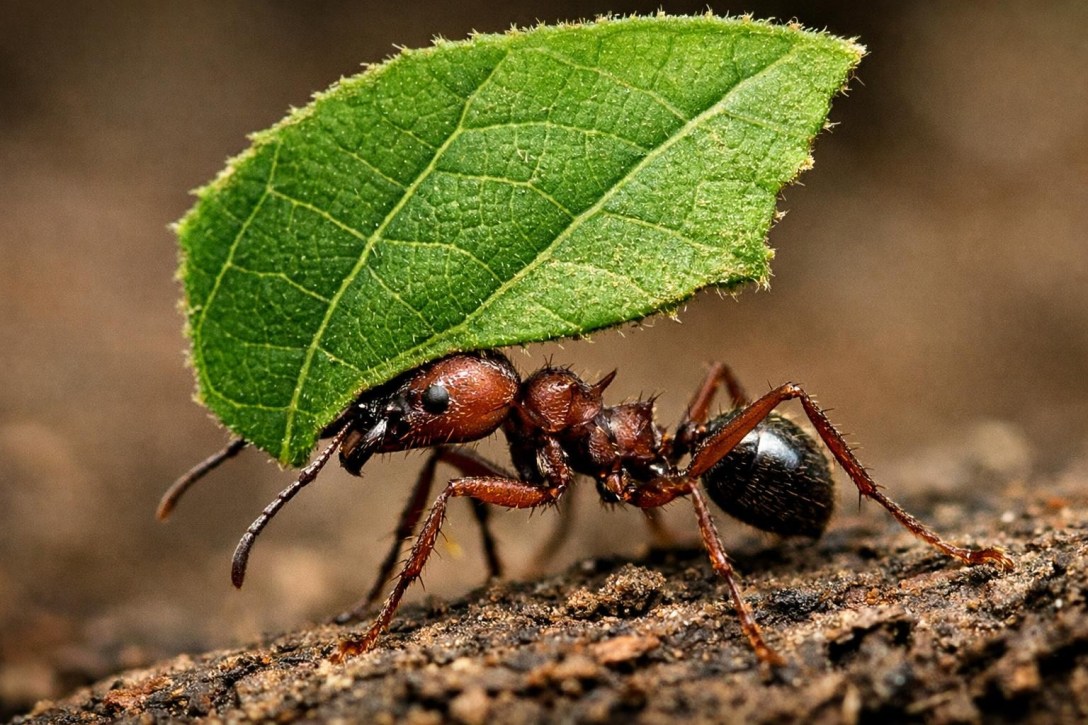
I am a farmer ant, technically known as an Attini, or fungus-grower. I am not intelligent in the way what you might call “higher animals” are. I only have around 100,000 neurons in my entire brain compared to 86 million in the average human. As an individual, I am not capable of particularly complex behavior or anything resembling intelligent thought. I operate under a few simple rules based on my worker caste, but as a colony numbering over 5 million strong, we invented farming around 20 million years before you did. When humans didn’t even remotely resemble humans yet and apes weren’t even really apes, we were cutting leaves and gathering other organic materials throughout our territory, bringing them back to our nest, and culturing them into a fungus, generally from the family Agaricacaceae, in an underground garden designed specifically for the purpose. We do not directly eat the leaves we gather. Instead, we feast upon the product of our labors, the same as humans. A large colony such as mine gathering leaves is a sight to behold. Thousands of us workers stream out from the nest to collect leaf fragments from wherever they are plentiful, pick up what look like green flags larger than we are in our mandibles, then stream directly back to the nest as though we were in a parade. You can barely see our little bodies beneath the panoply of green, as if the leaves themselves decided to get up and take a walk in the woods. If a leaf is too large, several of us will help carry it distances of over one hundred yards. This first set of workers, of which I am a part, enters the nest with our prize, then deposits it on the chamber floor, where a smaller variety proceed to clip the large leaf into small pieces, the ideal size for growing more food, then even smaller workers add fertilizer in the form of fecal droppings. After the new pile of leaves is ready to grow more fungus, workers pluck loose strands of our existing store and literally plant them on the pile. After the initial planting, the workers almost lovingly tend the new crop, delicately poking at the piles with their small antennae, licking the surfaces of the leaves for moisture, and even performing pest control by removing potentially invasive fungi and other spores. We are so adept at this process that some species have been cultivating the same strain of fungus for millions of years, as humans might with a strain of yogurt, only over much longer time periods.
At this point, you might be wondering how we achieve this level of skill with such small brains, when none of us, not even our beloved queen, is capable of understanding what we are doing or why. Instead, we just do it. How? You might be surprised to learn that the answer reveals a secret about the nature of your own intelligence. In your brain, each individual neuron has no idea what it’s doing either. It is merely a complex cell connected to other neurons in complex ways that change in response to stimulus or over time. While ants like me do not have a lot of neurons, there are a lot of ants like me that behave similar to neurons if they were entire organisms, following simple rules applied in large numbers and adapting over time. For example, we identify food sources by a combination of both random and directed action. Workers like myself leave the nest in directions that are random at first, designed to cover the ground around us across a broad area, but as we make our way, we leave behind a scent trail, known as pheromones, for both ourselves and others to follow. If we stumble upon a large cache of leaves by luck, the number of trails to and from increases, which leads other workers to the cache. The more trails, the more followers, until the cache is secured, and then the process repeats itself after another work finds a new opportunity ready to exploit. Though I am not aware of any of this – I am just an ant after all – the number of my fellows each operating on their own, following the simple rule of randomly seeking, then following increasingly concentrated pheromones, enables us to find and harvest food as effectively as if we had a plan from the beginning. If anything, the process is even more complicated in some species. A. combica, for example, doesn’t bring the leaves straight back to the nest. Instead, it creates smaller caches along the way, with ants traveling between. Another, A. vollenweideri, that can carry leaves over 150 yards, hands them off like footballs between players along the way, each worker with their own role. To be sure, your scientists do not agree as to exactly why some species do this, but they believe it helps concentrate scent to mark territory. Since I am only an ant, I don’t know either.
Beyond our capacity to find and procure these leaves, the process for cutting them is more complex than you might think, or perhaps not if you consider how you might go about breaking down large plants into perfectly sized pieces for transportation with your bare hands. While it is convenient to think of my mandibles as jaws, they are not quite the same yours or any other vertebrate. There is a part of it that is fixed in place like your upper jaw that I use to lock onto a piece of vegetation before the motile lower mandible goes to work with a sawing motion. To make things more interesting, the fixed and motile sides can switch depending on the angle of the leaf and my body, meaning I can lock either in place. As I am cutting, my lower legs – the third set, like all insects I have six mounted the center of my segmented body – anchor in place to keep me in a fixed location for leverage. As I am cutting away, my entire body moves in a rhythm that causes the gaster – the bulbous end to my abdomen, the third and largest body segment – goes up down, causing the first gastric tergite – the first section of the gaster – and a scraper on the postpetiole – essentially my waist, the middle body segment – to rub together loud enough that the sound can be heard by human ears if you get really close and dramatic enough to be visible using a device known as a laser-Doppler vibrometer, which bounces an object with small laser beams that can measure slight changes in position. In nature, however, everything tends to serve a purpose and nothing is wasted, especially energy. These vibrations echo through the my body to mandibles themselves, causing them to vibrate in a rapid pattern as well, helping make the cutting process smoother and more effective overall. As you might imagine, the process is very energy intensive – though I do not fly, while I am cutting leaves my metabolic rate increases to be on par with my fellow insects who do, placing me among the most energetic of all animals.
By now, you might be wondering how it is that so many ants can work seamlessly together. In addition to the workers, there are other castes, primarily soldiers who defend the nest and the queen that births us all, and yet somehow we do not constantly fight among ourselves as humans do. While separate ant colonies have been known to raid or even take over one another nests, each individual colony usually behaves as a single cohesive organism despite having potentially millions of members. There are only a handful of other organisms that do this. My fellow ants, of course, bees, and termites. Almost every other animal is at constant war with their own kind, competing over resources and mates in the endless quest to pass their DNA down to the next generation. How is it that we alone seem to avoid this constant strife? At first glance, it might be easy to conclude that this is because every ant in the colony is the offspring of a single queen, making us all siblings. While that is part of it, siblings in other species have certainly been known to have their feuds, and in some cases killing each other with a ferocity that is only reserved for family, see the history of the British Monarchy if you don’t believe me, not that I know much or anything at all about such things. In truth, we are something more than siblings and something less than clones. Siblings in most animals share 50% of their DNA, half from each parent, but in insect colonies – including the bees and termites I mentioned earlier – we share 75%, binding us together much closer because from a gene’s point of view, we are much closer to being the same organism and the fate of the genes is tied closer to together. If one succeeds, we all do. The process that allows this to happen is known as “haplodiploidy.” Females in the colony – I am a female in case you were wondering – develop from fertilized eggs that receive 100% of their genes from our father and 50% from our mother. The males, rather incredibly, develop from unfertilized eggs, though they exist primarily to impregnate the next queen.
The queen, perhaps needless to say, is the center of our world. She birthed and sustained us, sitting on the equivalent of a throne in the middle of the colony. After mating with one of the drones – the queens and the drones are the only castes among us with wings – she settles on the ground and digs between eight inches and a foot into the earth, creating a small chamber, then regurgitating a small wad of fungus to begin growing a new garden. In about three days, the fungus begins to grow in the comfortable dark and the queen lays her first clutch of eggs, a small batch between three to six, but things begin to accelerate from there. In a month, there are more eggs, and worker ants that have entered the larvae and pupal stages. Before they mature, the queen is the only one who does any work, fertilizing the garden with something halfway between feces and urine, and growing it for the future colony, though there is a darker side to this process. Rather than eat the fungus, she consumes her own eggs, devouring up to 90% of them and even consuming part of her own body she will not need anymore, her wing muscles and fat deposits. The first larvae are cannibals as well, feeding off the eggs, but once they grow into workers they begin to harvest the fungus and leave the remaining eggs for the young. Around five weeks after the queen dug her little chamber, the first round of workers burst from the surface and began gathering leaves, accelerating the growth of the fungus and the entire colony while the queen herself reduces her labors strictly to laying more eggs. For about two years, the colony grows slowly and steadily before a rapid expansion until reaching its peak at around five years. At this peak, a colony like mine can reach almost 6,500 square feet, about the size of a luxury home with five bedrooms and five and a half baths, or a small industrial warehouse. The mound of fungus we feast on can reach close to a foot high, covering a space about the area of a small apartment, nestled inside with thousands upon thousands of workers tending to it. Perhaps needless to say, starting this kind of colony is not a sure thing. While it varies based on species, only between .0% and 2.53% survive, though I guess that’s nature, red in tooth and claw as ever even when animals have mandibles and pincers.
Regardless, it’s not a bad living. To be a part of the whole even if you don’t know it, to build your home and grow your own food, even if you have no idea how or why you do such things. There are around 50 different species – most smaller and less successful than I am – primarily in North and South America that have adopted this farmer lifestyle. If you happen to see a parade of leaves marching through the woods, kind of like a miniature forest marching in Shakespeare’s Macbeth, stop and think of us with envy. We’re better farmers than humans will ever be.

 Confessions of a Conservative Atheist